
What was here?
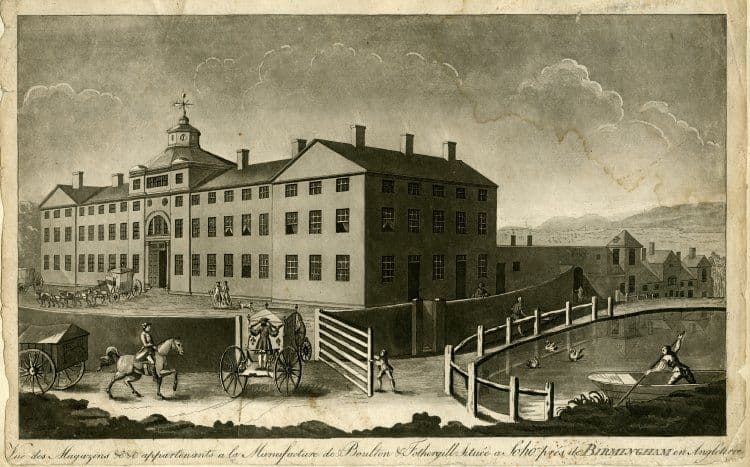
A palatial factory beside the Hockley Brook, built by Matthew Boulton from 1762. Behind its grand front hundreds of people made buttons, buckles, boxes, silver, plated ware and ormolu. Watt’s steam engine was first set to work here. Nothing of it stands above ground today; houses and gardens on South Road cover the site.
History
A mill on a brook
In 1761 Matthew Boulton and his partner John Fothergill leased about thirteen acres “just over the Hockley Brook”, outside Birmingham in the Staffordshire parish of Handsworth. On the land stood a rolling mill and a house. The brook mattered more than anything: running water meant power.
Boulton wanted something no Birmingham maker had tried. Instead of farming out work to dozens of small workshops, he would bring whole processes under one roof. Building began in 1762, and the factory was finished around 1765–66. The Library of Birmingham names the designer as “the local architect William Wyatt”. In June 1788 the estate was valued at £10,185 15s, of which the Manufactory alone was worth £8,519 10s.
The palace of toys
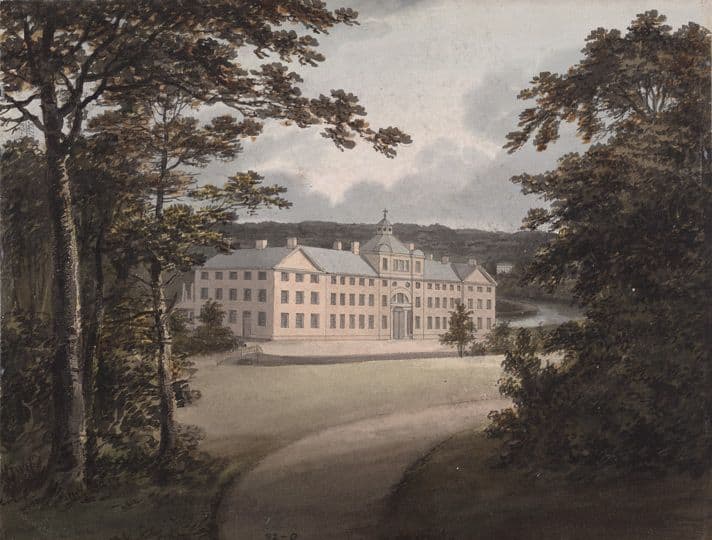
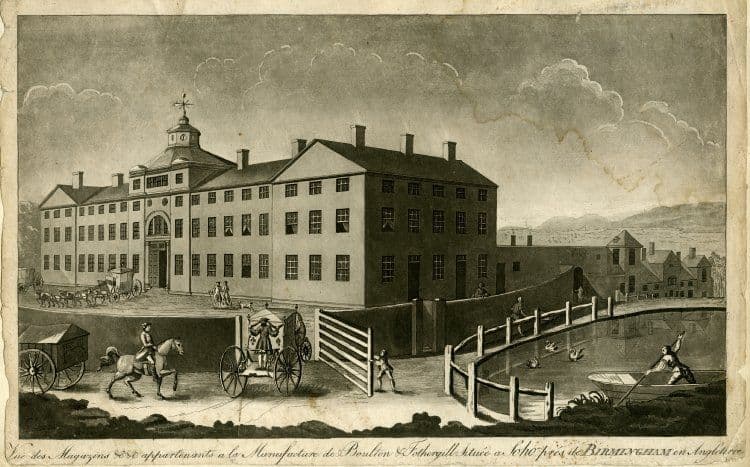
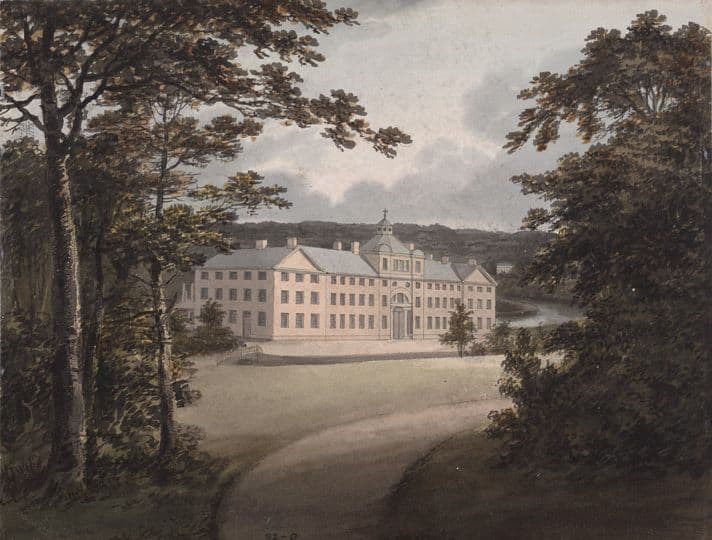
Visitors arriving along the main road saw a long Palladian front, the “Principal Building”, more like a country house than a workshop. That was the point: Soho was meant to impress. Francis Eginton’s 1773 print of the works carried a French title, aimed at buyers abroad.
Behind the front, the work was Birmingham’s “toy” trade on a new scale: buttons, buckles, snuff boxes and small metal goods, along with japanned ware, silver and Sheffield plate, and gilded bronze ornaments called ormolu. The Victoria County History puts the workforce at about 800 to 1,000 people around 1770. The Soho site was not one firm but many: eight separate trading partnerships were recorded there in 1800.
Water, then steam
At first Soho ran on a water wheel fed from a mill pool on the Hockley Brook. In dry summers the pool ran low, and Boulton was already experimenting with a “fire engine” to pump water back above the wheel in 1766.
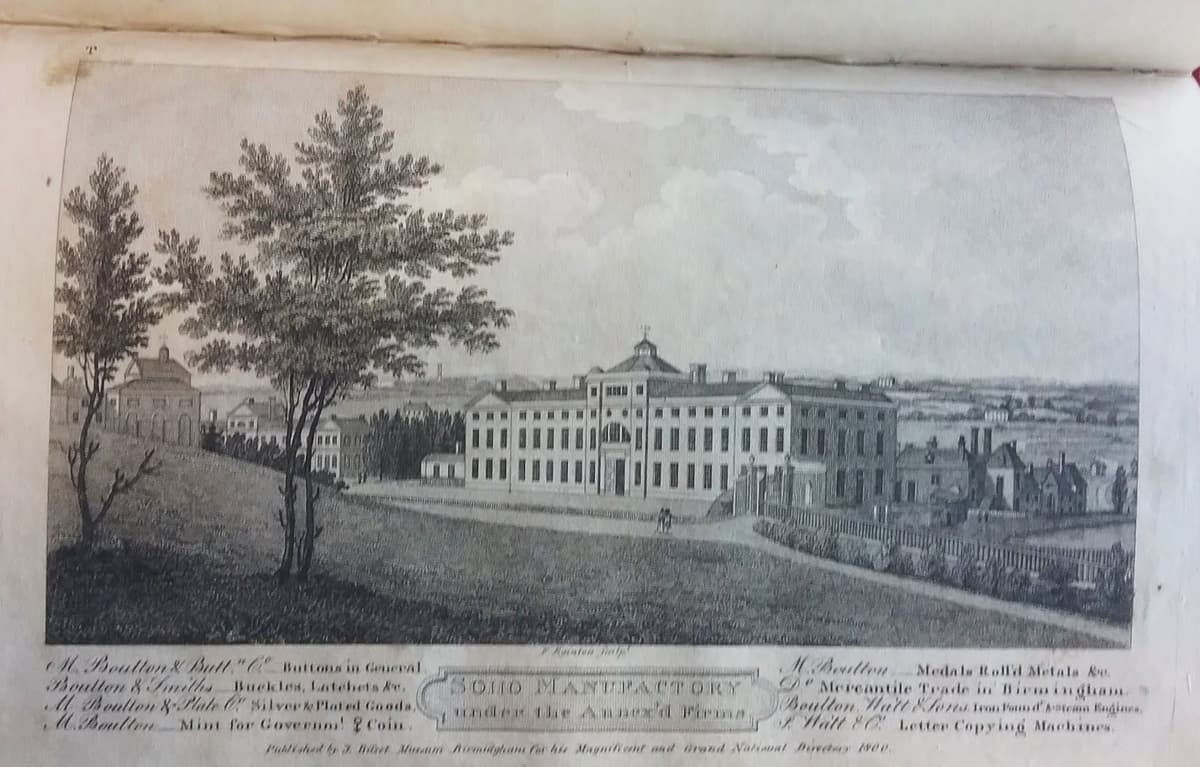
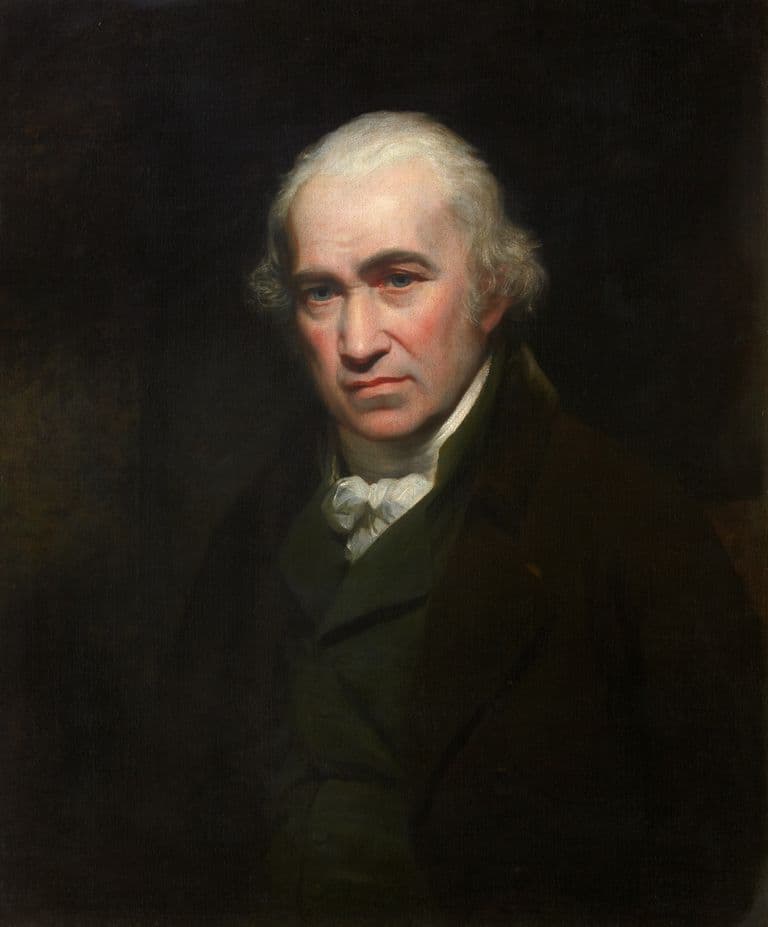
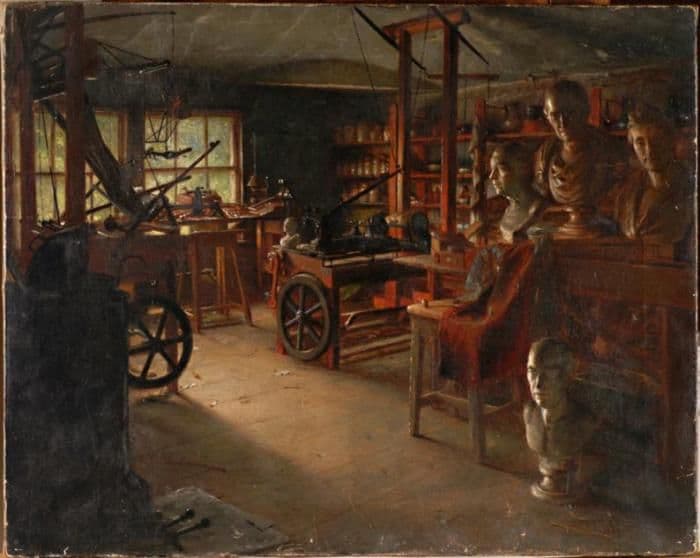
In 1774 James Watt’s experimental engine, later known as “Old Bess”, arrived from Scotland. Historian George Demidowicz has shown that it was used to pump the mill’s tail-race water back to the head race, a role no surviving document spells out. The next year Parliament extended Watt’s patent and the partnership of Boulton & Watt began. Engines were assembled at Soho until the purpose-built Soho Foundry opened at Smethwick in 1795–96, about 1.8 km to the west. Keep the two apart: the Manufactory made metal goods and was where steam began; the Foundry, later, made complete engines.
A light in the windows
The same spot, then and now
1888–1913
Today
Old map: Ordnance Survey six-inch, reproduced with the permission of the National Library of Scotland (CC BY 4.0). Today: © OpenStreetMap contributors.
In March 1802, during celebrations for the Peace of Amiens, William Murdoch’s gas lights were shown at each end of the Manufactory. The evidence rests mainly on later accounts, and the old Dictionary of National Biography says the gas was used only “to a small extent”. It was a glimpse of the future rather than a blaze.
Fading away
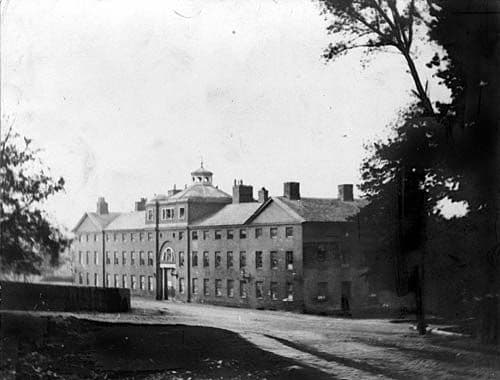
The Manufactory outlived its founders, but not by long. The water wheel was still turning, Demidowicz says, “almost to the end of its life in the 1850s”. The Soho Mint, on the same estate, closed in 1849 and its machinery was auctioned in 1850. The Manufactory closed around the same time and was taken down in stages. Demidowicz says it was “completely demolished by 1863”, and Sue Tungate’s research on the Mint agrees: “Both the Mint and Manufactory were demolished and no trace of either was left by 1863.”
Early in the 20th century much of the site was dug away for sand, and later it was built over with houses. The Manufactory’s own mill pool was filled in, and Soho Pool, the great ornamental pool to the south (also called Hockley Pool), was drained in 1868 and became a railway goods wharf.
Found again
At Easter 1996 Channel 4’s Time Team dug in back gardens off South Road. Under patios and lawns they found three sections of the brick drive-shaft tunnel of the 1824–26 Mint, part of the wall of the coin cutting-out room, and the southern end of the Principal Building’s front wall at cellar level. For the first time the position of the great factory could be fixed on the ground. The episode, “Steam-Powered Mint”, was broadcast in January 1997.
Soho was where Birmingham’s makers learned to work at the scale of the world. The building has gone, but under the gardens of South Road its foundations are still there.
What happened here?
Boulton & Fothergill made buttons, buckles, boxes, japanned ware, silver, plated ware and ormolu here from the 1760s. Watt’s first engine was set to work here in 1774, and Boulton & Watt assembled engines here until the Soho Foundry opened in 1795–96. Murdoch showed gas lights on the building in 1802. The Soho Mint stood nearby on the same estate.
Why it mattered
Soho showed that a Birmingham maker could gather hundreds of workers and many trades into one planned factory, and sell its goods across Europe. It was also where the Boulton–Watt partnership began, linking the town’s metal trades to the steam engine. Its image was printed with a French title for buyers abroad as early as 1773.
Why it disappeared
Industrial decline · Redevelopment
By the 1840s the Boulton family’s businesses at Soho were winding down. The Soho Mint on the same estate closed in 1849 and its equipment was auctioned on 29 April 1850, and by 1850 Matthew Piers Watt Boulton was letting Soho House. The Manufactory’s water wheel worked until the 1850s; the buildings were then demolished in stages and no trace was left by 1863 (Tungate; Demidowicz). In the early 20th century much of the site was dug for sand, and it was later covered with housing.
The Soho Manufactory, on today’s streets
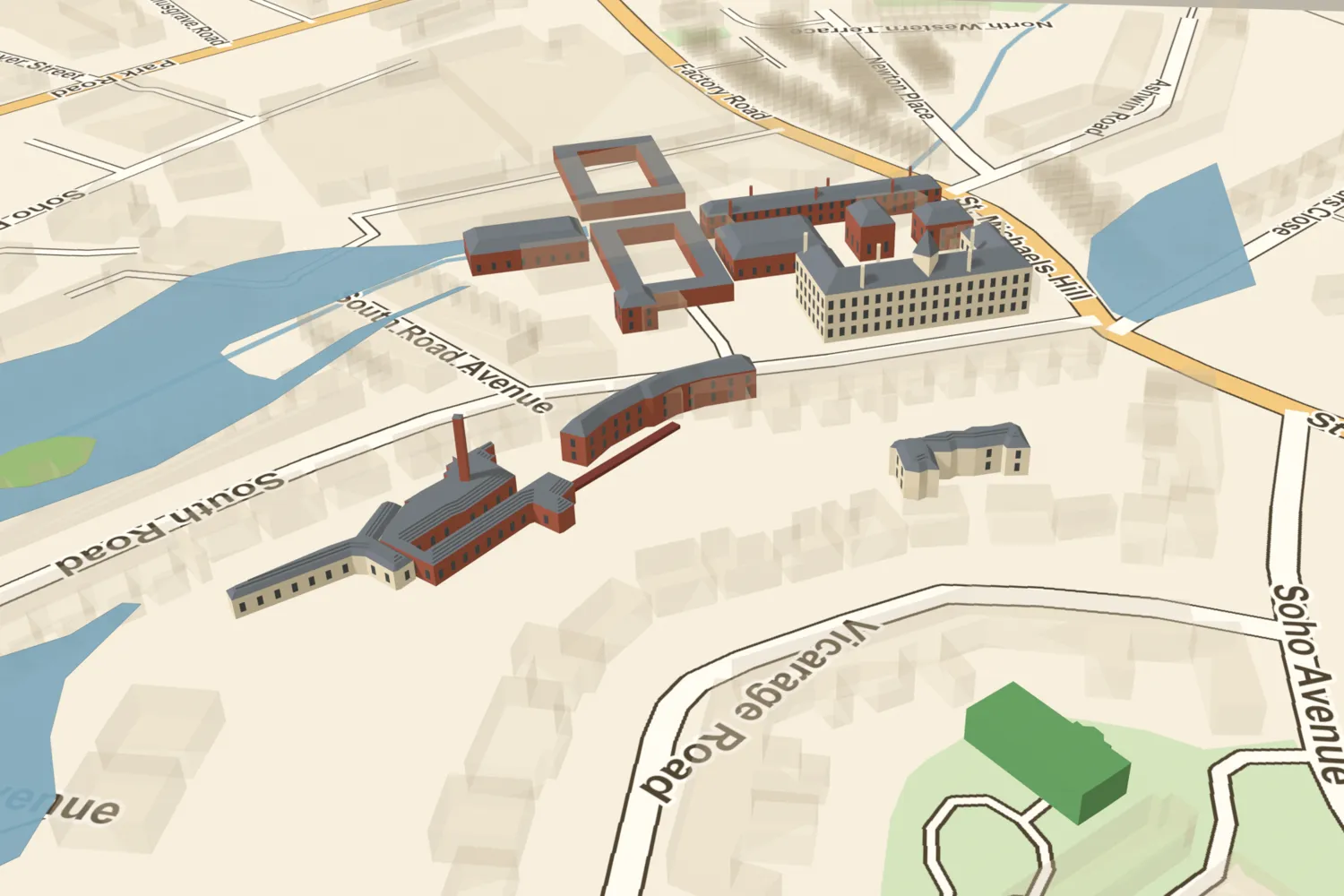
What’s there now
What replaced it
Sand pits in the early 20th century, then 20th-century housing and gardens on South Road, and commercial units off Factory Road, Hockley/Handsworth.
What survives
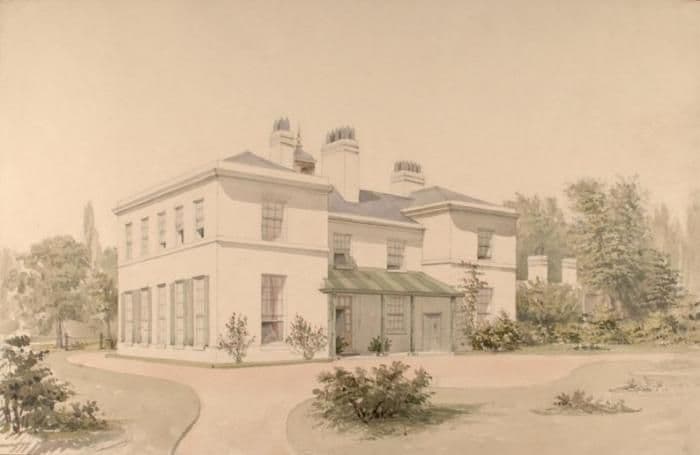
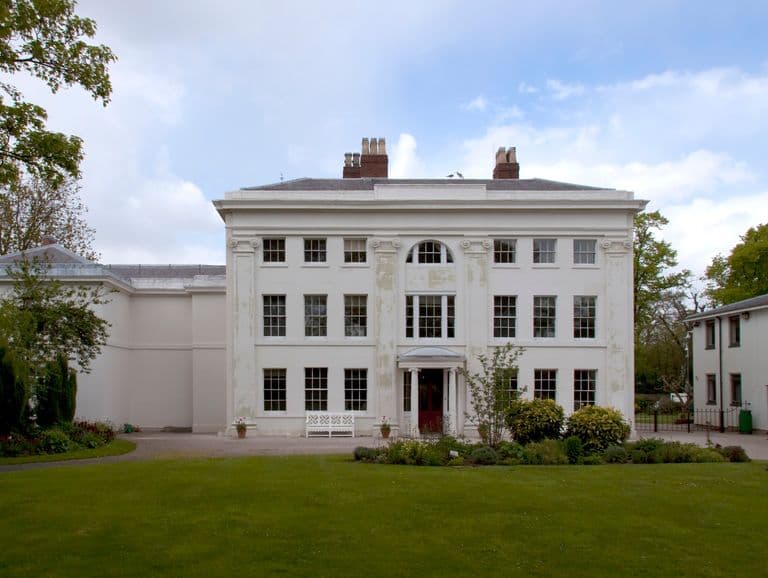
Nothing above ground. Buried remains survive under private gardens off South Road, where Time Team found the southern end of the Principal Building’s front wall in 1996. Street names recall the works: Factory Road, Soho Road, Soho Hill, Soho Avenue, Soho Pool Way and Boulton Road. Soho House, Boulton’s home, still stands just up the hill. Images of the factory survive in prints and watercolours from 1773 onwards.
Today
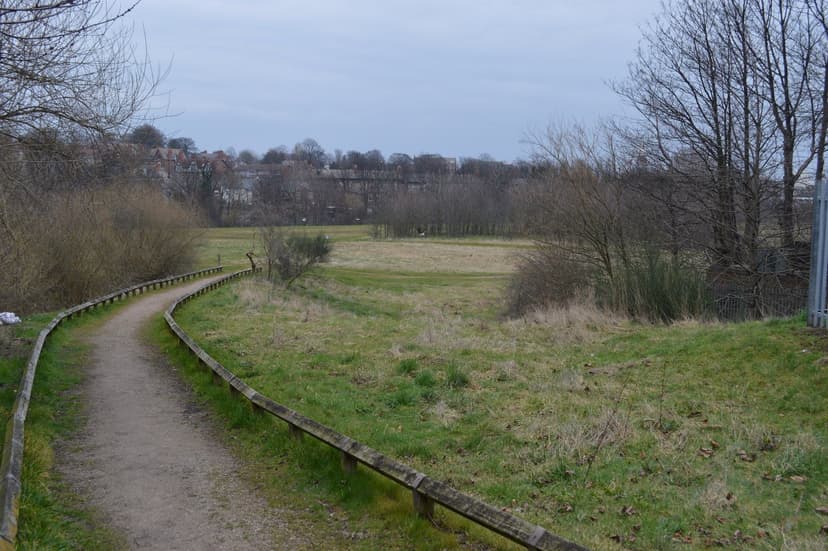
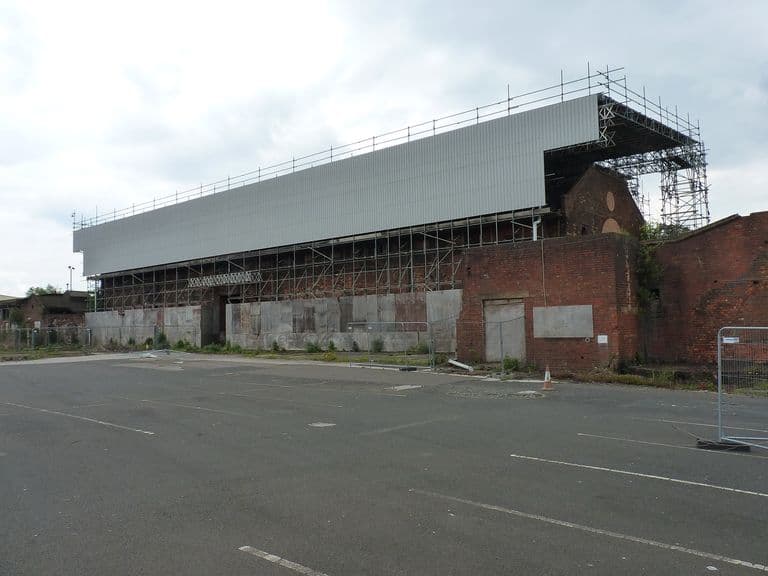
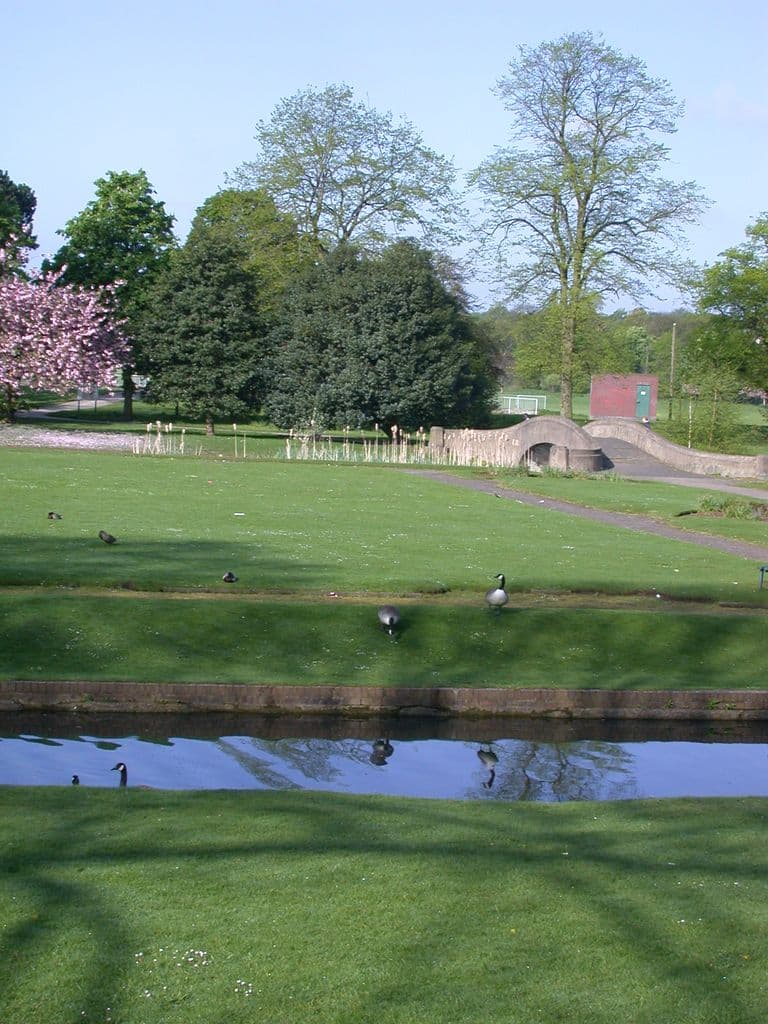
Stand on South Road, Handsworth (B18), between Soho Avenue and Factory Road. The houses and back gardens around you, and the industrial units off Factory Road, cover the site of the Manufactory. Soho House is a few minutes’ walk up the hill. To the south, Soho Pool Way marks Soho Pool, the great pool below the works, later a railway wharf. The remains are on private land and cannot be visited.
Then and now
Then · 1773
Now · 14 March 2015
Key dates
- 1761 — Boulton takes the Soho estateMatthew Boulton acquires the Soho estate on the Hockley Brook in Handsworth parish, Staffordshire, where a rolling mill already stood. Building of the Soho Manufactory begins the next year.
- 1762 — Building begins at the Soho ManufactoryA year after Matthew Boulton and John Fothergill leased land on the Hockley Brook, building began on the Soho Manufactory. The works were finished around 1765–66.
- 1773–74 — Roebuck’s share in Watt’s engine passes to BoultonRuined by flooded coal pits, John Roebuck settles a debt of about £1,200 to Matthew Boulton by handing over his two-thirds share in James Watt’s engine patent. Watt’s trial engine is shipped from Kinneil to Soho, and Watt follows in 1774.
- 1774 — Watt comes to BirminghamJames Watt moves to Birmingham, and his experimental engine is brought to Soho, where it pumps water back to the Manufactory’s mill pool.
- 1775 — Boulton & Watt partnership beginsParliament extends Watt’s 1769 patent by 25 years, to 1800, with Boulton’s help, and the partnership of Boulton & Watt begins.
- 1777 — William Murdoch joins Boulton & WattThe young Ayrshire millwright’s son William Murdoch joins the firm at Soho. He will work for Boulton & Watt for more than fifty years.
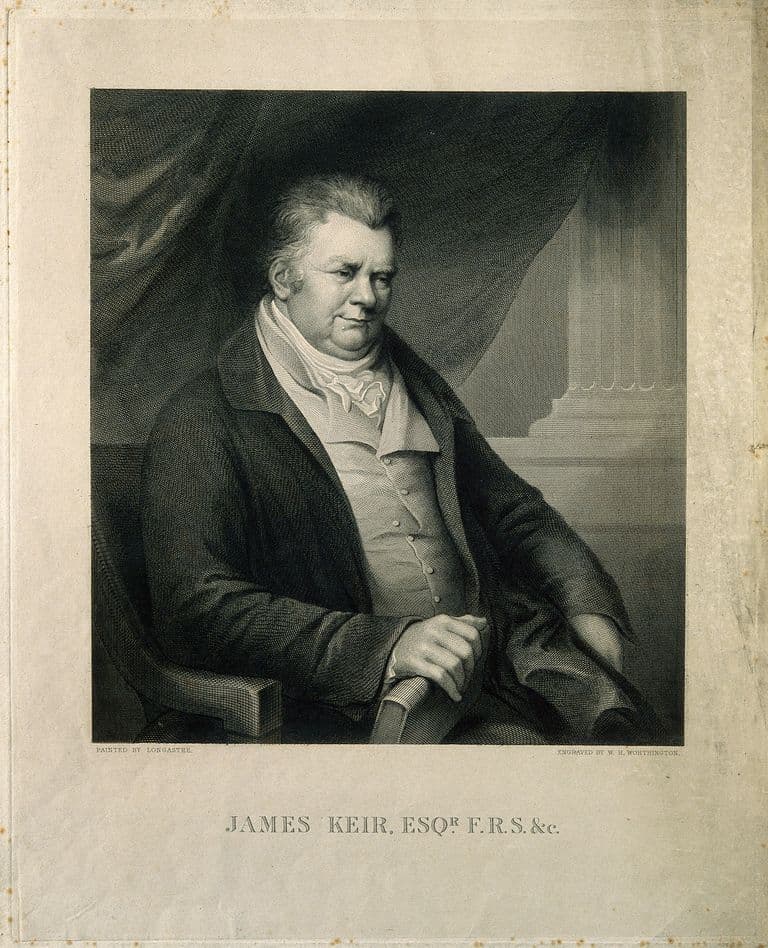
- 1778 — Keir runs SohoWith Boulton and Watt both away, James Keir manages the Soho works. He turns down the offer of a partnership as too risky.
- March 1802 — Gas lights at Soho for the Peace of AmiensGas lights are shown at each end of the Soho Manufactory during celebrations for the Peace of Amiens — a small display by William Murdoch, not a floodlit factory.
- c. by 1863 — The Soho Manufactory is goneAfter closing around 1850, Boulton’s Soho Manufactory and the old Soho Mint are demolished in stages. By 1863 nothing is left above ground; the site is later partly dug for sand and built over with housing.
Sources and further reading
Demolition: Wikipedia says ‘demolished in 1853’, the Soho Foundry list entry says ‘demolished 1860’, and Demidowicz and Tungate say nothing was left by 1863; we say ‘demolished in stages; gone by 1863’. A photograph on Wikimedia Commons is labelled 1860–65; its date is unverified. Construction is dated 1762–64, completed 1765 (Revolutionary Players) or 1766 (Wikipedia). The architect is ‘William Wyatt’ in the Archives of Soho and ‘the Wyatt family of Lichfield’ on Wikipedia. The claim that Soho was the first site with a Watt rotative engine (1782) is a lead only and is not used. The map point is approximate: no large-scale map of Soho earlier than 1863 was available, and a precise position needs Demidowicz’s reconstruction plans.
- The Soho Manufactory, Mint and Foundry, West Midlands: Where Boulton, Watt and Murdoch Made History — George Demidowicz, Historic England / Liverpool University Press, 2022
- Matthew Boulton and the Soho Mint: copper to customer (PhD thesis) — Sue Tungate, University of Birmingham, 2011. p.256 n.948
- Soho manufactory and estate — Archives of Soho — Library of Birmingham, Birmingham City Council. Ref. MS 3782/12/108/7; MS 3147/5/1447; MS 3147/5/1455
- Steam engines — Archives of Soho — Library of Birmingham, Birmingham City Council. Ref. MS 3782/12/1/2
- Economic and Social History: Industry and Trade, 1500–1880, in A History of the County of Warwick, vol. 7, pp. 81–139 — W. B. Stephens (ed.), Victoria County History, 1964
- The Soho Manufactory: From Snow Hill to Handsworth — Revolutionary Players (History West Midlands)
- Murdock, William — Dictionary of National Biography, vol. 39 — R. B. Prosser, Smith, Elder & Co., 1894
- Time Team excavations at the Soho manufactory and mint, Birmingham, 1996 — Archaeology Data Service
- Soho Foundry, former Boulton and Watt foundry, pattern stores and erecting shops — National Heritage List for England entry 1268451 — Historic England
- Ordnance Survey six-inch map, second edition (1888–1913), georeferenced — National Library of Scotland
- Soho Manufactory — Wikipedia
Archive references: Library of Birmingham MS 3147/5/1447 (1788 valuation); Library of Birmingham MS 3782/12/1/2 (Boulton to Franklin, 1766)
Comments
Comments will load here.