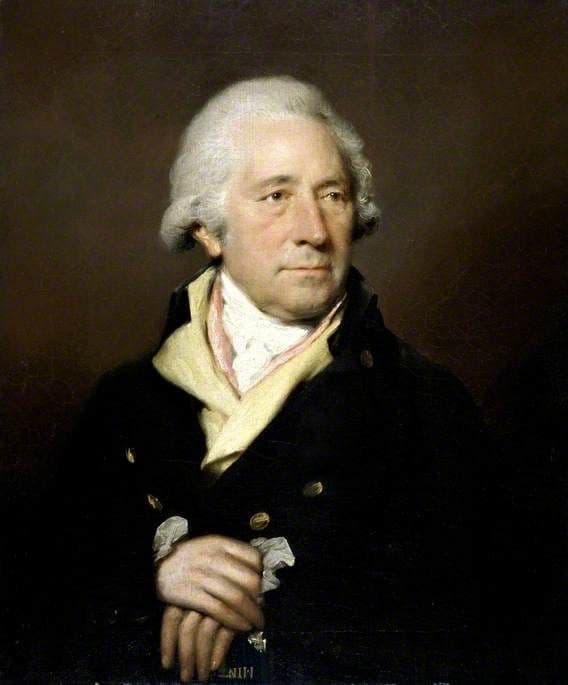
Before steam engines, Soho made “toys”. In 18th-century Birmingham that word meant small metal goods: buttons, buckles, snuff boxes and toothpick cases. Matthew Boulton had grown up in the trade. His father was a toy-maker, and Boulton joined the family firm in 1745.
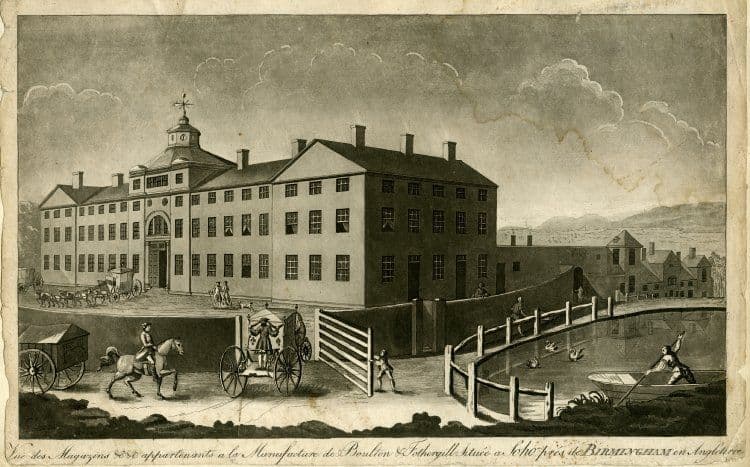
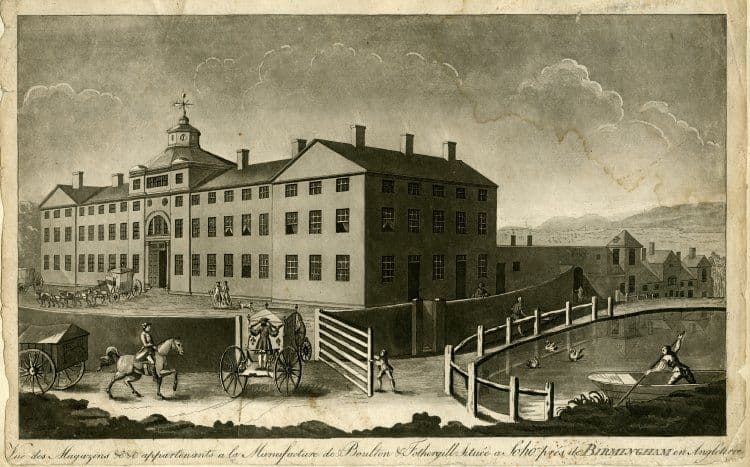
In 1761 Boulton and his partner John Fothergill leased about 13 acres just over the Hockley Brook in Handsworth parish, then in Staffordshire. The land came with a rolling mill and a house. Building began the next year. The Library of Birmingham names the architect as the local man William Wyatt; other accounts credit the Wyatt family of Lichfield. The main block, a handsome Palladian front facing the road, was finished by about 1765–66.
The idea was simple and bold. Birmingham’s metal trades usually worked on the putting-out system, with jobs farmed out to small workshops. Boulton wanted whole processes under one roof. By around 1770 the Victoria County History puts the workforce at 800 to 1,000 people.
What did they make? Buttons and buckles, certainly, but also Sheffield plate, solid silver, japanned ware and gilded bronze ornaments known as ormolu. Boulton fought for Birmingham to have its own assay office for marking silver, and it was set up by Act of Parliament in 1773.
In 1773 the engraver Francis Eginton made an aquatint of the works with a French title, the “Vue des Magazins” of Boulton & Fothergill “située à Soho près de Birmingham”.
The building was expensive: Revolutionary Players puts the bill at around £10,000. The Library of Birmingham notes that money from Boulton’s two marriages, to the sisters Mary and Ann Robinson, helped pay for his expansion. The partnership ended when Fothergill died in 1782. By then Soho had a new product, the steam engine, and a new partner, James Watt.
On the map
4 places connected with Boulton & Fothergill. Tap a number for directions — some sites are private homes or gardens, so each place’s page says what you can see from the street.

- New Hall, Boulton’s town warehouse (site) — Lost, Site redeveloped · Directions to New Hall, Boulton’s town warehouse (site) (opens Google Maps)
- Boulton family house and works, Snow Hill — Lost, Site redeveloped
- Soho Manufactory — Lost, Site redeveloped · Directions to Soho Manufactory (opens Google Maps)
- Soho House — Surviving · Directions to Soho House (opens Google Maps)
Key dates
- 1761 — Boulton takes the Soho estateMatthew Boulton acquires the Soho estate on the Hockley Brook in Handsworth parish, Staffordshire, where a rolling mill already stood. Building of the Soho Manufactory begins the next year.
- 1762 — Building begins at the Soho ManufactoryA year after Matthew Boulton and John Fothergill leased land on the Hockley Brook, building began on the Soho Manufactory. The works were finished around 1765–66.
- c. by 1863 — The Soho Manufactory is goneAfter closing around 1850, Boulton’s Soho Manufactory and the old Soho Mint are demolished in stages. By 1863 nothing is left above ground; the site is later partly dug for sand and built over with housing.
Sources and further reading
- Matthew Boulton (1728 to 1809) — Archives of Soho — Library of Birmingham, Birmingham City Council. Ref. MS 3782/16/1; MS 3782/12/108/1
- Soho manufactory and estate — Archives of Soho — Library of Birmingham, Birmingham City Council. Ref. MS 3782/12/108/7; MS 3147/5/1447; MS 3147/5/1455
- A Portrait of Matthew Boulton — Revolutionary Players, History West Midlands
- The Soho Manufactory: From Snow Hill to Handsworth — Revolutionary Players (History West Midlands)
- Economic and Social History: Industry and Trade, 1500–1880, in A History of the County of Warwick, vol. 7, pp. 81–139 — W. B. Stephens (ed.), Victoria County History, 1964. workforce c.1770
- The Soho Manufactory, Mint and Foundry, West Midlands: Where Boulton, Watt and Murdoch Made History — George Demidowicz, Historic England / Liverpool University Press, 2022. via publisher’s summary