
In October 1796 a young Birmingham manufacturer carried a large locked case into the Admiralty in London. Inside was a working model of a ship with paddle wheels and a small steam engine. A train of wheels turned the rudder at set moments, and spring triggers would fire the cargo when the ship struck its target. It was a fire-ship with no crew, designed to steer itself into French harbours and burn Napoleon’s fleet at anchor.
Edward Thomason worked the model on the table in front of the First Lord, Earl Spencer, and a roomful of officers. They admired it, he recalled, and turned it down.
That scene sums him up. Thomason was inventive, ambitious and never short of nerve. He came out of Matthew Boulton’s Soho as one of its most gifted pupils, built one of the showpiece factories of Georgian Birmingham, struck medals for half the crowned heads of Europe, and became, by the Victoria County History’s reckoning, the first Birmingham industrialist to be knighted. He also wrote memoirs that read like a catalogue of his own honours. Both sides of him are true.
A pupil of Soho
At sixteen the son was articled to Boulton and his partners at Soho “to learn their trades, until I attained the age of twenty-one years”, as he put it in his memoirs.
Thomason was born in Birmingham in 1769, the son of a buckle maker. Buckles were a staple of the town. His father, also Edward, said his works made a thousand pairs a day, and he lived in a house on the Colmore Row side of St Philip’s churchyard, owning the houses round the corner into Church Street, with the warehouses and workshops behind.
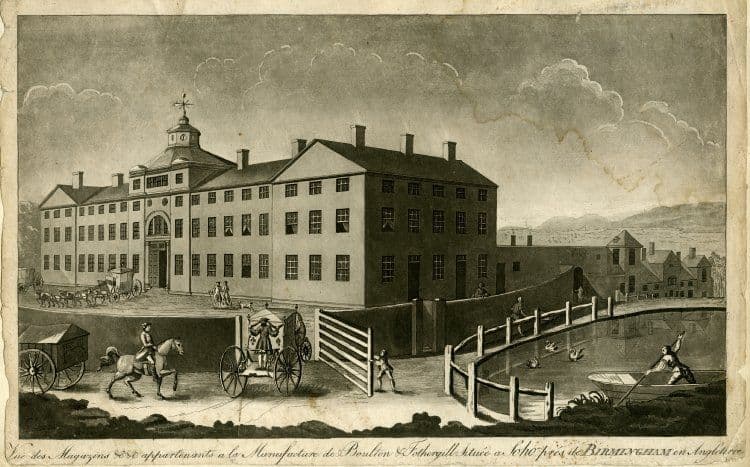
At sixteen the son was articled to Boulton and his partners at Soho “to learn their trades, until I attained the age of twenty-one years”, as he put it in his memoirs. He never forgot what he saw there: buttons, bronzes, steel toys, silver and plated wares and steam engines, made with machinery that “excelled all others of the like description in Europe”. Soho, he wrote, gave him “a versatility of taste for mechanism”, and an ambition “far beyond the means I possessed”.
He was not the only one to carry Soho’s methods into the town. Skilled die-sinkers and medallists trained there, such as Webb, later worked for Thomason, and the Soho way of doing things, with machines, fine dies, divided labour and showrooms, spread across Birmingham.
The Church Street manufactory
In 1793 his father retired and left the Church Street buildings ready for him. Thomason started with gilt and plated buttons “of the finest class”, then added gold jewellery, then a department for “medals, tokens, and coins”, then bronzes and cut glass, and finally silver and gold plate. By his own count the works filled sixty to seventy rooms, about twelve of them showrooms.
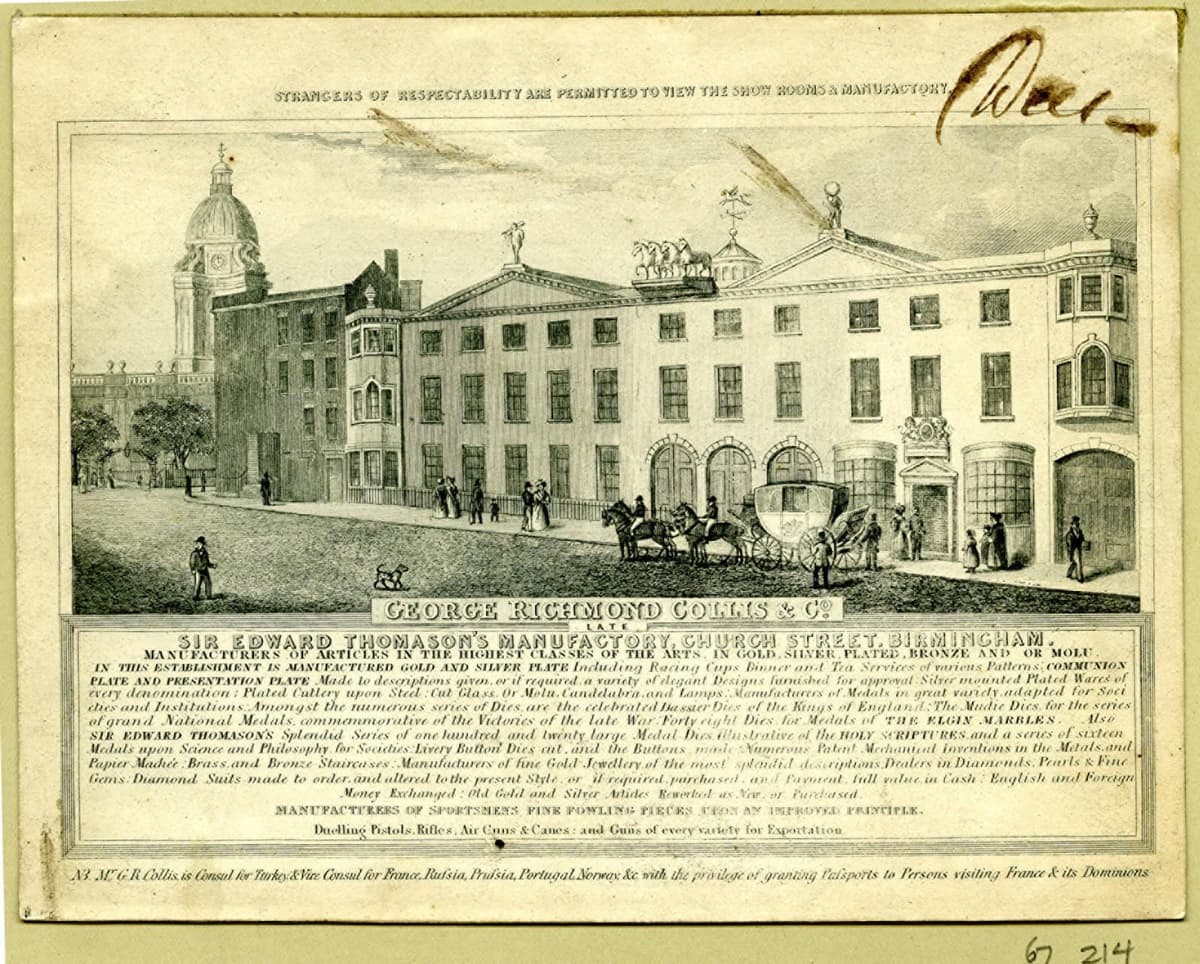
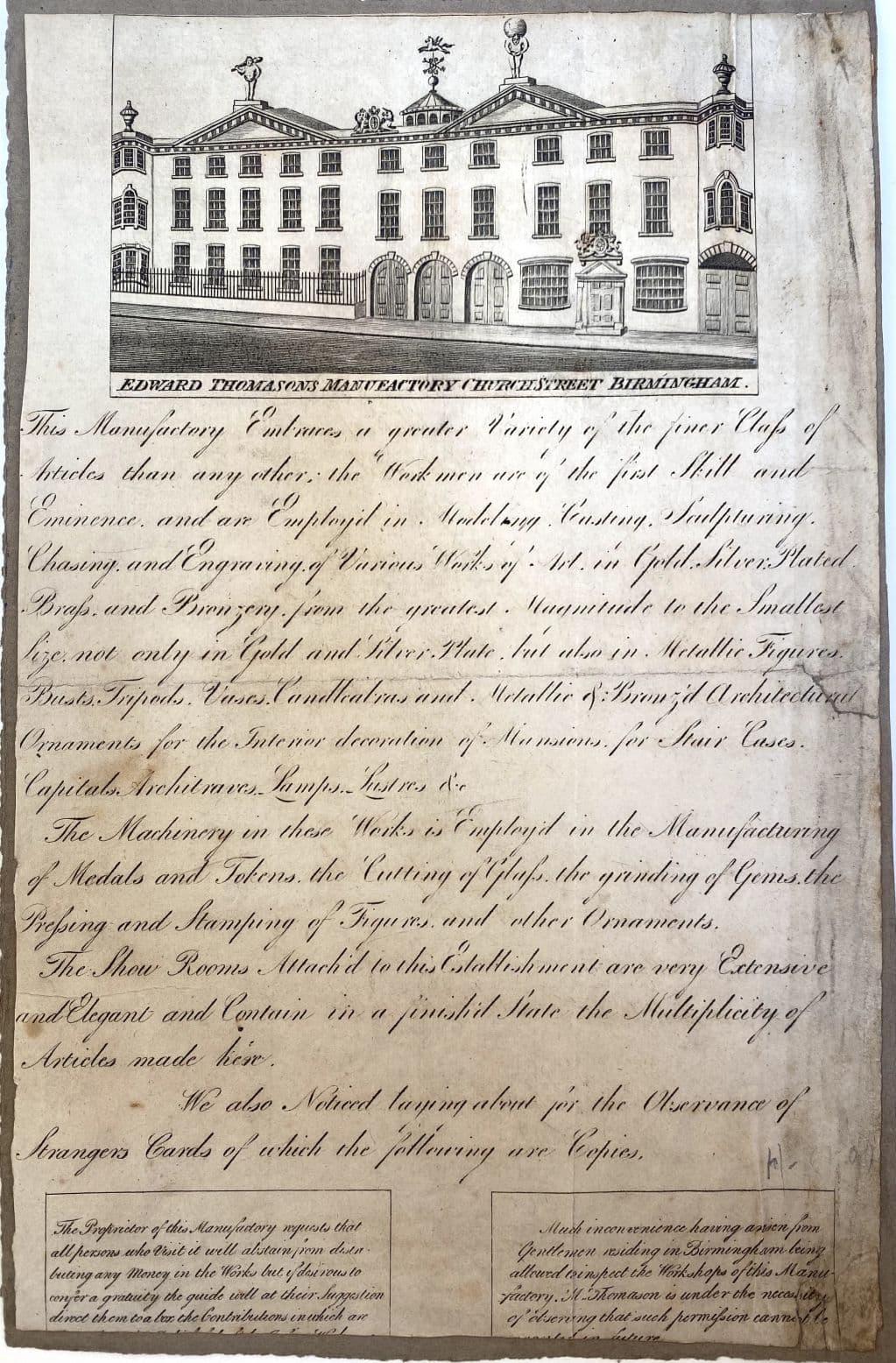
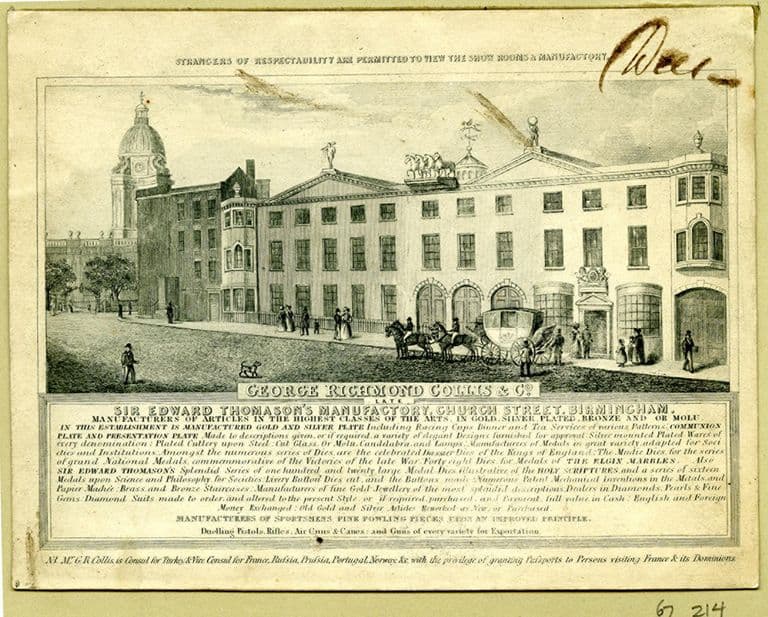
It was a sight to see, and it was meant to be. Thomason’s printed sheet boasted that the works made “a greater Variety of the finer Class of Articles than any other”, with machinery for medals and tokens, cutting glass, grinding gems and stamping figures. Gentlemen visitors were shown round, until so many came that he had to stop local people inspecting the workshops. Later engravings show a long classical front on Church Street, close to St Philip’s, with four bronze horses on the roof.
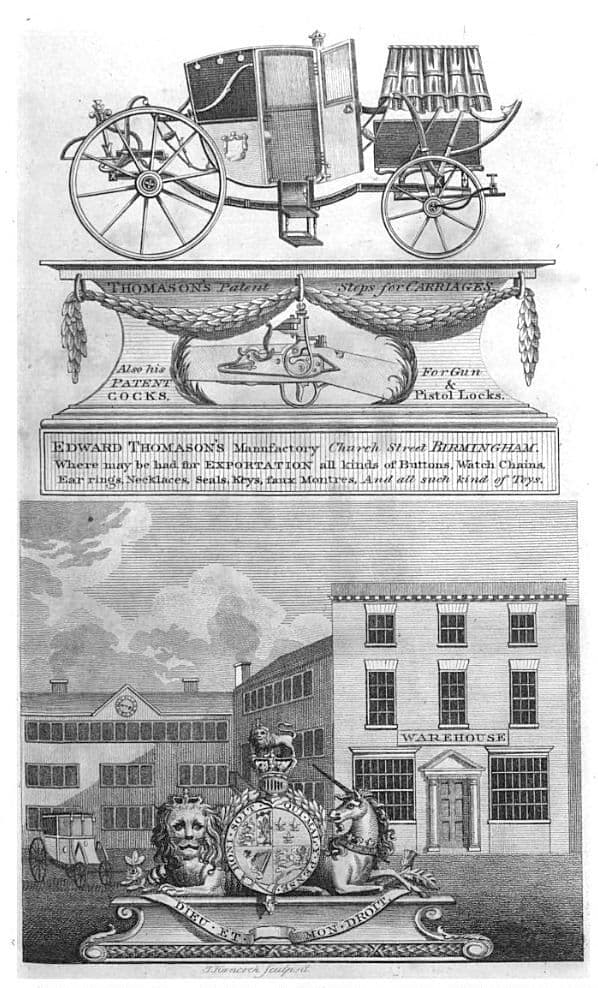
He patented almost anything. There were folding carriage steps that tucked away when the door closed (1796 and 1798), gun-locks, corkscrews, hearth brushes, whips, and in 1808 an umbrella combined with a walking stick, which he called the “rhabdoskidophoros”. The Victoria County History calls him “a prolific inventor of not particularly useful gadgets”.
One idea was more useful than it sounds. In 1803 he worked out how to draw a thin skin of brass tightly over an iron rod or tube. The result looked like solid brass but cost far less: stair rods, curtain poles, shop-front rails. Samuel Timmins, writing in 1866, judged that Thomason, not the man who later patented it, deserved credit for “the now familiarly known patent tube”, and that one firm alone was then making more than 100,000 feet of it a year.
Tokens and medals
The French wars left Britain short of small change. Employers could not get coins to pay wages, so they issued their own copper tokens. Thomason put up coining machinery in 1807 and struck tokens for ironmasters and banks. In 1811, he wrote, he made more than two million copper tokens for the Black Country ironmaster Samuel Fereday. Parliament banned private tokens from 1818.
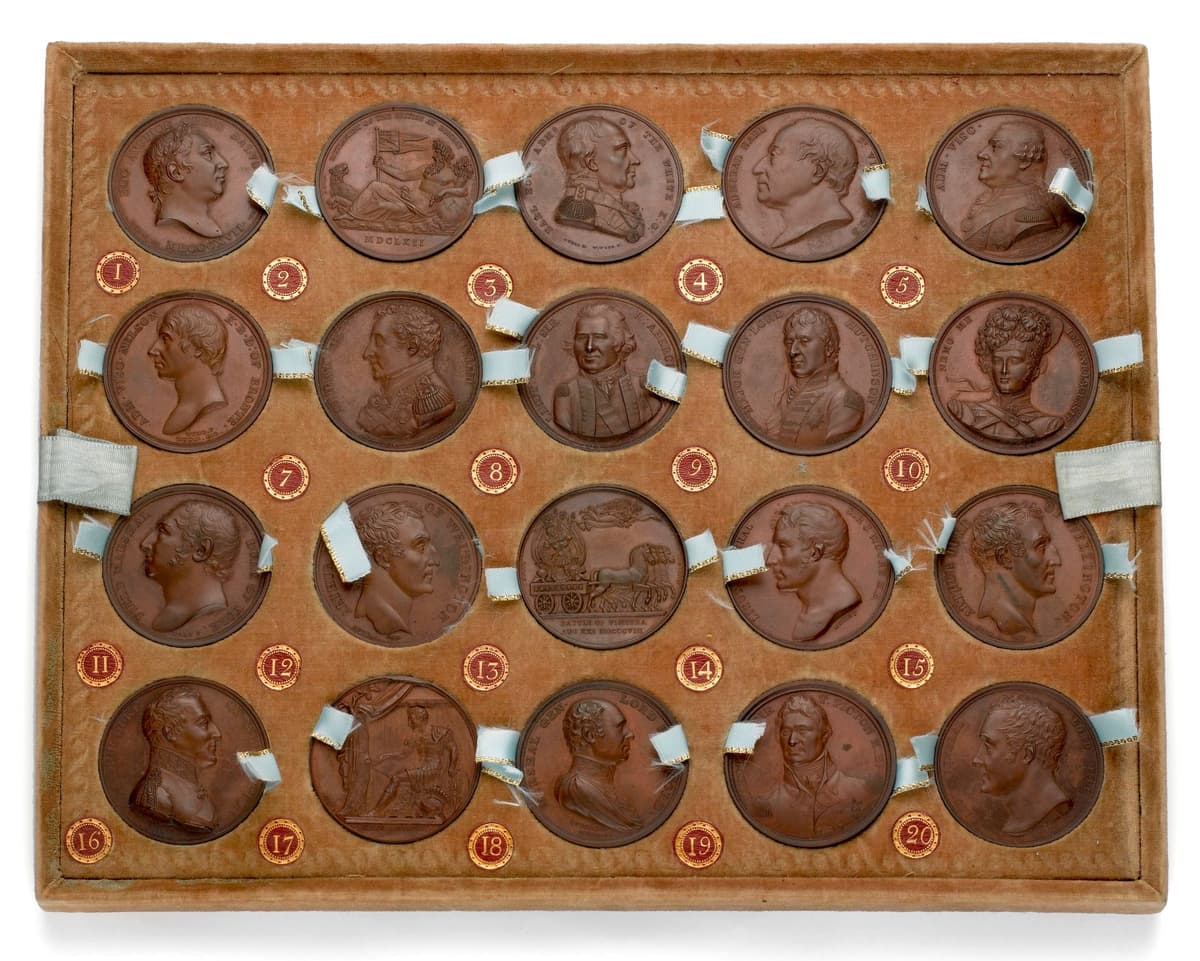
Medals lasted longer. After Boulton’s death in 1809, Timmins wrote, “the principal medallic works produced in Birmingham were struck at Thomason’s establishment.” He hired skilled die-sinkers, among them men who had worked at Soho, and members of the Wyon family. He struck a large medal of his old master Boulton. In 1820 he made a series of forty-eight medals of the Elgin Marbles, then thirty-two on the sciences, and in 1830 a set of sixty large medals of Bible scenes after the old masters.
The vase and the horses
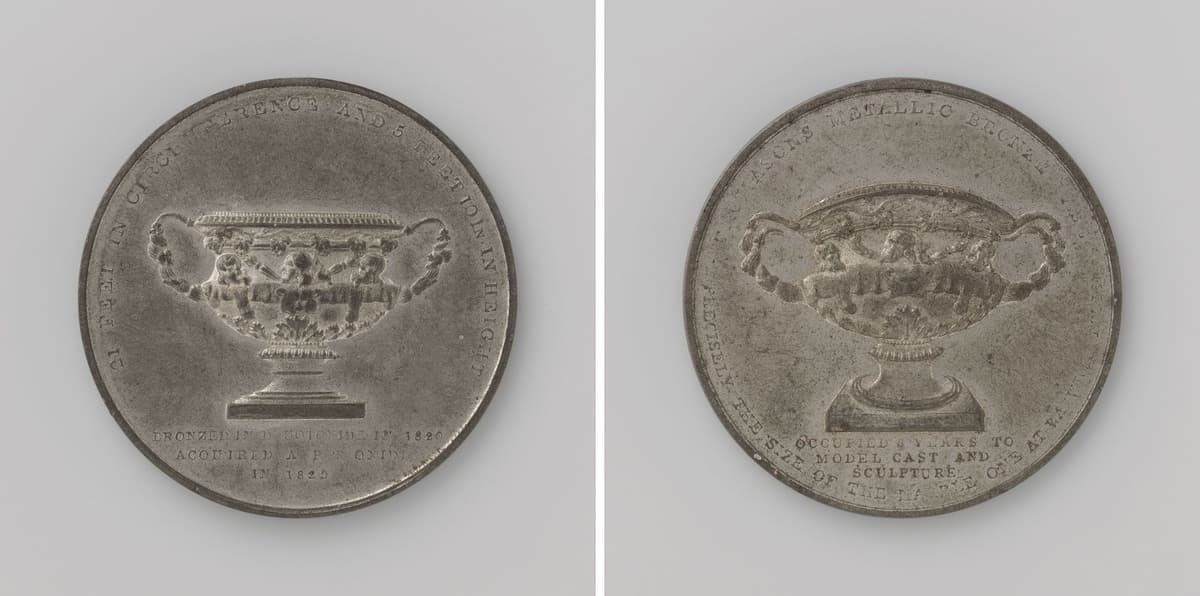
Thomason also wanted to be an artist. In July 1816 the Earl of Warwick let his modellers into the conservatory at Warwick Castle to copy the Warwick Vase, a huge ancient marble vase. Four craftsmen worked on scaffolding for more than eight months taking moulds. Thomason’s memoir says the bronze copy was 21 feet round and 5 feet 10 inches high, and took six years to model, cast and finish. He struck a medal to celebrate it.
In 1823 he went further, modelling a six-foot statue of George IV and copies of the four bronze horses of St Mark’s in Venice, and building a casting house to make them. He hoped to cast “the first bronze statue that has ever been achieved out of the capital of an empire”. The horses ended up on his factory roof.
Sir Edward
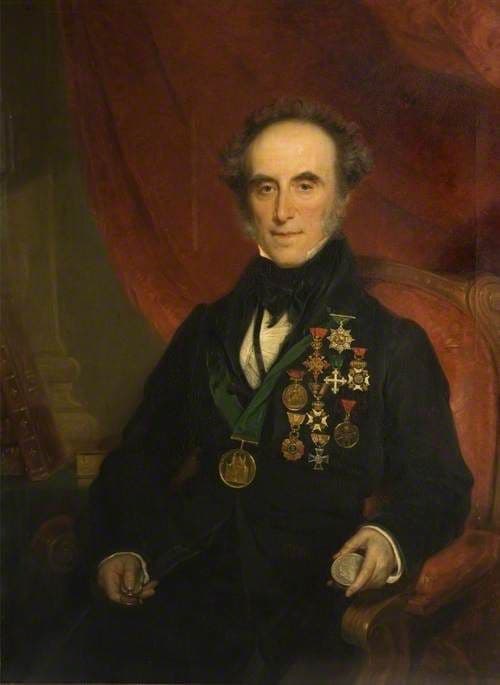
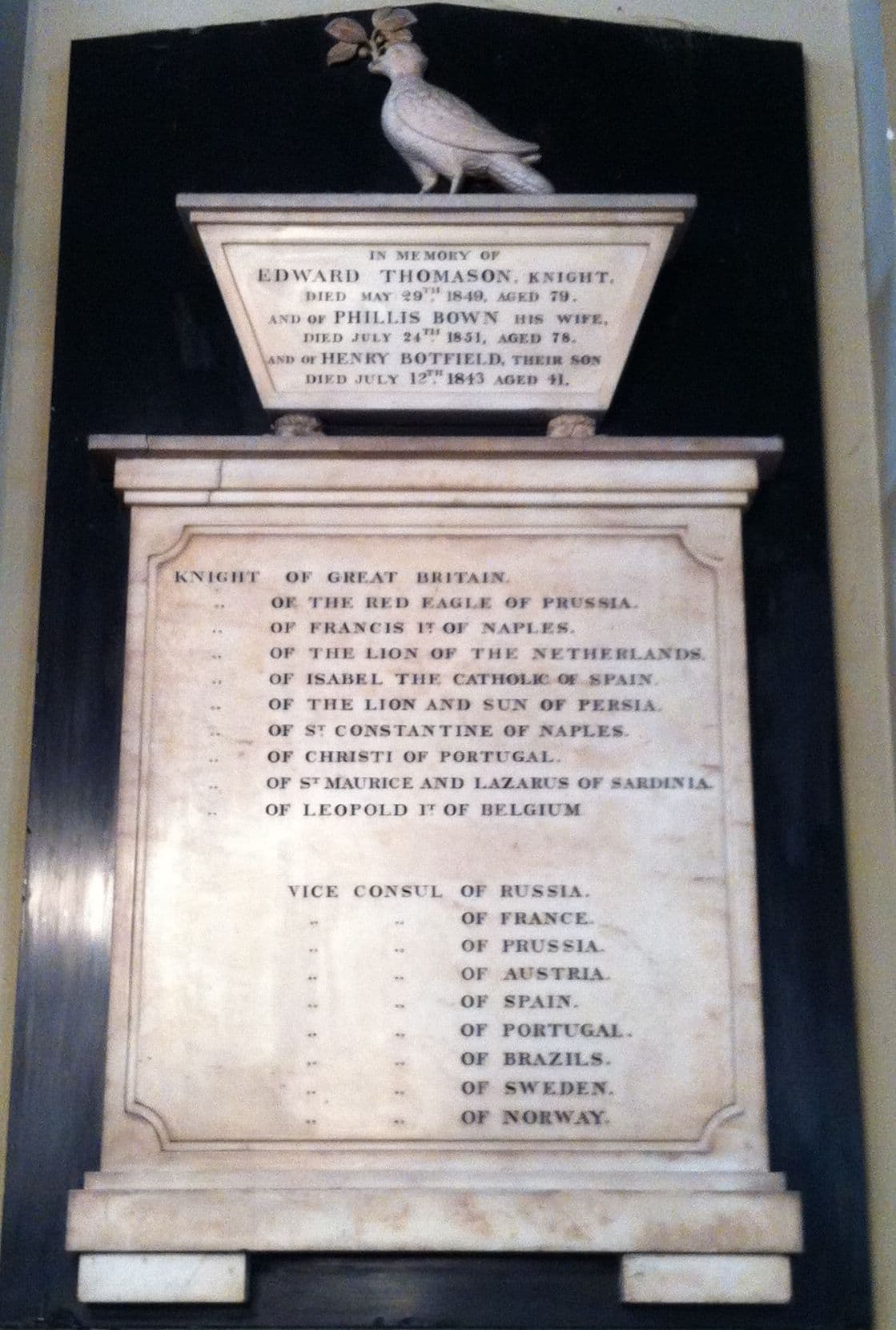
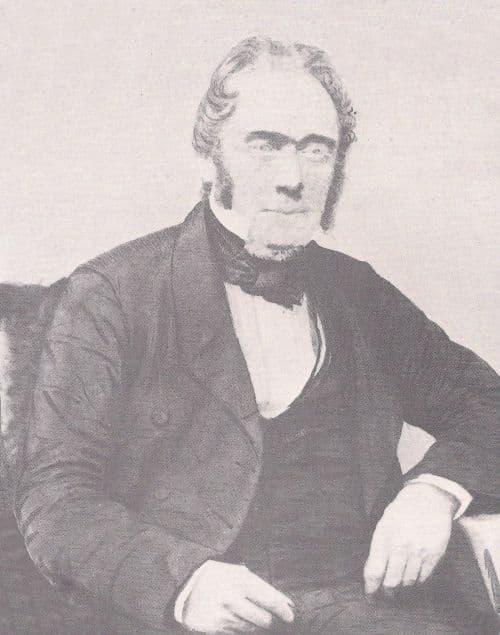
What Thomason really collected was honours. He sent his medals as gifts to monarchs across Europe, and they sent back orders, gold medals and diplomas. He served as vice-consul in Birmingham for several foreign governments. The Dictionary of National Biography counts eight foreign orders of knighthood; the Victoria County History says twenty or thirty decorations, “which he frequently wore”. His portrait shows them pinned in rows across his chest. In 1832 William IV knighted him.
His memoirs, published in 1845, say he admired Wilberforce’s campaign against the slave trade. They also print a letter he received in 1804 from the Governor of Tobago attacking “canting abolitionists”, and his exchanges with Sir Sidney Smith over a campaign against slavery in North Africa.
The memoirs must be read with care. They are long on letters from kings and short on wages or accounts. The Victoria County History calls them “one of the most egotistical and snobbish productions ever published”, and adds in the same breath that he “did much in his day to raise the standards of industrial craftsmanship.”
The end
By the mid-1830s Thomason was handing over. Timmins says he sold the works in 1835 to Whitgrave and Collis; a later trade card for George Richmond Collis & Co. still advertised “late Sir Edward Thomason’s Manufactory”. Thomason retired in 1844 to Ludlow, then Bath, then Warwick. His only son, Henry, had died in 1843. Sir Edward died at Warwick on 29 May 1849 and was buried in the family vault at St Philip’s, where his memorial still hangs.
Why it mattered
Edward Thomason shows what Soho did to Birmingham. Boulton trained young men in machines, dies, design and salesmanship, and some of them walked out and set up rival works of their own. Thomason took the lessons two miles into the centre of town, to Church Street and ran a manufactory that made buttons, tokens, plate, bronzes and medals under one roof, with showrooms for visitors, just as Soho had.
After Boulton died, Thomason’s works became the town’s leading medal factory, and his dies, presses and craftsmen kept Birmingham’s reputation for fine metalwork alive. His brass-cased tube became a standard Birmingham product.
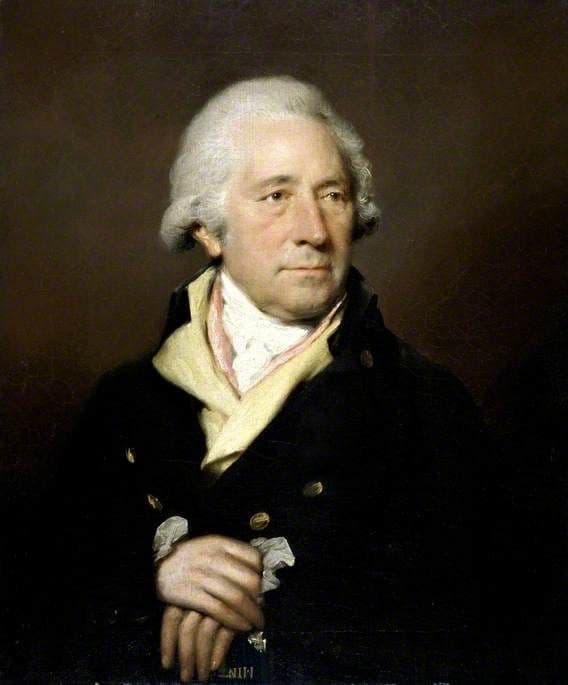
He was vain, and his memoirs prove it. But he also proved that a Birmingham manufacturer could be honoured by the courts of Europe. The factory has gone from Church Street. Yet his portrait in the Birmingham Museums collection still shows the toymaker’s son with his chest full of foreign orders, each one won with something made in Birmingham.
On the map
3 places connected with Edward Thomason. Tap a number for directions — some sites are private homes or gardens, so each place’s page says what you can see from the street.

- Thomason’s Manufactory, Church Street — Lost · Directions to Thomason’s Manufactory, Church Street (opens Google Maps)
- Soho Mint — Lost, Site redeveloped · Directions to Soho Mint (opens Google Maps)
- Soho Manufactory — Lost, Site redeveloped · Directions to Soho Manufactory (opens Google Maps)
Key dates
- 1793 — Thomason opens his Church Street manufactoryEdward Thomason, trained at Boulton’s Soho, takes over his father’s buildings at Colmore Row and Church Street and starts making gilt buttons. The works grows into a showpiece making medals, tokens, plate and bronzes.
Sources and further reading
Date of the sale of the works: Timmins (1866) says Thomason disposed of the Church Street works to Whitgrave and Collis in 1835; the Dictionary of National Biography says he retired from business in 1844. He may have kept some interests after 1835. Honours: the DNB counts eight foreign orders of knighthood; the VCH says “some twenty or thirty foreign decorations”. The VCH calls his 1832 knighthood the first awarded to a Birmingham industrialist; not checked further. The Warwick Vase copy: the DNB calls it bronze and Thomason gives its size; one modern account says an iron copy is at Aston Hall, but that has not been confirmed with Birmingham Museums Trust, so its present whereabouts are not given here. The scale of Thomason’s workforce is not recorded in any source seen. Much detail (the fire-ship, the Fereday tokens, the vase) comes from his own memoirs of 1845, which were written to impress. His grandson is usually identified as Yeoville Thomason, architect of the Council House, but that rests on secondary biographies. The location of the manufactory is placed from his memoir (the corner of Colmore Row and Church Street) and an engraved trade card; no map has been checked.
- Thomason, Sir Edward — Dictionary of National Biography, vol. 56 — Edward Irving Carlyle, Smith, Elder & Co., 1898
- Sir Edward Thomason’s Memoirs during Half a Century — Sir Edward Thomason, Longman, Brown, Green, and Longmans, 1845. vol. 1, opening chapter; 1796, 1803–04, 1811, 1816, 1823
- Economic and Social History: Industry and Trade, 1500–1880, in A History of the County of Warwick, vol. 7, pp. 81–139 — W. B. Stephens (ed.), Victoria County History, 1964. buckles, umbrellas, die-sinkers and medals, showrooms
- The Resources, Products, and Industrial History of Birmingham and the Midland Hardware District — Samuel Timmins (ed.), Robert Hardwicke, London, 1866. pp. 564–65 (die-sinkers); patent tube
- Trade card of George Richmond Collis & Co., late Sir Edward Thomason’s Manufactory, Church Street — British Museum. Ref. BM D,2.174
- Edward Thomason — Wikipedia. lead only
Comments
Comments will load here.