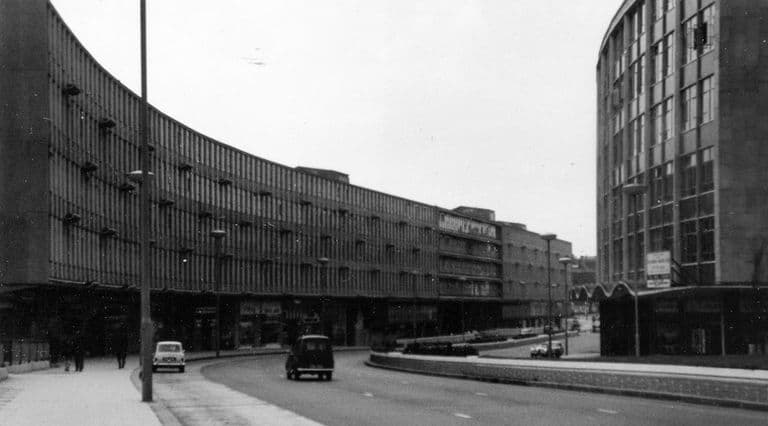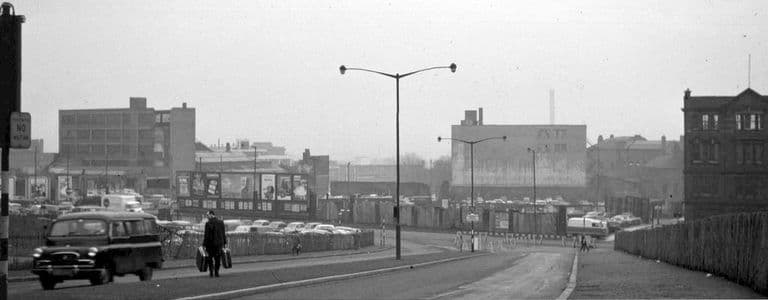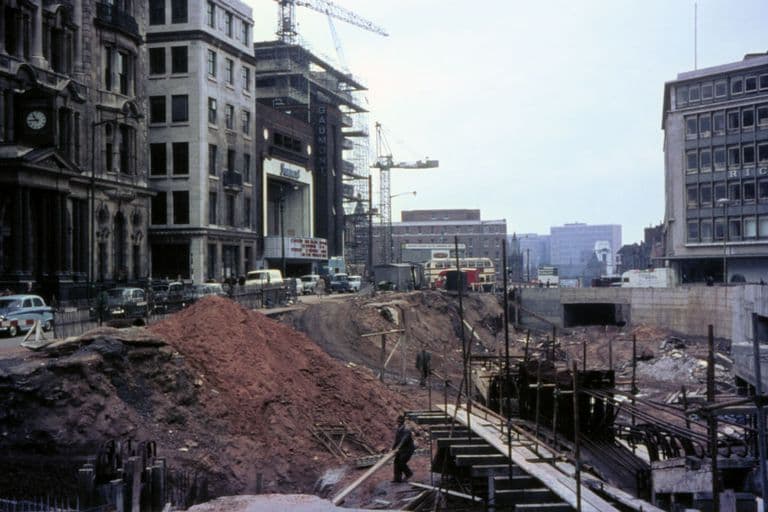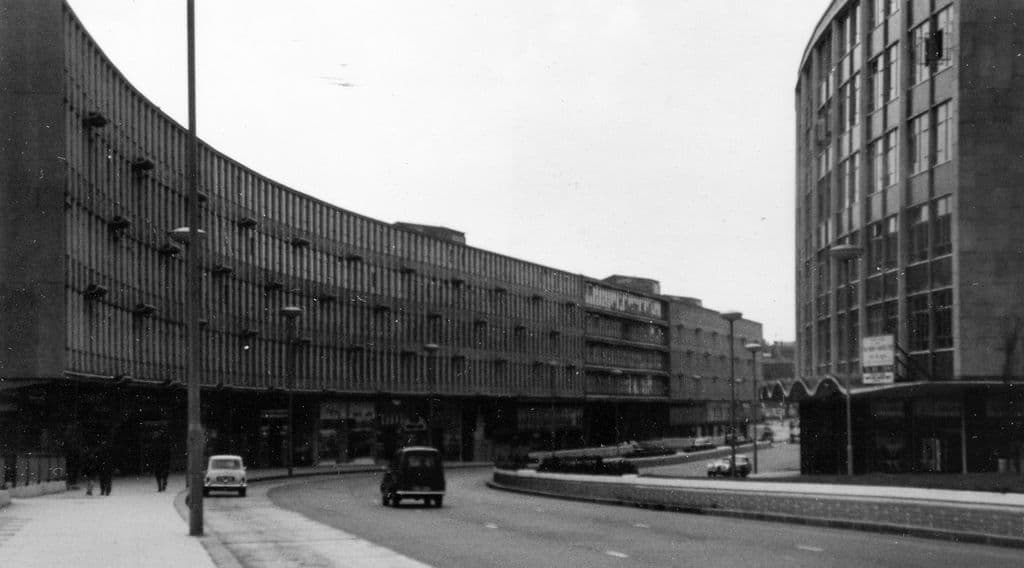
On 27 February 1941, with the city still clearing up after the winter raids, the *Birmingham Mail* asked the City Engineer and Surveyor whether the bombing had changed his plans. Herbert Manzoni said no. “We have not got to start replanning Birmingham,” he said. “All we want is the opportunity to carry out the plans we have already.”
That interview, quoted by the planning historian Peter Larkham, is the key to what happened next. Birmingham’s post-war rebuilding was not born from the rubble. It was waiting for it.
The engineer
Manzoni was born in Birkenhead in 1899, trained as an engineer at Liverpool, and joined Birmingham’s public works department in the 1920s, working on sewers and rivers. He became City Engineer and Surveyor in 1935, aged 36, and held the post until 1963. In Birmingham the engineer, not an architect or planner, controlled the shape of the city. Until 1952 the city did not even have a City Architect; when it got one, Alwyn Sheppard Fidler, it was Manzoni who appointed him.
Planning in wartime
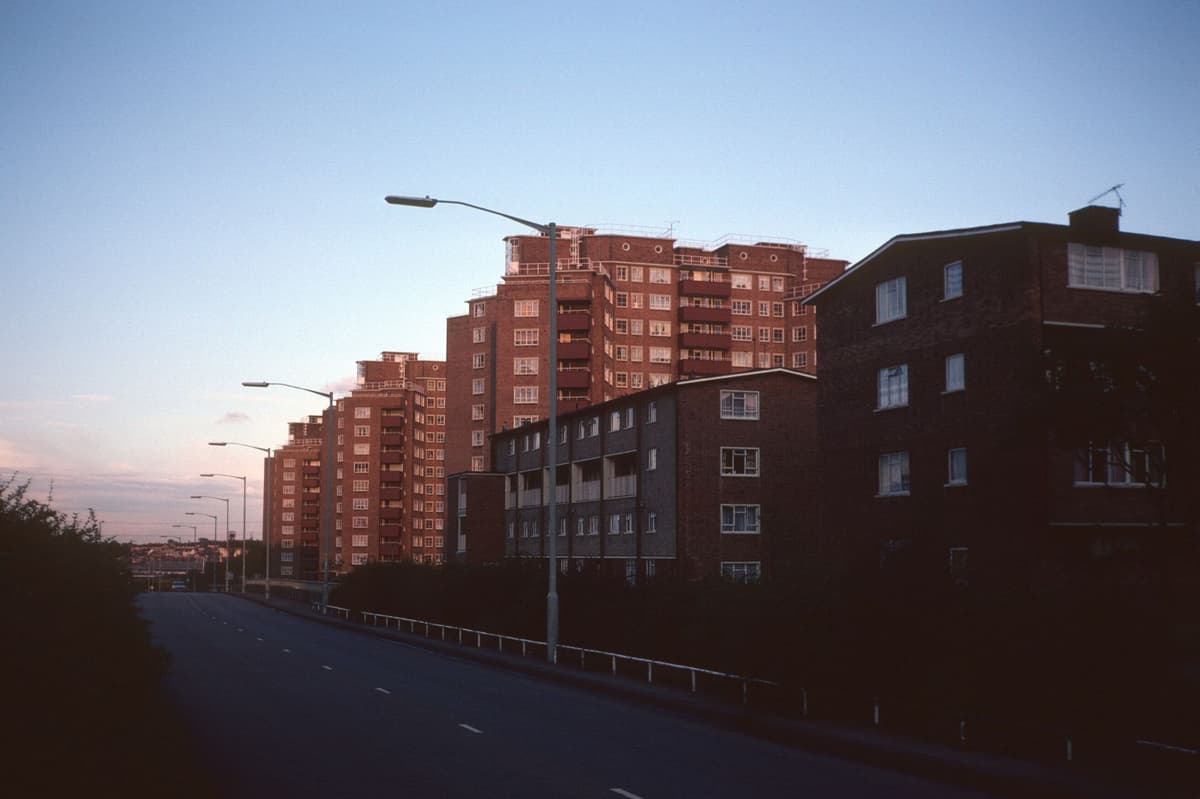
On 16 October 1941 Manzoni sent the Public Works Committee a confidential report on “central city planning”, built round a ring road. Four advisory panels followed, covering traffic, housing, redevelopment areas and the limits of the city. The idea of an inner loop road was not new: plans had been drawn in 1917–18. Nor were the slum areas: Larkham shows that Manzoni had identified five clearance areas before the bombing.
Others were thinking big too. In 1941 the Bournville Village Trust published *When We Build Again*, arguing for comprehensive clearance, even “the wholesale redevelopment of the Jewellery Quarter”. Larkham sees in it “the origins of the derided post-war comprehensive clearance approach”.
He is widely quoted, and the words appear in several local histories, as saying: “I have never been very certain as to the value of tangible links with the past. They are often more sentimental than valuable.”
The committee approved the ring road in principle on 29 April 1943. In July 1945 the council agreed to seek an Act of Parliament, and the Birmingham Corporation Act 1946 gave powers to build the road and buy the land. Larkham calls it the largest scheme of its kind any council had brought to Parliament.
The powers to buy
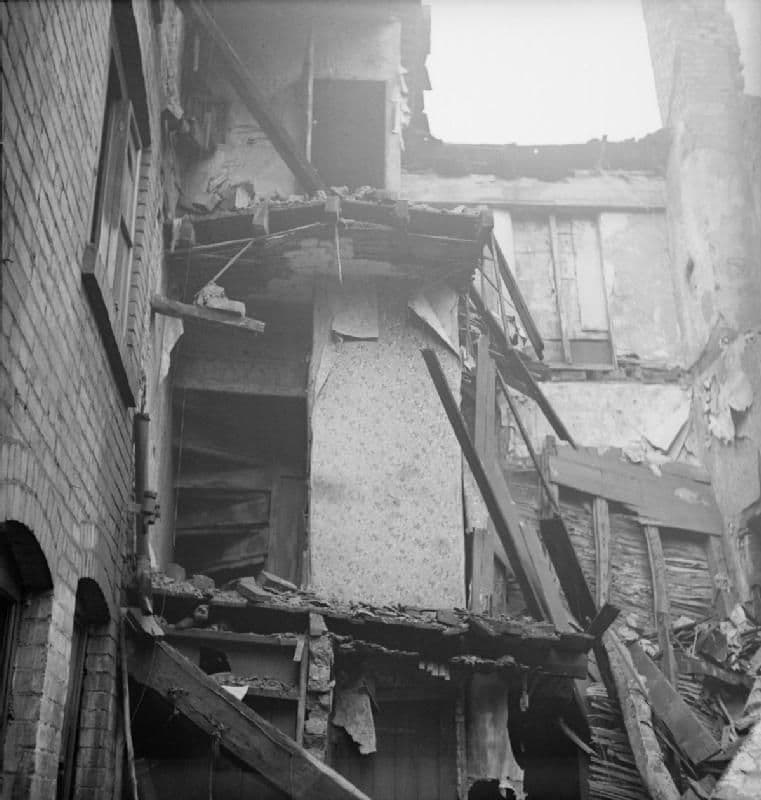
The national Town and Country Planning Act of 1944, nicknamed the “Blitz and Blight” Act, let councils buy whole districts damaged by bombs or simply worn out. Manzoni later said Birmingham was ready, “because our plans had already been drawn up in detail”, and even that “we’d shaped the legislation for it”. In 1947 the council completed the purchase of about 1,400 acres in five areas ringing the centre. A council history of 1995 notes that it used an “expedited completion procedure”, taking ownership before paying compensation, and became the biggest owner of slum property in the city.
Austerity
Then very little happened, at least on the ground. Only about 2,000 new houses were built in the city in 1940–44. Labour and materials were scarce; the freeze of early 1947 stopped building altogether. The council’s own history describes Shell-BP House in New Street, opened in April 1954, as the first new building on a city-centre bomb site.
By 1955 the council reckoned it needed 50,000 new homes and had land for 8,000. In 1956 it hoped to find room for 220,000 people in “overspill” towns over twenty years. The ring road, approved in 1946, waited eleven years for a minister to fund it.
“Little of real worth”
When the money came, Manzoni moved fast, and he did not apologise for what went. He is widely quoted, and the words appear in several local histories, as saying: “I have never been very certain as to the value of tangible links with the past. They are often more sentimental than valuable.” And: “As to Birmingham’s buildings, there is little of real worth in our architecture. Its replacement should be an improvement.” The exact occasion has not been traced.
Larkham notes a striking fact: “no overall plan was ever produced for the city, or even for the city centre.” Manzoni thought such plans were obsolete before they were built. He worked scheme by scheme.
The verdicts
Opinion was divided from the start. Leslie Ginsburg, founding head of the Birmingham School of Planning, wrote in 1959 that the ring road looked like “the greatest traffic and town design tragedy yet to afflict an English city”. The critic Ian Nairn called the rebuilding “disastrously ham-handed” in 1960. The architect John Madin, who worked alongside him, said: “basically Manzoni was a road engineer … this was his limitation.”
Others admired the drive. One historian, writing in 2002 and quoted by Larkham, observed that “far more of the city was rebuilt than in other big provincial centres like Manchester, Liverpool and Leeds”. The *Birmingham Post*’s tribute said that nowhere in Britain had development been “approached so determinedly and carried out as comprehensively”. Manzoni was knighted in 1954 and died in 1972. Larkham’s own conclusion is that reconstruction was “expert-driven” and “paternalist”, with “a technocentrism which prioritised vehicle movement”.
Applause
The clearest sign of how far opinion had moved came in January 1980. The council agreed that the Jewellery Quarter, still marked for wholesale redevelopment, should be saved instead, and made it a conservation area. The council’s report records how the public meeting about the plan ended: “in spontaneous applause”.
A long read
Herbert Manzoni: the man who remade Birmingham
Birmingham survived the Blitz, then rebuilt itself on purpose. Compare the city before and after on four lined-up maps, see what the Inner Ring Road took, and judge for yourself.

On the map
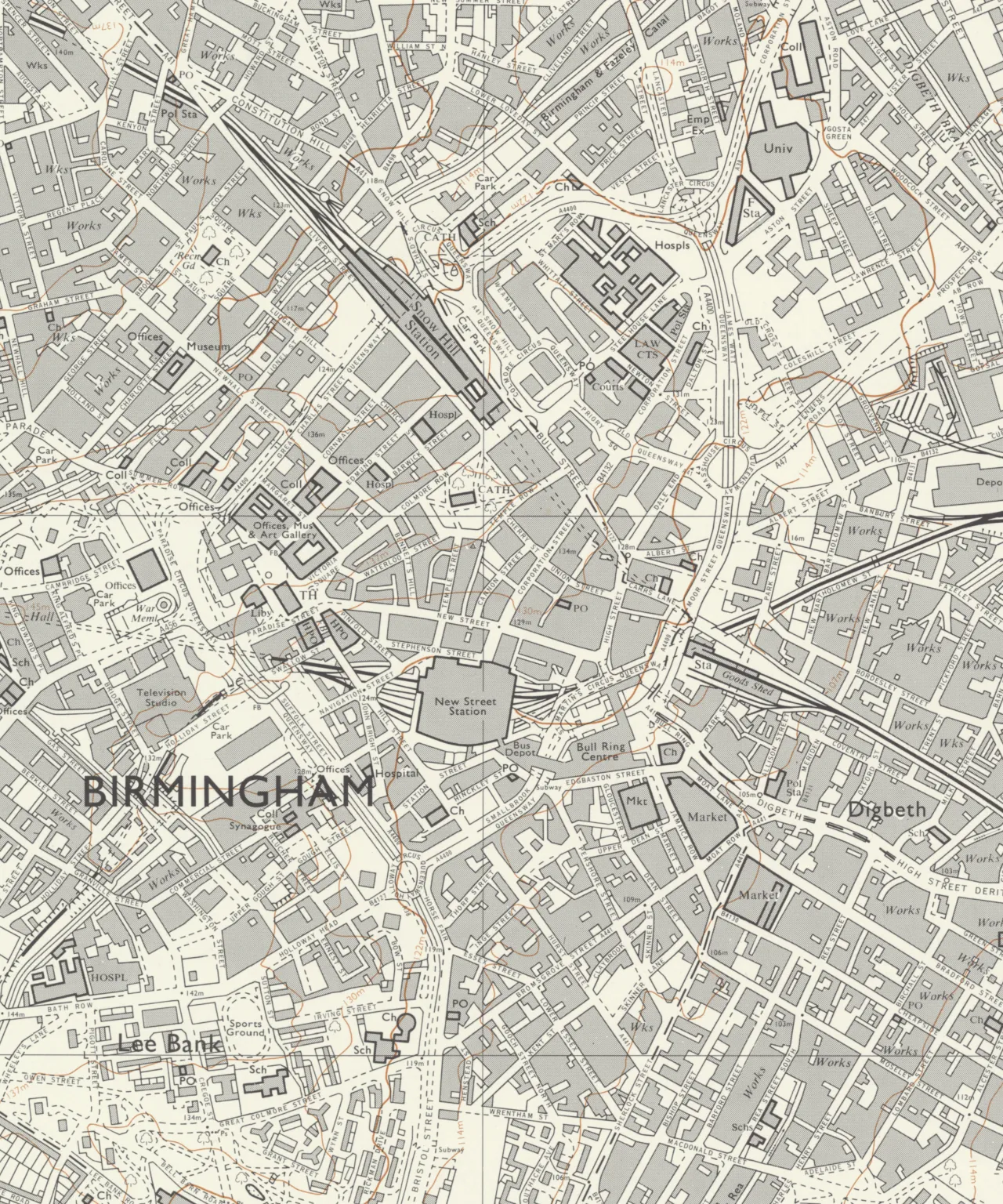
11 places connected with Post-war reconstruction and Herbert Manzoni. Tap a number for directions — some sites are private homes or gardens, so each place’s page says what you can see from the street.

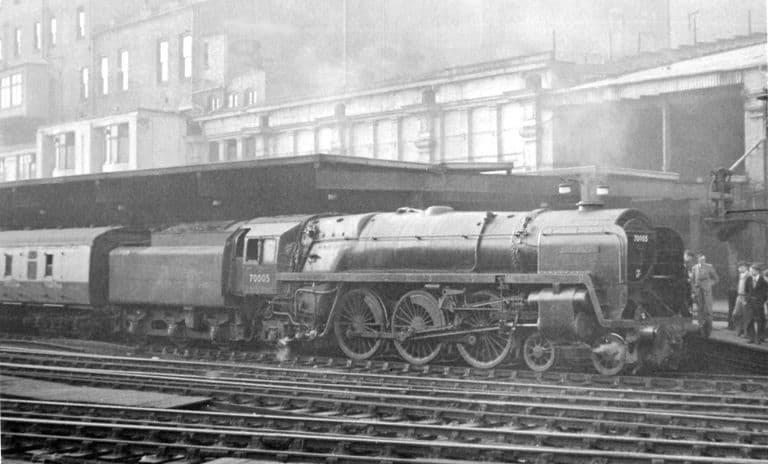
- The Victorian New Street Station — Lost, Site redeveloped · Directions to The Victorian New Street Station (opens Google Maps)
- Summer Lane and the old Newtown — Site redeveloped
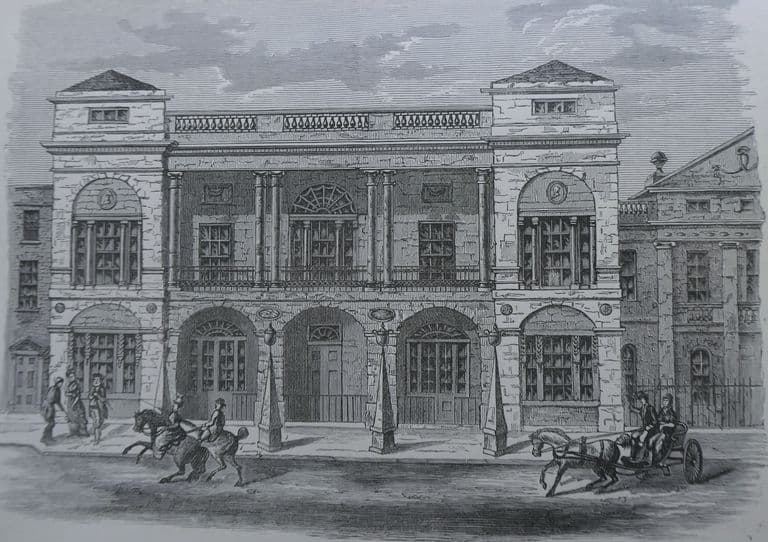
- Theatre Royal, New Street — Lost, Site redeveloped · Directions to Theatre Royal, New Street (opens Google Maps)
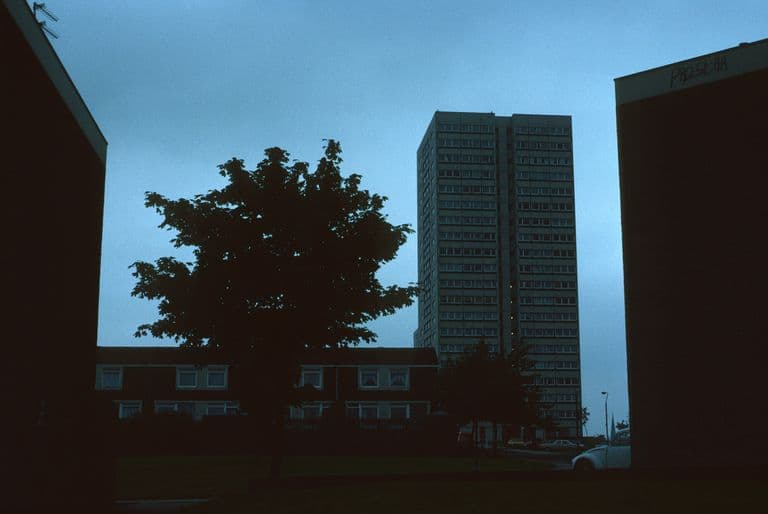
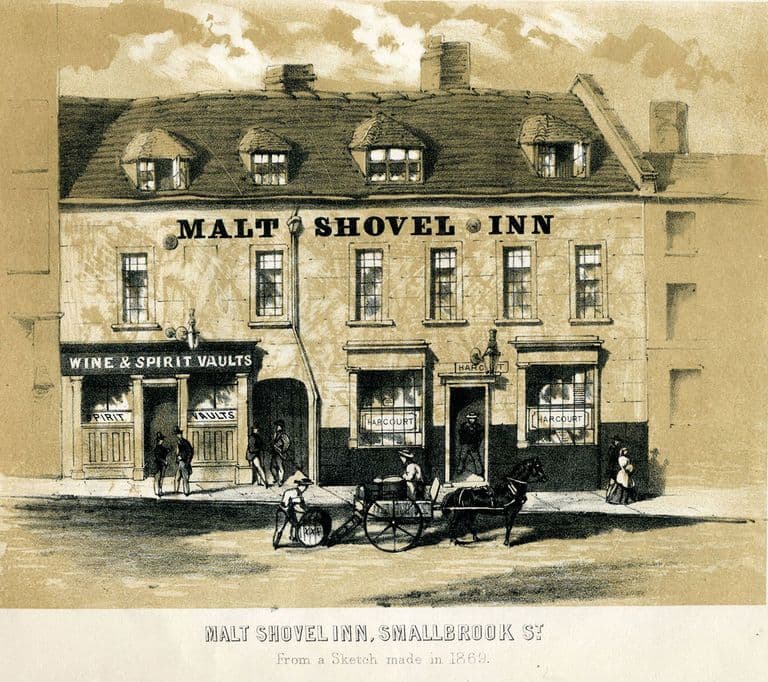
- Smallbrook Street — Lost, Site redeveloped
- The old Bull Ring and Spiceal Street — Lost, Site redeveloped · Directions to The old Bull Ring and Spiceal Street (opens Google Maps)
- Holloway Circus — Surviving, Surviving but altered · Directions to Holloway Circus (opens Google Maps)
- Lancaster Circus — Surviving, Surviving but altered · Directions to Lancaster Circus (opens Google Maps)
- St Chad’s Circus — Surviving but altered · Directions to St Chad’s Circus (opens Google Maps)
- Smallbrook Queensway — Surviving but altered · Directions to Smallbrook Queensway (opens Google Maps)
- Masshouse Circus — Lost, Site redeveloped · Directions to Masshouse Circus (opens Google Maps)
- Gaumont Palace, Colmore Circus — Lost, Site redeveloped
Key dates
- 1899 — Herbert Manzoni is born in BirkenheadHerbert John Baptista Manzoni is born in Birkenhead, the son of an Italian sculptor and potter. He will study engineering at Liverpool University.
- 1923 — Manzoni joins Birmingham’s Public Works DepartmentManzoni comes to Birmingham as an engineering assistant in the Sewers and Rivers Section of the Public Works Department. Four years later he is chief engineer of the section, and in 1929 deputy City Engineer.
- 17 July 1935 — Manzoni becomes City Engineer and SurveyorIn his mid-thirties, Manzoni succeeds Herbert Humphries as City Engineer and Surveyor, in charge of roads, sewers, planning and building. He will hold the post for 28 years.
- November 1937 — Duddeston and Nechells redevelopment plan approvedThe council approves Manzoni’s plan to redevelop 267 acres of Duddeston and Nechells as a whole, separating homes from industry. It is the city’s first comprehensive redevelopment area plan, drawn up before the war.
- September 1939 — Manzoni’s planning paper for a New York congressManzoni writes a paper on city planning and the Restriction of Ribbon Development Act 1935 for the British–American Engineering Congress in New York; the Institution of Civil Engineers publishes it in November 1939.
- 27 February 1941 — ‘We have not got to start replanning Birmingham’Asked by the Birmingham Mail whether the bombing has changed his plans, Manzoni says no: ‘we have not got to start replanning Birmingham. All we want is the opportunity to carry out the plans we have already.’
- 16 October 1941 — Manzoni reports on central city planningCity Engineer Herbert Manzoni sends a confidential report on central city planning, built round a ring road, to the Public Works Committee. Four advisory panels follow, on traffic, housing, redevelopment areas and the city’s limits.
- June 1942 — Manzoni’s paper on post-war planningThe Journal of the Institution of Civil Engineers publishes Manzoni’s paper ‘Post-war planning and reconstruction’, covering housing, slums, traffic and roads.
- 29 April 1943 — Ring road approved in principleThe Public Works Committee approves Manzoni’s ring-road proposals in principle. The line follows the inner loop first suggested in 1917 and uses bombed sites where it can.
- 6 June 1945 — Minister counts Birmingham’s bombed homesAnswering a written question, the Ministry of Works tells Parliament that about 90,000 Birmingham houses were affected by bombing, 5,000 of them destroyed, and about 2,000 other properties put out of use.
- July 1945 — Council backs a Bill for the ring roadThe full City Council authorises a Parliamentary Bill for the Inner Ring Road. Keith Jordan dates the council’s approval of the scheme to July 1944; Larkham, working from the archives, gives July 1945 for the Bill.
- 1946 — A housing survey counts the slumsA city housing survey finds 29,000 back-to-back houses, 6,500 homes without their own water supply, nearly 40,000 without their own lavatory and more than 142,000 without a bathroom.
- 1946 — Birmingham Corporation Act passedParliament gives the council powers to build the Inner Ring Road and buy the land compulsorily. Peter Larkham calls it the largest such council scheme to have come before Parliament.
- 29 January 1947 — Parliament debates the 1947 Planning BillLewis Silkin calls the Town and Country Planning Bill “the most comprehensive and far-reaching planning Measure” ever put before the Commons. It gives councils wide compulsory purchase powers, paying the existing-use value of land.
- 1947 — Council buys the five redevelopment areasThe council completes the purchase of about 1,400 acres of slum housing and old industry in five areas round the centre: Duddeston and Nechells, Summer Lane, Ladywood, Bath Row and Gooch Street.
- 1953 — Birmingham’s last trams runThe last tram routes, to Erdington, Pype Hayes and Short Heath, are replaced by buses. The transport department now runs nearly 1,800 buses carrying 500 million passengers a year.
- 1 January 1954 — Manzoni knightedManzoni is knighted in the New Year Honours. On 16 February 1954 Queen Elizabeth the Queen Mother, acting for the Queen, confers the knighthood at Buckingham Palace.
- 1957 — ‘Little of real worth in our architecture’Manzoni says he has ‘never been very certain as to the value of tangible links with the past’ and that ‘there is little of real worth in our architecture’. The council’s 1989 history dates the words to 1957; where he said them has not been traced.
- February 1958 — The Victorian Society is foundedJohn Betjeman, Nikolaus Pevsner and others found the Victorian Society to protect Victorian and Edwardian architecture, just as Birmingham’s rebuilding gathers pace.
- 1960 — Manzoni becomes President of the Institution of Civil EngineersManzoni becomes President of the Institution of Civil Engineers for 1960–61. He chairs his last meeting as retiring President on 7 November 1961.
- 27 November 1963 — Traffic in Towns is publishedColin Buchanan’s report reaches MPs. The Minister of Transport, Ernest Marples, says: “Cars are a boon. But they have now started to choke movement.” Birmingham’s ring road has been under construction since 1957.
- 1963 — Manzoni retiresManzoni retires as City Engineer and Surveyor after 28 years in the post. Neville Borg succeeds him.
- 1964 — British Railways demolishes the Victorian New Street stationThe 19th-century New Street station and the Queen’s Hotel are demolished as British Railways rebuilds for West Coast Main Line electrification. The new station opens in 1967.
- 1966 — Pevsner praises Birmingham’s ‘courage’Nikolaus Pevsner and Alexandra Wedgwood’s Warwickshire calls the courage of devising a completely new set of roads and open spaces in the centre of Birmingham ‘wholly admirable’, though they find the city’s high housing disappointing.
- 27 July 1967 — Conservation areas become lawThe Civic Amenities Act lets councils protect whole areas “of special architectural or historic interest”. The Jewellery Quarter will become one of Birmingham’s in 1980.
- 18 November 1972 — Death of Sir Herbert ManzoniManzoni dies in Birmingham, the year after the Queen opened his Inner Ring Road. In 1974 Sutcliffe and Smith dedicate their history of Birmingham 1939–1970 to his memory.
- January 1980 — Jewellery Quarter becomes a conservation areaThe council abandons the Jewellery Quarter’s status as a redevelopment area and designates it a conservation area. Its report records that the public meeting “ended in spontaneous applause”. The area was enlarged in 1996 and 2000.
- July 2011 — The Big City PlanBirmingham’s city centre masterplan aims to grow the city core by a quarter, beyond the old ‘concrete collar’ of the Inner Ring Road, with over 5,000 new homes in its areas of transformation.
Sources and further reading
- Replanning post-war Birmingham: process, product and longevity — Peter J. Larkham, architectura 46, 2016
- Architecture and Austerity: Birmingham 1940–1950 — Sheila McGregor, Chris Upton and Nicola Coxon, Birmingham City Council Department of Planning and Architecture, 1995
- A History of the County of Warwick, vol. 7: The City of Birmingham — Local Government and Public Services, pp. 318–353 — W. B. Stephens (ed.), Victoria County History, 1964
- A History of the County of Warwick, vol. 7: The City of Birmingham — The Growth of the City, pp. 4–25 — W. B. Stephens (ed.), Victoria County History, 1964
- The Inner Ring Road, Underpasses & Murals of Birmingham — Keith M. Jordan, Sutton Coldfield Local History Research Group, 2006
- Sir Herbert Manzoni, CBE — Fred Price, Moseley Society
- The city as artwork: the dismemberment of modern Birmingham — Phil Jones, University of Birmingham, 2005
- Jewellery Quarter Conservation Area Designation Report — Birmingham City Council, 1980–2000