
What was here?
Houses, a park and the Lucas Circus roundabout now cover the ground where the Lucas works stood. For a century this corner of Hockley and Newtown made lamps, then magnetos, dynamos, wipers and ignition parts, and the main board of the Lucas group had its offices on the seventh floor of M Block.
History
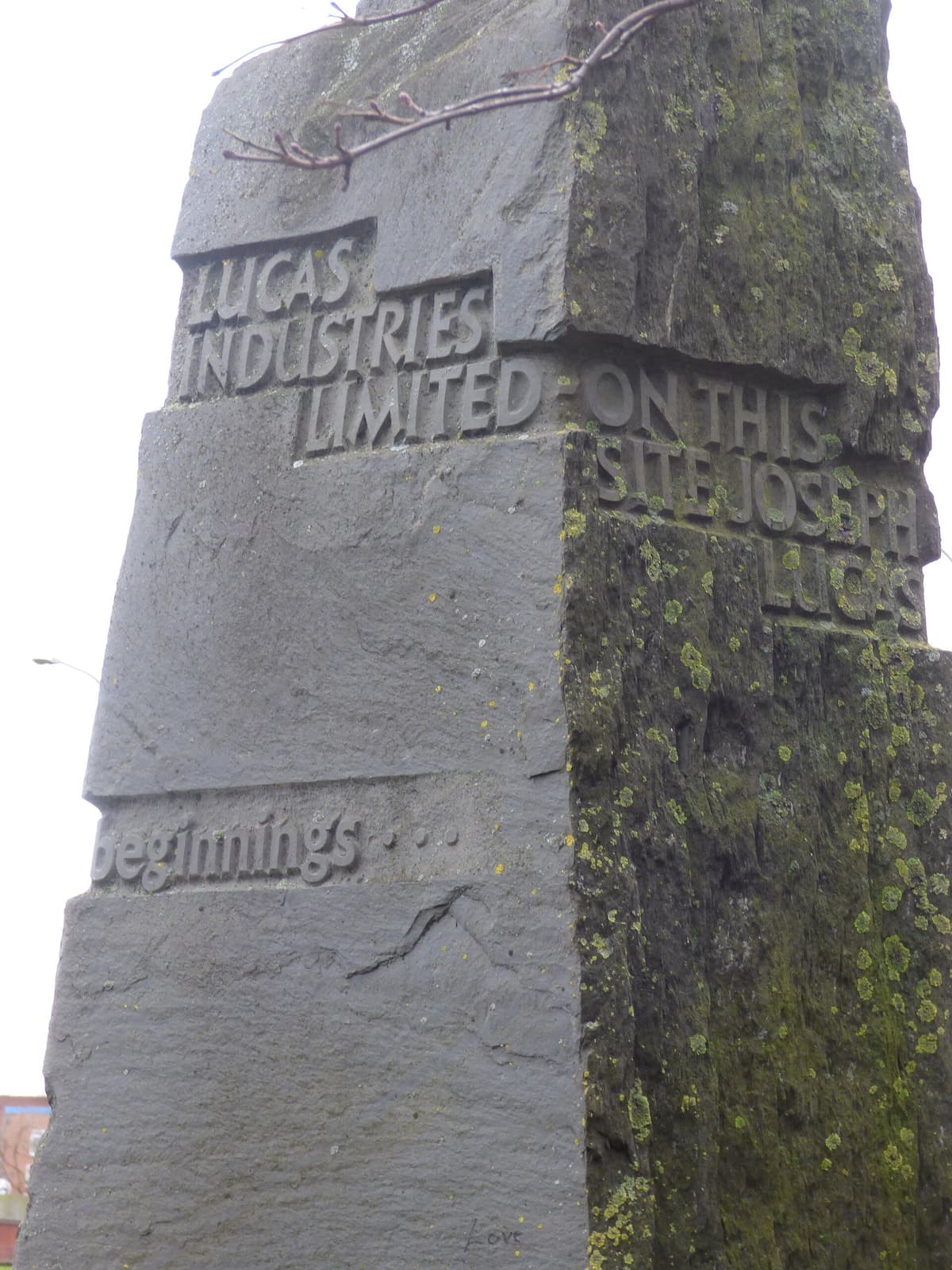
It began with a house and a workshop. In 1869 Joseph Lucas, a dealer in lamps and oils who had started out selling paraffin door to door, moved to 209 Great King Street. From about 1870 the family made domestic tinware there. Soon afterwards Joseph and his son Harry set up the Tom Bowling Lamp Works around the corner in Little King Street, a street that no longer exists. A slate slab laid by Lucas Circus in 1994 dates that first workshop to “c.1872”, and gives its address as 24 Little King Street.
Lamps for ships and bicycles
The works took its name from the Tom Bowling ship’s lamp, made for the fishing industry. Then came the bicycle boom, and the “King of the Road” cycle lamp, patented in 1880. Joseph Lucas & Son was formed in 1882. By the 1890s the firm needed a real factory.
Roger Bater, an engineering manager at the works in its last years, dated the first two blocks on Great King Street to 1896 and 1898. They were later known as A and B. The Moseley Society says the family’s old house, at the corner of Great King Street and New John Street, became the nucleus of the new works. In 1897 the business became a public company, Joseph Lucas Ltd, and the money raised paid for a five-storey factory.
From lamps to electrics
The same spot, then and now
1888–1913
Today
Old map: Ordnance Survey six-inch, reproduced with the permission of the National Library of Scotland (CC BY 4.0). Today: © OpenStreetMap contributors.
From 1902 Great King Street turned to the motor trade: car lamps, tyre pumps and jacks, then batteries and dynamos. By 1914 Lucas employed 1,600 people. That year it bought the magneto business of Thomson-Bennett and won a bulk contract to supply Morris. In the First World War the works made shells, fuses and electrical equipment for aircraft and military vehicles.
The site kept growing. Bater records that blocks C to K were up by the late 1920s, M Block was finished in 1929 and GK Block followed in the 1930s. The ends of M and GK Blocks made the famous frontage that faced you from the top of Great King Street. The last phase, in the 1950s, included a proving laboratory for fleet test vehicles. The Moseley Society puts the finished works at some twelve acres.
A vertical factory
Great King Street was a factory stacked on top of itself. Production spread over as many as seven floors, served by huge old lifts. Bater remembered a numbering system in which the basement was floor 1, even where there was no basement, so that M6 meant the ignition distributor shop on the fifth floor above the ground in M Block. M7 was “the holy of holies”, home to the main board. Great King Street was not just a factory. It was the headquarters of Lucas Electrical and the worldwide headquarters of Lucas Industries, which took in CAV diesel, Girling brakes and Lucas Aerospace. Bater says it employed up to 7,000 people.
The end
In the end the strength of the buildings was their weakness. Modern manufacturing wanted single-storey sheds, not seven-floor blocks. In the 1980s a team that included Bater spent over a year working out the true cost of running the site. Ignition production moved to a new purpose-built factory; many wiper lines were sold to Delco; most of the rest closed and the machinery was sold off. Bater called it “rather like a very large garage sale”. By 1988 nearly a million square feet stood empty.
The demolition men thought they would need six months. The blocks were so strongly built that it took much longer. Photographs of the demolition posted to the Birmingham History Forum were taken in March 1994.
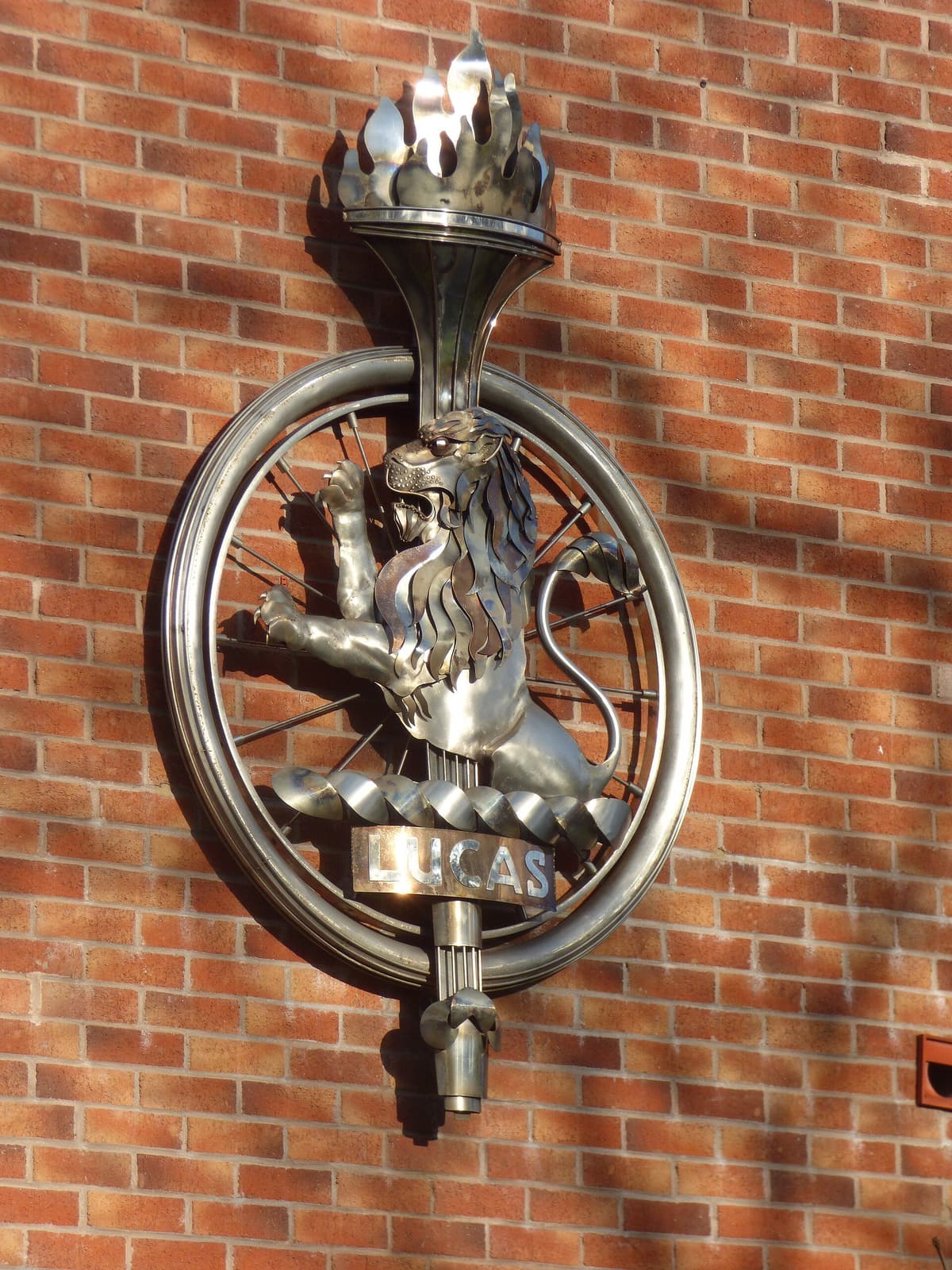
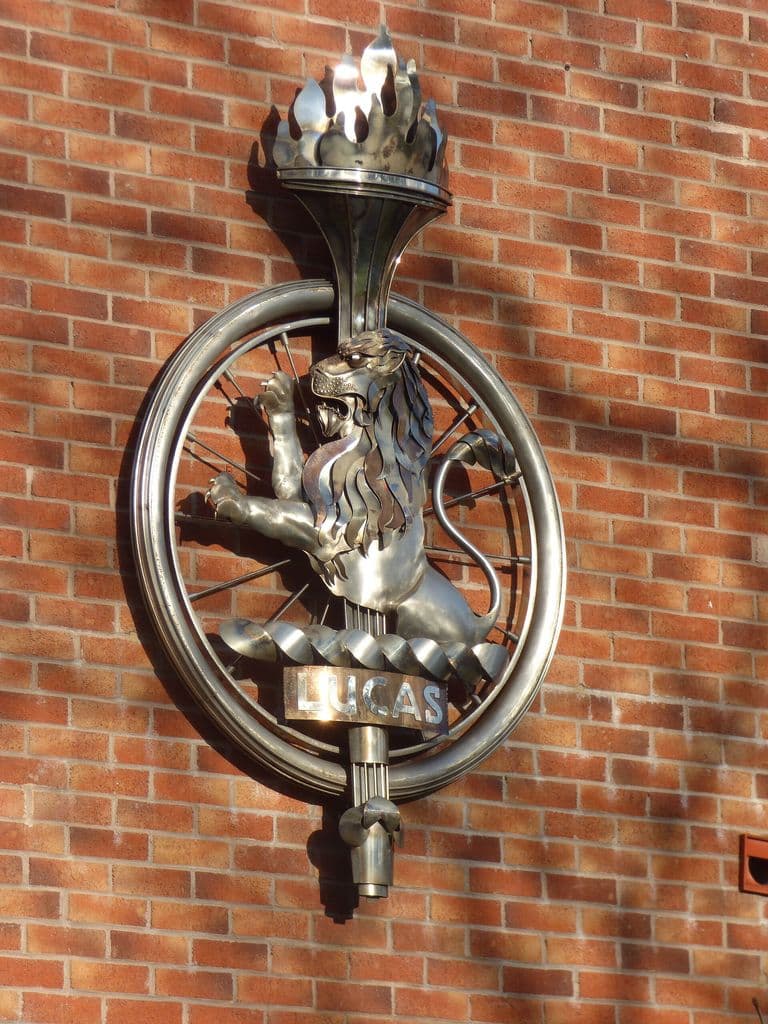
That year Lucas laid a slate monument by the roundabout, with a roundel carrying the old address of Joseph Lucas & Son. In November 1998 a stainless-steel Lucas lion, wheel and flambeau, made by John McKenna, was unveiled on the end wall of a new house in Wheeler Street. Around it, homes now stand where the blocks once rose, and the roundabout is called Lucas Circus. The words on the monument say it all: “From small beginnings”.
What happened here?
Joseph and Harry Lucas made ship’s lamps and the “King of the Road” bicycle lamp here from the 1870s. From the 1890s the works grew into a multi-storey complex making car lamps, magnetos, dynamos, starter motors, wipers and ignition equipment, and became the headquarters of Lucas Industries, employing up to 7,000 people.
Why it mattered
Great King Street was the birthplace and the headquarters of the firm that dominated British motor electrics for most of the twentieth century, supplying Morris, Austin and almost every British car maker. Its story runs from one man’s paraffin round to an international group, and its closure in the 1980s was part of the end of Birmingham’s great motor-industry era.
Why it disappeared
Industrial decline · Redevelopment
The multi-storey blocks could not be adapted to modern single-storey production. Lucas moved ignition work to a new factory, sold or closed the rest, and by 1988 nearly a million square feet were empty. The buildings were demolished in the early 1990s and the site was redeveloped for housing.
What’s there now
What replaced it
Housing built from the 1990s, New John Street Park, and the Lucas Circus roundabout where New John Street West meets Great King Street North.
What survives
None of the factory blocks. The 1994 slate monument by Lucas Circus (on Birmingham’s local list, Grade C) and the 1998 stainless-steel Lucas emblem on a house in Wheeler Street. The street names Great King Street and New John Street survive; Little King Street does not.
Today
Stand on the footway by Lucas Circus, where Great King Street North meets New John Street West. The slate monument, set in a circle of block paving, faces the roundabout; the factory lay to the north of it. A short walk north-east, on the end wall of a house in Wheeler Street near an entrance to New John Street Park, is the shining Lucas lion, wheel and flambeau.
Then and now
Then · Photographed 23 January 2018
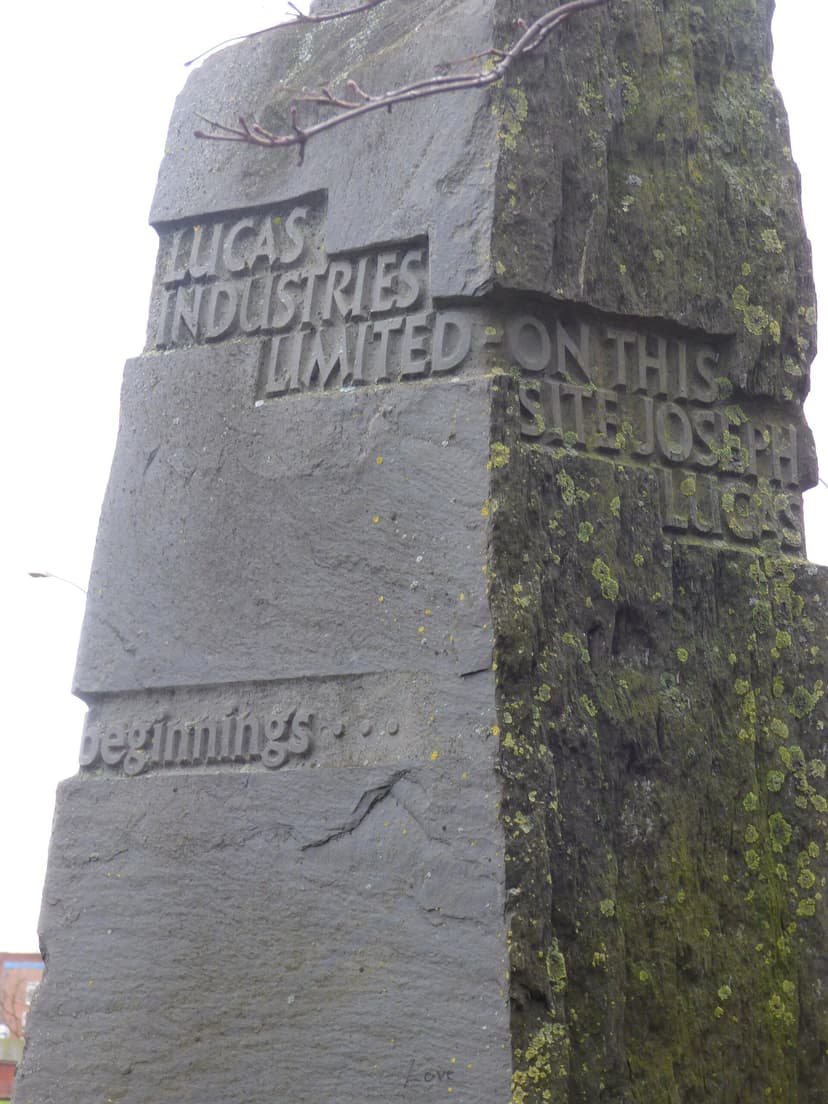
Now · Photographed 23 January 2018
Today
Lucas lion, wheel and flambeau emblem, Wheeler Street, Photographed 10 January 2018Photographed 10 January 2018. Elliott Brown via Flickr and Wikimedia Commons · CC BY-SA 2.0
Key dates
- 1860 — Joseph Lucas starts in businessJoseph Lucas begins trading on his own account, selling paraffin, buckets, shovels and other hollow-ware door to door. By 1869 he is listed as a dealer in lamps and oils at 209 Great King Street.
- c. 1872–75 — Tom Bowling Lamp Works, Little King StreetJoseph Lucas and his son Harry set up the Tom Bowling Lamp Works in Little King Street, Hockley, named after their ship’s lamp for the fishing industry. The 1994 monument dates the first workshop to c.1872.
- 1880 — Lucas patents the King of the Road lampJoseph Lucas is granted a patent for his lamp. The “King of the Road” bicycle lamp makes the firm’s name, and its first consignment goes to the United States in 1881.
- 12 November 1897 — Joseph Lucas Ltd registeredJoseph Lucas Ltd is registered as a public company with a nominal capital of £225,000 to take over Joseph Lucas & Son. The money pays for a five-storey factory on Great King Street.
- 1914 — Lucas buys Thomson-Bennett and wins the Morris contractJoseph Lucas Ltd pays £9,000 for the magneto maker Thomson-Bennett, the purchase Grace’s Guide sees as the root of its dominance in motor electrics, and wins a bulk contract to supply Morris.
- 1926 — Lucas wins the Austin contractLucas buys its two largest competitors, C. A. Vandervell and Rotax, and wins the contract for all of Austin’s starting, lighting and ignition equipment for the following year.
- c. by 1988 — Lucas Great King Street emptiedLucas moves ignition work to a new factory and sells or closes the rest. Nearly a million square feet at Great King Street stand empty; the blocks are demolished in the early 1990s.
Sources and further reading
Closure and demolition dates: Roger Bater’s account says the site was empty by 1988; a Birmingham History Forum member’s photographs of the demolition are dated March 1994; a Flickr caption on Wikimedia Commons says Lucas was in the area until 1996, which may refer to other Lucas premises nearby. No newspaper or planning record has yet been checked.
First workshop: the 1994 monument says Joseph Lucas established his first workshop on this site “c.1872”; Grace’s Guide (from the Oxford DNB) puts the Tom Bowling works in Little King Street by about 1875 and Joseph at 209 Great King Street from 1869.
Extent: “some twelve acres” is the Moseley Society’s figure; the site plan reproduced by Bater has not been measured.
The 1998 emblem: the maker (John McKenna) and date come from a photographer’s caption on Wikimedia Commons, not from an authoritative record.
No historic Ordnance Survey map has yet been used to plot the blocks.
- The Final Years of Lucas Great King Street — Roger Bater, Triple C (reproduced with permission)
- Joseph, Harry and Oliver Lucas — Fred Price (Moseley Society, Some Moseley Personalities), Moseley Society
- Joseph Lucas — Grace’s Guide to British Industrial History
- Joseph Lucas (1834–1902) — Grace’s Guide to British Industrial History
- Monument to Lucas Factory (PMSA record WMbiBIxx238) — Public Monuments and Sculpture Association, National Recording Project
- Locally listed buildings (spreadsheet) — Birmingham City Council, Birmingham City Council
- Lucas Great King Street demolition (forum thread) — Birmingham History Forum, 2008
- Lucas’ Lion, Wheel, and Flambeau emblem – Wheeler Street, Newtown (photograph and caption) — Elliott Brown, via Wikimedia Commons, 2018
Comments
Comments will load here.