
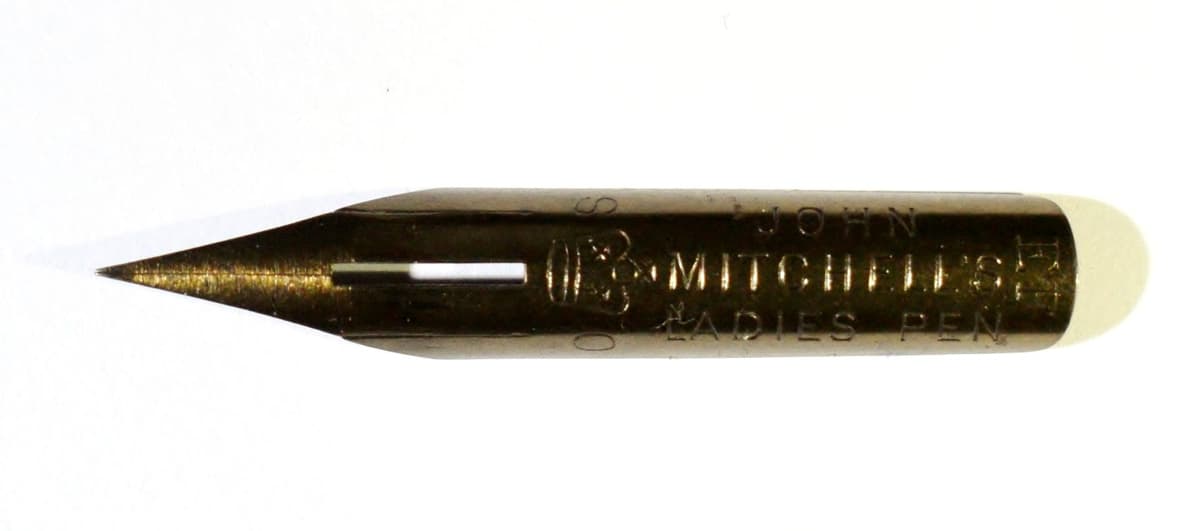
In January 1872 Birmingham buried Joseph Gillott, and a local paper declared that the steel pen owed its existence to him. One reader could not let it pass. On 12 January Henry Mitchell wrote to the Daily Post that it was “due to the memory of my late father – John Mitchell – that I should state that he not only made steel pens, but used machinery in their production, for some time before Mr. Gillott commenced in that branch of business.”
Four years later he wrote again, more bluntly. His father, he told Aris’s Gazette in October 1876, was “the first to introduce the making of steel pens by means of tools, which were purely his own invention”, and “the date of the invention I believe to be 1822 or thereabouts.” As far as the record shows, nobody wrote in to contradict him.
A family from Sheffield
John Mitchell was born in Sheffield, probably in 1798, and set up as a pen maker at 36 Newhall Street, which runs up into what is now the Jewellery Quarter. By 1835 he had moved to larger premises at 48 Newhall Street. Pen making was a family business. His brother William worked with him before starting on his own in 1824. In 1823 their sister Maria married another Sheffield man, a cutler named Joseph Gillott. The 1841 census lists John as a steel pen maker in the St Paul’s district; by 1851 he was living in Edgbaston, and his son Henry was a pen maker too.
A pen that cost twopence
Before the steel nib, writing meant a goose quill and a penknife. Steel pens existed, but as curiosities. Mason said that the split-ring maker Samuel Harrison made some for Joseph Priestley around 1780, from sheet steel rolled into a tube and filed to a point. At Sedgley, in the Black Country, a smith called Fellows and his apprentice Thomas Sheldon made pens by hand, which Birmingham stationers sold. In 1823 Henry Manton watched steel and silver pens being made in a workshop behind Suffolk Street, Birmingham, with hammer, draw-plate, watch-spring saw, shears and file. Each one, he remembered, cost a journeyman about twopence to make.
Press, die and slit
Frederick Parkes, 15, worked the vitriol “pickle” used to clean the steel: “The pickle burns my clothes and fetches holes in the bottoms of my shoes.”
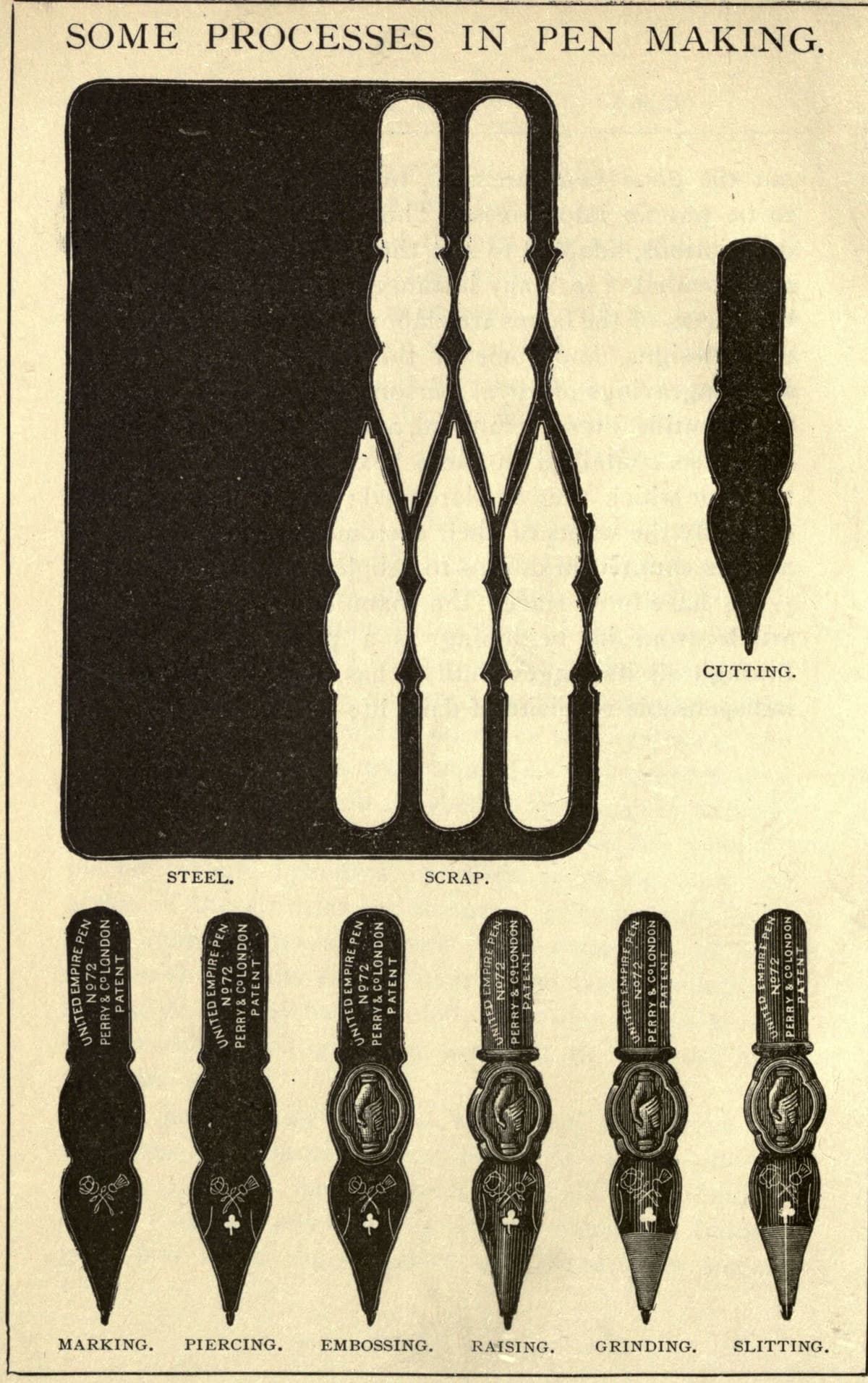
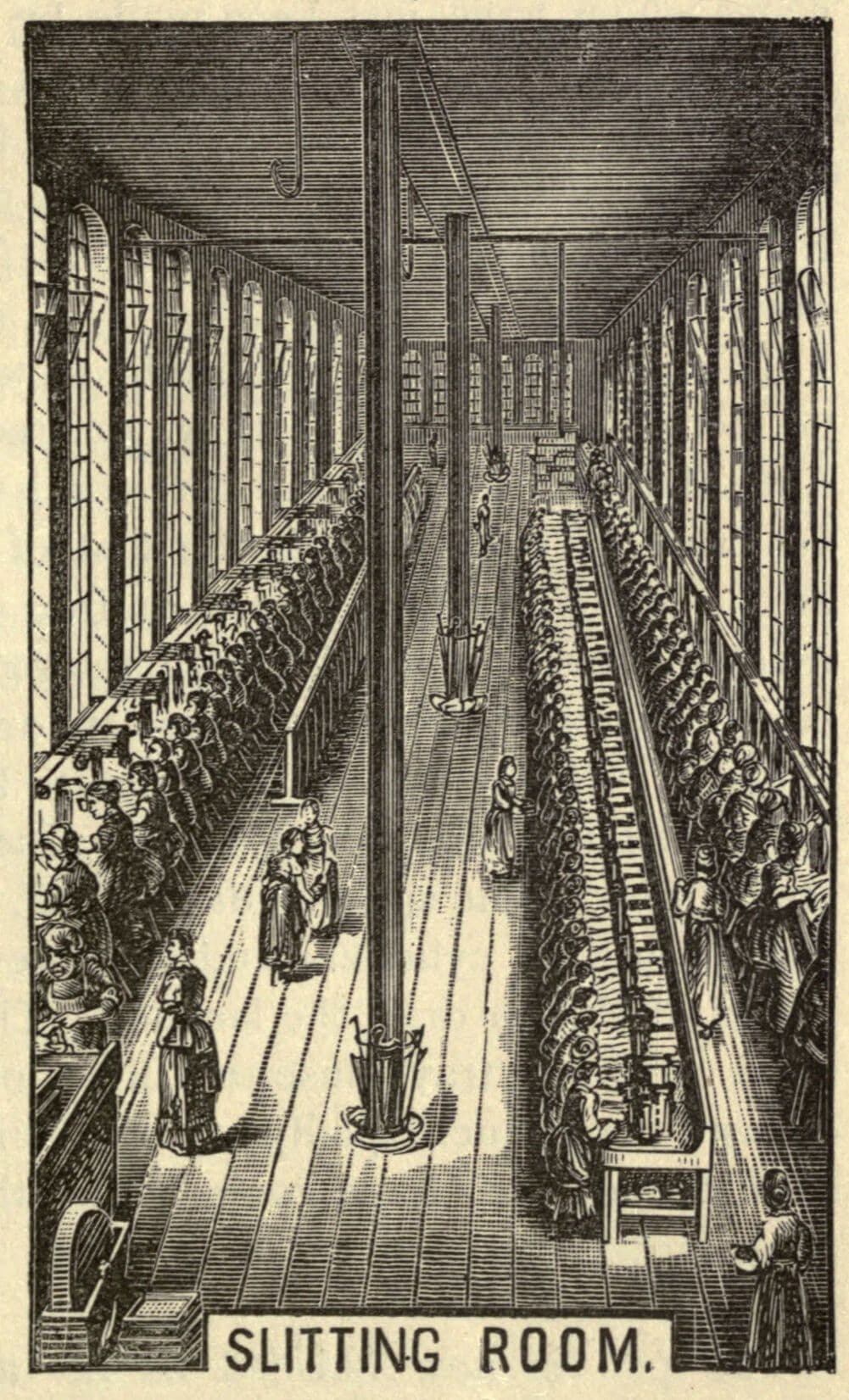
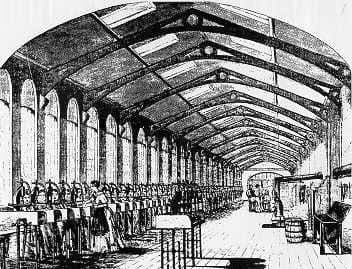
Birmingham already had the answer in its button and toy workshops: the hand press and the die. A machine-made pen began as a strip of rolled steel. Presses cut out the blank, pierced it, marked it and raised it into a curve; it was hardened, tempered, ground and finally slit. One factory’s costing form of the 1860s listed thirteen separate stages. The slit was the hard part. Cut in a press it was clean and regular; cracked with a hammer, the old way, it was, in Bunce’s words, “uncertain”.
Exactly what Mitchell built first is not recorded. But the early witnesses point his way. A report on the Vienna Exhibition of 1873, quoted by the pen historian Henry Bore, said the brothers John and William Mitchell made steel pens “wholesale and by machinery”, and that Gillott “had learnt the business with the Mitchells.” William Levesley, a Sheffield cutler who had known Gillott as a young man, told the Birmingham writer Sam Timmins that “Mitchell had the secret of pen making” and had sent for Gillott to come to Birmingham. Sheldon of Sedgley, one correspondent said, carried on until his trade “was destroyed through inability to compete with the machine-made pens of Mitchell and Gillott.” Both names appear as pen makers in Wrightson’s Birmingham directory for 1830.
Who invented the steel pen?
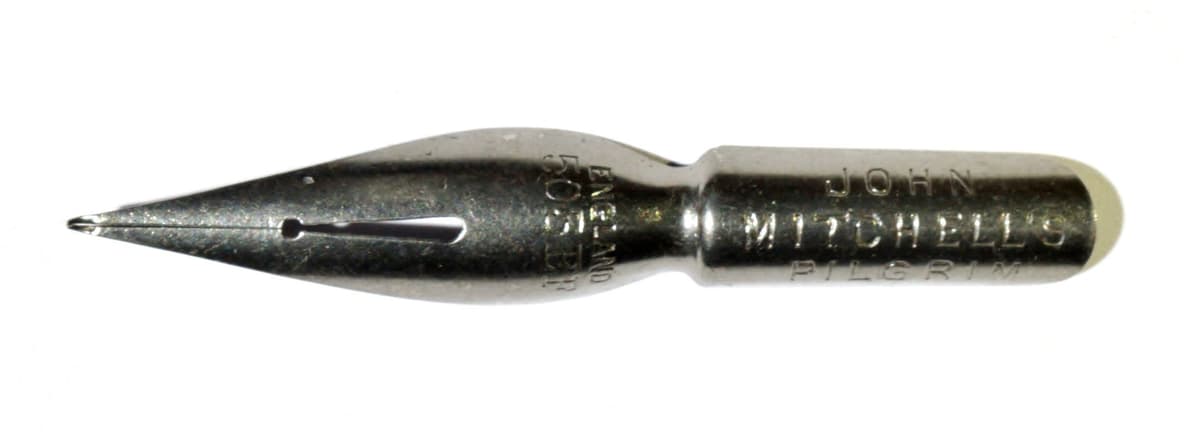
There is no single answer, and the argument is older than anyone now living. Each man was first at something different. Harrison made steel pens for Priestley. A maker named Wise sold “perpetual pens” in the stationers’ shops early in the century, and an encyclopaedia of 1837 remembered him as “the original inventor”. James Perry made pens in Manchester from 1819 and London from 1824, patented an improvement in 1830, and did more than anyone to persuade the public to try them. Josiah Mason made Perry’s pens from about 1829, and insisted that Perry himself “certainly never made a pen as they are now made, viz., the slit cut with press tools.” Gillott began in 1824, according to the Victoria County History, and turned the machine-made pen into a mass product.
Bore, writing in 1890, weighed the claims and concluded that “the evidence is in favor of Mitchell” for machine-making, while “the merit of having popularized the article is due to Perry.” But Bore’s book was partly a history of Perry & Co., the firm that had absorbed Mason’s works. Mason’s biographer, J. T. Bunce, gave the press-cut slit to “Mr. Mitchell, Mr. Gillott, and Mr. Mason”, adding that “the first named had slightly the priority in date.” The Victoria County History names Gillott and Mason as the great rivals, with the Mitchells as the third force, and puts it most safely: “the successful processes were all devised in Birmingham.”
Why did Mitchell fade from view? Like Mason, he probably began by making for dealers, whose names the public knew better than his. And his son’s claims came half a century after the event, when Gillott’s name was known across the world.
The pen shop of the world
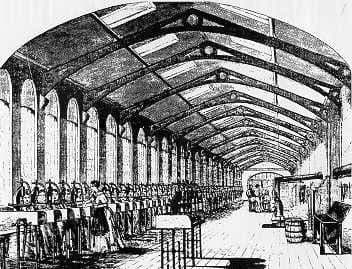
Whoever came first, the machine did the work. In 1849, Sam Timmins reported, Birmingham had 12 pen factories employing 300 men and boys and 1,550 women and girls, making 65,000 gross of pens a week. By 1865 the same number of firms employed 360 men and boys and 2,050 women and girls, and made 98,000 gross. Pens that had sold wholesale at 5s. a gross in the 1830s now sold for as little as 1½d. Most of the steel came from Sheffield; everything else was done in Birmingham, which Timmins called “the ‘pen shop’ of the world.” France built pen factories behind protective tariffs, and America started its own during the Civil War. By 1889, Bore counted 13 Birmingham firms using about 24 tons of steel a week.
In the cellars
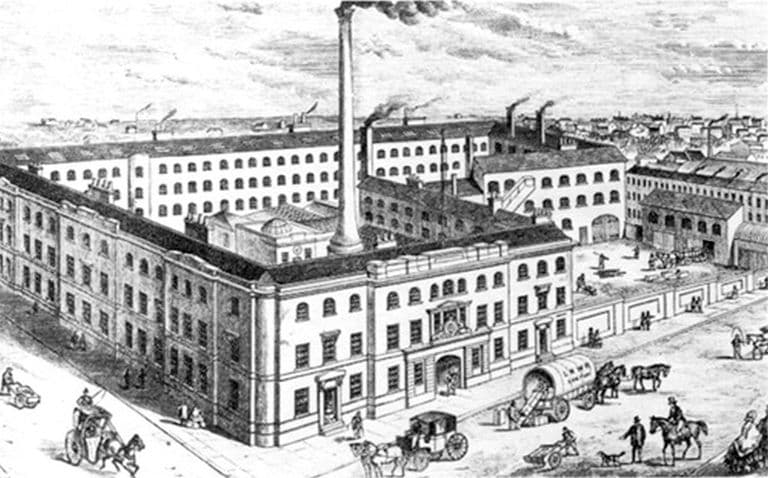
Timmins thought conditions in the pen works “very satisfactory”, with large and lofty rooms. Not everywhere. In the early 1860s J. E. White of the Children’s Employment Commission visited John Mitchell’s works in Newhall Street. He found old buildings, “unusually gloomy”, and two places where boys worked that were “mere vaults or cellars unfit for human occupation.” Frederick Parkes, 15, worked the vitriol “pickle” used to clean the steel: “The pickle burns my clothes and fetches holes in the bottoms of my shoes.” At William Mitchell’s works in Cumberland Street, White found the lacquering shop “oppressively hot”, and an infant sitting with its mother as she worked at a grinding wheel.
After John
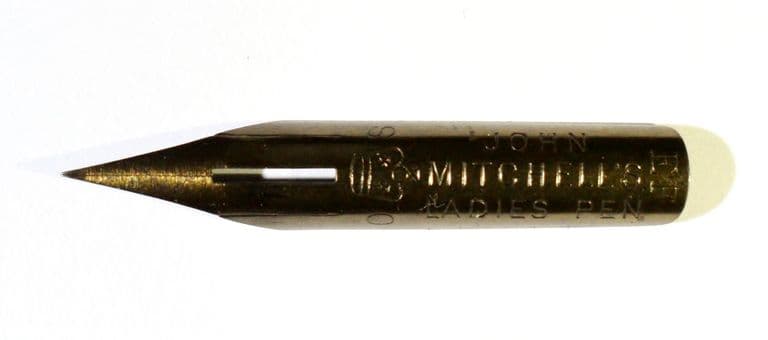
John Mitchell died before January 1872. His firm moved in 1908 to the Newhall Works in Moland Street, near today’s Aston University. Its pens, among them the “plumes ballon”, sold widely in France and Belgium. The works was damaged in an air raid in April 1941, and in 1947 the business was sold to Esterbrook Hazell Pens. William Mitchell’s firm moved from St Paul’s Square to Cumberland Street, off Broad Street, in 1852, and in 1920 joined Hinks, Wells & Co. to form British Pens. Even Mason’s works had a Mitchell connection: his nephew Isaac Smith, who revived it in the 1850s, had learned his trade as the slitting-tool maker at William Mitchell’s.
Why it mattered
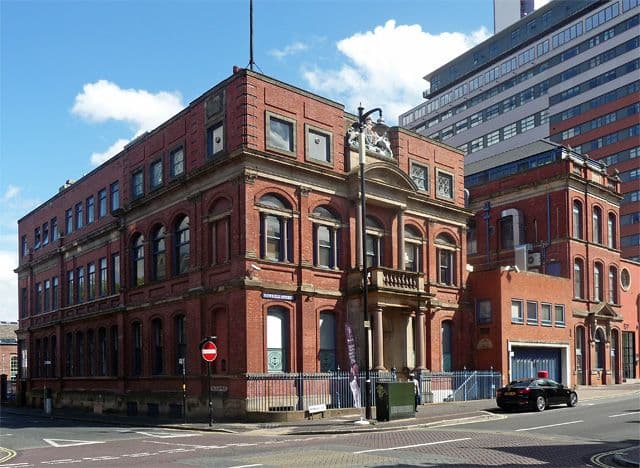
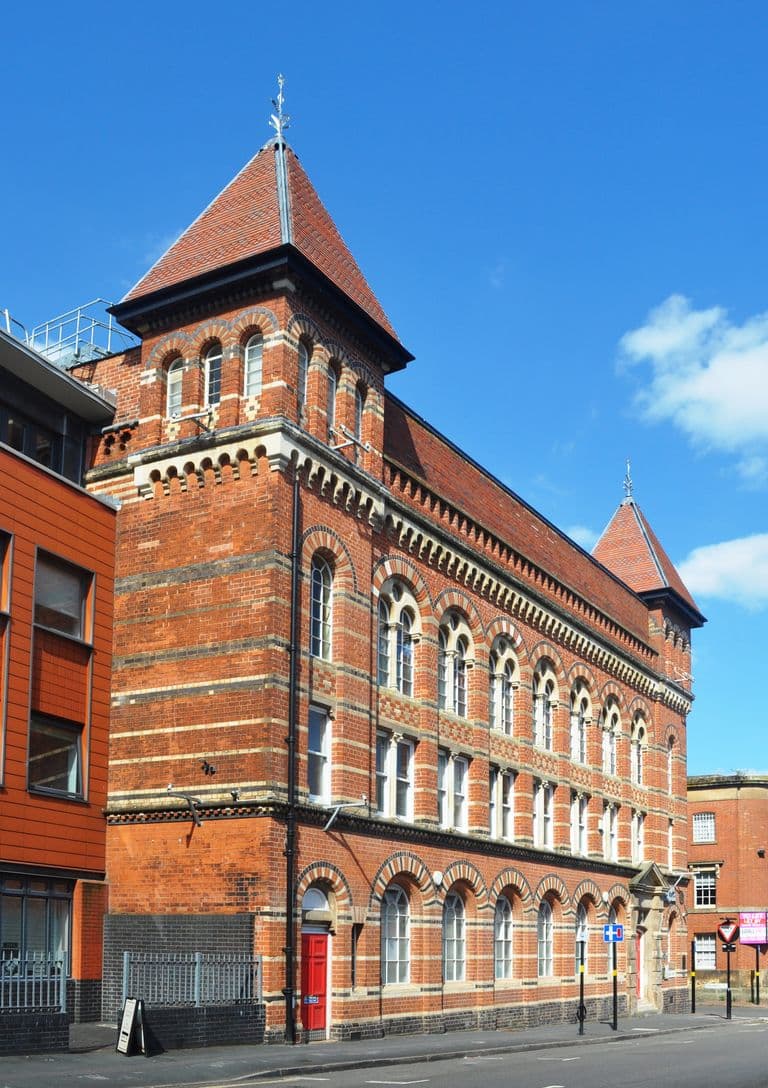
John Mitchell left no portrait, no listed building and no plaque. His works are gone, and his name survives mostly on nibs in collectors’ boxes. But the idea most closely tied to him, that a pen could be stamped, pierced, shaped and slit by press tools instead of filed by hand, is the idea that turned the steel pen from a twopenny curiosity into something sold by the gross for pennies. Whether he was first by a year or two, or one of three or four men reaching the same answer in the same few streets, the Mitchells were there at the beginning. They trained skilled hands, by several accounts they taught the business to Gillott, and they helped make the Jewellery Quarter the place where the world’s pens came from. Walk from Newhall Street up to Graham Street and Frederick Street, past Victoria Works and the Pen Museum, and you cover almost the whole story in ten minutes.
On the map
3 places connected with John Mitchell. Tap a number for directions — some sites are private homes or gardens, so each place’s page says what you can see from the street.

- The Jewellery Quarter — Surviving, Surviving but altered
- Pen Museum, Argent Centre — Surviving · Directions to Pen Museum, Argent Centre (opens Google Maps)
- Victoria Works, Graham Street — Surviving, Surviving but altered · Directions to Victoria Works, Graham Street (opens Google Maps)
Key dates
- c. about 1822 — John Mitchell makes steel pens with press toolsAccording to his son, John Mitchell of Newhall Street began making steel pens with press tools of his own design in about 1822, replacing hand filing. It is the earliest claim for machine-made pens in Birmingham, though Gillott, Mason and Perry all have rival claims.
Sources and further reading
Dates: no birth or death record has been checked. Grace’s Guide gives a Sheffield birth in 1798, apparently from census ages. His son called him “my late father” in January 1872, so he had died by then.
Priority: the claim that Mitchell first made pens by press tools in about 1822 rests mainly on his son Henry’s letters of 1872 and 1876, printed by Henry Bore (1890), and on later accounts that repeat it. Bore admits it is “ex-parte” but notes that it was never contradicted. Bunce (1882) agrees that Mitchell had “slightly the priority”. The Victoria County History dates Gillott’s start to 1824 and does not rank Mitchell first. Timmins (1866) does not mention Mitchell at all.
Gillott and the Mitchells: the DNB and the existing Gillott record say Gillott married Maria Mitchell in 1823. One Sheffield account printed by Bore says instead that a Mitchell married Gillott’s mother; it is not followed.
Addresses: 36 Newhall Street, then 48 Newhall Street by 1835 (Birmingham Jewellery Quarter website), and 104–8 Newhall Street (Grace’s Guide); Victorian street numbers changed, so these are not mapped.
Later firm: the royal warrant and exhibition medals claimed for John Mitchell’s firm, and the story that Mitchell workmen helped Richard Esterbrook start pen making in the United States, rest on secondary or lead-only sources and are not used.
- The Story of the Invention of Steel Pens, with a Description of the Manufacturing Process by which they are Produced — Henry Bore, Ivison, Blakeman & Co., New York / Perry & Co., London, 1890
- Josiah Mason: a biography — John Thackray Bunce, Simpkin, Marshall & Co.; Cornish Brothers, Birmingham, 1882. ch. 3
- Economic and Social History: Industry and Trade, 1500–1880, in A History of the County of Warwick, vol. 7, pp. 81–139 — W. B. Stephens (ed.), Victoria County History, 1964. pen trade
- The Birmingham Steel Pen Trade, in The Resources, Products and Industrial History of Birmingham and the Midland Hardware District, pp. 633–637 — Samuel Timmins (ed. and author), Robert Hardwicke, London, 1866
- Children’s Employment Commission (1862): Third Report of the Commissioners, evidence of J. E. White on the Birmingham steel pen trade — Children’s Employment Commission, HMSO (command paper), 1864. pp. 86–87 and 90, Mr John Mitchell’s and Mr Wm. Mitchell’s
- John Mitchell — Grace’s Guide, Grace’s Guide to British Industrial History
- John Mitchell (1798– ) — Grace’s Guide, Grace’s Guide to British Industrial History
- More about the pen trade — Birmingham Jewellery Quarter website (jquarter.org.uk)
- Gillott, Joseph — Dictionary of National Biography, vol. 21 — George Clement Boase, Smith, Elder & Co., 1890
Comments
Comments will load here.