
What was here?
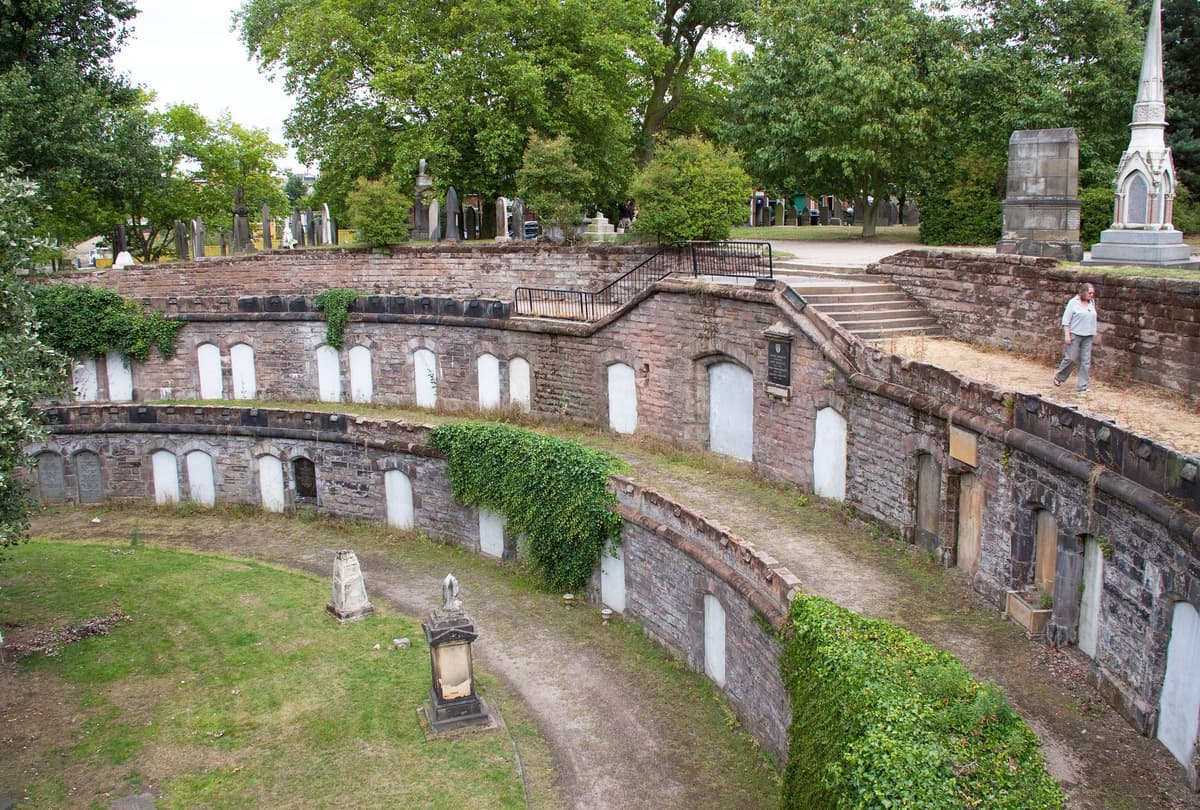
A private Church of England cemetery, laid out in a disused sand pit on Warstone Lane. Its chapel stood at the centre, with terraces of catacombs built into the old quarry faces around it.
History
A cemetery in a sand pit
Birmingham’s Nonconformists opened their General Cemetery on Key Hill in 1836. Anglicans wanted their own. The Church of England Cemetery Company was founded in 1845 and, with the approval of the Bishop of Worcester, bought about seven hectares on Warstone Lane for £9,630. Part of the land was a disused sand quarry. The Quarter’s hills were full of them: the fine sand was used for casting metal.
The company’s architect was James R. Hamilton of the Gloucester firm Hamilton and Medland. The foundation stone of the chapel was laid in April 1847 and the cemetery opened for burials in 1848. The Birmingham nurseryman Richard H. Vertegans may have laid out the grounds.
The catacombs
The cemetery’s great feature is its catacombs: two terraces of rock-faced sandstone vaults built into the sides of the old quarry. They took until 1880 to complete. In a vault here lies the printer John Baskerville, moved in 1898 after a long and strange posthumous journey.
The company had also bought land north of Pitsford Street for expansion, but sold it in 1854 to the Birmingham to Dudley and Wolverhampton Railway, whose line passes under the area in tunnels and cuttings.
The War-Stone
The cemetery and the lane are named after the War-Stone, a large glacial boulder that now sits in the cemetery. A Cross of Sacrifice remembers the dead of the First World War.
Into public hands
The chapel was damaged by bombing in the Second World War and later demolished. In 1952 Birmingham City Council compulsorily bought both Key Hill and Warstone Lane cemeteries, and both closed for burials in 1982. The blue-brick Tudor Gothic lodge on Warstone Lane survives. Warstone Lane was added to the Register of Parks and Gardens at Grade II.
What happened here?
Anglican burials from 1848 to 1982, including many Jewellery Quarter families, in graves and in two tiers of catacombs cut into a former sand quarry.
Why it mattered
Its terraced catacombs, cut into a sand pit that once fed Birmingham’s foundries, show Victorian burial on a grand scale, and its graves record the families who built the Jewellery Quarter.
The same spot, then and now
1888–1913
Today
Old map: Ordnance Survey six-inch, reproduced with the permission of the National Library of Scotland (CC BY 4.0). Today: © OpenStreetMap contributors.
More pictures
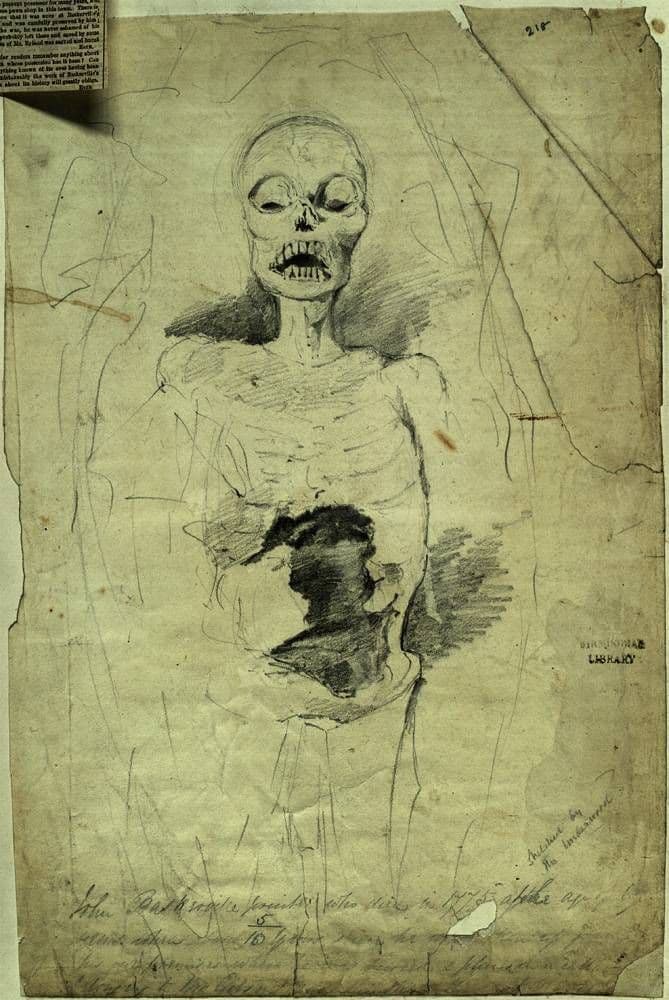
John Baskerville’s body, sketched in 1829Thomas Underwood, 15 August 1829. Library of Birmingham, MS 897 (Pershouse collection of Birmingham illustrations, vol. II) · Public domain
What’s there now
What survives
The layout, the two tiers of catacombs, the lodge on Warstone Lane, the War-Stone, the Cross of Sacrifice and many monuments. The chapel has gone.
Today
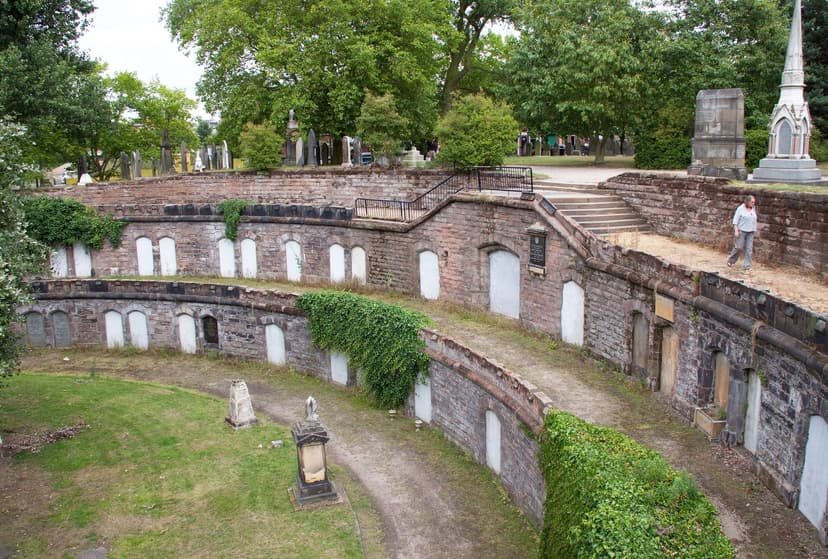
A public open space owned and managed by Birmingham City Council. The catacombs are sealed but can be seen from the paths.
Then and now
Then · 27 July 2011
Now · 27 July 2011
Key dates
- 1848 — Warstone Lane Cemetery opensThe Church of England Cemetery Company opens its burial ground in an old sand quarry on Warstone Lane. Its catacombs are completed in 1880.
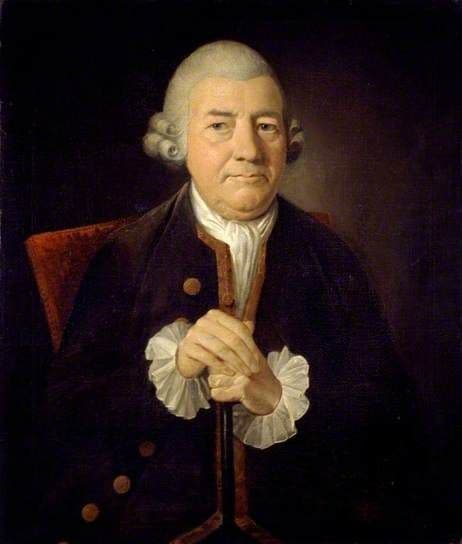
- February 1898 — Baskerville is reburied at Warstone LaneWith Christ Church due for demolition, Baskerville is moved to the catacombs of Warstone Lane Cemetery in the Jewellery Quarter, where he still lies.
Sources and further reading
The chapel’s demolition is dated 1958 by Parks & Gardens UK and 1954 in other summaries. The Parks & Gardens entry, quoting the Register, gives Key Hill’s opening as 1836; the council appraisal says 1835. The register text reads ‘Sir Thomas Cooch’, an error for Gooch. The name ‘Brookfields Cemetery’ is a local alternative not checked. The lodge’s own list entry has not been checked.
- Warstone Lane Cemetery — Register of Parks and Gardens entry 1001545 — Historic England
- Warstone Lane Cemetery — Parks & Gardens UK
- Jewellery Quarter Conservation Area Character Appraisal and Management Plan — Birmingham City Council (Donald Insall Associates), 2002. section 3.2
- Warstone Lane: Birmingham’s hidden catacombs — Burials & Beyond, 2018
Comments
Comments will load here.