
What was here?
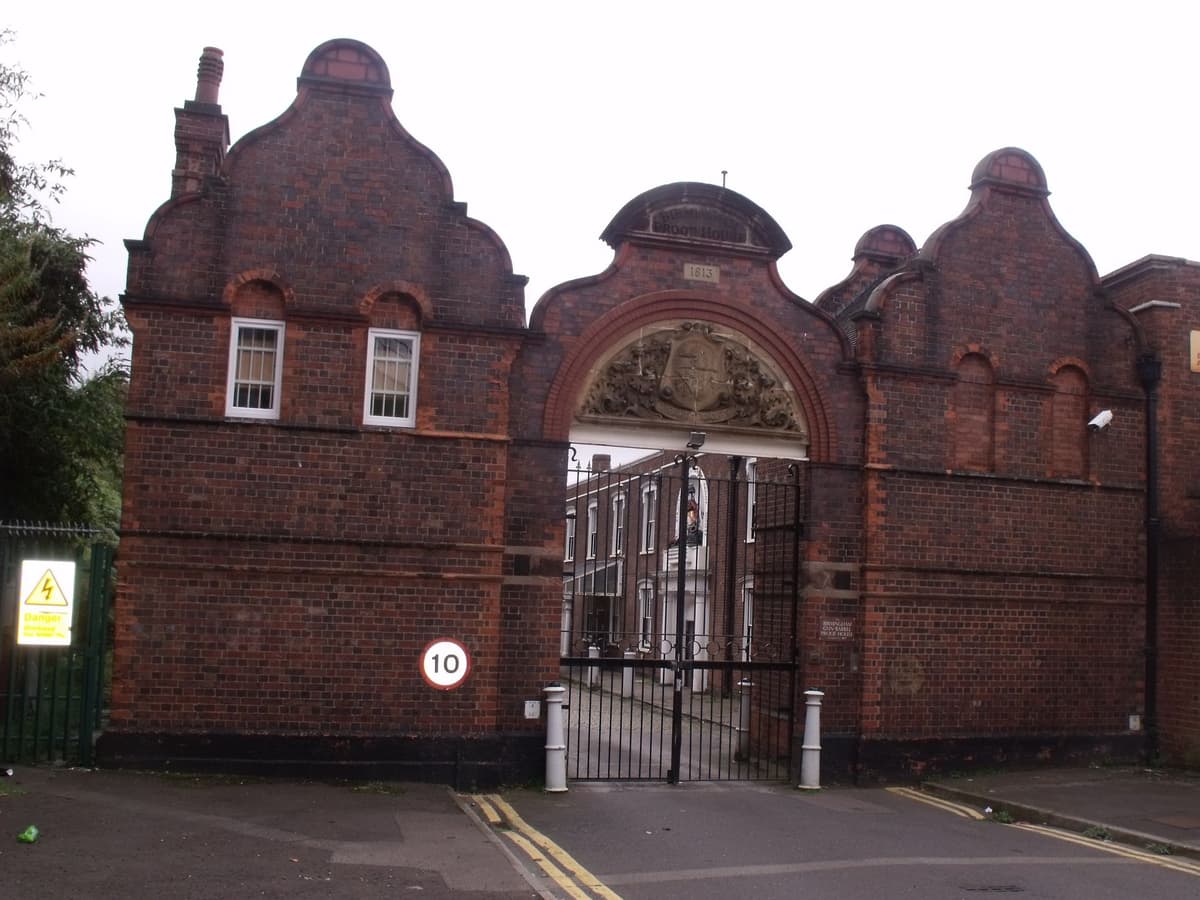
The testing house of the Birmingham gun trade, on Banbury Street beside the Digbeth Branch Canal. Gun barrels and finished guns are loaded with an overcharge, fired, inspected and stamped with a proof mark if they pass. It has done this job since 1813.
History
“Sure to burst”
In May 1766 Lord Shelburne visited Birmingham and wrote down what shocked him most. The town sent more than 150,000 guns a year to the coast of Africa, and above half of them, “from the manner they are finished in, are sure to burst in the first hand that fires them”. His answer was simple. If Parliament ordered “a proof-master to be settled at the expence of the manufacturers themselves”, then “for one shilling more the barrels might be properly bored and finished”.
It took nearly fifty years. Some makers proved their own barrels and those of others. Thomas Ketland is said to have been proving guns for other makers by 1750, and Samuel Galton built a proof house for general use in Weaman Street. But proof was voluntary, and the cheap trade ignored it.
An Act “for public security”
The push came from London. In 1813 the London gunmakers backed a bill to force every maker to mark his weapons with his own name. Birmingham’s makers feared it would hand their trade to their London rivals, who put their own names on Birmingham parts. They came together, opposed the bill, and asked instead for a proof house of their own. The Act of 1813 set up a board of guardians, trustees and wardens and a proof master, and it made proof compulsory. The first proof master was John Bondman.
The building went up in 1813–14 to designs by John Horton of Bradford Street, Deritend. It still carries its message over the door: a tablet reading “ESTABLISHED BY ACT OF PARLIAMENT / FOR PUBLIC SECURITY, ANNO DOM: 1813”. Above is a trophy of arms attributed to the sculptor William Hollins, and the rainwater heads are dated 1813.
The proof hole
The early years were stormy, with rival makers accusing each other of running the house for their own ends. Later Acts, of 1855 and 1868, settled its rules. The building grew with the trade. In 1860 Charles Edge added a new Proof Hole, where barrels are laid on a stone bench grooved to hold them, packed in sand and fired in sequence by a fuse. The walls are lined with thick iron plates, “heavily scarred”, says Historic England’s list entry, and the roof is louvred to let the smoke out.
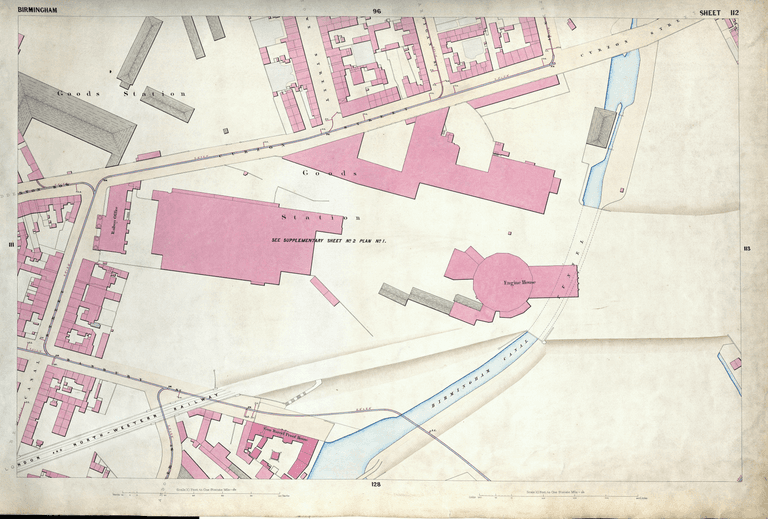
The same spot, then and now
1888–1913
Today
Old map: Ordnance Survey six-inch, reproduced with the permission of the National Library of Scotland (CC BY 4.0). Today: © OpenStreetMap contributors.
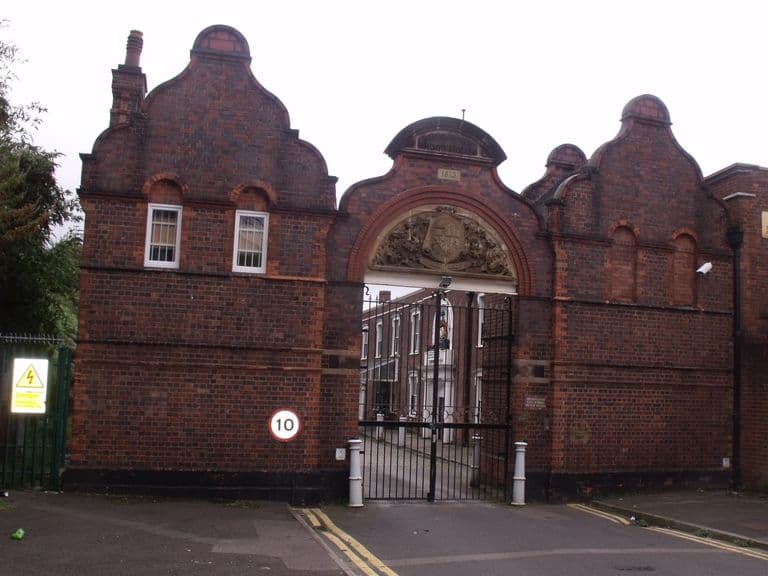
Bateman and Corser enlarged the house in 1868–70 and added a new magazine in 1876. In 1883 Jethro Cossins built the shaped-gabled entrance on Banbury Street. A bomb fell in the yard in 1940 and destroyed one bay of the Proof Hole.
Still firing
The Proof House was the trade’s own creation, and it is still run by a board of guardians. It was first listed in 1970 and is now Grade II*. Historic England describes it as “an obvious, public expression of one of Birmingham’s foremost industries”. Its museum has roots in a collection bought by the guardians in 1873. Over two hundred years after the Act, barrels are still being proved here.
What happened here?
Gun barrels and complete guns from the Birmingham trade were, and still are, inspected, fired with an overcharge in the proof rooms and marked if they passed. From 1813 proof was compulsory.
Why it mattered
It turned a dangerous, unregulated trade into one buyers could trust, and was paid for by the gunmakers themselves. More than two centuries on, its marks still guarantee that a gun is safe to fire.
What’s there now
What survives
The 1813 front range with its Tuscan doorway, the dated tablet, trophy of arms and clock; the Guardians’ board room; the 1860 Proof Hole with its iron-lined walls, shutters and louvred roof; the range of smaller proof rooms; the 1876 magazine; and the 1883 entrance range on Banbury Street.
Today
A working proof house. From Banbury Street you can see the 1883 gateway and, through it, the 1813 front with its trophy of arms. The site sits beside the Digbeth Branch Canal, close to Curzon Street.
Today
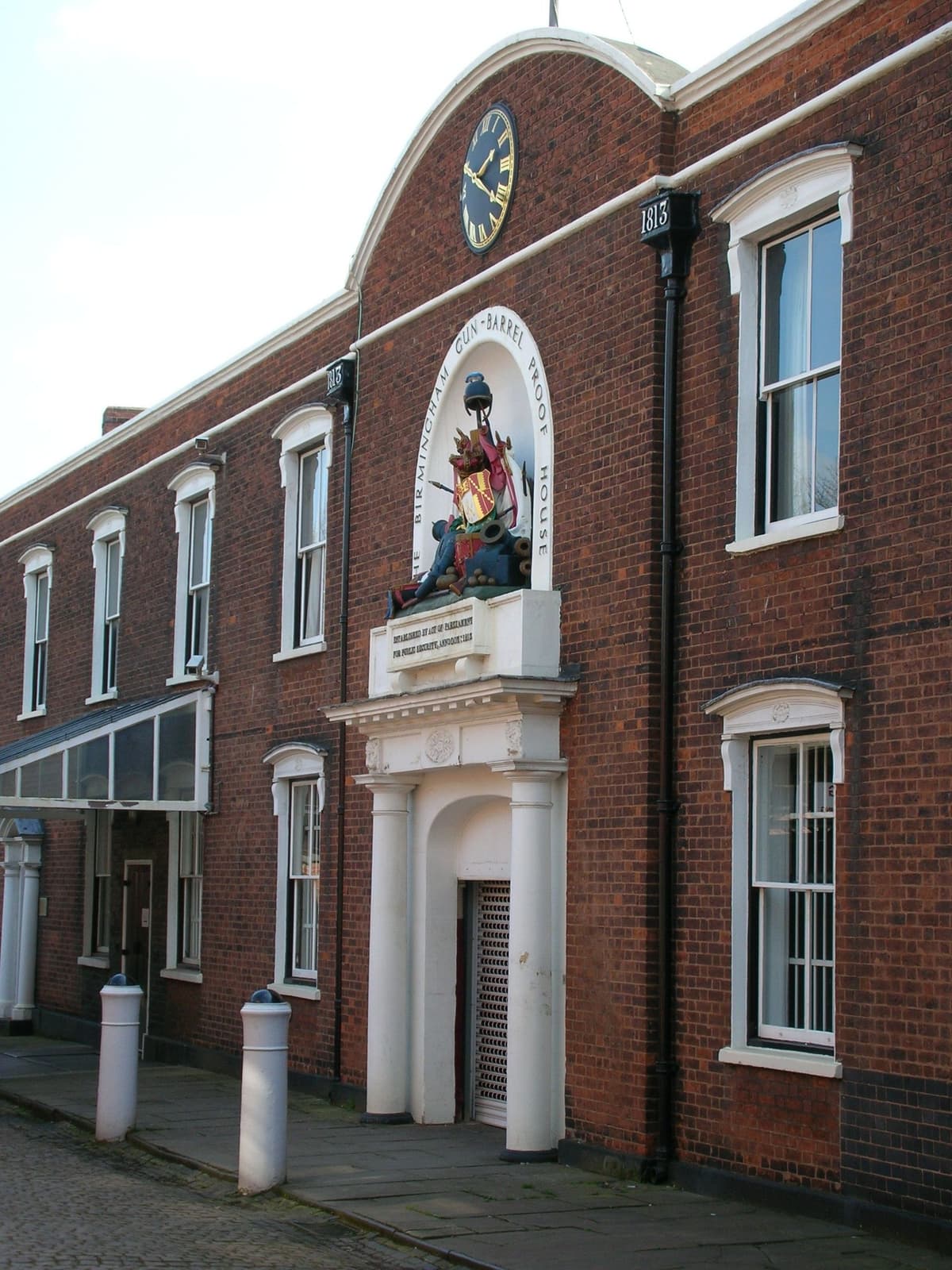
Birmingham Gun Barrel Proof House, 2007Oosoom, 2007. Wikimedia Commons (transferred from English Wikipedia) · CC BY-SA 3.0
Key dates
- 1813 — The Birmingham Proof House is establishedAn Act of Parliament, sought and paid for by the gun trade, makes proof of gun barrels compulsory and sets up guardians and a proof master. The Proof House in Banbury Street is built in 1813–14.
Sources and further reading
Historic England lists the building at Grade II*; some sources (Wikipedia, William Dargue) say Grade II. Wikipedia says it was then one of only two proof houses in England, the other being in London; not checked, so left out of the text. Goodman (1866) says the guardians first named were fifteen gunmakers. The date of Galton’s Weaman Street proof house is given as ‘early in the present century’ by Goodman (1866); the VCH gives no date. The museum’s collection history comes from the Proof House website.
- Birmingham Gun Barrel Proof House — National Heritage List for England entry 1291262 — Historic England
- Economic and Social History: Industry and Trade, 1500–1880, in A History of the County of Warwick, vol. 7, pp. 81–139 — W. B. Stephens (ed.), Victoria County History, 1964. ‘Employers’ Organizations and the Proof House’
- The Resources, Products, and Industrial History of Birmingham and the Midland Hardware District — Samuel Timmins (ed.), Robert Hardwicke, London, 1866. J. D. Goodman, ‘Proving of Barrels’, pp. 398–400
- Life of William, Earl of Shelburne, vol. 1 — Lord Edmond Fitzmaurice, Macmillan, London, 1875. vol. 1, p. 404
- Museum & Pattern Rooms — Birmingham Proof House
- A History of Birmingham Places & Placenames: The Gun Quarter — William Dargue
Comments
Comments will load here.