
In 1826 the most famous shooting writer in England paid a Birmingham gunmaker an outrageous compliment. Colonel Peter Hawker told his readers that Mr Westley Richards, of Birmingham, was considered by some of the best sportsmen to be “Joe Manton the second”. Joseph Manton was the London gunmaker every gentleman wanted. Hawker went further. “Mr. Richards is really a scientific man,” he wrote, “instead of having more tongue than brains, like many of our gunmaking charlatans.”
That was not how people usually talked about Birmingham guns. Sixty years earlier Lord Shelburne had been told that half the cheap guns the town sent to Africa would burst “in the first hand that fires them”. William Westley Richards spent his working life showing that a Birmingham name could stand for the opposite.
A toyshop on the High Street
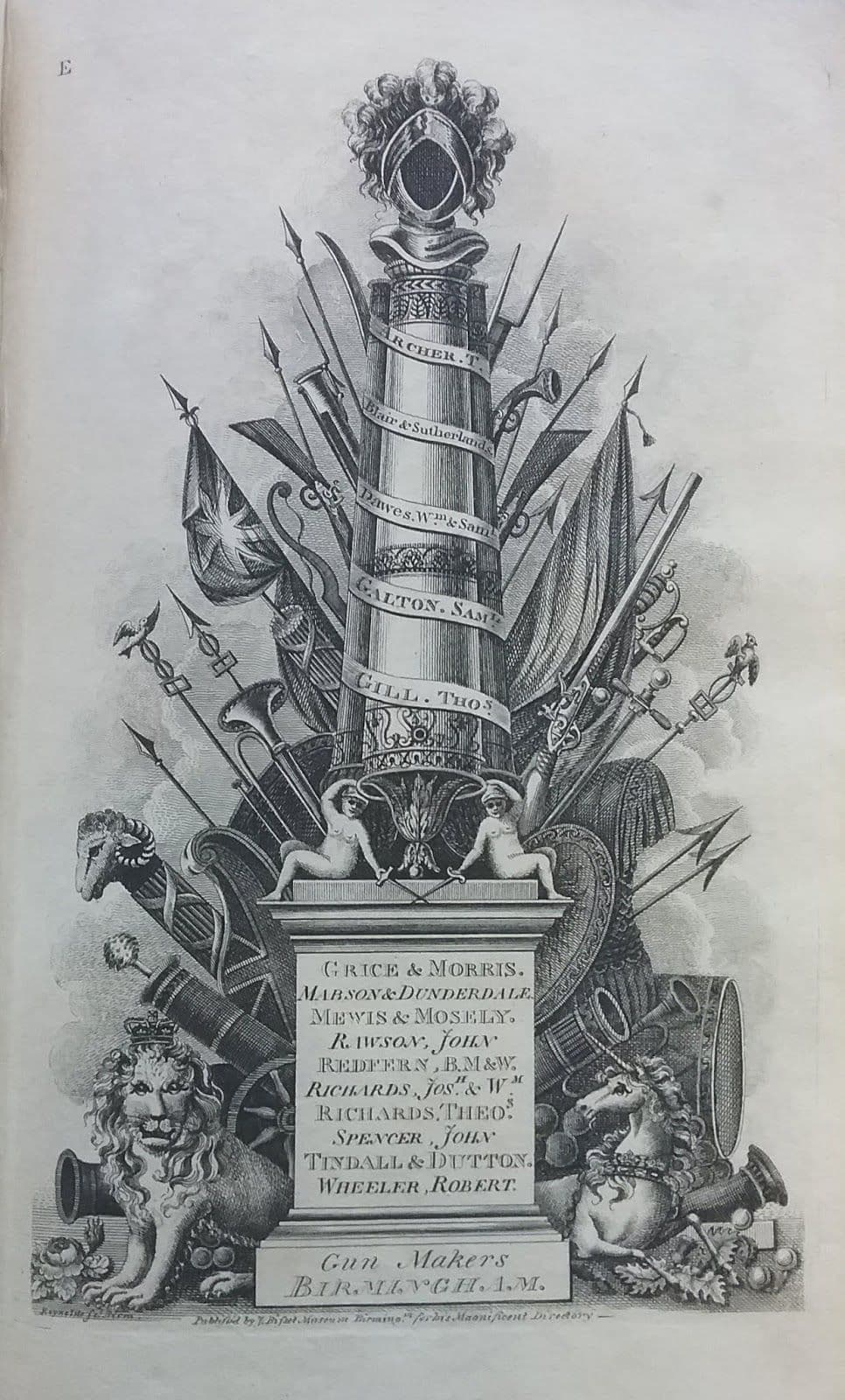
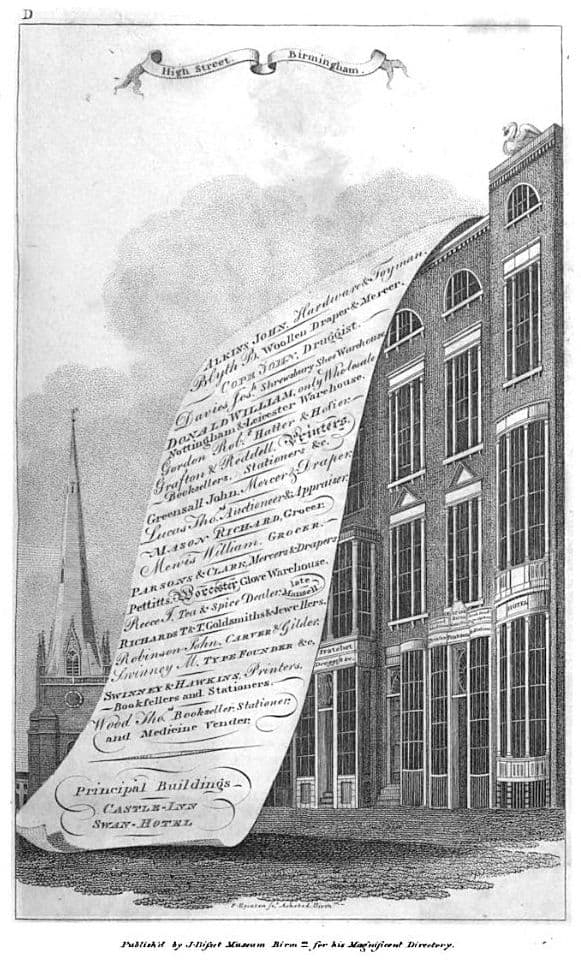
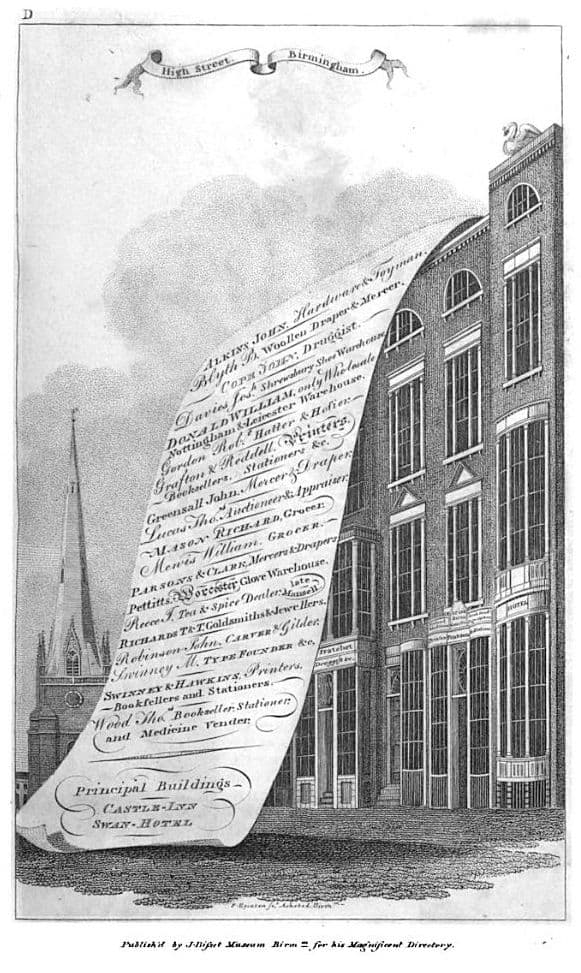
He was born in Birmingham in 1788 or 1789, into a family that already lived by metal. The firm’s own history describes his relatives as silversmiths, jewellers, cutlers and gunmakers, and his father, Theophilus Richards, is listed among the town’s gun makers in James Bisset’s illustrated directory of 1800. In 1812, aged about twenty-two, William set up in business at 82 High Street, where, according to Grace’s Guide, his father and grandfather had kept a toyshop. In Georgian Birmingham a “toy” was a small, fashionable metal object, a buckle or a snuff box or a seal, not a plaything.
High Street was the old commercial spine of the town, running down towards the Bull Ring. It was a street for customers. The guns themselves were made somewhere else.
A trade of many hands
Nobody in Birmingham made a whole gun. The trade was split into dozens of specialisms: barrel makers and lock makers, stockers, screwers, polishers, engravers and the “setters-up” who put the parts together. By the early 1800s the town directories listed fifty-one separate gun trades. Barrels were mostly forged outside the Gun Quarter, in Aston, Deritend, Smethwick and West Bromwich, and locks in the Black Country. The finishing was done in the crowded houses and backyard workshops north of Steelhouse Lane, with boys carrying half-finished guns from one workman to the next.
When Hawker wrote to ask how barrels were proved, Richards replied: “The barrels at our proof-house are proved singly or together, as the parties desire. I prove mine singly, as this is a greater trial to a barrel.”
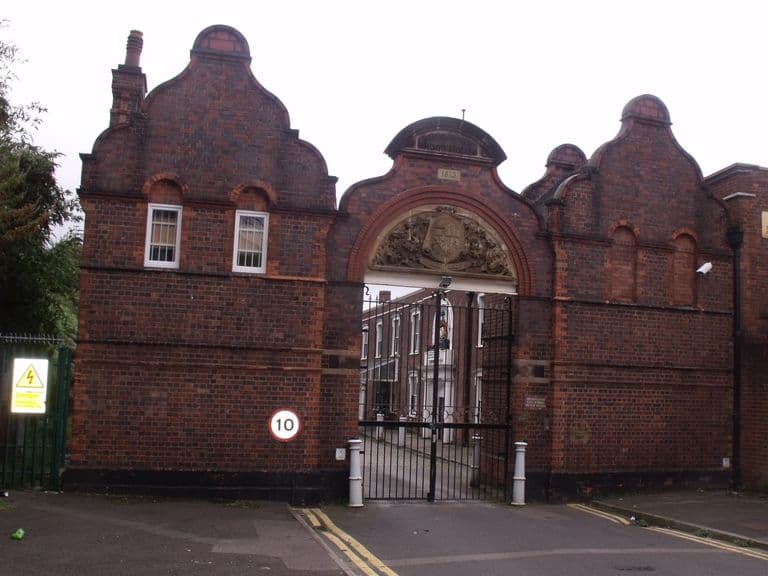
A Birmingham “gunmaker” was usually the master who ordered the parts, judged the quality, and put his name on the result. That made trust the whole business. In 1813 the trade asked Parliament for a proof house of its own, where barrels would be tested before they could be sold. The firm’s history says Theophilus Richards was among the petitioners, and the Proof House in Banbury Street opened in 1813–14.
William used it hard. When Hawker wrote to ask how barrels were proved, Richards replied: “The barrels at our proof-house are proved singly or together, as the parties desire. I prove mine singly, as this is a greater trial to a barrel.” It was a small boast with a big meaning: a maker choosing the tougher test.
The Bond Street window
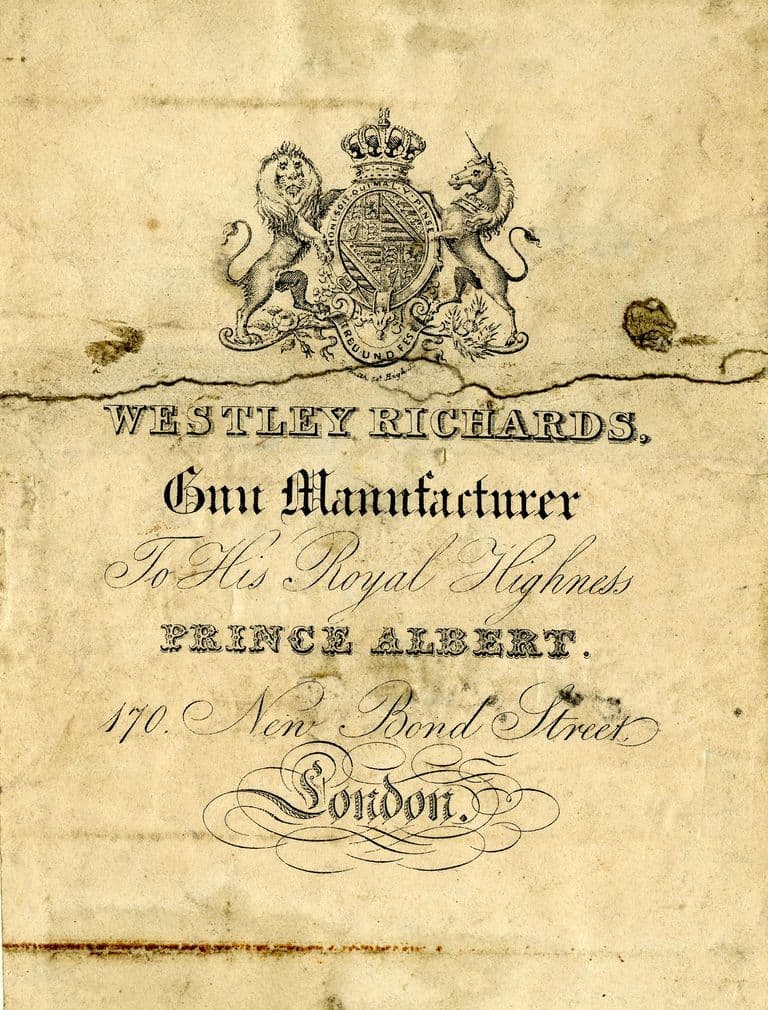
Richards understood that his best customers did not come to Birmingham. They shopped in London, and many believed only London guns were any good. So he went to them. His agent, William Bishop, sold Westley Richards guns from 170 New Bond Street. Grace’s Guide dates the arrangement to 1815; Hawker reported it in 1826. By the 1838 edition of his book Hawker could write that “Westley Richards is quite the star of Birmingham, with more business than ever”, while “his Bond-street agent, Uncle Bishop” was perhaps the first man in London for a good gun at a few hours’ notice.
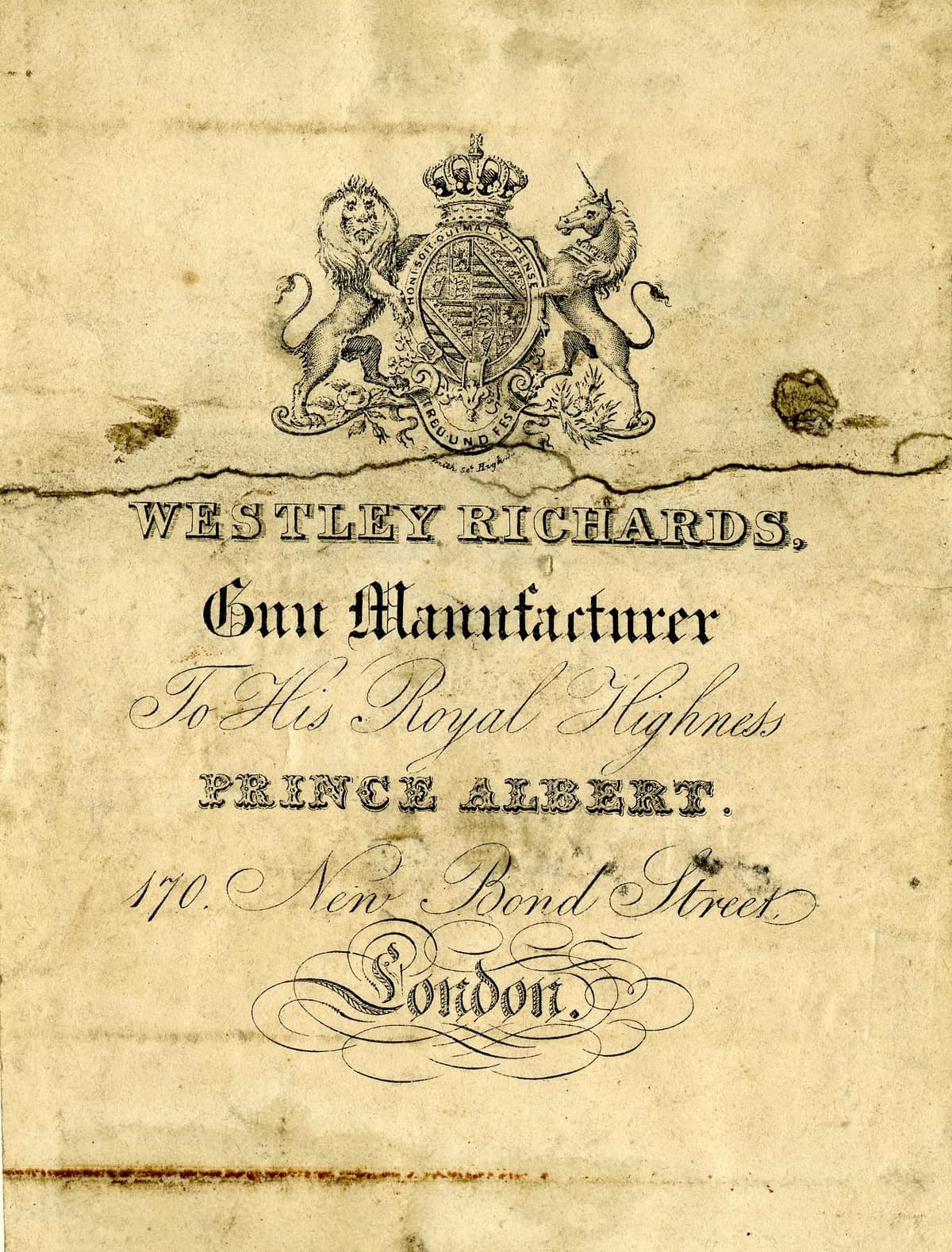
It was a division of labour on a national scale: Birmingham workmanship, London salesmanship. In 1840 Richards was appointed gunmaker to Prince Albert, and the firm’s trade cards carried the royal arms above the Bond Street address.
Primers and patents
His working life spanned the biggest change in sporting guns for two centuries: the move from the flintlock to percussion ignition, in which a small charge of detonating powder took the place of flint and steel. Every gunmaker in Britain was experimenting, and the race was fought through the patent office.
Bennet Woodcroft’s index of patents records William Westley Richards, “of Birmingham, gun maker”, six times: for gun and pistol locks in 1821; for touch holes and primers in 1831; for primers again in 1836 and 1838; for locks and primers in 1841; and for improvements in firearms and projectiles in 1852. The firm’s own history adds a hinged “flip-up” sight supplied to the British Army in 1834. Hawker gave a page, with an engraving, to “Westley Richards’s new steel primer” and praised it above the copper cap for shooting in wet coastal weather.
These were improvements, not revolutions, and the people who praised Richards did not pretend otherwise. What they valued was the combination: patient invention, fine finish and reliability.
Father and son
The firm’s history says William handed the business to his eldest son, Westley Richards (1814–1897), in 1840. The patent record suggests a gentler handover, since the father was still taking out patents in 1841 and 1852. Either way, it was the son who carried the firm into the age of the breech-loader.
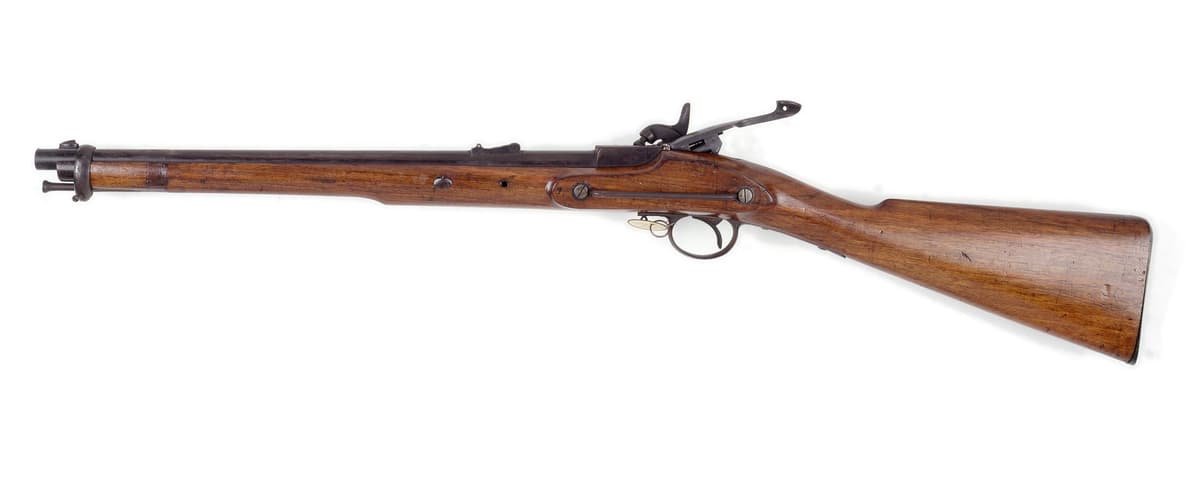
The younger Westley Richards took out about twenty patents between 1855 and 1871. One produced a capping breech-loading carbine, nicknamed the “monkey tail” after the long curling lever on top of its breech. The British Library, which holds an example made at the government factory at Enfield in 1865, calls it one of several designs considered for the British cavalry around 1855–60, which “later saw limited production and use”. A survey of the Birmingham gun trade published in 1866 reported that it had been “tested in the field, both in China and in New Zealand”, in Britain’s colonial wars, and that a large number for the cavalry were being made “by Mr. Richards and at Enfield”.
By then the firm stood apart from most of the Gun Quarter. The Victoria County History notes that while many gun workers still sat in “cramped ill lit workshops”, Westley Richards ran “a highly integrated factory” and made revolvers “with a good deal of machinery”.
A Birmingham worthy
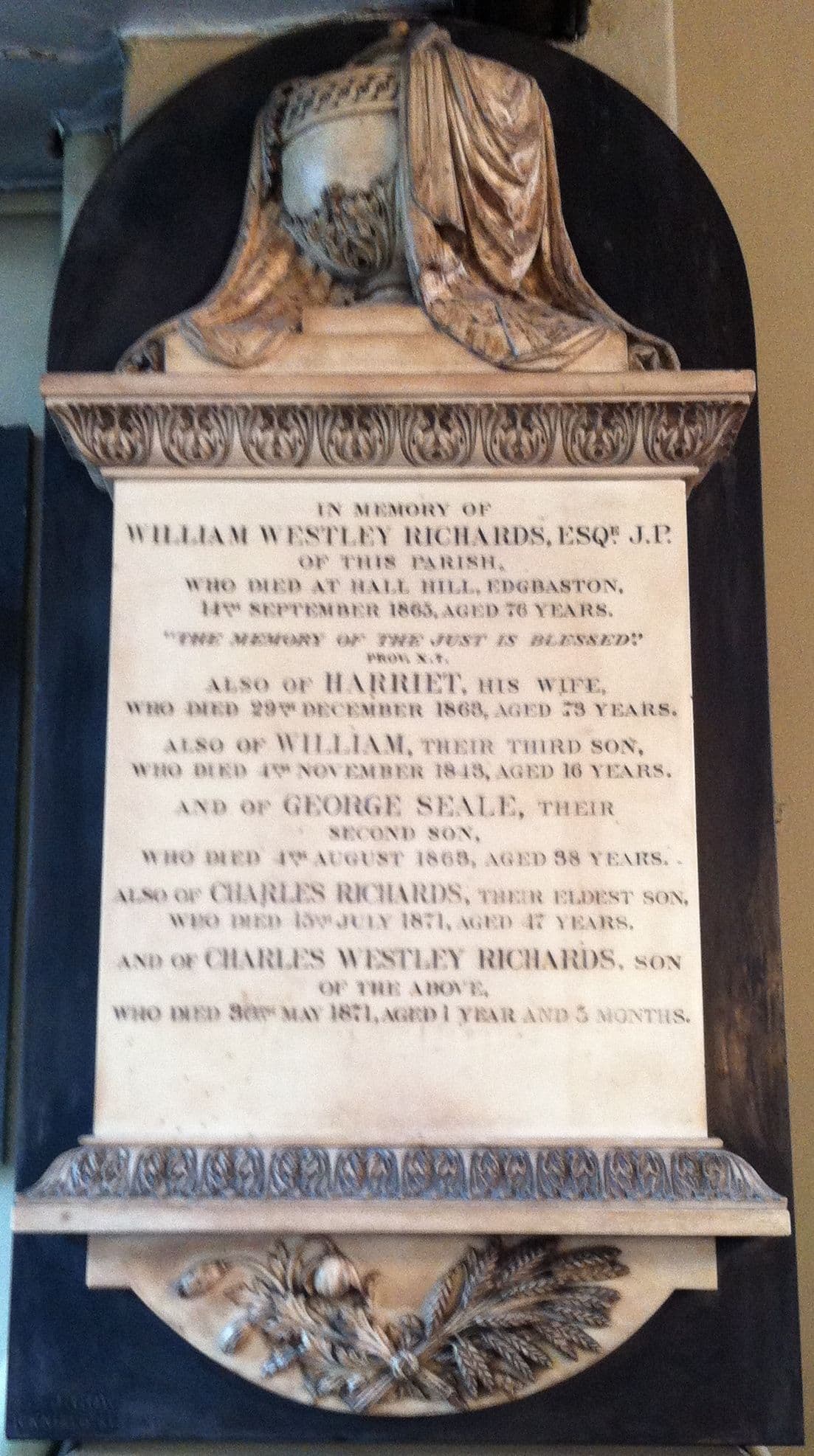
William Westley Richards became the kind of citizen his trade liked to hold up. He was a magistrate and, the firm records, a churchwarden of St Philip’s, a trustee of George Fentham’s charity, chairman of the 1849 Birmingham exhibition, held in the grounds of Bingley House, and a juror at the Great Exhibition of 1851. He died at Hall Hill in Edgbaston on 14 September 1865, aged 76. His memorial tablet in St Philip’s, now Birmingham Cathedral, carries the line: “The memory of the just is blessed.”
From the High Street to Bournbrook and back
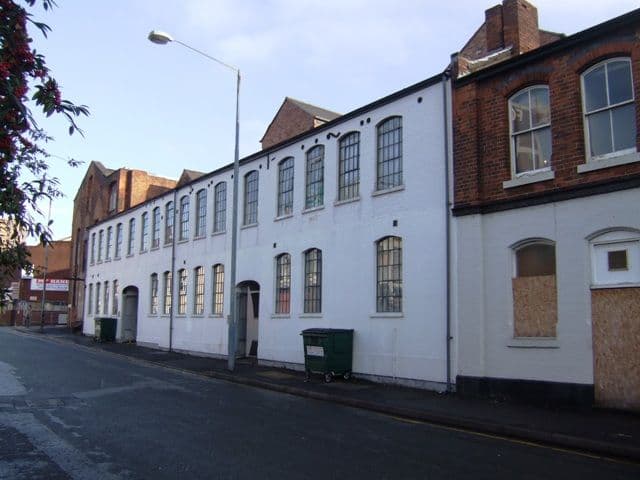
The business kept moving with the city. In 1894 the firm opened a purpose-built factory in Grange Road, Bournbrook, south-west of the centre, leaving behind what the Victoria County History calls “the cramped surroundings of the gun quarter”. It worked there for 114 years. In 2008 Westley Richards moved into two converted Victorian and Edwardian factories in Pritchett Street, which the firm describes as “an arrow’s flight from the traditional Gun Quarter”. The Bournbrook building was demolished the following year.
When Grace’s Guide checked in 2008, Westley Richards was the only one of the famous historic Birmingham gunmakers still working in the area. It still is.
Why it mattered
William Westley Richards did not invent the percussion gun, and his patents were refinements rather than breakthroughs. His importance lies elsewhere. He took a trade the world associated with cheap export muskets and showed that Birmingham could make sporting guns good enough to be compared with the best in London, and sell them on Bond Street under a Birmingham name.
He did it by mastering the whole system: the scattered workshops of the Gun Quarter, the Proof House that guaranteed their work, the London shop window, the royal warrant and the patent office. His son took the firm into breech-loading and machine production, and later owners moved it to Bournbrook and back again.
That continuity is rare. Most of the Gun Quarter’s great names disappeared as the trade declined and the ring road cut through its streets. Westley Richards is still there, a short walk from Steelhouse Lane, working to the motto its founder is said to have coined: “to be the maker of as good a gun as can be made”.
On the map
5 places connected with William Westley Richards. Tap a number for directions — some sites are private homes or gardens, so each place’s page says what you can see from the street.

- Westley Richards, Pritchett Street — Surviving, Surviving but altered · Directions to Westley Richards, Pritchett Street (opens Google Maps)
- Westley Richards works, Grange Road, Bournbrook — Lost, Site redeveloped · Directions to Westley Richards works, Grange Road, Bournbrook (opens Google Maps)
- Westley Richards, 82 High Street — Lost · Directions to Westley Richards, 82 High Street (opens Google Maps)
- Birmingham Gun Barrel Proof House — Surviving, Surviving but altered · Directions to Birmingham Gun Barrel Proof House (opens Google Maps)
- The Gun Quarter — Partly surviving, Site redeveloped
Key dates
- 1812 — Westley Richards sets up as a gunmakerWilliam Westley Richards, about 22, goes into business at 82 High Street. Selling through a Bond Street agent, his firm becomes one of Birmingham’s best-known sporting gunmakers and is still working in the city today.
- 1894 — Westley Richards moves to BournbrookWestley Richards opens a purpose-built gun factory in Grange Road, Bournbrook, leaving the cramped workshops of the Gun Quarter. It stays for 114 years before returning to Pritchett Street, near the old quarter, in 2008.
Sources and further reading
Birth: his memorial tablet says he died on 14 September 1865 aged 76, so he was born between September 1788 and September 1789. Wikipedia (lead only) gives 24 November 1789, which would make him 75; the firm’s blog says 1788; Grace’s Guide says 1785. Wikipedia gives the date of death as 11 September; we follow the tablet.
The 1812 address and the family toyshop come from Grace’s Guide and the firm’s histories; we have not seen a directory of 1812. Bisset’s directory of 1800 lists Theophilus Richards as a gun maker, and separately “Richards T. & T.”, goldsmiths and jewellers, in High Street; the family link to the second entry is not proved.
Proof House: the firm says Theophilus Richards joined the 1813 petition; Grace’s Guide says William helped to establish the Proof House. Neither has been checked against the petition itself.
Bishop’s appointment: 1815 per Grace’s Guide; Hawker’s 1826 edition calls him “now” the agent.
Patents: the firm’s blog lists nine patents with some numbers and years that do not match Woodcroft’s index (for example “7051 (1831)” where Woodcroft has 7041 of 1836). We use Woodcroft for the six to 1852. The 1834 army sight is the firm’s claim; no patent was found for it.
Handover: the firm says William retired in 1840, but Woodcroft records patents in his name in 1841 and 1852.
Bournbrook: Grace’s Guide and the firm give 1894; the Victoria County History says only “before the end of the century”. Wikipedia (lead) says the building was designed by Charles Bateman and demolished for the Selly Oak relief road; not checked.
Claims that the firm made rifles for Joseph Whitworth were found only in auction catalogues and are not used. No evidence was found of the firm supplying guns to the African trade.
- Titles of Patents of Invention, Chronologically Arranged (2 vols) — Bennet Woodcroft, Great Seal Patent Office, London, 1854. nos. 4611 (1821), 6071 (1831), 7041 (1836), 7582 (1838), 9177 (1841), 14,027 (1852)
- Instructions to Young Sportsmen in All that Relates to Guns and Shooting (4th edn) — Peter Hawker, Longman, London, 1826. “Joe Manton the second”; Bishop as agent
- Instructions to Young Sportsmen in All that Relates to Guns and Shooting (8th edn) — Peter Hawker, Longman, London, 1838. “quite the star of Birmingham”; proving barrels singly; steel primer
- Westley Richards and Co — Grace’s Guide to British Industrial History, Grace’s Guide. 82 High Street, 1812; Bishop 1815; Bournbrook 1894; 2008 quotation
- William Westley Richards — Grace’s Guide to British Industrial History, Grace’s Guide. royal warrant 1840; 1851 juror; partnership with Henry Edwards
- Westley Richards (1814–1897) — Grace’s Guide to British Industrial History, Grace’s Guide. the son’s patents
- William Westley Richards, Founder (1789–1865) — Westley Richards & Co., Westley Richards (The Explora blog). family; Theophilus and the Proof House petition; public offices; motto
- Pritchett Street: Home of Westley Richards — Westley Richards & Co., Westley Richards (The Explora blog). Bournbrook 1894–2009; Pritchett Street 2008
- Memorial tablet to William Westley Richards, St Philip’s Cathedral, Birmingham — c.1865–71. death at Hall Hill, 14 September 1865, aged 76
- Westley Richards’ cavalry carbine, 1865 (IOSM F994) — British Library, British Library, via Wikimedia Commons. cavalry carbine trials c.1855–60
- The Resources, Products, and Industrial History of Birmingham and the Midland Hardware District — Samuel Timmins (ed.), Robert Hardwicke, London, 1866. J. D. Goodman, ‘The Birmingham Gun Trade’
- Economic and Social History: Industry and Trade, 1500–1880, in A History of the County of Warwick, vol. 7, pp. 81–139 — W. B. Stephens (ed.), Victoria County History, 1964. integrated factory; revolvers; Bournbrook
- Life of William, Earl of Shelburne, vol. 1 — Lord Edmond Fitzmaurice, Macmillan, London, 1875. vol. 1, p. 404
- A Poetic Survey round Birmingham, with a Magnificent Directory — James Bisset, Swinney & Hawkins for the author, Birmingham, 1800. plates D and E
- Jewellery Quarter Conservation Area Character Appraisal and Management Plan — Birmingham City Council (Donald Insall Associates), 2002. the gun trade’s organisation
- William Westley Richards — Wikipedia. lead only: birth date
- Westley Richards — Wikipedia. lead only: Bateman; demolition
Comments
Comments will load here.