
What was here?
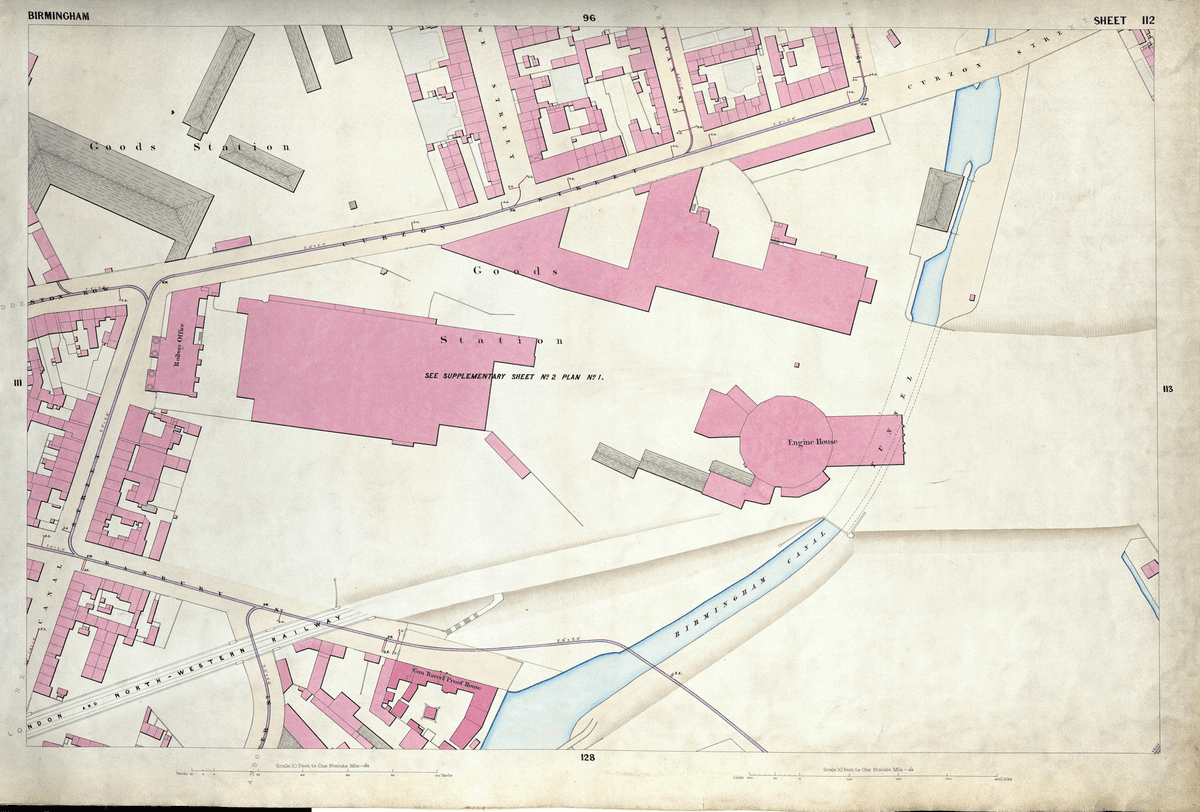
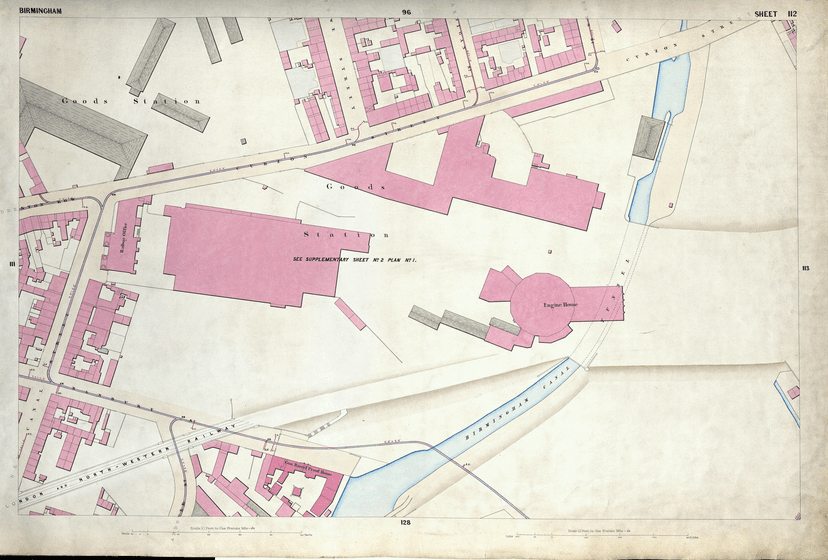
The London & Birmingham Railway’s engine house at its Curzon Street terminus: a sixteen-sided brick shed around a central turntable, with sixteen bays radiating from it over inspection pits, a coke vault below ground and ranges attached on either side.
History
Turning the engines
When the London & Birmingham Railway reached Birmingham, its locomotives needed somewhere at the end of the line to be turned, stabled and serviced. Robert Stephenson designed the answer: a round engine house beside the Curzon Street terminus. The drawings are dated 23 March 1837, and one is signed by the contractors, Grissell and Peto. The engine house was working by 12 November 1837, before the line opened to passengers in 1838.
It was a sixteen-sided brick shed around a central turntable 15 feet across. An engine ran onto the table, was turned, and could then be run into one of sixteen bays fanning out from the centre, each with an inspection pit 3 feet deep below the rails. Current Archaeology reckons the bays could hold 32 locomotives, or half as many with their tenders. Below ground was a large coke vault, with a tunnel to the canal.
Outgrown
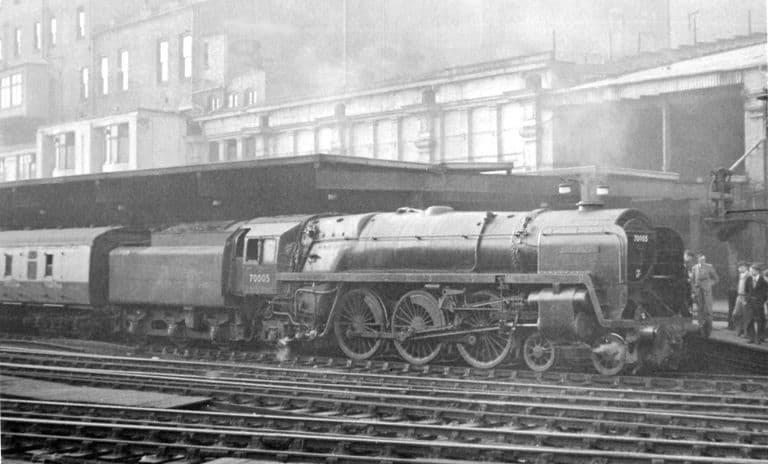
The railway age moved fast. New drawings were made in 1842, and by 1843 the roof had been changed from an open ring around the turntable to a dome. An extension was added at the north end in 1852. But engines were getting bigger and heavier, and by 1854 passenger trains had moved to New Street, leaving Curzon Street to goods.
In 1860 the roundhouse was demolished to make room for more goods traffic. Tracks were laid across its site, and much later it disappeared under concrete and a car park.
Found again
Then HS2 came to Curzon Street. Trial trenches in 2019 found the engine house, and from February 2020 to March 2021 Headland Archaeology (MOLA Headland) uncovered it. The outer wall survived to above knee height. The archaeologists found the base of the turntable, made of early concrete, the inspection pits under all sixteen roads, brick culverts and the walls of the 1852 extension.
Researchers at the University of Bradford built 3D models from the excavation and Stephenson’s drawings. A Historic England inspector said the reconstructions “had completely changed their understanding of the design and evolution of the roundhouse”.
The earliest known
Historic England calls the site “the world’s earliest round house engine shed”, internationally important for its surviving layout and its early concrete. HS2 believes it was almost two years older than the roundhouse at Derby, which has long held the title. The careful claim is that Curzon Street is the earliest known railway roundhouse. It is not the oldest standing one: Derby’s roundhouse still stands, while Curzon Street’s survives only below ground.
The same spot, then and now
1888–1913
Today
Old map: Ordnance Survey six-inch, reproduced with the permission of the National Library of Scotland (CC BY 4.0). Today: © OpenStreetMap contributors.
The remains were not dug away. The fragile turntable base and vaults were boxed in with concrete blocks and filled with sand. The whole site was covered with sand, a membrane and crushed fill to make a protective platform, though part of the north-west side was removed for the piers of HS2’s viaduct.
The first railway roundhouse anyone knows of now lies sealed in the ground beside the newest railway into Birmingham.
Why it mattered
The Curzon Street roundhouse is the earliest known railway roundhouse, the first known example of a building type that served steam railways all over the world. Historic England judges its buried remains internationally important for their layout and their early concrete turntable base. It shows how quickly the first main line outgrew its own buildings.
Why it disappeared
Railway changes
Within a few years locomotives had outgrown its bays, and once passenger trains moved to New Street Curzon Street became a goods station. The roundhouse was demolished in 1860 to make room for more goods traffic.
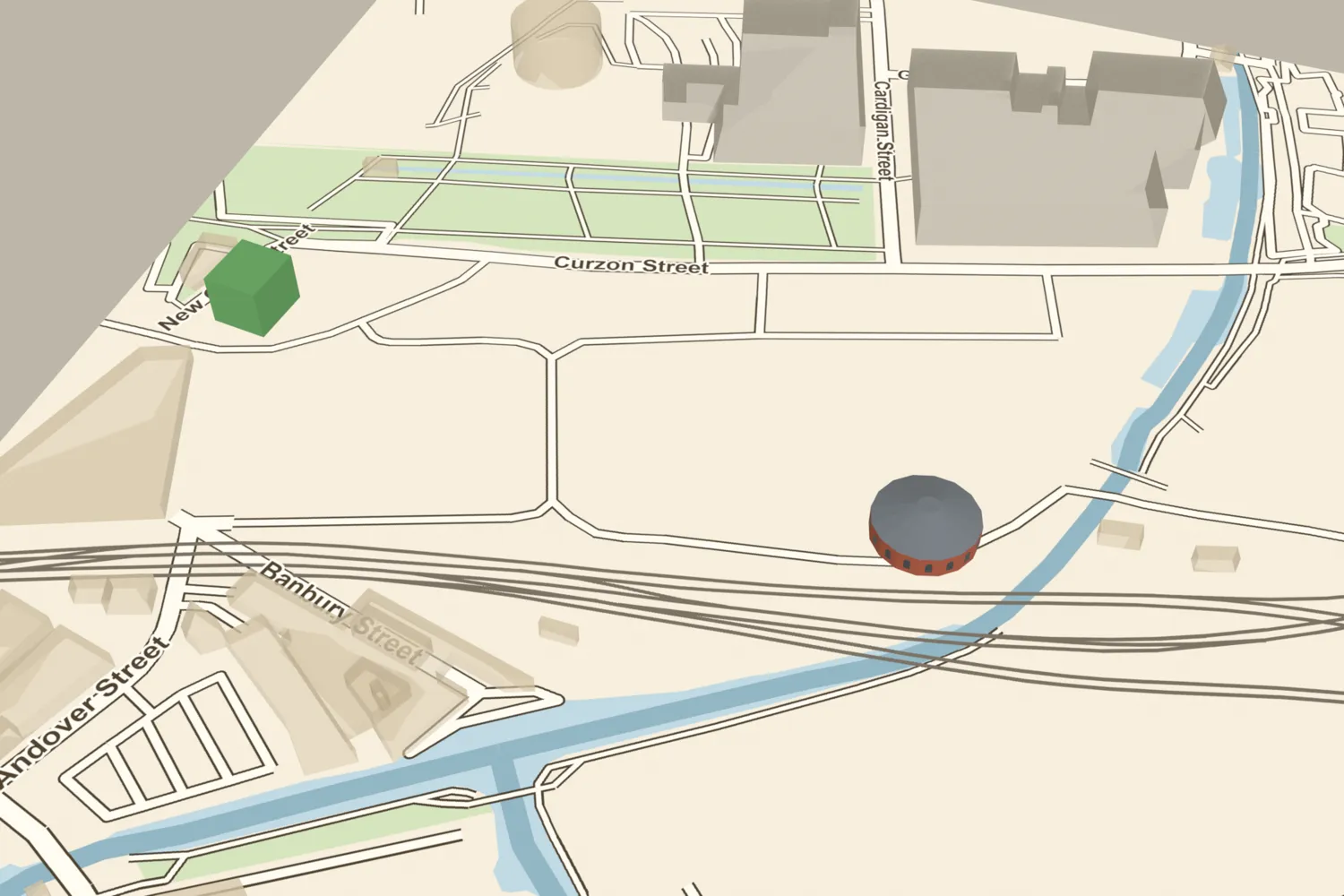
The Curzon Street roundhouse, on today’s streets
What’s there now
What replaced it
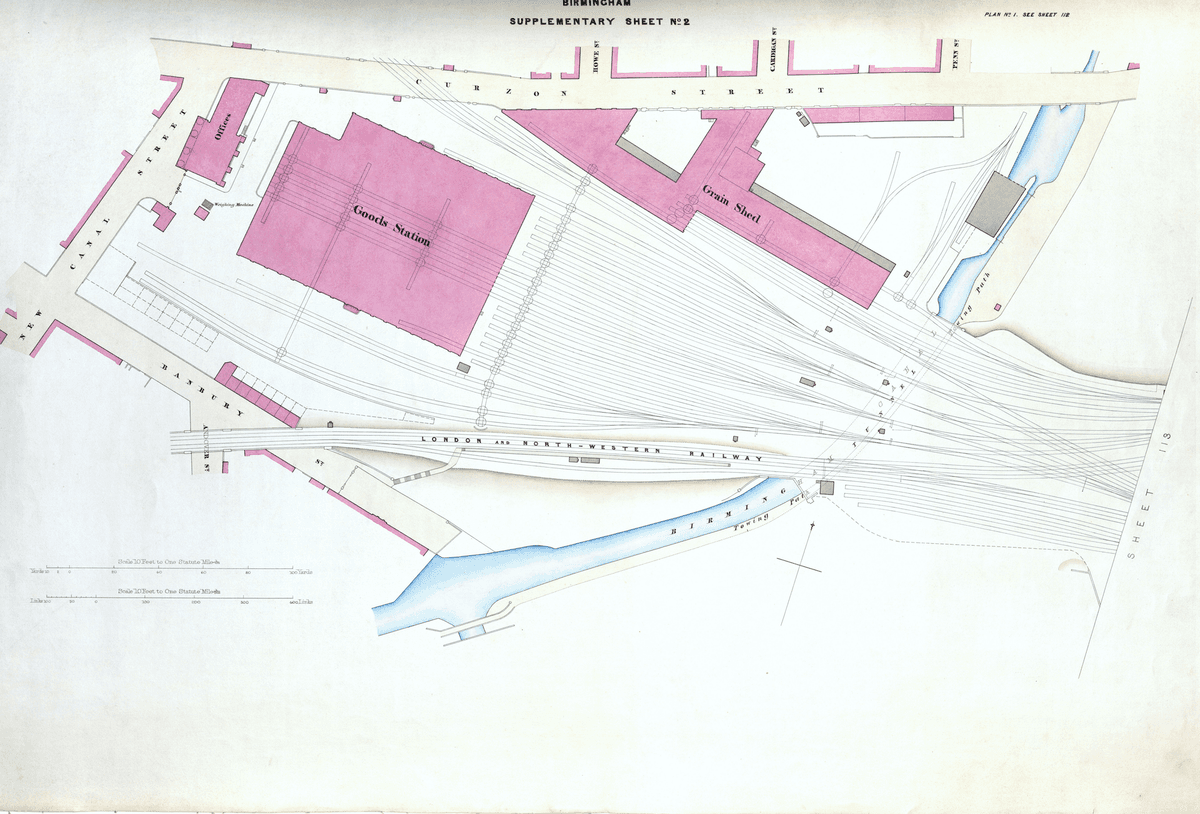
Goods-yard sidings (shown across the site on the OS 1:500 of 1887–88), then concrete hardstanding and a car park. Since 2020 the site has been part of the HS2 Curzon Street works.
What survives
Buried remains, reburied in place: the brick outer wall to above knee height, the concrete base of the turntable, the inspection pits of the sixteen roads, brick culverts, the coke vault and its tunnel, and the walls of the 1852 extension. The north-western part was removed for HS2 viaduct piers.
Today
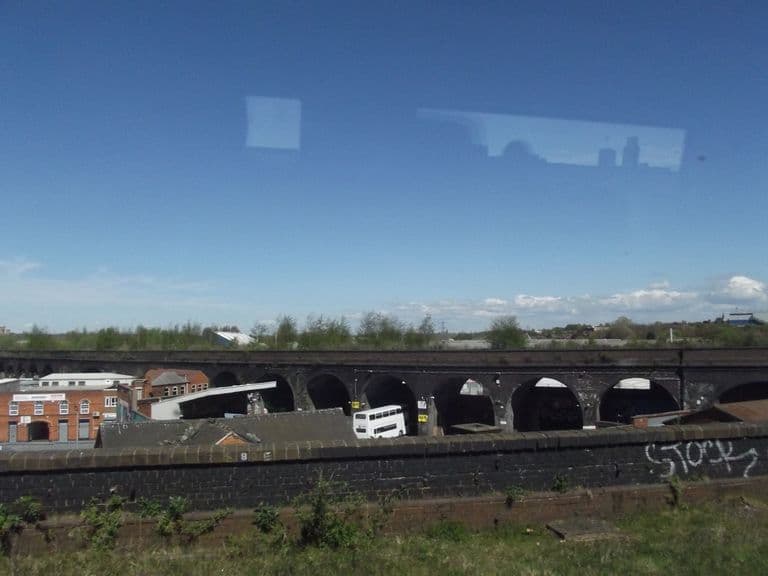
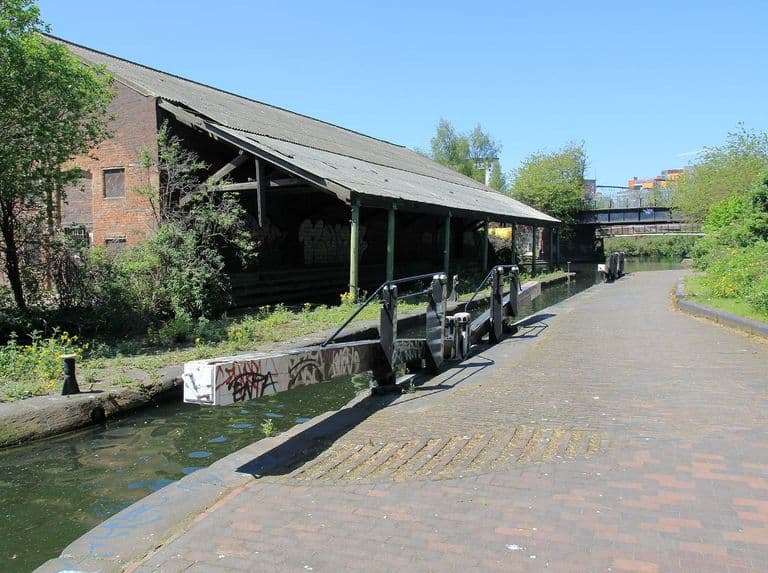
The site is inside the HS2 Curzon Street construction area, in its south-east corner between the railway at Proof House Junction and the Digbeth Branch Canal. The remains lie under a fenced, raised platform beside the new viaduct and cannot be seen.
Then and now
Then · 1855
Now · 28 April 2021
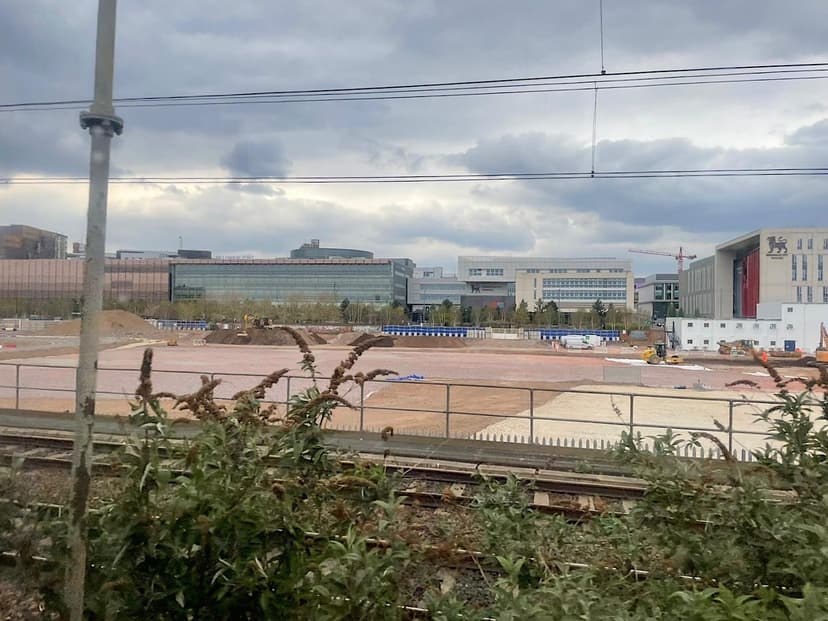
Today
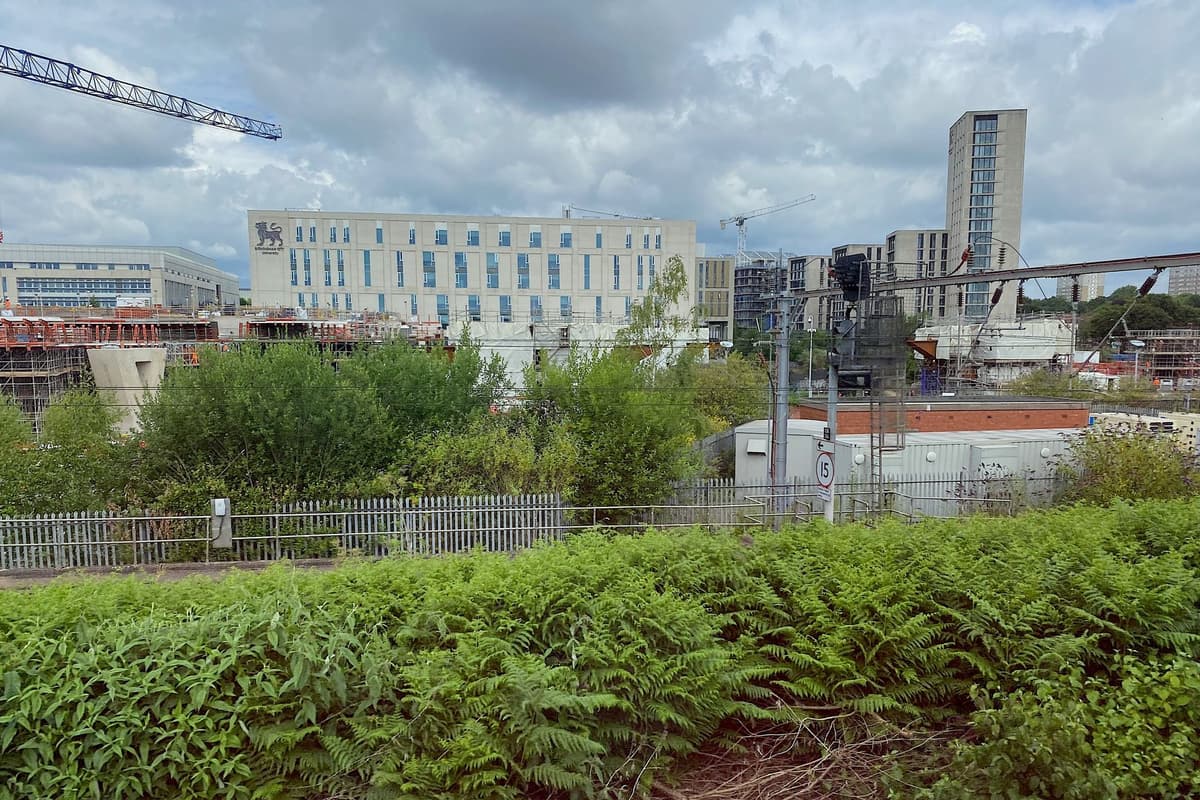
HS2 Curzon Street site, July 2024Robin Stott, 12 July 2024. Geograph Britain and Ireland via Wikimedia Commons · CC BY-SA 2.0
Sources and further reading
“World’s oldest”: Historic England calls it “the world’s earliest round house engine shed”, and HS2 says it is “thought to be” the oldest and “likely to predate” Derby by almost two years. The narrower claim used here is that it is the earliest known railway roundhouse. It does not survive above ground, so it is not the oldest surviving one; Derby’s roundhouse (Grade II*, list entry 1228933) still stands.
Demolition: 1860 is given by four sources; Historic England’s case study says “around 1852”, perhaps confusing it with the 1852 extension or the end of passenger services.
No published diameter has been found: about 36 m from the excavated outline and about 38 m from Pigott Smith’s survey. The Headland excavation report has not been read; the archive and some Historic England pages were seen only through the Wayback Machine or search summaries. The date of the Pigott Smith supplementary sheet showing tracks across the site is not known.
- Preserving Archaeological Remains, Appendix 5, Case Study 1: Curzon Street Round House — Historic England, 2024. remains, 1852 extension, reburial
- Visualising the Curzon Street roundhouse — T. Sparrow, K. Bain, J. Kimber and A. Wilson, 2024. Table 1 timeline; roof 1842–43; demolition 1860
- “Full steam ahead”, Current Archaeology 362 — Carly Hilts, 2020
- Discoveries in Birmingham (Curzon Street station archaeology) — HS2 Ltd
- HS2 uncovers world’s oldest railway roundhouse at Curzon Street archaeological site — HS2 Ltd, 2020
- HS2, Curzon Street: Collaboration in the Round — Historic Environment Forum
- Engine shed, Derby (the Derby roundhouse) — National Heritage List for England entry 1228933 — Historic England. Derby roundhouse, for comparison
- Curzon Street: the former Principal Building of the Birmingham Terminus for the London–Birmingham Railway — National Heritage List for England entry 1343086 — Historic England
- A History of the County of Warwick, vol. 7: The City of Birmingham — Communications, pp. 25–42 — W. B. Stephens (ed.), Victoria County History, 1964. railways: line opened 1838
- Plan of the Borough of Birmingham (Pigott Smith), 1855 — J. Pigott Smith, National Library of Scotland (online), 1855. ‘Engine House’, sheet 112
- Ordnance Survey 1:500 town plan of Birmingham, 1887–88, georeferenced — National Library of Scotland, 1888. sidings over the site
- OpenStreetMap data (Overpass and Nominatim), central Birmingham — OpenStreetMap contributors, 2026. way 932597242
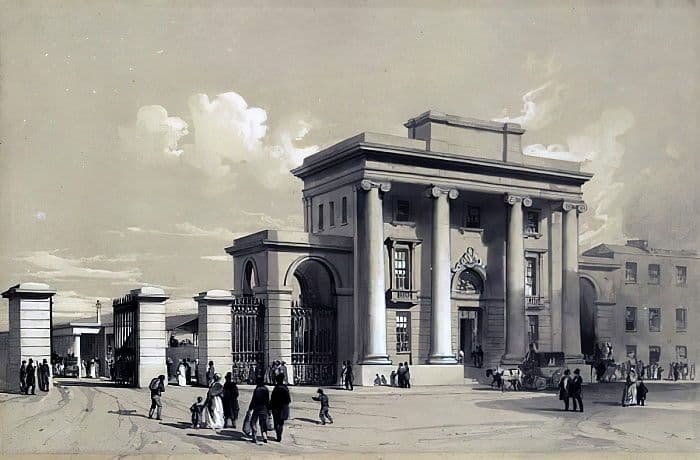
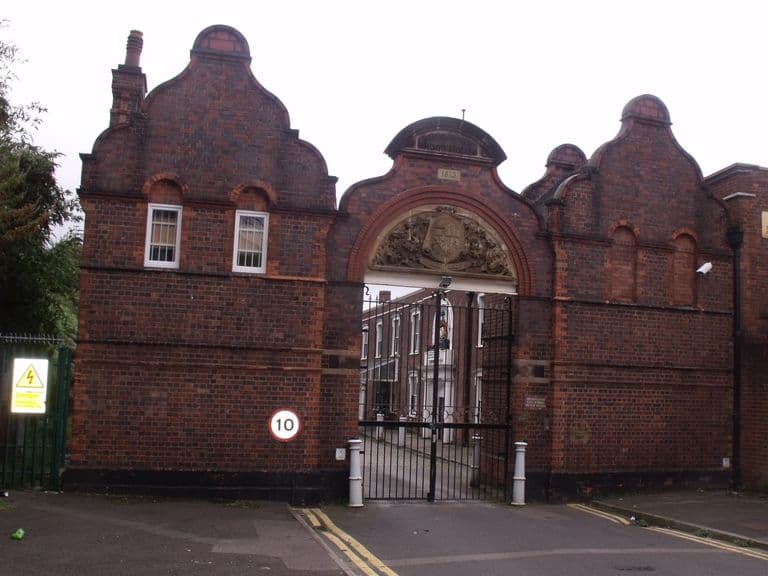
Comments
Comments will load here.