
What was here?
Before the Bullring shopping centre, the ground north-west of St Martin’s Church held Birmingham’s Market Hall: a huge stone hall with Doric columns at its doors, running from the Bull Ring to Worcester Street along Bell Street. For more than a century it was the town’s main covered market.
History
Birmingham has traded on the slope below St Martin’s Church since the Middle Ages. For centuries its markets were held in the open around the Bull Ring. By the 1830s the town wanted something grander and drier: a covered hall big enough for the general retail market.
The design went to Charles Edge. The Victoria County History says the hall was built between 1828 and 1835, which probably covers the years from the authorising Act to completion; building itself is usually dated to the 1830s. It opened for the general retail market in 1835.
Built to impress
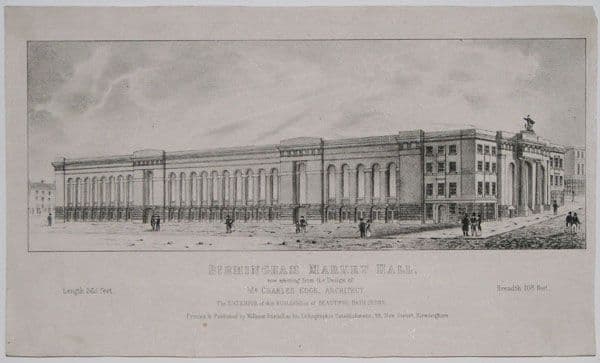
This was not a shed. The Victoria County History describes tall round-headed windows and, at each entrance, “massive Doric columns supporting an entablature”. The principal doors faced the Bull Ring at the east end and Worcester Street at the west. Along Bell Street the ground fell away sharply, and Edge used the drop for a row of basement shops tucked beneath the hall.
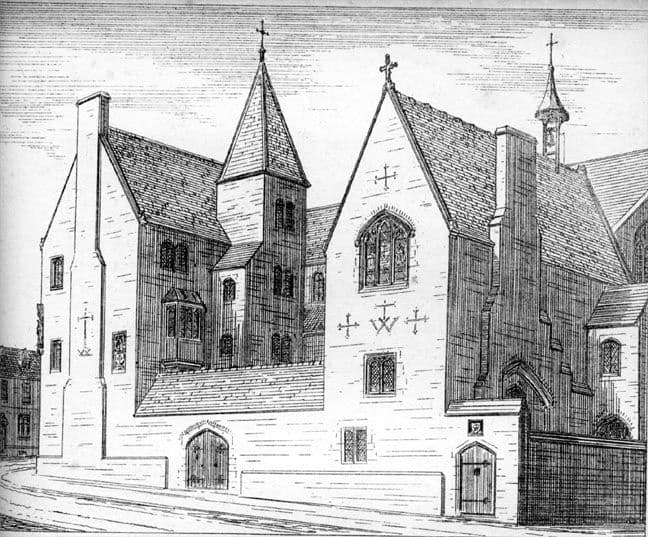
The local historian Bill Dargue gives the size as about 365 feet by 180 feet and 60 feet high, with room for 600 stalls. In 1835 The Penny Magazine called it “one of the finest structures of the kind in the kingdom”. Drawings of the design from the early 1830s, by or after Edge, show a temple of trade, all columns and cornices, set down in the middle of a workshop town.
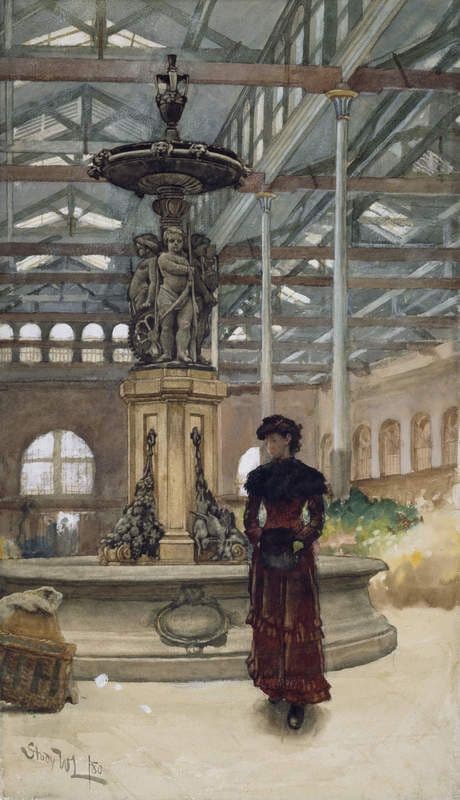
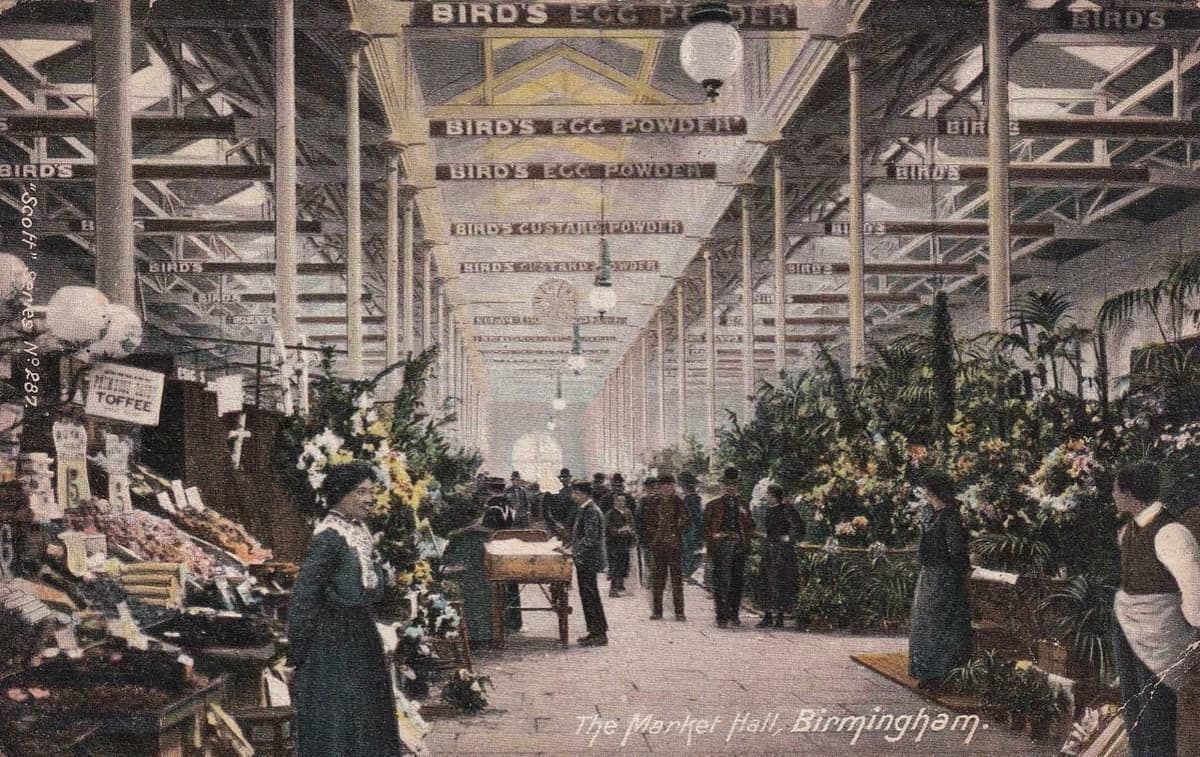
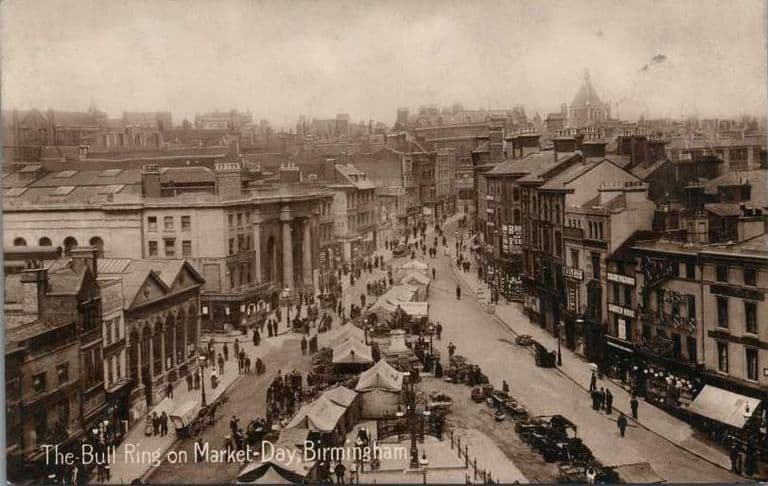
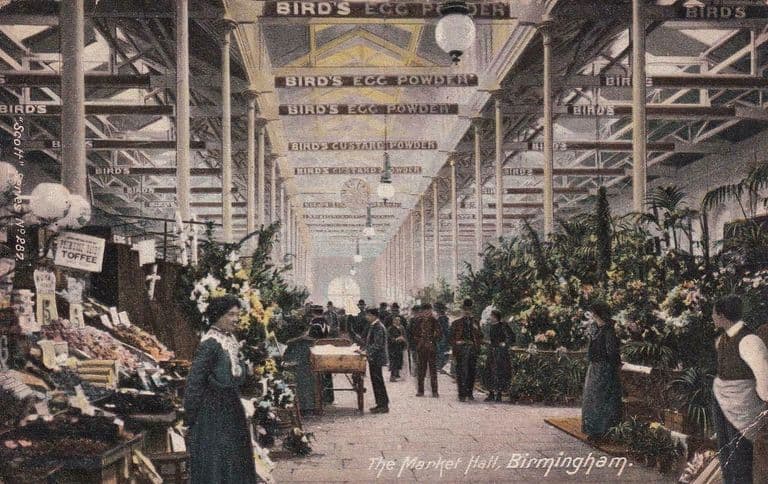
For the next hundred years this was where Birmingham shopped. Walter Langley painted the old hall and its fountain in 1880. Postcards from the early twentieth century show the interior packed with stalls under the great roof, with advertising boards high on the walls; one, from before the war, carries hoardings for Bird’s Custard Powder.
1940
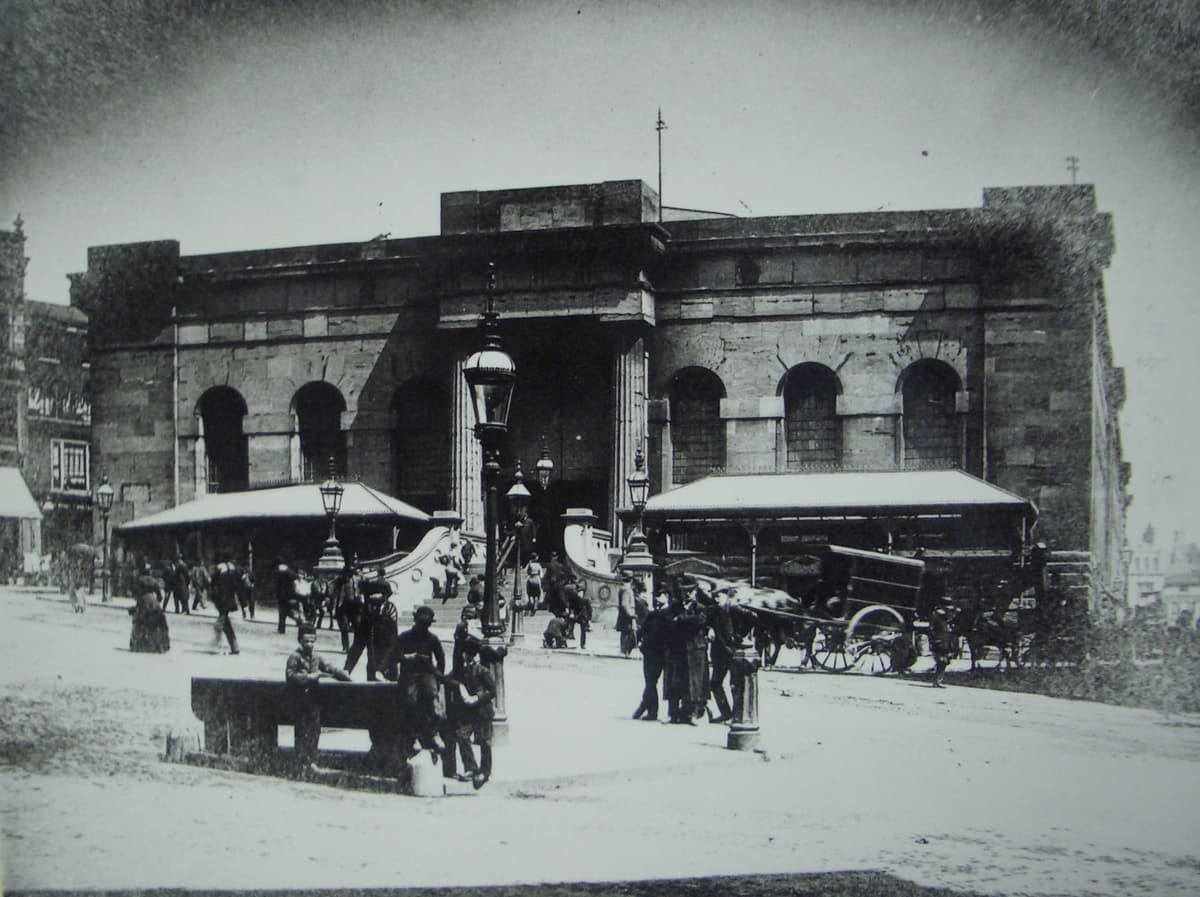
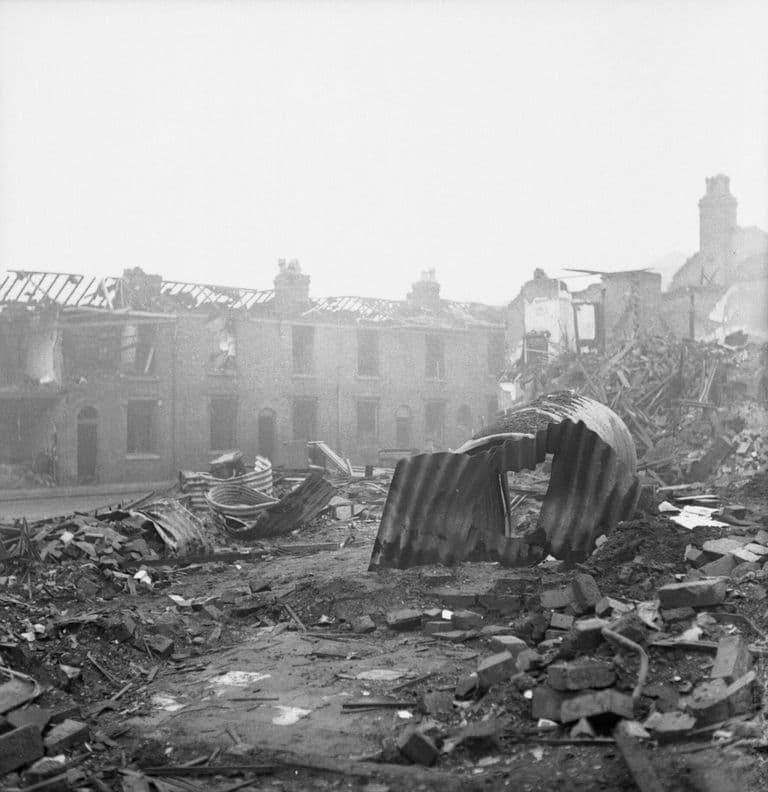
The war reached the Bull Ring in 1940. The Victoria County History puts it in one line: the hall was “reduced to a shell by enemy action in 1940”. Secondary accounts date the raid to 25 August 1940, the first raid on the city centre. A photograph in Historic England’s George Bernard Mason Collection shows the hall from Bell Street after an incendiary attack.
The same spot, then and now
1888–1913
Today
Old map: Ordnance Survey six-inch, reproduced with the permission of the National Library of Scotland (CC BY 4.0). Today: © OpenStreetMap contributors.
What happened next is the remarkable part. The ruin was not cleared. “It was gutted in 1940 and covered stalls were erected on the site,” the Victoria County History records. Trading simply carried on inside the roofless walls. For more than twenty years Birmingham bought its goods in the shell of a bombed building, and the walls “were still standing in 1962”.
Cleared for the new Bull Ring
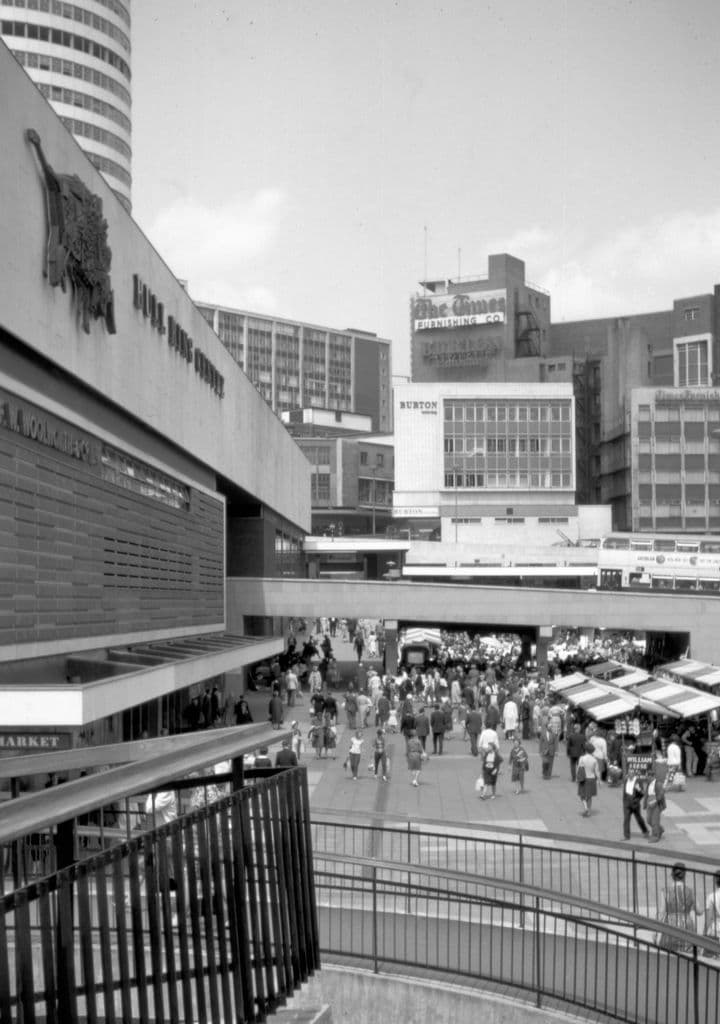
The end came not from the Luftwaffe but from the planners. In the early 1960s the shell was demolished to make way for the Bull Ring Centre, part of the rebuilding of central Birmingham. Part of the site became Manzoni Gardens, an open space. That 1960s centre did not last either. It was replaced in turn by the present Bullring, which opened in 2003.
So the ground where Edge’s hall stood has been rebuilt twice since it came down. Nothing of the building is known to survive in place. It lives on in drawings, a watercolour, a handful of postcards and one wartime photograph of scorched walls seen from Bell Street.
It is a story with an unexpected shape. The bombs took the roof, but the market refused to leave. It took peace, and a new vision of the city, to finish what the war began.
Why it mattered
The Market Hall was the centrepiece of the Bull Ring markets, on ground where Birmingham has traded since the Middle Ages, and the town’s main covered market for more than a century. It also shows how many of the city’s losses came in two waves. The bombs of 1940 hollowed it out, but traders kept working inside the ruin for two decades. It was the post-war rebuilding of the 1960s that finally removed it.
Why it disappeared
Wartime destruction · Redevelopment
Bombing in 1940 gutted the hall and left only its walls (Victoria County History). Covered stalls were put up inside the shell, which was still standing in 1962. It was demolished in the early 1960s for the Bull Ring Centre (Dargue).
The Market Hall, on today’s streets
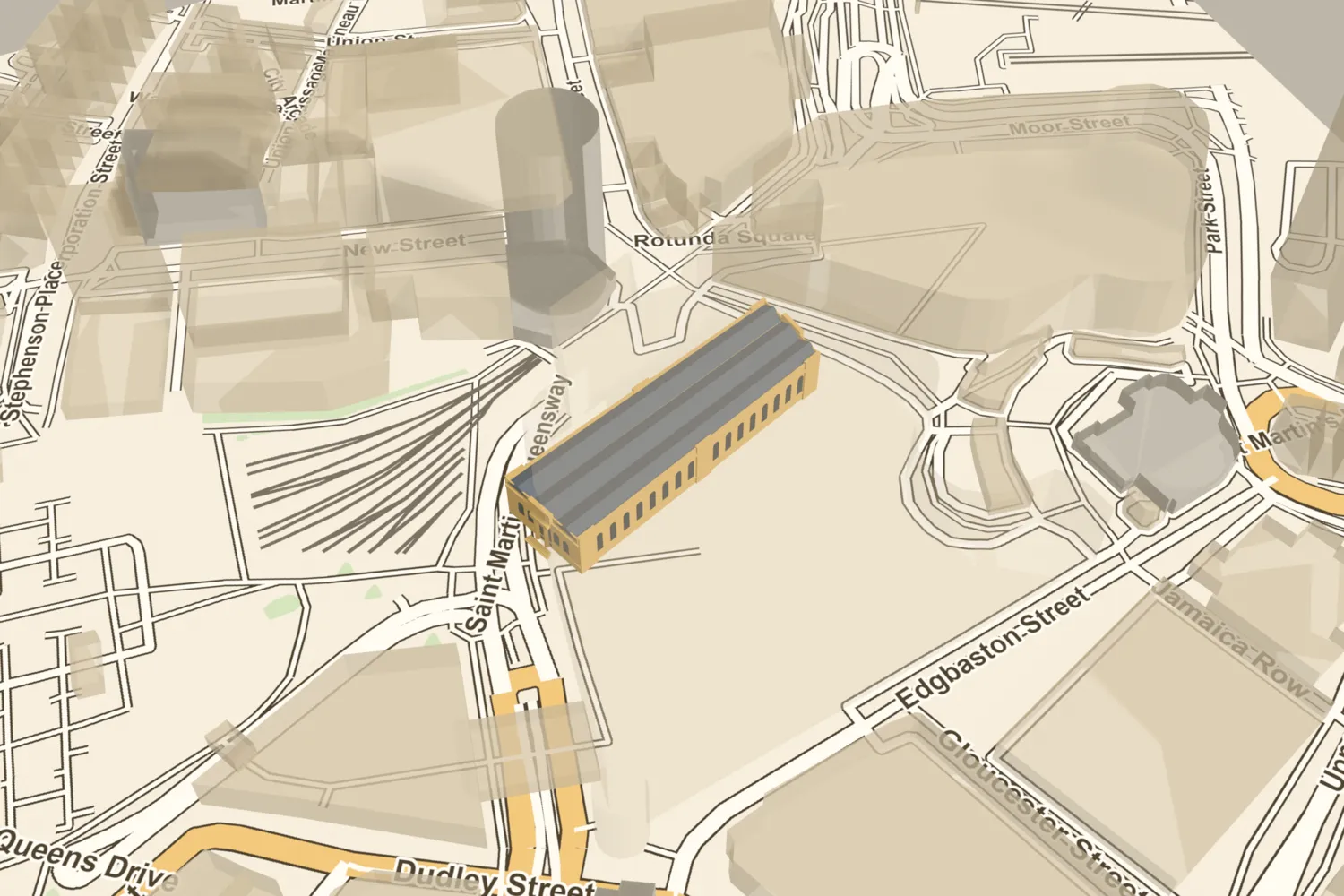
What’s there now
What replaced it
The Bull Ring Centre of the 1960s, with Manzoni Gardens, an open space, on part of the site. The 1960s centre was itself replaced by the present Bullring shopping centre, opened in 2003. The land now lies within the Bullring and its approaches between St Martin’s Church and New Street.
What survives
Nothing of the hall is known to survive on the site. It survives in pictures: Charles Edge’s drawings of the early 1830s, Walter Langley’s 1880 watercolour in the collection of Birmingham Museums Trust, early twentieth-century postcards of the interior, and a wartime photograph of the bomb damage in the Historic England Archive.
Today
The site is part of the Bullring shopping centre and its approaches, north-west of St Martin’s Church and below New Street.
Key dates
- 1835 — Birmingham Market Hall opensCharles Edge’s covered Market Hall opens beside the Bull Ring for the general retail market, with Doric columns at its entrances and basement shops along Bell Street.
- 1940 — Market Hall gutted by bombingEnemy action reduces the Market Hall to a shell. Covered stalls are put up inside the walls, and trading carries on there until the early 1960s.
- 1946 — Birmingham Corporation Act passedParliament gives the council powers to build the Inner Ring Road and buy the land compulsorily. Peter Larkham calls it the largest such council scheme to have come before Parliament.
- January 1959 — Public Works Committee agrees to demolish the Market HallA Public Works Committee conference on the Bull Ring agrees to demolish the bombed Market Hall, opening the way for the ring road and the Bull Ring Centre.
- c. early 1960s — Market Hall shell demolishedThe walls of the bombed Market Hall, still standing in 1962, are demolished for the Bull Ring Centre.
- 29 May 1964 — Bull Ring Centre opensThe Duke of Edinburgh opens the Bull Ring Centre, built by Laing in under three years. Historic England calls it the first indoor city-centre shopping centre in the UK.
- 4 September 2003 — The new Bullring opensThe Birmingham Alliance’s Bullring opens on the site of the 1964 centre, with Future Systems’ Selfridges store clad in 15,000 aluminium discs.
Sources and further reading
Building dates: the Victoria County History says “built between 1828 and 1835”; other accounts give a construction start in 1833. The 1828 date probably refers to the authorising Act or land purchase. The text says built in the 1830s and opened in 1835; the exact opening day has not been confirmed outside Wikipedia.
The raid date of 25 August 1940 comes from secondary sources; the Victoria County History gives only the year.
Final demolition: the Victoria County History says the walls were still standing in 1962; other accounts give 1963. The text says “early 1960s”.
Bill Dargue’s dimensions (about 365 by 180 feet, 60 feet high, 600 stalls) come from a local gazetteer and are less certain than the Victoria County History’s description. Claims about an 1851 fountain given by the Street Commissioners and a 1930s clock rest on Wikipedia alone and are left out.
- A History of the County of Warwick, vol. 7: The City of Birmingham — Secular Architecture, pp. 43–57 — W. B. Stephens (ed.), Victoria County History, 1964. pp. 43–57
- A History of the County of Warwick, vol. 7: The City of Birmingham — Economic and Social History: Markets and Fairs, pp. 251–252 — W. B. Stephens (ed.), Victoria County History, 1964. pp. 251–252
- The Bull Ring — History of Birmingham Places & Placenames A to Y — Bill Dargue
- The Market Hall viewed from Bell Street showing damage caused by an incendiary attack (George Bernard Mason Collection, AA42/00723) — Historic England Archive. Ref. AA42/00723
Archive references: Historic England Archive (George Bernard Mason Collection) AA42/00723
Comments
Comments will load here.