
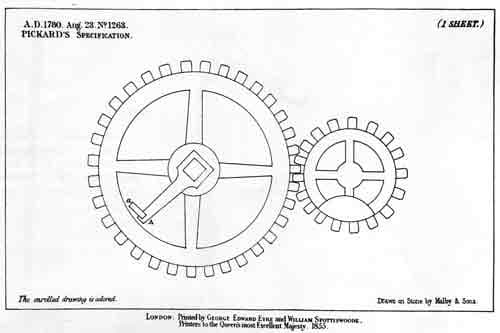
In 1780 a Birmingham button maker named James Pickard took out a patent that drove James Watt to fury. Watt said the idea had been stolen from him. Pickard has gone down in many histories as the man who “patented the crank”, the device that turns a back-and-forth push into a circular turn.
The truth is more interesting. The crank was ancient. Pickard’s patent did not even claim it. And the engine at the centre of the story was not built by Pickard at all.
Turning a wheel
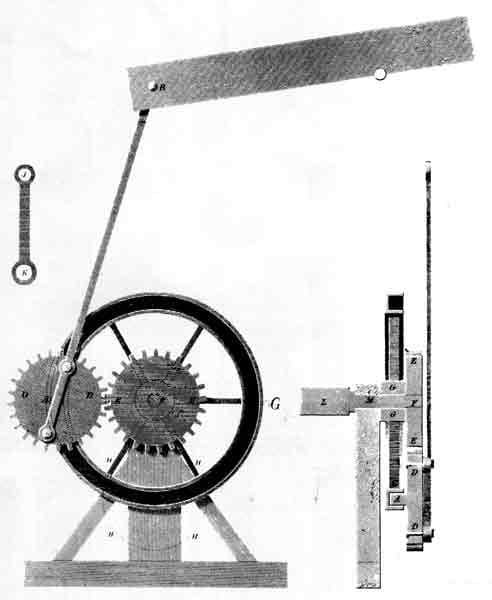
By the 1770s steam engines could pump. Newcomen’s atmospheric engines had been lifting water out of mines for sixty years, and Boulton and Watt were selling Watt’s far more efficient version. But a beam engine went up and down. A mill needs something that goes round.
The usual answer was roundabout. Use the engine to pump water uphill, and let the water turn a waterwheel. As late as 1781 John Smeaton, the leading engineer of the day, advised the Navy to do exactly that for a steam corn mill. No motion taken from an engine’s beam, he wrote, could ever act “perfectly equal and steady” in turning a wheel. A speaker at the Royal Society in 1777 had warned that an engine joined to a crank would be “either broken to pieces, or turned back”.
“I thought it better to endeavour to accomplish the same end by other means,” he wrote, “than to enter into litigation, and if successful, by demolishing the patent, to lay the matter open to every body.”
So the race was on, in the late 1770s, to make a steam engine turn a mill directly.
Wasbrough’s engine at Snow Hill
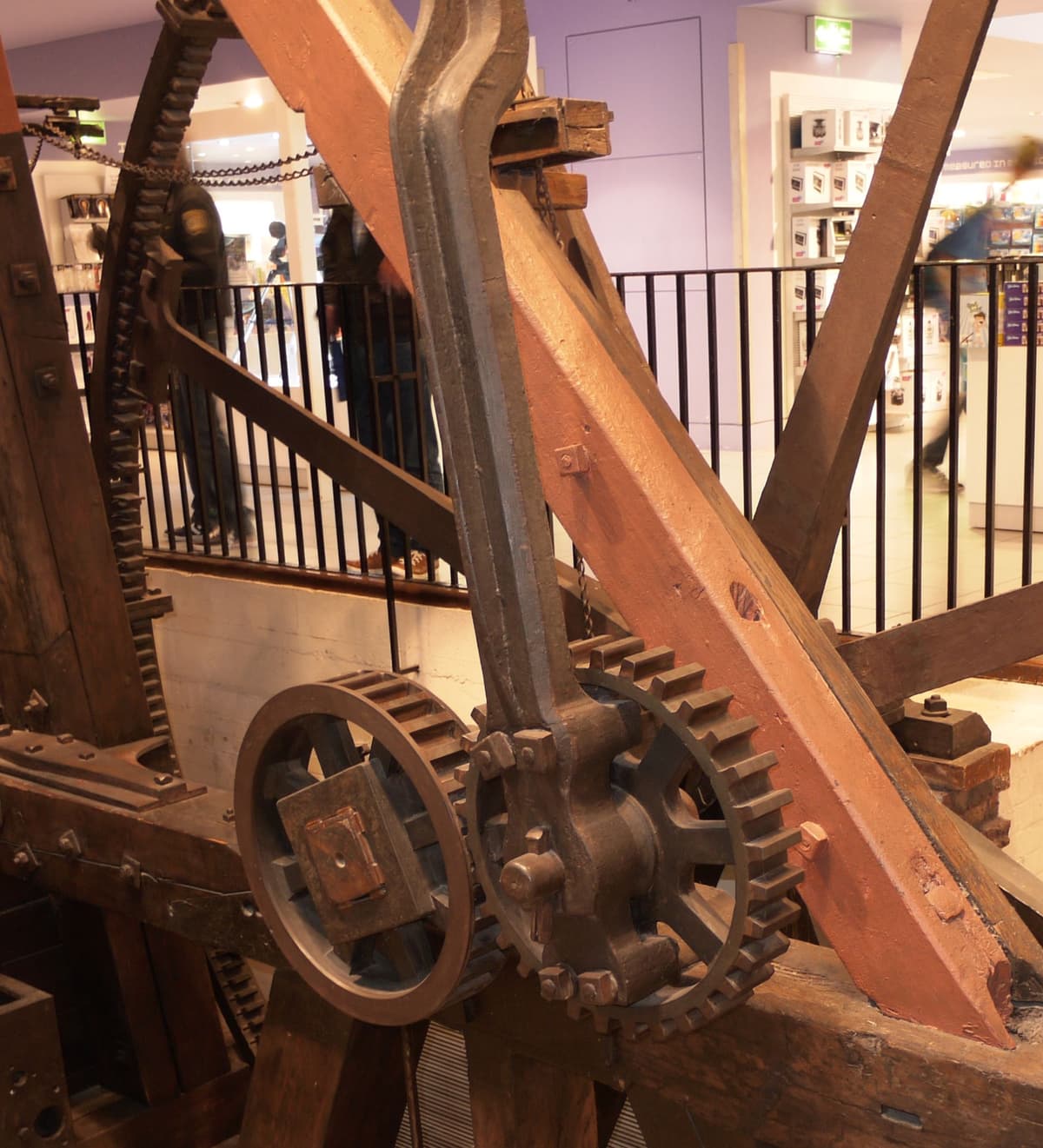
One of the first into the field was Matthew Wasbrough, a young Bristol engineer. In March 1779 he patented a system of ratchets and clicks to turn the beam’s motion into rotation, number 1213. He added a flywheel, a heavy wheel that stores momentum and smooths out the jerks. He did not mention a crank. He built several of these engines, including, by Watt’s account, one at Birmingham in 1778 or 1779.
That engine stood on Snow Hill. It drove the mill of James Pickard, a button maker.
The ratchets kept breaking. According to John Farey, writing in 1827, in 1780 “some of the people who had the management of it” stripped out the ratchet work and fitted a simple crank, keeping the flywheel. It worked far better than anything tried before. A steam engine was turning a mill directly by crank and flywheel, in Birmingham.
Patent 1263
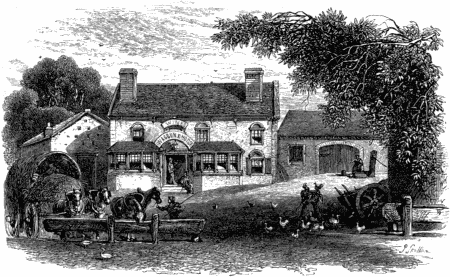
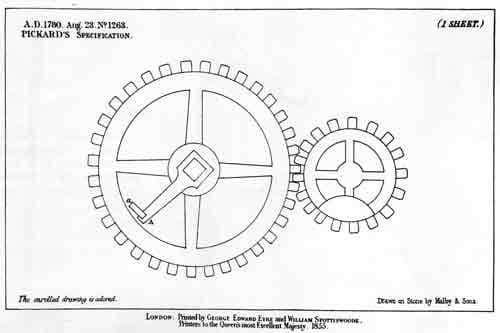
On 23 August 1780 James Pickard of Birmingham, button maker, was granted patent number 1263 for “a new method of applying steam-engines … to the turning of wheels”. Behind it stood a partnership that included Wasbrough and a John Steed, which Boulton called the “Snow Hill Company”.
Read the specification and the myth starts to crumble. It does show a crank on the end of a shaft, driven by a rod from the beam. But its real claim was a cogwheel on the crank shaft driving a second wheel half the size, with a heavy weight on its rim, to carry the crank past its dead points. The historian of technology Eugene Ferguson put it bluntly: the patent “claimed only the arrangement of counterweights, not the crank”. It says nothing about a flywheel. Farey found no sign that Pickard’s counterweight scheme was ever used.
Everyone treated it as a crank patent all the same, and nobody wanted to test it in court.
“Stolen from me”
Watt had been thinking about rotation too. Years later he told the story himself. In about 1778 or 1779, when he saw Wasbrough’s ratchet engine breaking down at Birmingham, he made a model of his own with cranks and a weighted flywheel, but did not patent it. “The invention was communicated by a workman employed to make the model,” he wrote, “to some of the people about Mr. Wasbrough’s engine, and a patent was taken out by them, for the application of the crank to steam-engines.”
Watt said the workman confessed. And then he added, with unusual fairness, that the engineer in charge claimed to have had the idea first, “which might be a fact, as the application to a single crank was sufficiently obvious”.
At the time he was less generous. He complained to Boulton that they had been “bolted out” of the crank, and that he dared not try a new scheme “lest we be betrayed again”. In 1781 the Navy Victualling Office wanted a Boulton & Watt engine fitted with Wasbrough’s crank for a corn mill at Deptford. Boulton refused, insisting the crank was not Wasbrough’s to patent. Watt called it a contrivance “stolen from me by the most infamous means”. The Soho archive’s catalogue sums up one of Boulton’s letters that summer in two words: “Pickard’s deceit”.
Victorian biographers made a scene of it. Samuel Smiles told how a Soho pattern maker, Dick Cartwright, chalked a crank on a table at the Waggon and Horses in Handsworth while a spy in workman’s clothes listened in the corner. Smiles himself wrote “it is said”, and his date of summer 1780 does not fit Watt’s own account. It is a good pub story, not evidence.
Getting round it
Watt chose not to fight. “I thought it better to endeavour to accomplish the same end by other means,” he wrote, “than to enter into litigation, and if successful, by demolishing the patent, to lay the matter open to every body.” Boulton & Watt had their own patents to protect.
On 25 October 1781 Watt patented five different ways of making an engine turn a wheel, number 1306. The one that stuck was the sun-and-planet gear, a toothed wheel on the end of the connecting rod that orbits a wheel on the shaft. The Library of Birmingham credits its invention to William Murdoch. It had a bonus: it turned the flywheel twice for every stroke, so the flywheel could be smaller. With it, and with the double-acting engine of 1782, Boulton & Watt began selling rotative engines to drive mills and factories.
Patents then ran for fourteen years, so Pickard’s lapsed in 1794. Afterwards the plain crank became normal. Watt later admitted that the sun-and-planet was more likely to wear and break than “a simple crank, which is now more commonly used”.
Bread and riot
Pickard stayed in business on Snow Hill as a miller and baker. In June 1795, a year of hunger, a crowd of about a thousand people, many of them women, broke into James Pickard’s mill and bakehouse, protesting against the new small loaf he had introduced. Troops and yeomanry were called out and two rioters were shot. In 1800 the mill was looted again.
A firm of mealmen and maltsters called Pickard, Son and Co. was dissolved in 1803. By 1814 the household goods of “the late Mr. James Pickard” of Colmore Row were being sold.
Why it mattered
James Pickard did not invent the crank. Cranks had turned grindstones and lathes for centuries. He probably did not even think of putting one on a steam engine; the people running Wasbrough’s engine at his mill seem to have done that, and Watt may have got there first. What Pickard did was patent it. His patent of 1780 actually claimed a counterweight gear, but it worked as a crank patent, and for fourteen years it shaped how Britain’s best engineers built their engines.
Its most famous result was a detour. To avoid it, Boulton & Watt sold their rotative engines with the sun-and-planet gear, and those engines powered the first great steam mills of the 1780s and 1790s.
The story also shows Birmingham’s industrial world at close quarters: a button maker’s mill on Snow Hill, a Bristol engineer, workmen talking out of turn, and the giants of Soho furious that someone else had got to the patent office first. One of the first steam engines to turn a mill by crank and flywheel worked on Snow Hill, a short walk from today’s station.
On the map
One place connected with James Pickard. Tap a number for directions — some sites are private homes or gardens, so each place’s page says what you can see from the street.

- Pickard’s mill, Snow Hill — Lost, Site redeveloped
Key dates
- 23 August 1780 — Pickard’s ‘crank patent’James Pickard of Snow Hill, button maker, patents a way of making a steam engine turn wheels (no. 1263), after a crank was fitted to Matthew Wasbrough’s engine at his mill. Watt claims the idea was leaked from Soho and avoids the crank with the sun-and-planet gear.
Sources and further reading
Life dates: we have not been able to verify any birth or death date. The dates “c.1730–1787” that circulate could not be traced to a source, and the Victoria County History places “James Pickard’s mill and bakehouse” in the riots of 1795. The James Pickard whose effects were sold in 1814 may be the patentee or a son of the same name; Grace’s Guide also gives his first name once as John.
Who fitted the crank: Farey (1827) says the ratchets on Wasbrough’s Birmingham engine were replaced by a crank in 1780 “by some of the people who had the management of it”. Modern popular accounts say Pickard did it himself or that Wasbrough designed a crank engine for him. We follow Farey.
What patent 1263 claimed: Farey and Ferguson, who both read the specification, say it described a crank with a counterweighted wheel turning twice per stroke and did not mention a flywheel. Many summaries say Pickard “patented the crank and flywheel”. That is not what the document says.
John Steed: named as joint patentee by Grace’s Guide; Boulton’s letter of 23 April 1781 records a meeting of “Wasbroughs and Steed and Boulton”. His exact part is unknown.
The leak: Watt’s own account, published in his notes to Robison’s article and quoted by Farey, says a workman told “the people about Mr. Wasbrough’s engine” and confessed it. Samuel Smiles’s tale of Dick Cartwright at the Waggon and Horses comes with “it is said” and a date (summer 1780) that conflicts with Watt’s own (1778 or 1779). Ferguson notes that Watt was in any case not convinced the crank was the best answer.
Sun-and-planet: patented by Watt in 1781; the Library of Birmingham credits William Murdoch with the invention, and Ferguson says Murdoch “may have suggested” it.
Site: Grace’s Guide and others say Pickard’s works stood on the site of today’s Snow Hill station. That is plausible but we have not found the evidence; the Victoria County History says only “in Snow Hill”.
Portrait: none known.
- A Treatise on the Steam Engine, Historical, Practical, and Descriptive — John Farey, Longman, Rees, Orme, Brown and Green, London, 1827. pp. 408–410, 423–424: Wasbrough’s patent and engines; crank fitted 1780; patent 1263 text; Watt’s account of the leak; Watt’s 1781 patent
- Kinematics of Mechanisms from the Time of Watt (Contributions from the Museum of History and Technology, paper 27; US National Museum Bulletin 228) — Eugene S. Ferguson, Smithsonian Institution, Washington, 1962. Smeaton 1781; 1777 Royal Society paper; patents 1213, 1263, 1306; ‘claimed only the arrangement of counterweights’
- Industrial Revolution: A Documentary History, Series One, Part 12: Boulton & Watt Correspondence and Papers (MS 3147/3/1–79) — detailed listing — Adam Matthew Publications, with listings by the Archives of Soho Project, Adam Matthew. Ref. Library of Birmingham MS 3147/3. MS 3147/3/5: Boulton to Watt, 19, 20, 23 and 26 April 1781 (‘pretended patent crank’, ‘is not his’, Steed, Snow Hill Company), 30 July 1781 (‘Pickard’s deceit’)
- Lives of Boulton and Watt — Samuel Smiles, John Murray, London, 1865. ch. 14: ‘bolted out’; ‘betrayed again’; ‘stolen from me’; Waggon and Horses story
- Steam engines — Archives of Soho — Library of Birmingham, Birmingham City Council. Ref. MS 3782/12/1/2. sun-and-planet credited to Murdoch
- A History of the County of Warwick, vol. 7: The City of Birmingham — Political History to 1832, pp. 270–297 — W. B. Stephens (ed.), Victoria County History, 1964. 1795 and 1800 riots at Pickard’s mill and bakehouse, Snow Hill
- James Pickard — Grace’s Guide to British Industrial History. button maker/miller; Steed; 1795 riot; 1803 partnership; 1814 sale
- Matthew Wasbrough — Grace’s Guide to British Industrial History. Wasbrough’s dates
Comments
Comments will load here.