
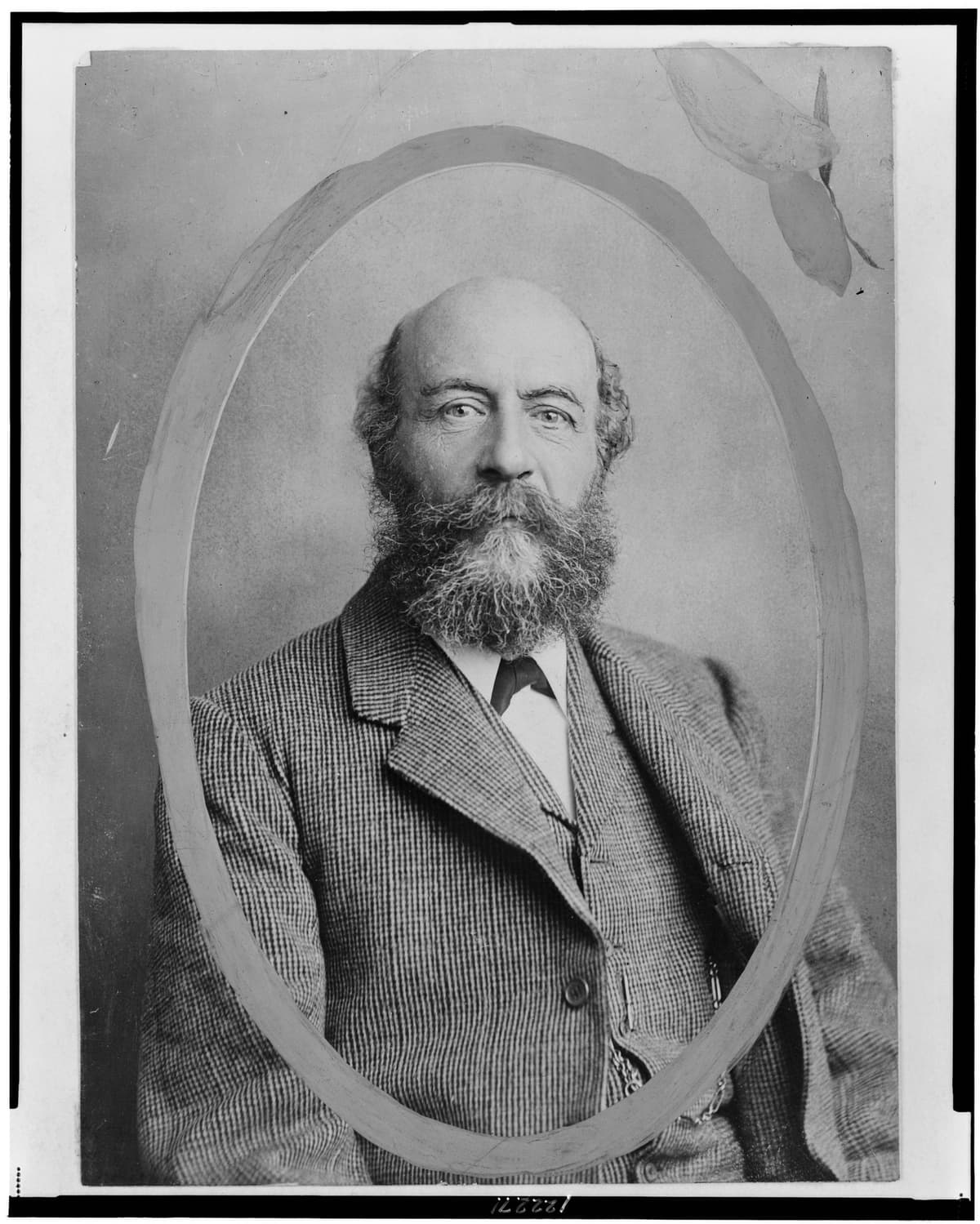
In 1863 the Cadbury cocoa business in Bridge Street was close to finished. Two years earlier George Cadbury, aged 22, and his brother Richard had taken over their father’s failing works with about £10,000 of their mother’s family money and a promise to each other: if the money ran out, they would close rather than borrow. The money was running out. George was planning to go to the Himalayas to grow tea. Richard thought he might become a land surveyor.
They held on. In 1864 the books showed a profit for the first time, and George later said that only his own spartan living had saved them. “If I had been married there would have been no Bournville to-day,” he wrote in July 1914 (quoted by A. G. Gardiner, 1923). “It was just the money that I saved by living so sparely that carried us over the crisis.”
A Quaker upbringing
George was born in Edgbaston on 19 September 1839, the third son of John Cadbury, a Quaker grocer who sold tea and coffee in Bull Street and had begun making cocoa in Crooked Lane, and his wife Candia, née Barrow. He trained in the Rowntree grocery business in York and joined his father’s cocoa works in 1856. When John Cadbury’s health broke after his wife’s death in 1855, the business declined, and in 1861 the sons took over.
Pure cocoa
Victorian cocoa was mostly something else. By George’s own account, the firm’s cheap cocoa was only one-fifth cocoa, padded out with potato starch, sago flour and treacle. In the 1860s he went to the Netherlands, without a word of Dutch, and bought a press of the kind used by Van Houten that squeezed out the fatty cocoa butter. In 1866 the brothers launched Cadbury’s Cocoa Essence, sold as “Absolutely pure”. When the Adulteration of Food Act of 1872 forced makers to declare what they added, the Cadburys dropped their cheap lines altogether.
Out to the fields
By the late 1870s Bridge Street was too small, and George wanted something better than a factory in a smoky street. In 1878 the brothers bought about 14½ acres at Bournbrook, four miles south of the city, beside the railway and the Worcester and Birmingham Canal. Building began in 1879, and that autumn the works moved out. They called it Bournville, after the Bourn stream, with a French ending because French chocolate was then the best.
“If I had been married there would have been no Bournville to-day,” he wrote in July 1914 (quoted by A. G. Gardiner, 1923).
The new works had playing fields and a garden, and sixteen houses for foremen. In 1893 George bought about 120 more acres nearby, and from 1895 he began building a model village. It was open to anyone, not only Cadbury workers, and was laid out with large gardens, trees and parks. In 1900 he handed the whole estate to the Bournville Village Trust. Its deed barred any pub without the trustees’ consent.
Generous, and in charge
Bournville workers had sports fields, swimming baths, classes, a pension fund and medical care, unusual benefits for the time. From 1866 George led a short daily service for his workpeople, with a Bible reading, a hymn and silent prayer. The firm grew from 303 employees in 1880 to 6,182 at the end of 1911.
The welfare came with rules. Men and women used separate entrances and dining rooms. Women had to leave when they married. “For a great many years married women have not been employed at the Works,” Edward Cadbury, George’s son, wrote in 1912, “as it is felt that a woman cannot give proper care to the home and children if she is spending the greater part of her time in a factory.”
Slave-grown cocoa
In 1901 the firm learned that cocoa from the Portuguese islands of São Tomé and Príncipe, which supplied about 45 per cent of its beans, was grown by Africans taken from Angola and held as forced labourers. George was chairman. The firm sent agents, lobbied Lisbon and the Foreign Office, and waited. In September 1908 the Standard newspaper accused Cadbury Brothers of hypocrisy. In March 1909 the firm stopped buying São Tomé cocoa, and that winter it sued the Standard for libel. The jury found for Cadbury, but awarded damages of one farthing, a sign that it was not impressed by eight years of delay.
Newspapers and causes
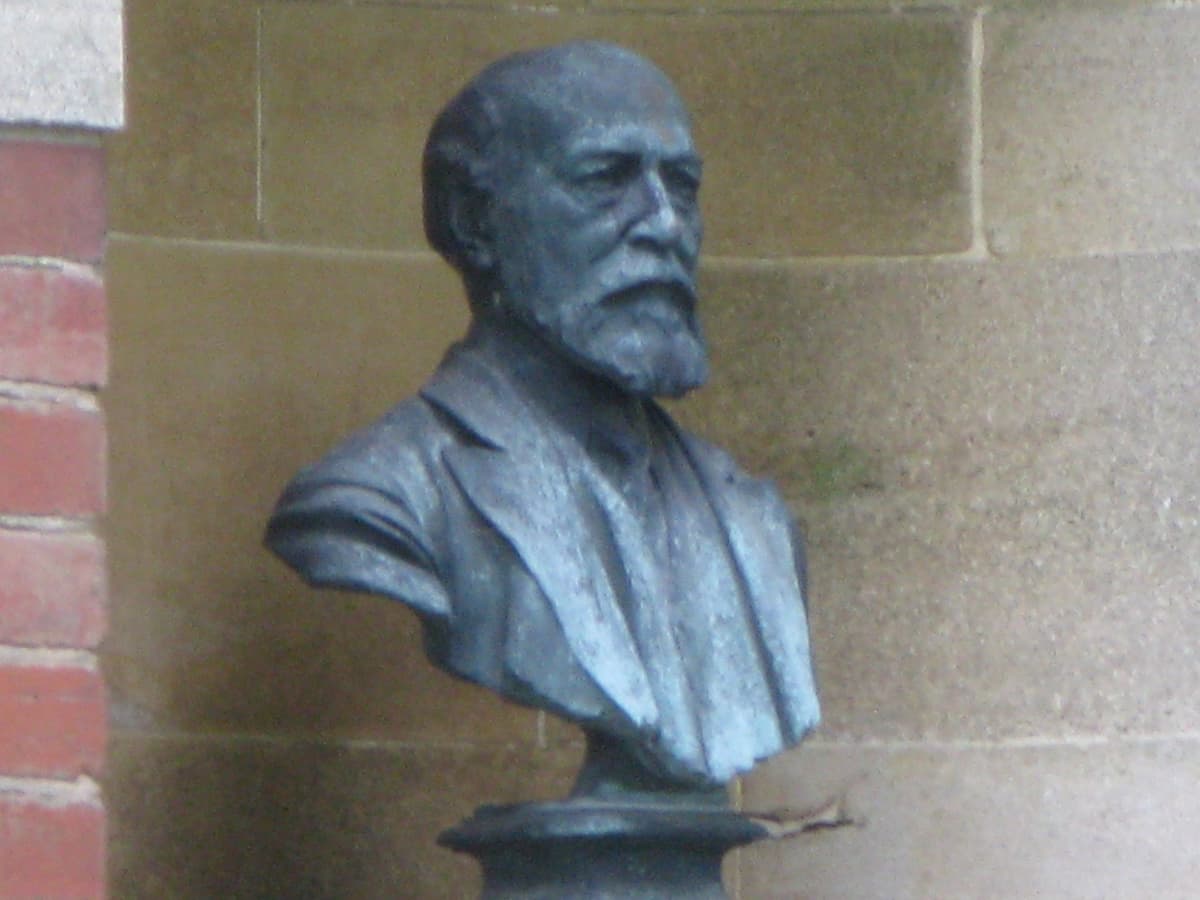
George taught at the Severn Street Adult School for half a century. He opposed the Boer War, and in 1901 he took on the Daily News to give that view a voice, banning racing tips and drink advertisements from its pages. He campaigned for old-age pensions. He died at the Manor House, Northfield, on 24 October 1922. His ashes rest in a columbarium in the Friends’ Meeting House on Bournville Green, and a bust of him looks out from an alcove on its front.
Why it mattered
George Cadbury showed that a factory did not have to sit in a slum. Bournville, a works in a garden beside a village of cottages and trees, became one of the best-known experiments in British housing. It influenced the garden city movement, and its trust still manages the estate today. Figures quoted by his biographer for the five years to 1919 gave Bournville a death rate of 7.7 per thousand, against 13.7 for Birmingham.
His record needs reading whole. He paid better than most and gave his workers a world of welfare, but he also set the rules for how they lived, whom they married and when they left. His firm’s cocoa came from forced labour for years while it lobbied rather than acted. But the estate he gave away is now home to more than 25,000 people. Few Victorian employers left anything so solid or so widely copied.
On the map
4 places connected with George Cadbury. Tap a number for directions — some sites are private homes or gardens, so each place’s page says what you can see from the street.

- John Cadbury’s shop, 93 Bull Street (site) — Lost, Site redeveloped · Directions to John Cadbury’s shop, 93 Bull Street (site) (opens Google Maps)
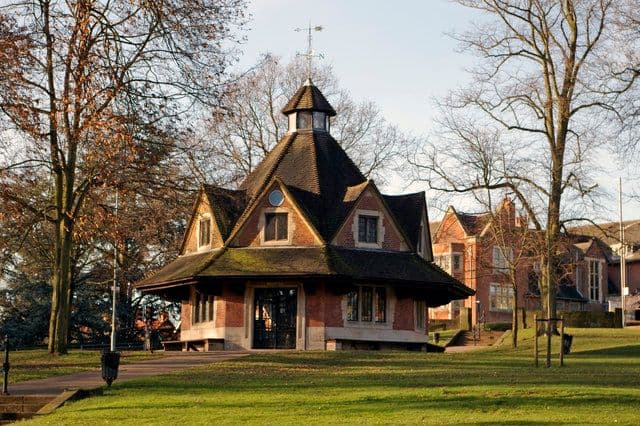
- Bournville village — Surviving · Directions to Bournville village (opens Google Maps)
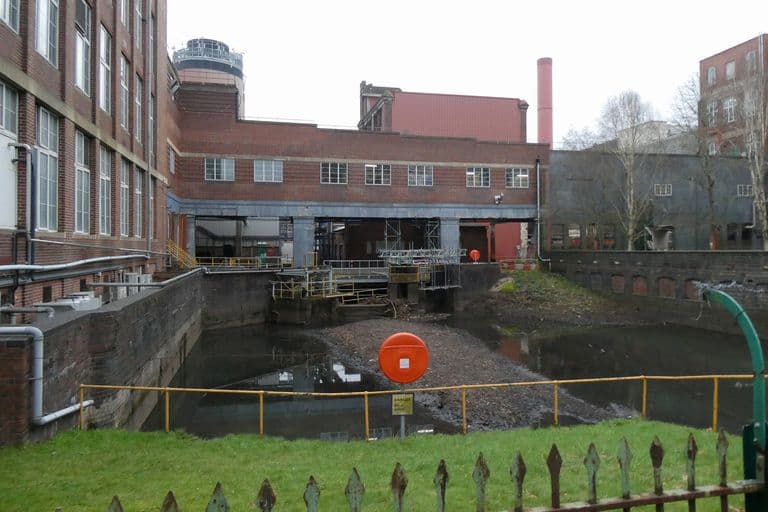
- Bournville works (Cadbury) — Surviving, Surviving but altered · Directions to Bournville works (Cadbury) (opens Google Maps)
- Cadbury’s Bridge Street works — Lost, Site redeveloped
Key dates
- 1861 — Richard and George Cadbury take overJohn Cadbury retires and hands the failing Bridge Street cocoa works, with about a dozen employees, to his sons Richard (25) and George (22). They put in about £10,000 of family money and nearly fail by 1863.
- 1866 — Cadbury’s Cocoa Essence goes on saleUsing a Dutch press to remove cocoa butter, Richard and George Cadbury launch Cocoa Essence, sold as “Absolutely pure”, at a time when most cheap cocoa was bulked out with starch and other fillers.
- 1879 — Cadbury moves to BournvilleRichard and George Cadbury build a new factory on the Bournbrook estate, four miles south of Birmingham, with playing fields and sixteen foremen’s houses. Bridge Street closes and the works moves in the autumn.
- 1893 — George Cadbury buys land for a model villageGeorge Cadbury buys about 120 acres near the Bournville works to stop speculative building and to plan a village of cottages with gardens. Building begins in 1895.
- 22 March 1899 — Richard Cadbury dies in JerusalemRichard Cadbury dies of diphtheria in Jerusalem during a family tour of Egypt and Palestine. He is buried at Lodge Hill Cemetery, Selly Oak, and Cadbury Brothers becomes a limited company under George.
- 1900 — Bournville Village Trust foundedGeorge Cadbury gives the Bournville estate, then hundreds of houses on about 500 acres, to a charitable trust, with rents to be spent on the estate and on housing reform.
- 1909 — Cadbury wins a farthing over slave-grown cocoaEight years after learning that its São Tomé cocoa was grown by forced labour, Cadbury stops buying it in March 1909. Later that year it sues the Standard for libel; the jury finds for Cadbury but awards one farthing.
- 24 October 1922 — Death of George CadburyGeorge Cadbury dies at the Manor House, Northfield. His ashes are placed in a columbarium at the Friends’ Meeting House on Bournville Green, with a bust of him set into the building.
Sources and further reading
The purchase of the land for the village is dated 1893 by the Bournville Village Trust and Historic England, and 1895 by Gardiner (1923) and a Cadbury World fact sheet; building began about 1895. The date the works moved is given as September 1879 (Cadbury World) or October 1879 (Gardiner); Bridge Street is said to have closed in July 1879. Building at Bournville began in January (Cadbury) or March 1879 (Gardiner; Dixon). Gardiner was editor of the Daily News under Cadbury and wrote as an admirer. The account of São Tomé follows a 2024 paper by the Barrow Cadbury Trust, itself drawing on Lowell Satre’s Chocolate on Trial (2005); the 45 per cent figure is from that paper. The year Cadbury bought the Dutch press is not certain; Cocoa Essence was launched in 1866.
- Life of George Cadbury — A. G. Gardiner, Cassell, 1923. chs. 2–3, 9, 12, 15
- Economic and Social History: Industry and Trade, 1500–1880, in A History of the County of Warwick, vol. 7, pp. 81–139 — W. B. Stephens (ed.), Victoria County History, 1964
- Bournville’s story — Bournville Village Trust
- Bournville Quaker Meeting House — National Heritage List for England entry 1076294 — Historic England
- Experiments in Industrial Organization — Edward Cadbury, Longmans, Green, 1912. Introduction; pp. 253–255
- Background paper on the origins of the endowment of the Barrow Cadbury Trust and the São Tomé and Príncipe slave trade — Barrow Cadbury Trust, Barrow Cadbury Trust, 2024
- Fact Sheet: Bournville Site — The Factory in a Garden — Cadbury World, Cadbury World
- The Cadbury Story — Cadbury UK
- Blue Plaque: George Cadbury — Birmingham Civic Society
Comments
Comments will load here.