
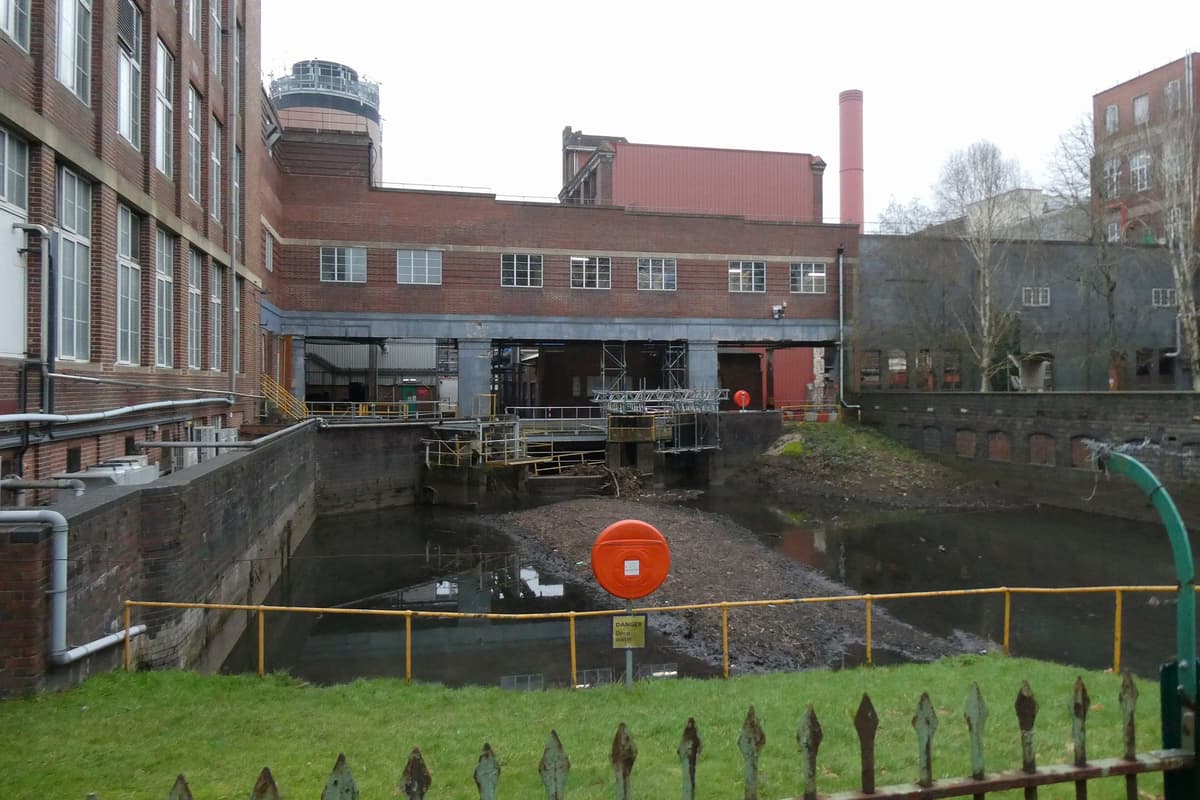
What was here?
Since 1879 this has been Cadbury’s Bournville factory, beside the Bourn brook, the railway and the Worcester and Birmingham Canal. It began on about three acres of a 14½-acre estate with playing fields and sixteen foremen’s houses. Today it is a large modern chocolate works owned by Mondelēz International, with the Cadbury World visitor attraction on site.
History
Out of the town
By 1878 Cadbury Brothers had outgrown its works in Bridge Street, in the centre of Birmingham. Most manufacturers in that position looked for a bigger site in an industrial district. Richard and George Cadbury went to the country. On 18 June 1878 they found the Bournbrook estate, about 14½ acres of meadow with a cottage and a trout stream, between Stirchley, Selly Oak and King’s Norton, four miles from the town. It had a railway station next door and the Worcester and Birmingham Canal, which linked it to the docks at Bristol where cocoa beans arrived.
Business friends in Birmingham thought they were mad. The brothers went ahead. They secured cheap weekly railway tickets for workers who still lived in town, and built on the part of the estate nearest the station. George drew up plans with the Birmingham architect George H. Gadd. Building began early in 1879. Bridge Street closed that summer, and in the autumn the first trainload of workers arrived at Bournville. The name came from the Bourn stream, with a French ending because French chocolate then had the highest reputation.
A factory in a garden
From the start it was meant to be different. There was a cricket and football field for the men and a playground with swings for the girls. There was an orchard, an open-air swimming pool where the Bourn widened, and sixteen semi-detached houses for foremen on the road to the south, let at five shillings a week. Inside were separate dining rooms for men and women, kitchens, heated dressing rooms and, later, separate gardens.
The same spot, then and now
1888–1913
Today
Old map: Ordnance Survey six-inch, reproduced with the permission of the National Library of Scotland (CC BY 4.0). Today: © OpenStreetMap contributors.
“If the country is a good place to live in, why not to work in?” George Cadbury asked, according to Cadbury’s own history.
Growing, and organising
The works grew quickly. In 1880 it employed 303 people. By 1899, when the firm became a limited company, it had trebled in size and employed more than 2,600. By the end of 1911 there were 6,182 workers, and by 1938 about 10,000. A younger generation of directors brought in laboratories, a sales department, a works committee, a medical department and education for young workers. The works became a series of ‘factories within a factory’, making almost everything it needed on site. In 1911 all workers were given paid holidays and brought into a pension scheme.
Life at the works had firm rules. Men and women used separate entrances and did not mix at work. For many years married women were not employed, because, as Edward Cadbury wrote in 1912, the firm felt that a woman “cannot give proper care to the home and children if she is spending the greater part of her time in a factory”. Morning services, held daily for decades, were still held three times a week when the workforce was nearly 5,000.
Wars, mergers and new owners
In the First World War more than 2,000 Bournville men joined the forces, and some buildings became hospitals. In the Second, parts of the works made gun doors for Spitfires and other war work. Cadbury merged its business interests with Fry’s of Bristol in 1918–19, joined Schweppes in 1969, and was taken over by the American company Kraft Foods in 2009–10. Since 2012 the Cadbury brand has belonged to Mondelēz International. Cadbury World, a visitor attraction about the history of chocolate, opened on the site in 1990.
What happened here?
Cadbury Brothers moved here from Bridge Street in 1879 and built up one of Britain’s biggest food factories, with sports grounds, welfare schemes and strict rules on the separation of men and women. The model village of Bournville grew beside it from the 1890s.
Why it mattered
Bournville was one of the first major British factories deliberately moved out to the countryside, and its mix of profitable mass production with welfare and green space was widely studied and copied. It made Cadbury a national name and gave the model village its reason for being.
What’s there now
What survives
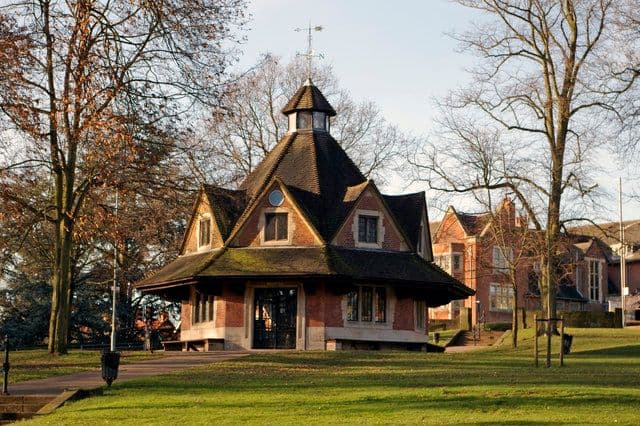
The factory is still working, though much rebuilt and extended over 140 years. Nearby Grade II listed buildings include Bournville Baths and the Men’s Pavilion of the Bournville Club. The Girls’ Recreation Ground, laid out for women workers in the 1890s, was restored for Cadbury’s 200th anniversary in 2024.
Today
A working Mondelēz International chocolate factory, with Cadbury World on Linden Road open to visitors. The works lies between Bournville Lane, Linden Road and the railway, next to Bournville station and the Worcester and Birmingham Canal.
Today
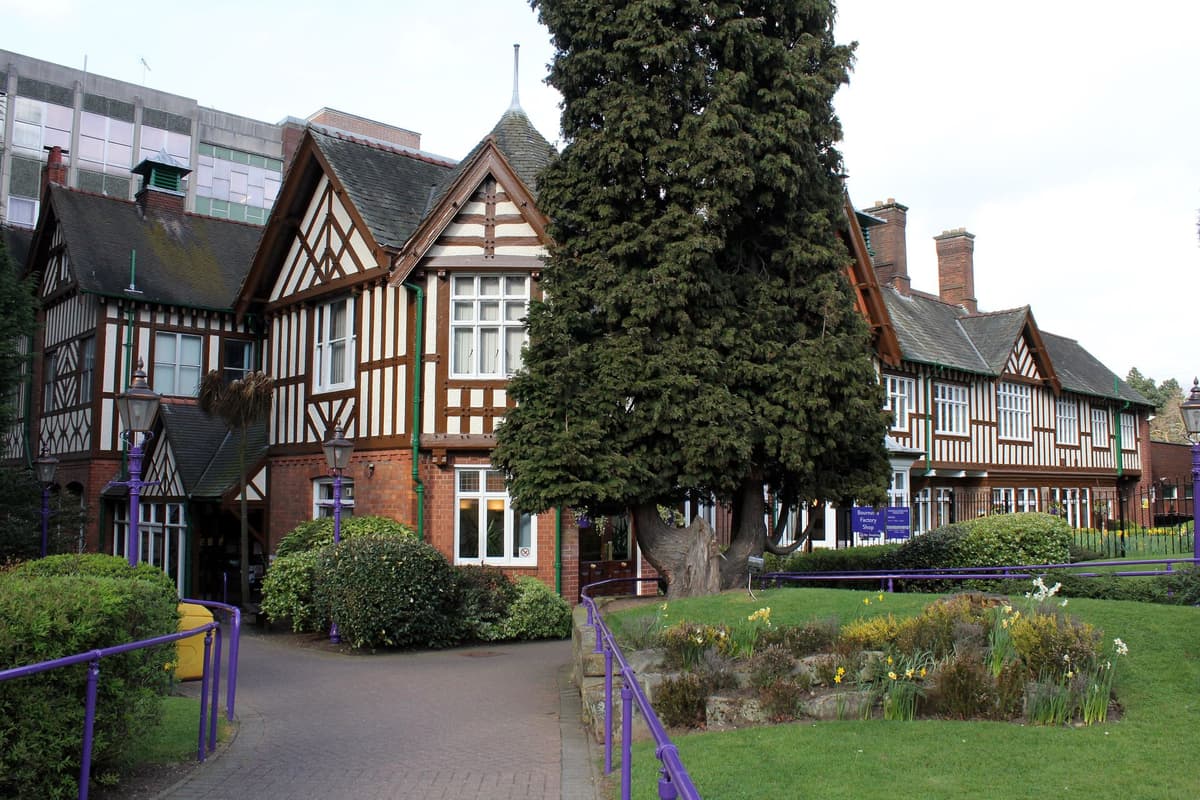
Cadbury works No. 1 Lodge, Bournville Lane, 1 April 2011Jo and Steve Turner, 1 April 2011. Geograph Britain and Ireland, via Wikimedia Commons · CC BY-SA 2.0
Key dates
- 1879 — Cadbury moves to BournvilleRichard and George Cadbury build a new factory on the Bournbrook estate, four miles south of Birmingham, with playing fields and sixteen foremen’s houses. Bridge Street closes and the works moves in the autumn.
- 1909 — Cadbury wins a farthing over slave-grown cocoaEight years after learning that its São Tomé cocoa was grown by forced labour, Cadbury stops buying it in March 1909. Later that year it sues the Standard for libel; the jury finds for Cadbury but awards one farthing.
- 1990 — Cadbury World opens at BournvilleCadbury opens Cadbury World, a visitor attraction about chocolate and the firm’s history, on the Bournville factory site. More than 18 million people had visited by 2025.
Sources and further reading
The start of building is given as January 1879 (Cadbury; Bournville Village Trust) or the end of March 1879 (Gardiner; Dixon). The move is dated September (Cadbury World) or October 1879 (Gardiner). The estate is described as 14½ acres (Cadbury World) or about 15 acres (Gardiner; Dixon). Which of the present factory buildings date from which period has not been established from the sources checked; none of the works buildings appeared on the national list in a search of the Historic England data. Cadbury’s own heritage pages are company publicity and are used here only for dates and quotations.
- Fact Sheet: Bournville Site — The Factory in a Garden — Cadbury World, Cadbury World
- Life of George Cadbury — A. G. Gardiner, Cassell, 1923. ch. 3
- Richard Cadbury of Birmingham — Helen C. A. Dixon (Helen Cadbury Alexander), Hodder and Stoughton, 1906. ch. 18
- Experiments in Industrial Organization — Edward Cadbury, Longmans, Green, 1912
- Cadbury Brothers — Grace's Guide
- The Cadbury Story — Cadbury UK
- A significantly sweet milestone: 35 years of Cadbury World — Merlin Entertainments, 2025
- Cadbury owner invests six-figure sum into Bournville heritage site — Greater Birmingham Chambers of Commerce
- Ordnance Survey six-inch map, second edition (1888–1913), georeferenced — National Library of Scotland
Comments
Comments will load here.