
What is it?
A planned garden village around Bournville Green, laid out by George Cadbury from 1895 on land beside his factory. Its houses, schools, Quaker meeting house, Rest House and almshouses, many designed by W. A. Harvey, are now a conservation area, still run by the Bournville Village Trust.
History
A fear of the speculators
When Richard and George Cadbury moved their works to Bournville in 1879 they built sixteen houses for foremen beside it. As the factory grew, so did the value of the fields round it, and George could see what was coming. If he did nothing, builders would hem the factory in with the same tight streets of back-to-backs that he had left behind. In 1893 he bought about 120 acres near the works and began to plan a village.
His aim, in the brothers’ words as quoted by the Bournville Village Trust, was to “alleviate the evils of modern, more cramped living.” The estate was not to be a company town. The houses were open to anyone, and the community was meant to be mixed in class and occupation.
Cottages and gardens
Building began in 1895. The Birmingham architect William Alexander Harvey, later consulting architect to the trust, designed many of its cottages and public buildings in an Arts and Crafts style. Roads were wide and lined with trees, houses had large gardens, and no building could cover more than a quarter of its plot. At least a tenth of the land, besides roads and gardens, was kept for parks and recreation grounds. By 1900 there were 313 houses.
Given away
In 1900 George Cadbury handed the whole estate, then about 500 acres including the village, to the Bournville Village Trust, under the Charity Commissioners. The rents had to pay for upkeep, with any surplus spent on extending the estate and on housing reform elsewhere. At the date of the gift the trust property was valued at £172,724 and had 370 houses. The trust was separate from the Cadbury business, though family members served as trustees. The deed barred any pub without the trustees’ consent.
The green
The same spot, then and now
1888–1913
Today
Old map: Ordnance Survey six-inch, reproduced with the permission of the National Library of Scotland (CC BY 4.0). Today: © OpenStreetMap contributors.
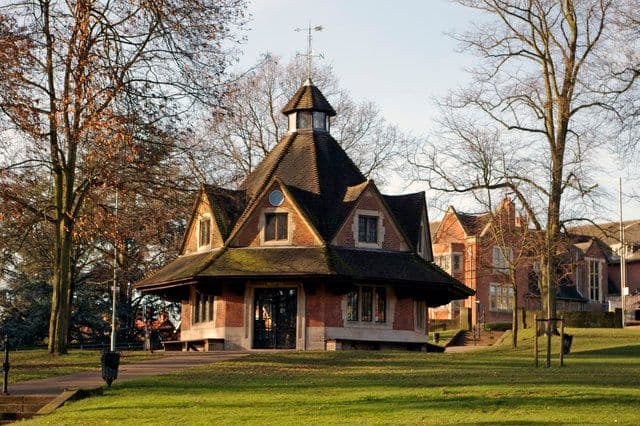
The heart of the village was the triangular green. Around it went the community buildings, nearly all by Harvey. The junior school, built in 1902–05, has a tower with a carillon of 48 bells in its present form of 1934 and, inside, frescoes of 1914. The Friends’ Meeting House of 1905 was built at George Cadbury’s expense and had an organ to welcome other Christians, so that locals called it the ‘Quaker Cathedral’. The octagonal Rest House of 1914, modelled on an old market building at Dunster in Somerset, celebrated George and Elizabeth Cadbury’s silver wedding. Two old timber-framed houses, Selly Manor and Minworth Greaves, were taken down elsewhere and rebuilt here in 1912–16 and 1929–32. Richard Cadbury’s almshouses of 1897, round a quadrangle on Mary Vale Road, were endowed by the rents of houses he built beside them.
Healthier lives
Bournville became a showpiece. Figures quoted by George Cadbury’s biographer for the five years to 1919 gave it a death rate of 7.7 per thousand, against 13.7 for Birmingham, and an infant death rate of 51 per thousand births, against 101 for the city. The village influenced the garden city movement and was copied in Britain and abroad.
When George Cadbury died in 1922 his ashes were placed in a columbarium at the Meeting House on the green. The estate kept growing, and today it covers about 1,000 acres and houses more than 25,000 people.
What happened here?
George Cadbury bought land in 1893, began building in 1895 and in 1900 gave the estate to the Bournville Village Trust, which still runs it. Around the green came schools, a meeting house, the Rest House, almshouses and two rebuilt medieval houses.
Why it mattered
Bournville was one of the most influential housing experiments in Britain. It showed that working people could have well-built cottages with gardens, trees and parks, that a trust could run them for the long term, and that healthier homes meant healthier families. It helped inspire the garden city movement.
Today
What survives
The village survives as a living community. Grade II listed buildings around the green include the Junior School and carillon, the Friends’ Meeting House (with George Cadbury’s bust and columbarium), the Rest House, the walls and seating of the green, the School of Arts and Crafts and Selly Manor. Richard Cadbury’s almshouses (The Quadrangle) on Mary Vale Road and a number of early cottages are also listed.
Today
A residential suburb of south Birmingham, still owned and managed by the Bournville Village Trust. The green, with the Rest House, meeting house, schools and Selly Manor Museum, is a short walk from Bournville station and Cadbury World.
Today
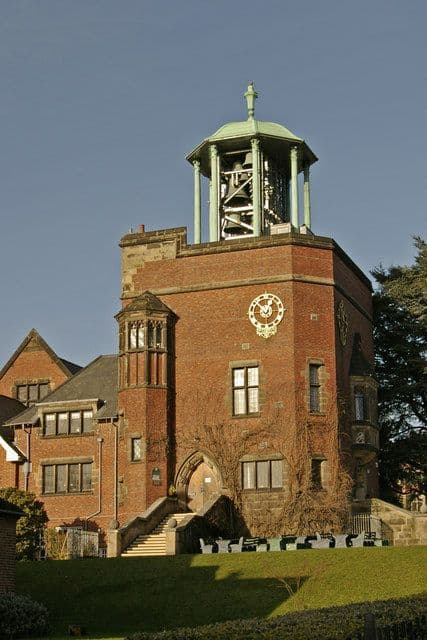
Junior School and Carillon, Bournville, 14 January 2007Phil Champion, 14 January 2007. Geograph Britain and Ireland, via Wikimedia Commons · CC BY-SA 2.0 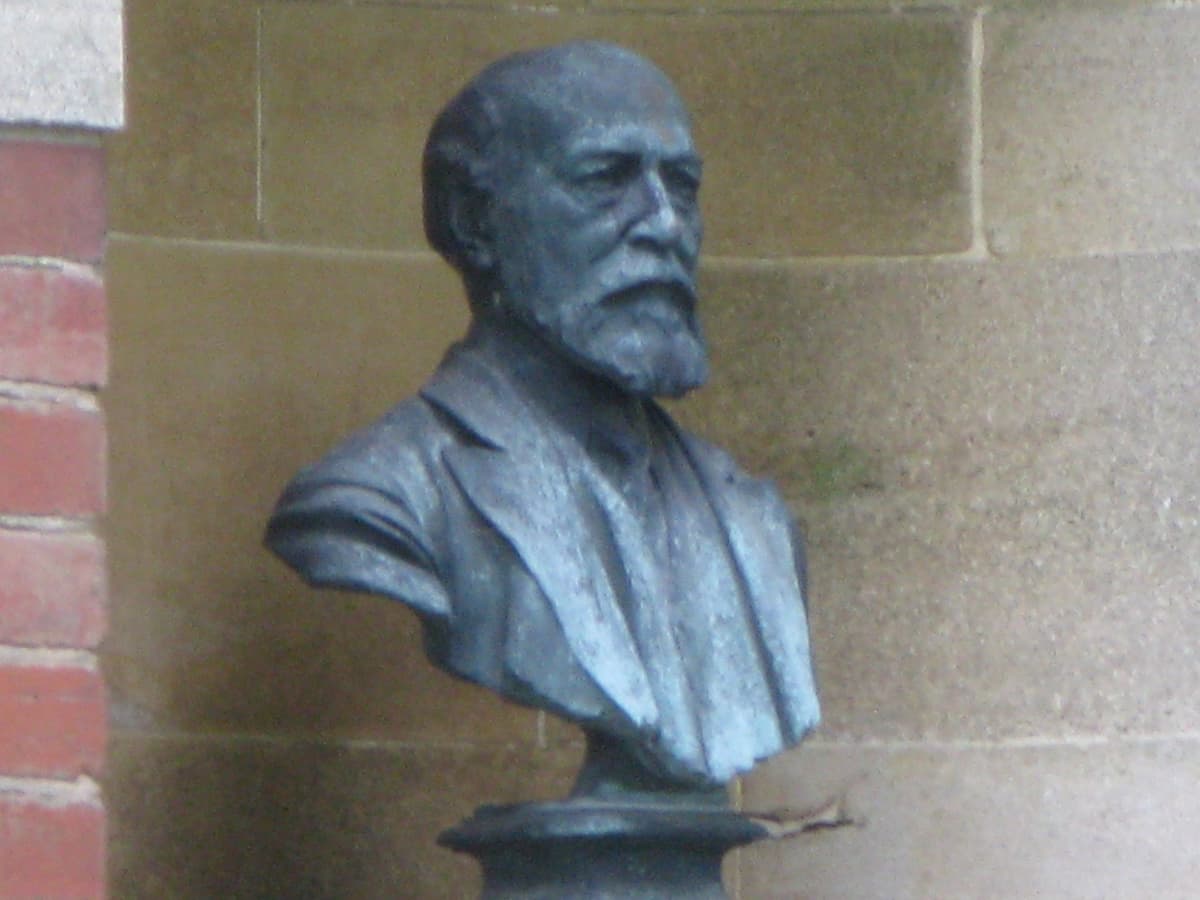
Bust of George Cadbury, Bournville Meeting House, 28 June 2013Brianboru100, 28 June 2013. Wikimedia Commons · CC BY-SA 3.0
Key dates
- 1893 — George Cadbury buys land for a model villageGeorge Cadbury buys about 120 acres near the Bournville works to stop speculative building and to plan a village of cottages with gardens. Building begins in 1895.
- 1900 — Bournville Village Trust foundedGeorge Cadbury gives the Bournville estate, then hundreds of houses on about 500 acres, to a charitable trust, with rents to be spent on the estate and on housing reform.
- 24 October 1922 — Death of George CadburyGeorge Cadbury dies at the Manor House, Northfield. His ashes are placed in a columbarium at the Friends’ Meeting House on Bournville Green, with a bust of him set into the building.
Sources and further reading
The land purchase is dated 1893 by the Bournville Village Trust and Historic England, and 1895 by Gardiner (1923) and a Cadbury World fact sheet; building began in 1895. Gardiner gives 370 houses at the date of the gift and Historic England 313 by 1900, perhaps counting at different dates. The health figures come from Gardiner, an admiring biographer, and the population of the estate may have been younger than the city’s, as he admitted. Harvey’s title of consulting architect to the Trust is from Historic England’s list entry for the meeting house; when he took it up has not been checked.
- Bournville’s story — Bournville Village Trust
- Bournville Quaker Meeting House — National Heritage List for England entry 1076294 — Historic England
- The Rest House, The Green, Bournville — National Heritage List for England entry 1075548 — Historic England
- Bournville Junior School — National Heritage List for England entry 1343070 — Historic England
- The Quadrangle (Bournville Almshouses), Mary Vale Road — National Heritage List for England entry 1076259 — Historic England
- Life of George Cadbury — A. G. Gardiner, Cassell, 1923. ch. 9, ‘The Village’
- Fact Sheet: Bournville Site — The Factory in a Garden — Cadbury World, Cadbury World
- National Heritage List for England — listed building points (open data) — Historic England
Comments
Comments will load here.