
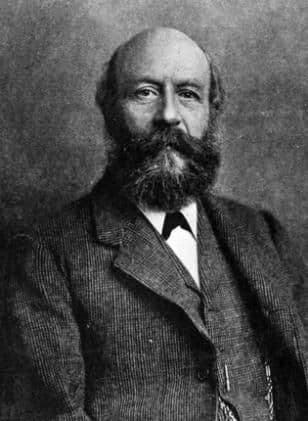
What was here?
John Cadbury’s tea and coffee shop, opened in 1824, with some of the first plate-glass windows in the town. He sold cocoa and drinking chocolate made by hand. In 1849 the shop passed to his nephew Richard Cadbury Barrow.
History
Sink or swim
In 1824 John Cadbury, a 23-year-old Quaker trained as a grocer in Leeds and in the London tea trade, opened as a tea and coffee dealer at 93 Bull Street. His father, the draper Richard Tapper Cadbury, lived and traded close by. John was among the first in Birmingham to put plate glass in mahogany frames in his shop windows, and people came from miles to look.
Alongside tea and coffee he sold cocoa and drinking chocolate that he prepared himself with a pestle and mortar. From the 1830s he made them in a warehouse in Crooked Lane, and in 1847 manufacturing moved to Bridge Street. The family lived in Bull Street until 1835.
A narrow shop with a famous name
One drawing shows the shop as it was. In about 1840 someone drew every shop front on the west side of Bull Street, numbered and named; the sheet is held at Birmingham Archives. No. 93 is a narrow building, only two windows wide, with “CADBURY / TEA DEALER” over the shop front and, beneath it, the words “Cocoa & Chocolate Manufactory in Crooked Lane”. The plot was about 18 feet wide on the 1855 town plan.
Next door, at No. 92, was the family drapery, wider and grander, lettered “B. H. Cadbury, linen draper and silk mercer”: John’s brother Benjamin. White’s directory of 1849 lists “Cadbury Brothers, tea dealers and coffee roasters, 93, Bull street”.
Barrow’s
In November 1849 John and his brother Benjamin gave up the retail trade and handed the shop to their nephew, Richard Cadbury Barrow. The Post Office directory of 1879 still lists “Barrow Richard Cadbury, tea merchant” at No. 93, between a linen draper and a funeral warehouse.
The same spot, then and now
1888–1913
Today
Old map: Ordnance Survey six-inch, reproduced with the permission of the National Library of Scotland (CC BY 4.0). Today: © OpenStreetMap contributors.
Then Birmingham cut Corporation Street through the old town. In 1880 the warehouse and garden behind the shop were sold to the Corporation for the new street, and Barrow built Lancaster Buildings on the corner, according to the Barrow family papers at the Library of Birmingham. The Bull Street building itself was rebuilt in 1903. Barrow’s Stores became one of Birmingham’s best-known grocers and traded on the site until the 1960s. The shop where Cadbury began had outlived its founder’s retail career by more than a century.
What happened here?
The Cadbury business began here in 1824 as a shop selling tea, coffee and home-made cocoa.
Why it mattered
It was the starting point of Cadbury, and of the cocoa trade that made Bournville.
Why it disappeared
Redevelopment
Bull Street has been rebuilt more than once since the 1820s.
John Cadbury’s shop, on today’s streets
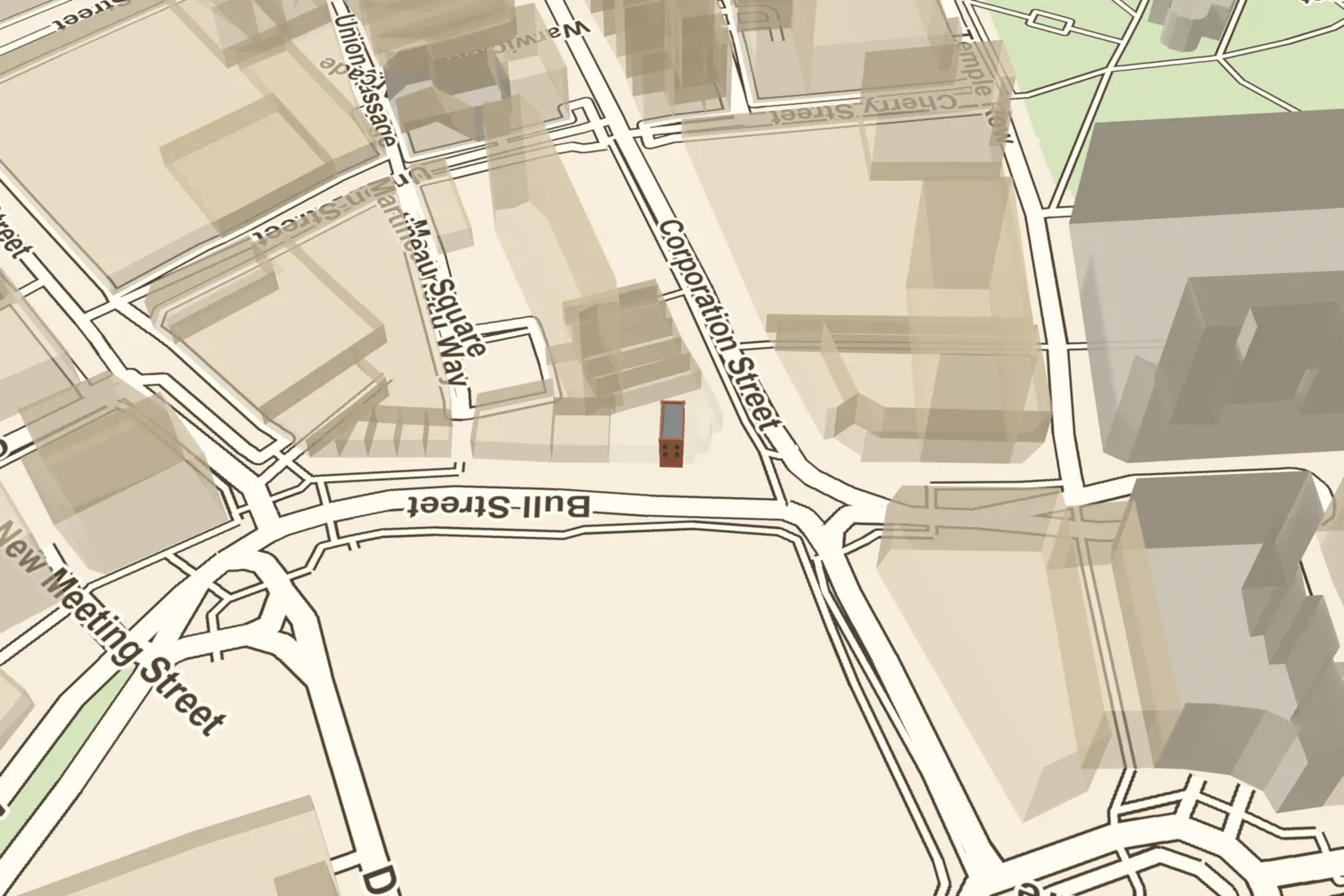
What’s there now
What replaced it
Barrow’s Stores grew on the plot: Corporation Street took the land behind the shop in 1880, Lancaster Buildings went up on the corner, and the Bull Street front was rebuilt in 1903. Today the site is under the block numbered 76 Corporation Street.
What survives
Nothing known. The only picture of the shop is an elevation drawing of about 1840, held at Birmingham Archives, which shows its “CADBURY / TEA DEALER” fascia.
Today
Bull Street and Corporation Street, in the city-centre shopping streets. The Friends’ Meeting House, home of the Quaker meeting the Cadburys attended, is still on Bull Street in a later building.
Key dates
- 1824 — John Cadbury opens his shop in Bull StreetJohn Cadbury, a 23-year-old Quaker, opens as a tea and coffee dealer at 93 Bull Street. He also sells cocoa and drinking chocolate he grinds himself: the beginning of the Cadbury business.
Sources and further reading
The exact plot boundaries are not surveyed: counting plots on the 1855 plan and reading the c.1910 map place the frontage within about 10 metres of each other. The Victoria County History dates the shop to 1834, apparently in error for 1824. No plaque marks the site.
- Richard Cadbury of Birmingham — Helen C. A. Dixon (Helen Cadbury Alexander), Hodder and Stoughton, 1906. ch. 3
- Life of George Cadbury — A. G. Gardiner, Cassell, 1923. ch. 1
- The Cadbury Story — Cadbury UK
- Economic and Social History: Industry and Trade, 1500–1880, in A History of the County of Warwick, vol. 7, pp. 81–139 — W. B. Stephens (ed.), Victoria County History, 1964
- History, Gazetteer and Directory of the Borough of Birmingham — Francis White & Co., 1849. Cadbury Brothers, 93 Bull street
- Post Office Directory of Birmingham — Kelly & Co., 1879. p. 38, Bull Street
- Elevation of the west side of Bull Street, c.1840 — Unknown, Birmingham Archives (reproduced by Mapping Birmingham), c.1840
- Barrow’s Stores — The Iron Room (Library of Birmingham archives blog), Library of Birmingham, 2024. Ref. MS 5094
- Plan of the Borough of Birmingham (Pigott Smith), 1855 — J. Pigott Smith, National Library of Scotland (online), 1855
Comments
Comments will load here.