
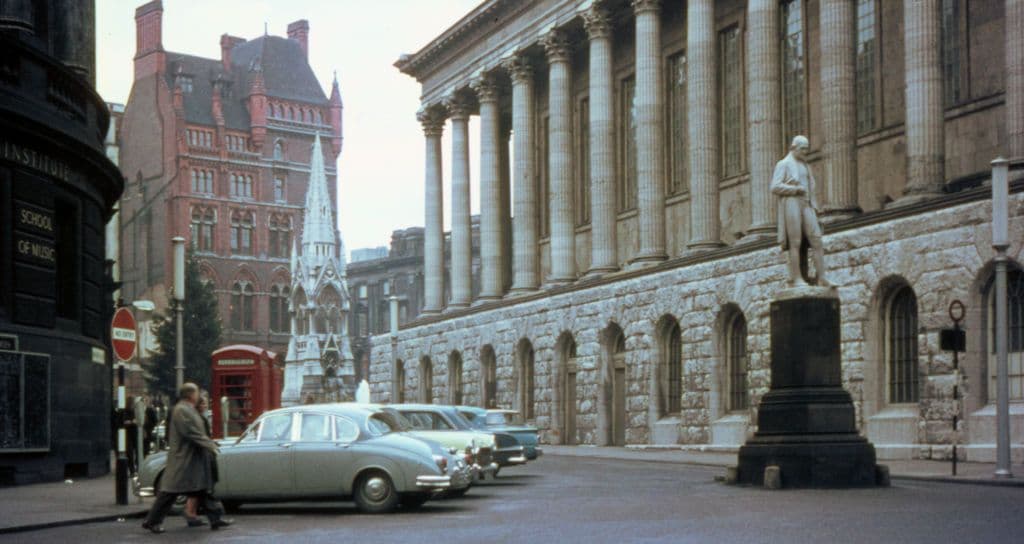
What was here?
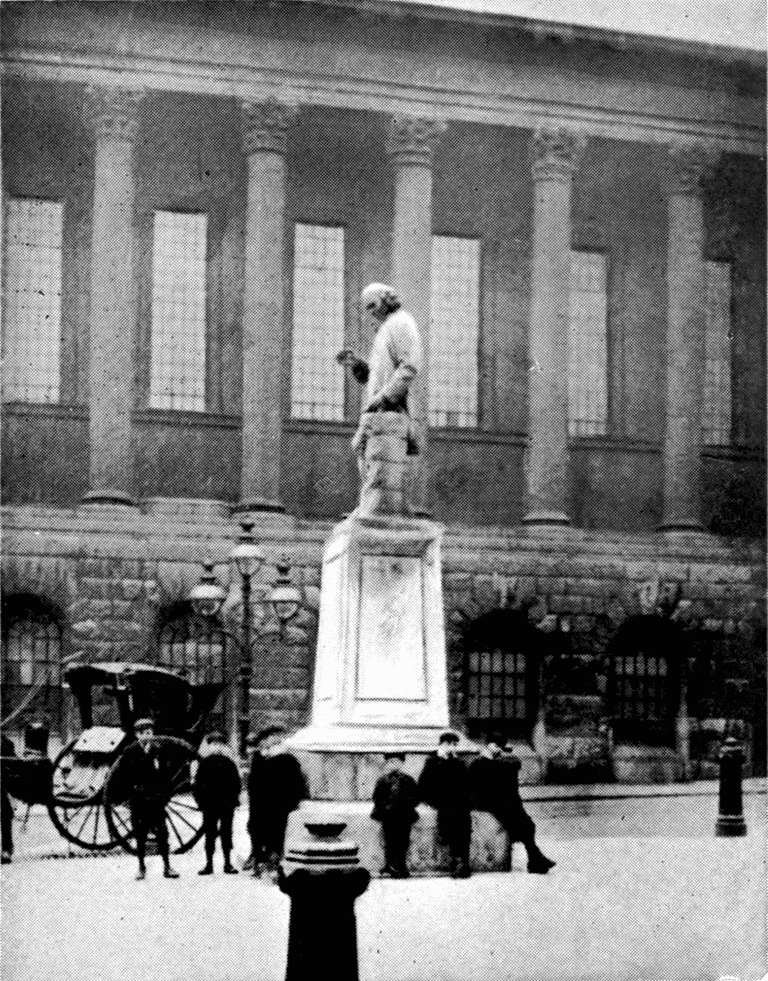
A larger-than-life stone figure of James Watt, compasses in hand and his other hand on the cylinder of a steam engine, set up in Ratcliff Place beside the Town Hall in 1868.
History
A Scot for Birmingham
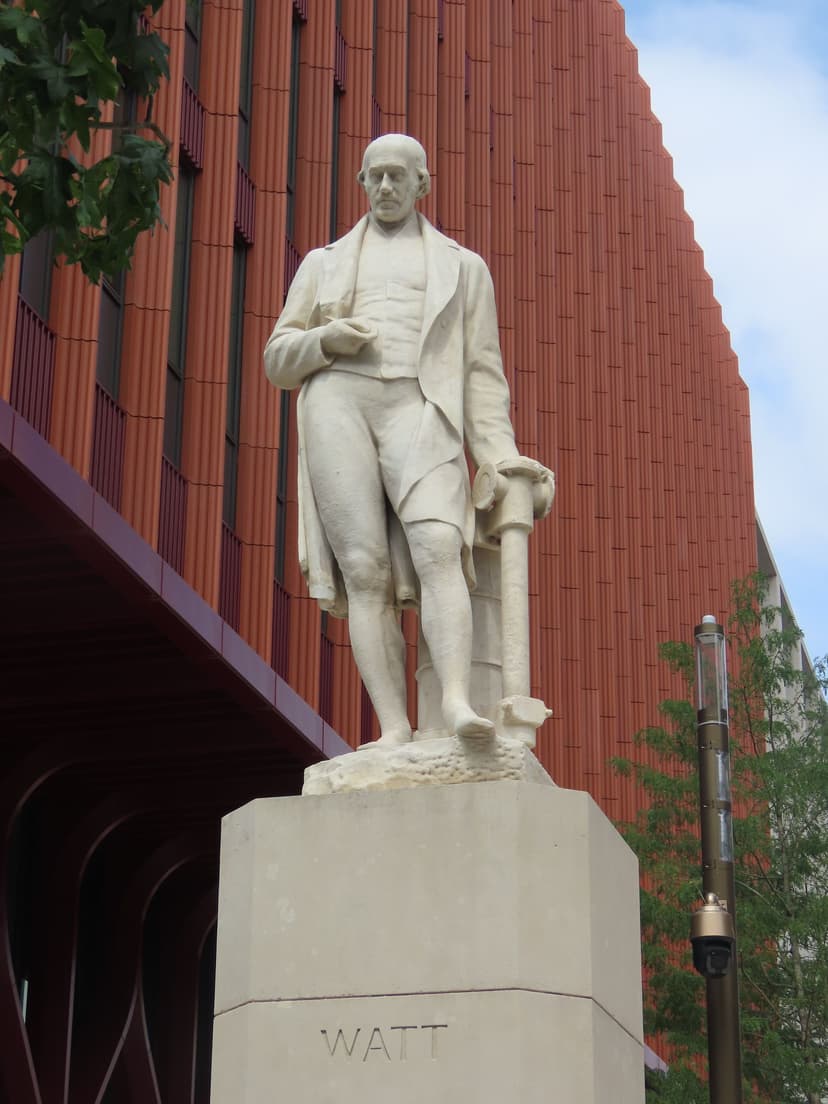
James Watt died in 1819, and Birmingham took half a century to put him on a plinth. The commission went to Alexander Munro, a Scottish sculptor of the Pre-Raphaelite circle. The Dictionary of National Biography lists among his works “a colossal statue of James Watt for Birmingham”. His figure is dated 1868 and signed “Alex Munro Sc”, with one word on the base: WATT.
Munro did not carve a hero striking a pose. Watt leans at ease, a pair of compasses upturned in his right hand, his left resting on the cylinder of a steam engine. It is the instrument maker’s statue, the man who measured things.
On the move
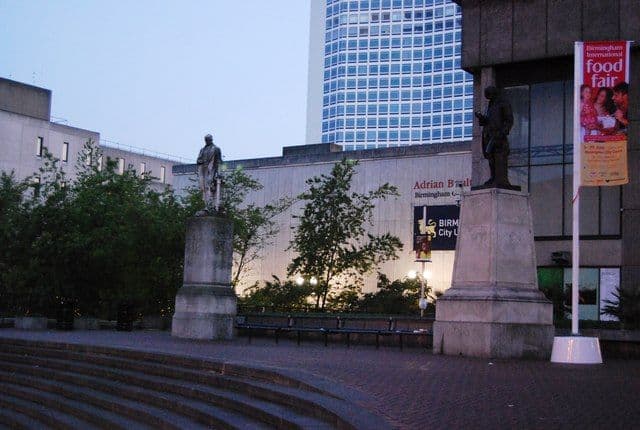
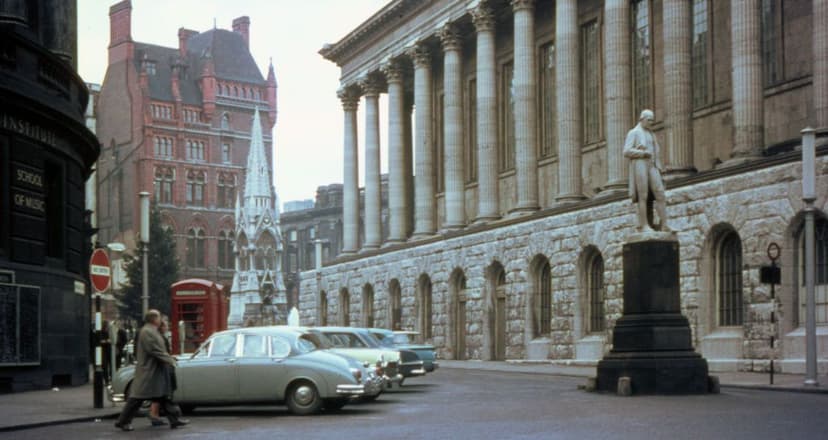
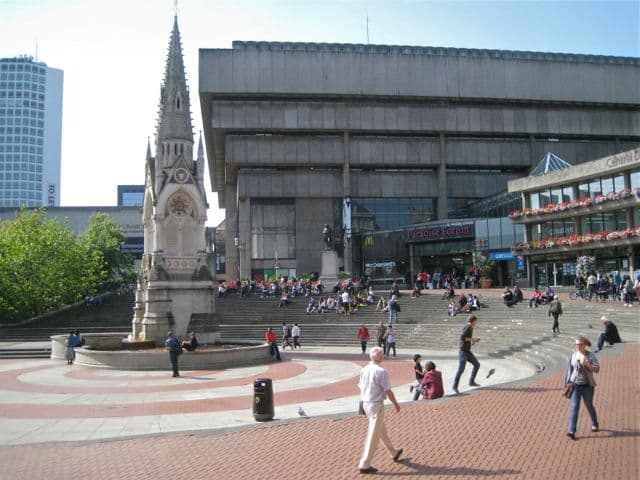
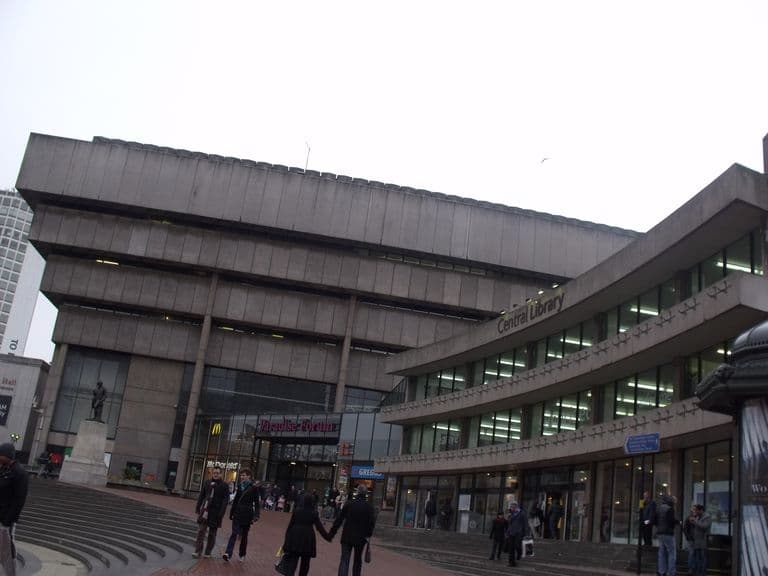
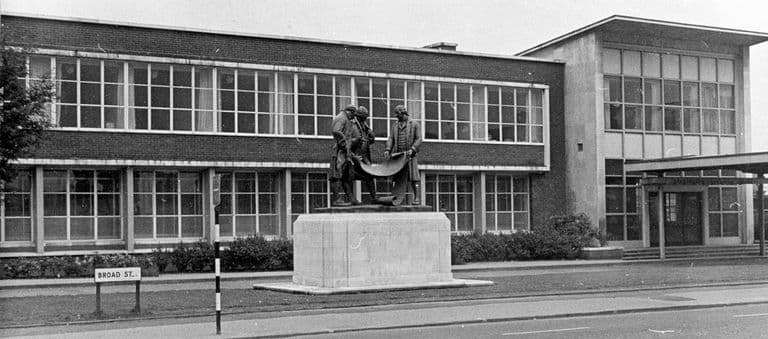
It first stood in Ratcliff Place, the short street between the Town Hall and the old library. A photograph by John Ball shows it still there in 1964, with the Chamberlain Memorial rising behind. When the city rebuilt its civic centre around Madin’s new Central Library, Watt moved a few yards into Chamberlain Square, and there he stayed for more than forty years.
Then came Paradise. The Central Library was pulled down and Chamberlain Square was dug up. In 2015–16 Watt was lifted off his plinth and taken into the care of Birmingham Museums Trust.
Home again
He spent a decade in store. Over the following year Midland Masonry, a stone conservator from Market Drayton, cleaned and repaired him. In July 2026 he went back up, on a 3-metre plinth at the southern end of Ratcliff Passage, the new walkway between Three Chamberlain Square and the Town Hall. Joseph Priestley stands at the other end.
The same spot, then and now
1888–1913
Today
Old map: Ordnance Survey six-inch, reproduced with the permission of the National Library of Scotland (CC BY 4.0). Today: © OpenStreetMap contributors.
It is a short walk from Ratcliff Place, where Munro’s statue was first unveiled. After 158 years and three homes, Watt is back almost where he started.
What happened here?
A public statue of James Watt was set up near the Town Hall in 1868, moved into Chamberlain Square, stored from 2015–16 during the Paradise redevelopment and reinstated at Ratcliff Passage in July 2026.
Why it mattered
It is Birmingham’s Victorian tribute to the engineer whose steam engines, built with Matthew Boulton at Soho, powered the industrial world, and it stands at the heart of the civic quarter the town built on that wealth.
What’s there now
What survives
The 1868 statue itself, cleaned and conserved, on a new plinth.
Today
It stands at the southern end of Ratcliff Passage, by the Town Hall, facing back towards Paradise Street. Priestley’s statue is at the northern end.
Then and now
Then · 1964
Now · 18 July 2026
Key dates
- 1868 — Watt’s statue goes up in Ratcliff PlaceAlexander Munro’s statue of James Watt, compasses in hand, is set up in Ratcliff Place beside the Town Hall.
- July 2026 — Watt and Priestley return to Ratcliff PassageAfter about ten years in store during the Paradise redevelopment, the statues of James Watt and Joseph Priestley are reinstated at either end of Ratcliff Passage, beside the Town Hall.
Sources and further reading
Date: 1868 is the date given by Munro’s carving and most sources; Wikipedia’s list of Birmingham public art gives 1866. The date of the unveiling has not been found.
Material: Paradise Birmingham and its August 2026 press release call it Portland stone; Wikipedia, the van der Krogt statue database and the stock-photo record of the Munro statue call it marble. The text says “stone”.
Moves: the move from Ratcliff Place to Chamberlain Square is dated “mid-1970s” by Wikipedia, while the 2026 press release says the statues stood in the square for 46 years, which points to about 1970. Removal is dated September 2015 (Wikipedia) or 2016 (Paradise Birmingham).
Return: photographs dated 18 July 2026 show the statue in place, and OpenStreetMap was updated on 6 July 2026; the developer’s press release followed on 11 August 2026. The text says July 2026.
The statue is not on the National Heritage List.
- Statues to return to Ratcliff Passage — Paradise Birmingham, Paradise Birmingham, 2026
- Paradise brings back statues of major Birmingham figures — Greater Birmingham Chambers of Commerce, 2026
- James Watt and Joseph Priestley statues return to Birmingham after ten years — TheBusinessDesk, TheBusinessDesk, 2026
- Birmingham – James Watt — R. & D. van der Krogt (Hither & Thither)
- Munro, Alexander — Dictionary of National Biography, 1885–1900 — Dictionary of National Biography
- List of public art in Birmingham — Wikipedia
- OpenStreetMap nodes 2109265229 (James Watt) and 2109265230 (Joseph Priestley) — OpenStreetMap contributors
Comments
Comments will load here.