
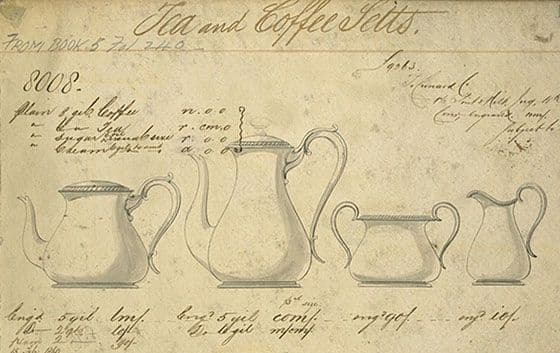
In the 1830s, if you wanted a silver teapot and could not afford solid silver, you bought Sheffield plate: a thin sheet of silver fused or soldered on to copper. It was clever, but it was laborious, and it wore through at the edges. Within twenty years a Birmingham firm had made it obsolete, using electricity.
The toy-maker’s son
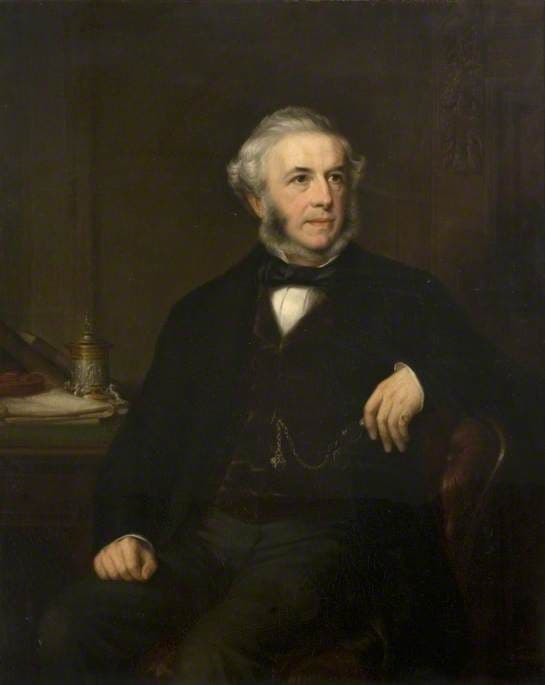
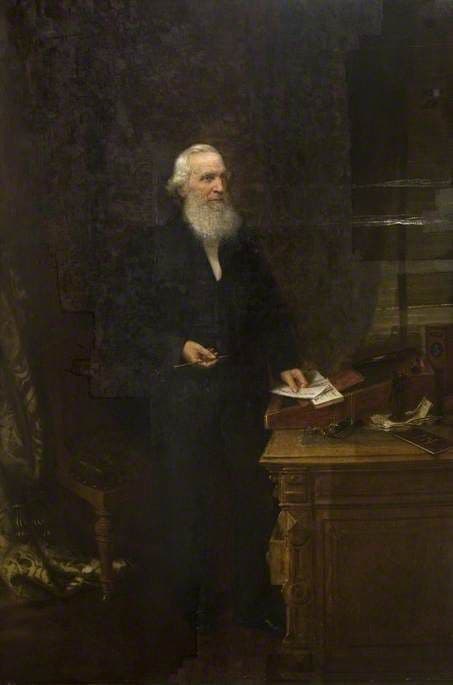
George Richards Elkington was born in St Paul’s Square, Birmingham, on 17 October 1801. His father, James, made gilt toys and spectacles. In 1815 George was apprenticed to his uncles, Josiah and George Richards, also of St Paul’s Square, and was soon taken into partnership. When they died he inherited the business. In 1825 he married Mary Auster Balleny; they had five sons and a daughter.
The Elkingtons were in the old plating and gilding trades, and they were curious. Ever since Michael Faraday’s work on electrolysis, says the Victoria County History, they had followed experiments in depositing one metal on another using an electric current.
The race to plate
The idea was not new. The DNB lists a string of experimenters, from William Wollaston in 1801 to Henry Bessemer in 1834, Moritz Jacobi in 1838 and Spencer of Liverpool in 1839, who had used electricity to lay one metal on another. None had made a business of it.
George worked with his younger cousin Henry Elkington. In 1836 and 1837 they patented methods of gilding with mercury. A patent of 1838 was the first, according to the Dictionary of National Biography, to use a separate electric current.
The breakthrough came from outside the family. John Wright, a Birmingham surgeon, found that silver or gold dissolved in potassium cyanide would deposit as a firm, even coat. The Victoria County History calls Wright “the true inventor”. The Elkingtons bought the process, and the patent was taken out in their names in 1840. Wright was paid a royalty, and after his death in 1844 his widow received an annuity. In 1842 the firm bought another patent, J. S. Woolrich’s, which used a magneto-electric machine instead of batteries to give a stronger, steadier current.
The struggle
Owning the patents was one thing; making them pay was another. The older plating trade resisted, and the process had flaws. The DNB says it took “a seven years’ struggle” before commercial success came. In France the Elkingtons patented their processes in 1842 and ran into a rival claimant, de Ruolz. The two sides compromised, and the Montyon prize was shared between them.
Money came from Josiah Mason, the pen maker, who joined the firm as a partner in the early 1840s; it traded as Elkington, Mason & Co. The great works on Newhall Street, by the Birmingham and Fazeley Canal, were completed by 1841, according to the DNB. The firm also opened a plating works in London and, with Mason, built copper-smelting works at Pembrey in South Wales.
A place of pilgrimage
Supply followed demand. Evans & Askin, a Birmingham firm that refined nickel for the “German silver” used as a base metal, became Elkington’s chief supplier, according to the Victoria County History.
Once it worked, it swept the field. The Victoria County History says electroplating had completely displaced older forms of plating by the middle of the century. The Newhall Street works became “the centre of the trade and a place of pilgrimage for scientists”. Elkington’s had 500 employees by 1850, half the British electroplating trade by 1862 and well over a thousand workers by 1880. It sold from a sumptuous gallery in Regent Street in London. Prince Albert came to Newhall Street, and was given a spider’s web coated in silver by one of the firm’s young chemists, Alexander Parkes.
The firm made more than cutlery and teapots. It used electrotyping to make exact metal copies of works of art, and from 1859 employed the French designer Léonard Morel-Ladeuil, whose Milton Shield was one of the stars of the Paris Exhibition of 1867. The South Kensington Museum, now the V&A, bought Elkington electrotypes so that students could study treasures they would never otherwise see.
George Elkington was remembered as a retiring man. He was made a borough magistrate in 1856 and was a governor of King Edward’s School. The DNB says he was a generous master who built houses and schools for his workpeople. The engineer William Siemens, in an address at the Midland Institute in 1881, spoke of his gratitude to Elkington for his early and generous encouragement. The VCH adds, more drily, that the firm was “reputed to have given Sir William Siemens a start in England by purchasing a process from him, which proved to be unworkable, for a handsome consideration.”
He died of paralysis at his home, Pool Park in Denbighshire, on 23 September 1865. His sons carried on the business.
Why it mattered
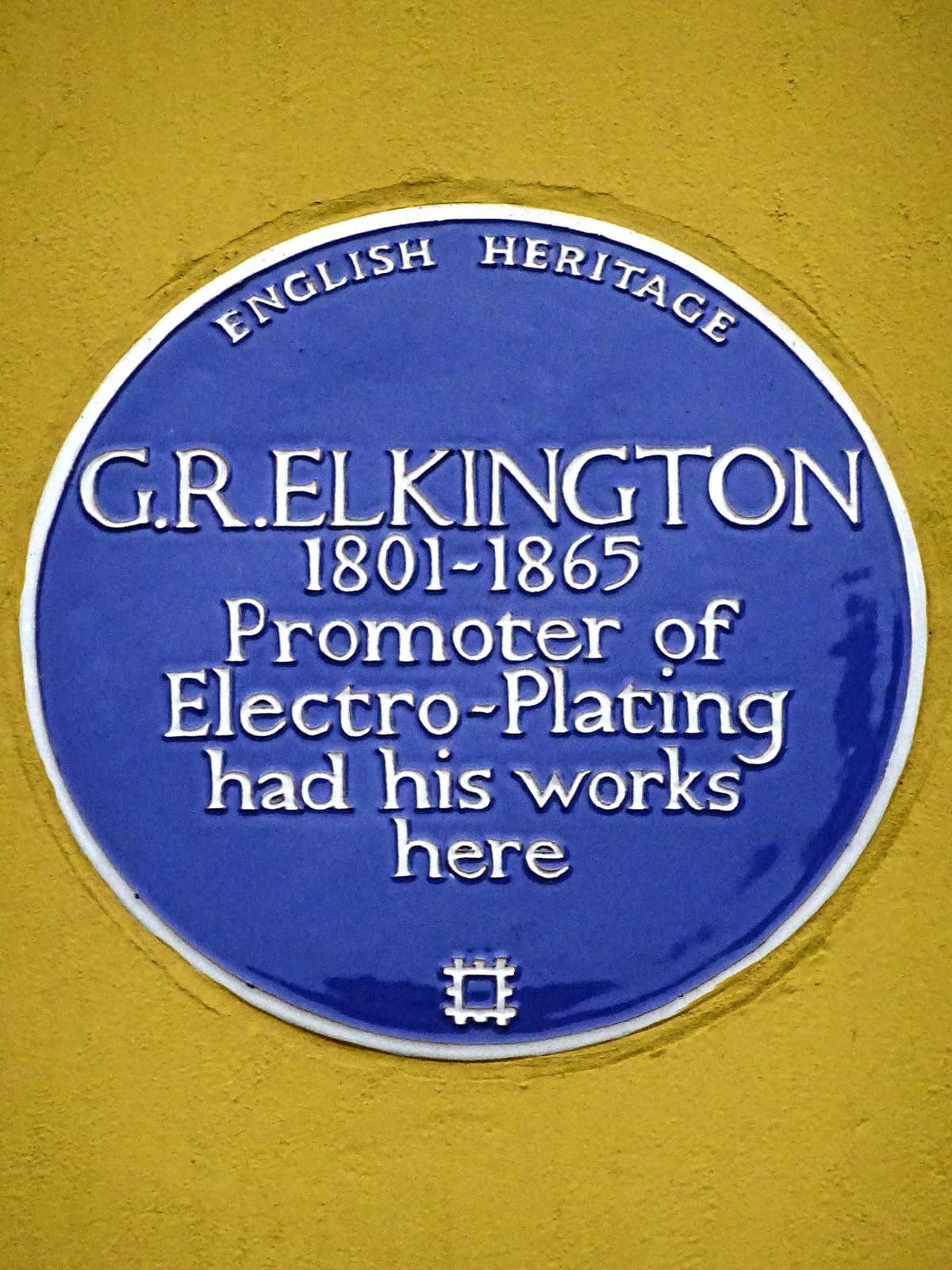
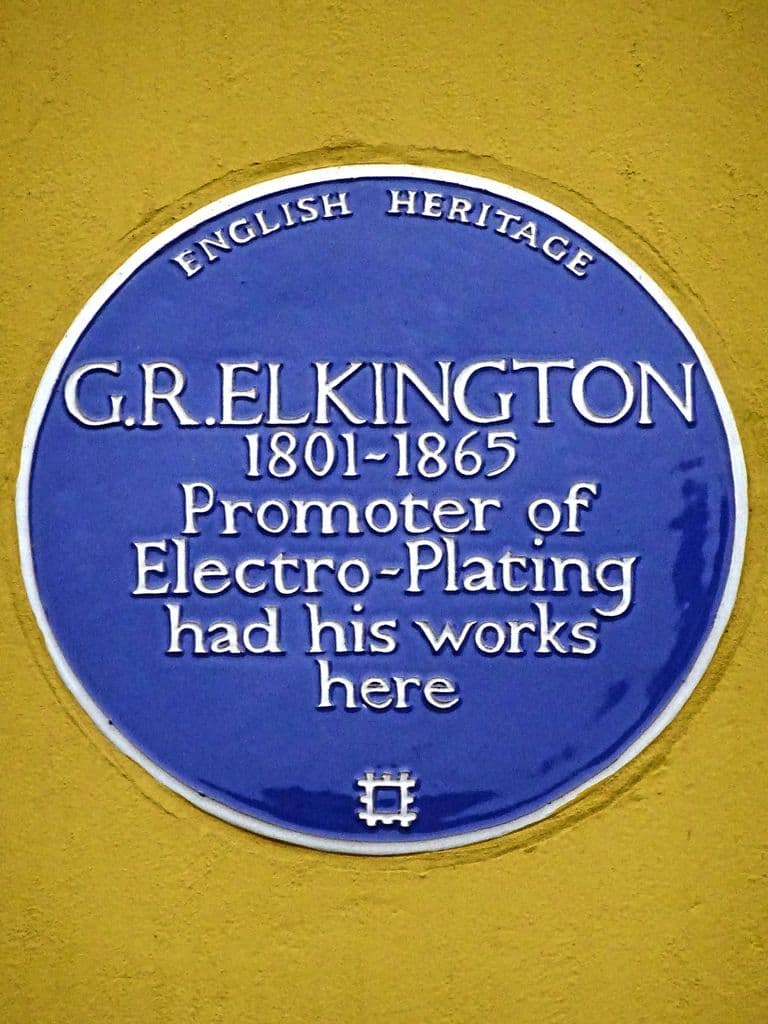
Elkington did not discover electroplating, and he never pretended the cyanide solution was his. His gift was to see what the laboratory had found, buy it, defend it and build an industry around it. Thanks to Newhall Street, silver-plated spoons, teapots and trophies stopped being luxuries and became ordinary things in middle-class homes across the world. The firm trained inventors too: Alexander Parkes worked his way from its casting shop to the first plastic. The firm’s electrotypes taught a generation of art students, and its exhibition pieces still sit in the V&A. Part of the works still stands at 144 Newhall Street, listed Grade II, with a blue plaque calling Elkington the “promoter of electro-plating”. Birmingham had always been the town that made cheap things look precious. Elkington made that true with electricity.
On the map
One place connected with George Richards Elkington. Tap a number for directions — some sites are private homes or gardens, so each place’s page says what you can see from the street.

- Elkington’s electroplating works, Newhall Street — Partly surviving, Surviving but altered · Directions to Elkington’s electroplating works, Newhall Street (opens Google Maps)
Key dates
- 1840 — The Elkingtons’ cyanide electroplating patentA patent in the Elkingtons’ names covers the Birmingham surgeon John Wright’s discovery that silver and gold dissolved in potassium cyanide plate evenly — the process that made commercial electroplating possible.
- 29 March 1842 — Josiah Mason joins the ElkingtonsJosiah Mason signed a partnership deed with George Richards and Henry Elkington, bringing the capital that turned their electroplating patents into a business. The firm traded as Elkington, Mason & Co.
- 23 September 1865 — George Richards Elkington diesGeorge Richards Elkington, who turned electroplating into a world industry, dies at Pool Park, Denbighshire. His sons carry on the firm.
Sources and further reading
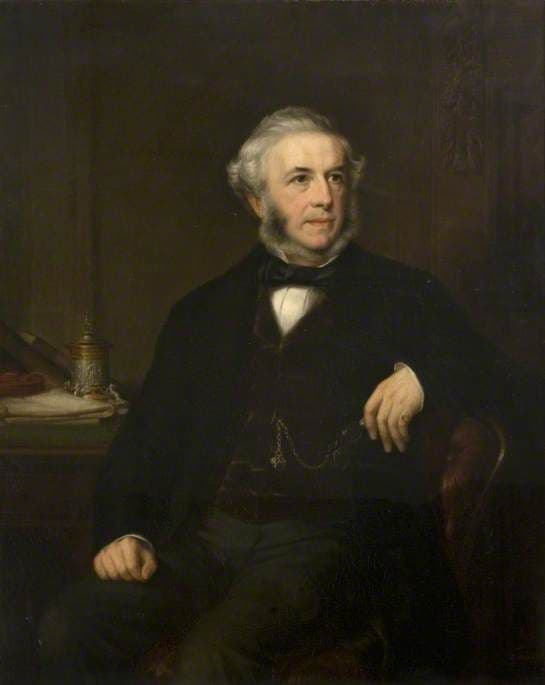
Date of death: the DNB text and the 2003 blue plaque give 1865 (23 September 1865, at Pool Park). The DNB’s own heading says 1801–1866; the text follows 1865. Birmingham Museums’ portrait by Samuel West is titled with a birth year of 1800; the DNB gives 17 October 1801.
The cyanide patent: VCH Warwickshire vol. 7 dates the Wright and Elkington patent to 1840, and Grace’s Guide gives British Patent 8447 of 1840. The DNB says Wright made his discovery in 1842; the text follows the VCH.
The works: the DNB says the Newhall Street works were “completed in 1841”; the existing place record and timeline give 1838 for their opening. They may have opened in 1838 and been completed in 1841.
Mason’s partnership: 1842 (Grace’s Guide) or 1843 (DNB).
French sources do not credit Wright or the Elkingtons as the originators of electroplating (VCH footnote 509).
- Elkington, George Richards — Dictionary of National Biography, vol. 17 (includes Henry Elkington) — William Jerome Harrison, Smith, Elder & Co., 1889
- Economic and Social History: Industry and Trade, 1500–1880, in A History of the County of Warwick, vol. 7, pp. 81–139 — W. B. Stephens (ed.), Victoria County History, 1964. new industries; the large firm
- Elkington and Co — Grace’s Guide, Grace’s Guide to British Industrial History
- George Richards Elkington — Grace’s Guide, Grace’s Guide to British Industrial History
- The Milton Shield (electrotype) — Victoria and Albert Museum, V&A
- Ewer (electrotype), Elkington & Co., 1888 — Victoria and Albert Museum, V&A
- 144 Newhall Street — National Heritage List for England entry 1392797 — Historic England
Comments
Comments will load here.