Before 1840, cheaper silverware meant Sheffield plate: thin silver rolled or soldered on to copper. It was slow to make and wore through.
The discovery
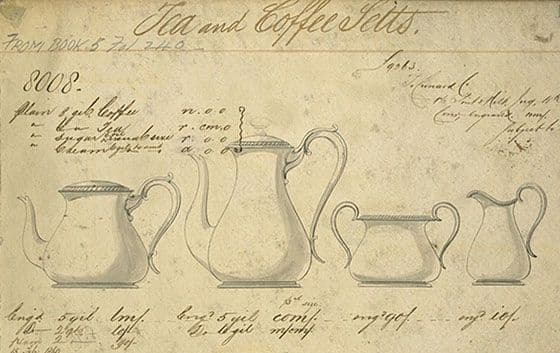
Scientists across Europe had used electric currents to lay one metal on another, and the Birmingham platers George Richards Elkington and his cousin Henry had followed the experiments closely. The key step was John Wright’s. Wright, a Birmingham surgeon whom the Victoria County History calls “the true inventor”, found that silver or gold dissolved in potassium cyanide gave a firm, even coat. The Elkingtons patented the process in their names in 1840 and paid Wright a royalty. In 1842 they bought J. S. Woolrich’s patent for a magneto-electric machine that gave a stronger, steadier current than batteries.
The industry
The old plating trade resisted, and success took years. But by the middle of the century electroplating had swept the older methods away. Elkington’s Newhall Street works became, in the VCH’s words, “the centre of the trade and a place of pilgrimage for scientists”. By 1862 the firm had half the trade, and other Birmingham firms employed about a thousand more. Local refiners of nickel, the base of “German silver”, grew up to supply them.
Electroplating did more than make cheap spoons. Electrotyping produced exact metal copies of works of art, and the South Kensington Museum bought Elkington electrotypes for students to study. One of Elkington’s chemists, Alexander Parkes, learned his craft here before going on to invent the first plastic.
Key dates
- 1840 — The Elkingtons’ cyanide electroplating patentA patent in the Elkingtons’ names covers the Birmingham surgeon John Wright’s discovery that silver and gold dissolved in potassium cyanide plate evenly — the process that made commercial electroplating possible.
- 1841 — Alexander Parkes takes his first patentWorking in Elkington’s casting department, Alexander Parkes patents a process for electro-depositing works of art — the first of dozens of patents.
- 29 March 1842 — Josiah Mason joins the ElkingtonsJosiah Mason signed a partnership deed with George Richards and Henry Elkington, bringing the capital that turned their electroplating patents into a business. The firm traded as Elkington, Mason & Co.
- 26 October 1852 — Henry Elkington diesHenry Elkington, co-patentee of the Elkington plating processes and head of the firm’s artistic side, dies in Birmingham in his early forties and is buried at Northfield.
- 23 September 1865 — George Richards Elkington diesGeorge Richards Elkington, who turned electroplating into a world industry, dies at Pool Park, Denbighshire. His sons carry on the firm.
Sources and further reading
- Economic and Social History: Industry and Trade, 1500–1880, in A History of the County of Warwick, vol. 7, pp. 81–139 — W. B. Stephens (ed.), Victoria County History, 1964. new industries
- Elkington, George Richards — Dictionary of National Biography, vol. 17 (includes Henry Elkington) — William Jerome Harrison, Smith, Elder & Co., 1889
- Elkington and Co — Grace’s Guide, Grace’s Guide to British Industrial History
- Ewer (electrotype), Elkington & Co., 1888 — Victoria and Albert Museum, V&A