
What was here?
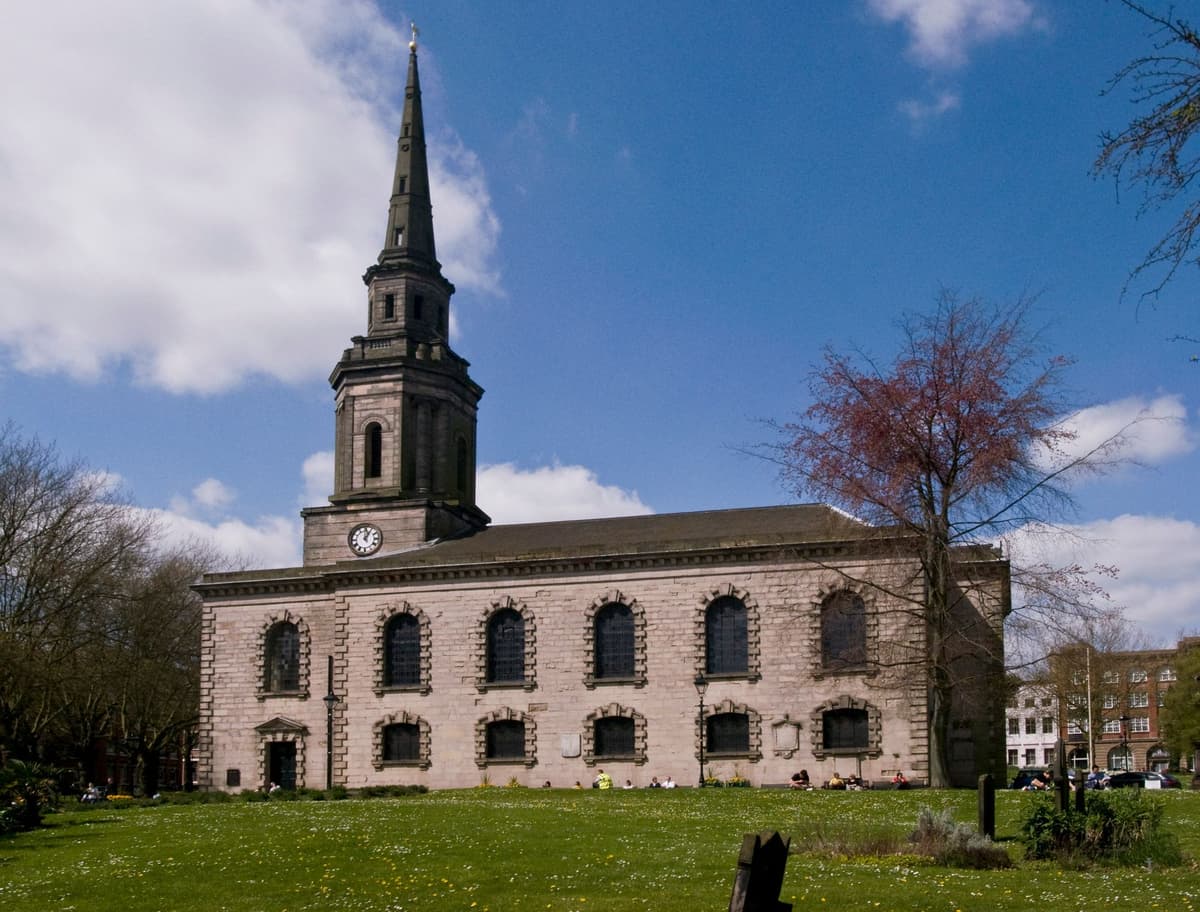
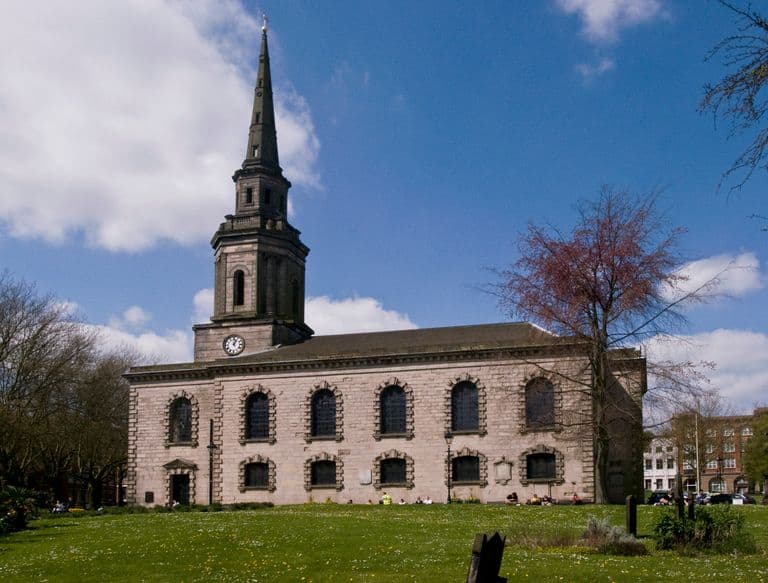
A classical chapel of ease, later a parish church, standing in the middle of a Georgian square. The square was laid out to attract wealthy buyers, and soon filled with merchants and makers of buttons, buckles and steel toys.
History
A church to sell a square
St Paul’s was a piece of property development as much as an act of faith. In 1772 Charles Colmore offered a site for a new church on his Newhall estate, and £1,000 towards building it. Birmingham City Council’s appraisal is blunt about why: “building plots close to a church were easily sold and commanded higher rents.” An Act for the church was passed the same year, and a formal square with a grid of streets was designed round it in the early 1770s.
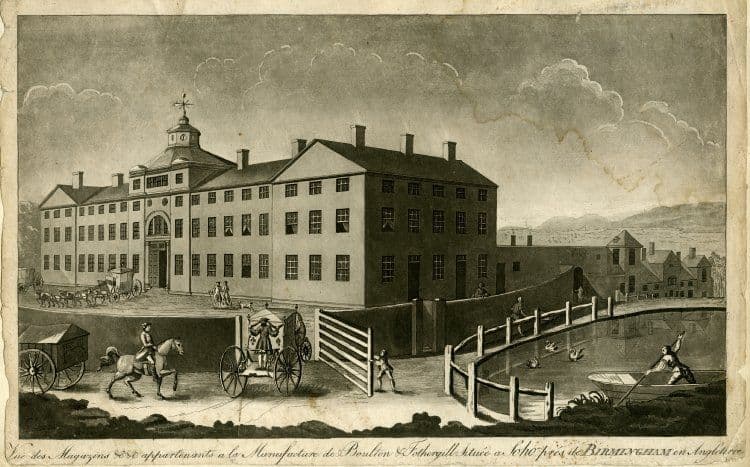
The church was built in 1777–79 as a chapel of ease to St Martin’s, the old parish church. Its designer was Roger Eykyn of Wolverhampton, whom Historic England describes as “master joiner, nurseryman, surveyor and architect”. He produced “a much simplified version” of St Martin-in-the-Fields in London, without the portico. Samuel Wyatt, of the family who worked for Boulton at Soho, was consulted on changes.
Paint, glass and a spire
In 1785 the Birmingham artist Francis Eginton was commissioned to paint the east window, three scenes from the life of St Paul after Benjamin West. It was finished in 1791. Eykyn’s steeple was never completed above the tower. The present belfry and spire, a Grecian design by Francis Goodwin, were added in 1822–23. Inside, the galleries, box pews and fittings are nearly all of the late eighteenth century, and there are monuments by the sculptor William Hollins.
Workshops behind the houses
The square was meant to be smart. It quickly became something else. By the 1780s, says the council’s appraisal, some of its elegant townhouses had workshops at the back, occupied by makers of buttons, buckles and steel toys. As the jewellery trade spread over the hill, St Paul’s became known as “the Jewellers’ Church”. It was given its own parish in 1841.
The same spot, then and now
1888–1913
Today
Old map: Ordnance Survey six-inch, reproduced with the permission of the National Library of Scotland (CC BY 4.0). Today: © OpenStreetMap contributors.
In November 1940 an air raid destroyed the Thomas Walker fastener factory on the square, built only in 1934. It was rebuilt within eighteen months.
Saving the square
In 1971 St Paul’s Square was made a conservation area, only four years after the law that created them. At first the reason was its Georgian town planning more than its industry. In 2000 it became part of the wider Jewellery Quarter Conservation Area. The church was listed at Grade I in 1952.
What happened here?
A Georgian church and square laid out from 1772 to sell building plots on the Colmore estate. The houses around it soon held workshops, and the church became the parish church of the jewellery trade.
Why it mattered
The church and square show how the Jewellery Quarter began: as a speculative estate for the well-off that quickly filled with skilled trades.
What’s there now
What survives
The church of 1777–79 with Goodwin’s steeple, its Georgian interior, galleries and box pews, Eginton’s east window and the Hollins monuments. The square keeps its 18th-century layout, with some Georgian houses and later works around it.
Today
A working Church of England parish church in a square of offices, flats, bars and restaurants. The church still stands in its churchyard in the middle of the square.
Key dates
- 1777–79 — St Paul’s Church built in the new Colmore squareSt Paul’s is built on land given by Charles Colmore, at the centre of a new square laid out to sell building plots. Within a few years the houses around it have workshops behind them.
Sources and further reading
Building dates: 1777–79 (council appraisal) or 1776–79 (Historic England). The list entry says Samuel Wyatt’s involvement was ‘apparently’ in amendments to Eykyn’s design. The church’s association with Boulton and Watt as worshippers is often repeated but has not been checked and is left out here.
- Church of St Paul, St Paul’s Square — National Heritage List for England entry 1220815 — Historic England
- Jewellery Quarter Conservation Area Character Appraisal and Management Plan — Birmingham City Council (Donald Insall Associates), 2002. sections 3.1–3.3
Comments
Comments will load here.