
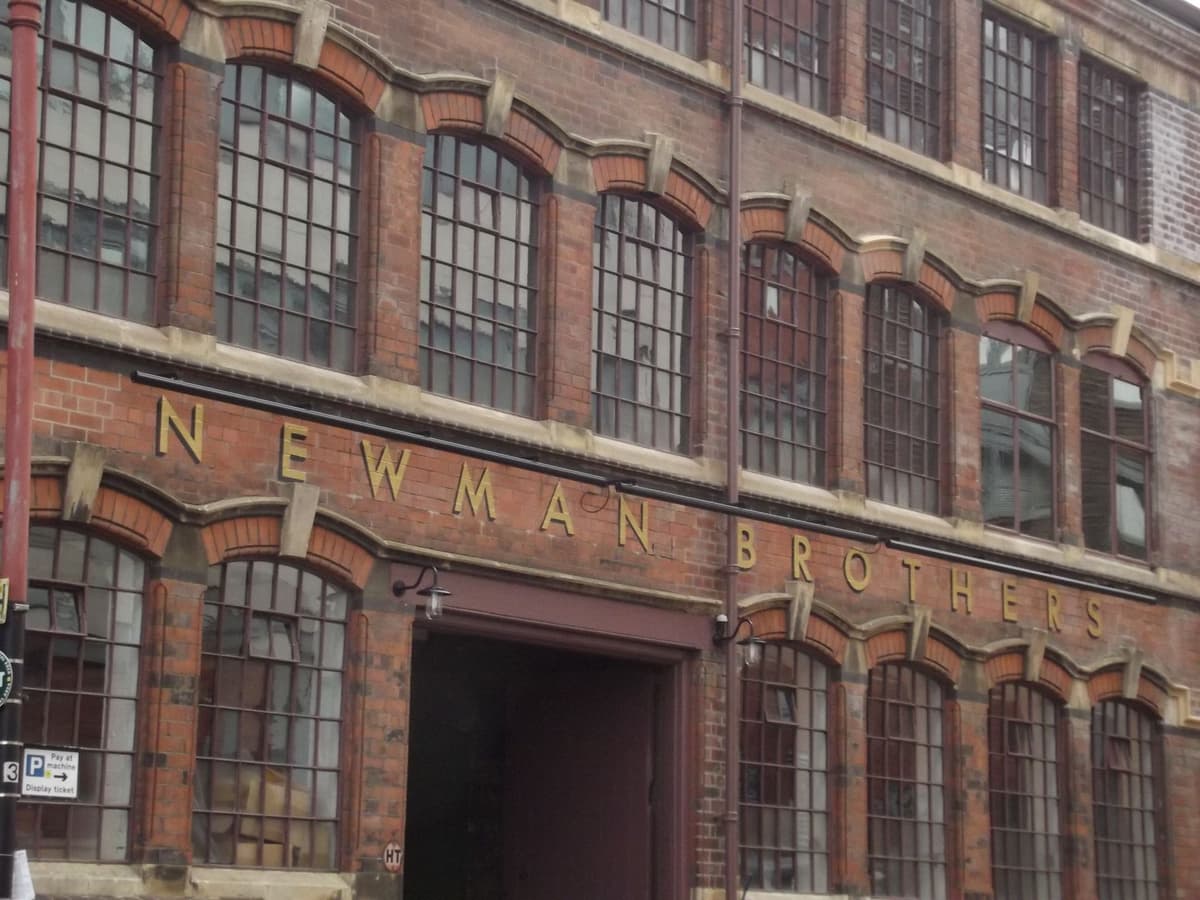
What is it?
The works of Newman Brothers, who made the metal fittings for coffins (handles, breastplates, crucifixes and ornaments) and, on the top floor, shrouds and robes. The firm worked here from 1894 until it stopped trading at the end of the 1990s.
History
Brass founders
Newman Brothers began in 1882 as brass founders, set up by two brothers, Alfred and Edwin Newman. Ten years later they commissioned a new works at 13–15 Fleet Street, on the southern edge of the Jewellery Quarter, and moved in by 1894.
They were part of a building wave. Around 1900 the Quarter was at its busiest, and firms short of room cleared old courts of workers’ houses on its fringes to build. Birmingham City Council’s appraisal picks out “the modest brassworking manufactories built on Fleet Street in the 1890s” as an example.
Death, made in Birmingham
Newman Brothers made coffin furniture: everything metal that goes on a coffin, from handles and breastplates to crucifixes and decorative ornaments. On the top floor they made shrouds and robes. The museum says its fittings were used at the funerals of Winston Churchill, Princess Diana and the Queen Mother.
Historic England’s list entry describes how the factory worked. The three-storey front range held the warehouse, the office and the showroom, with a hand-operated hoist serving every floor. Behind it, along one side of a long narrow yard, ran the workshop range, or “shopping”. On the ground floor, the press shop held hand-operated fly presses on benches below the windows, a battery of four drop stamps against the back wall, and shelves of stamping dies. Line shafting with pulleys ran along the ceiling. Next door was the plating shop, with its vats. Upstairs, workers polished and finished the goods using gas soldering lights known as “Birmingham side-lights”. A small brick furnace survives.
The last owner
The same spot, then and now
1888–1913
Today
Old map: Ordnance Survey six-inch, reproduced with the permission of the National Library of Scotland (CC BY 4.0). Today: © OpenStreetMap contributors.
Trade fell away in the later twentieth century. Joyce Green joined the firm as office secretary in 1949, became company secretary in the 1950s and in 1989 its sole owner. Newman Brothers stopped trading at the end of the 1990s. Nobody cleared the building. Machinery, workbenches, furniture, dies and more than 800 boxes of stock and paperwork stayed where the workers had left them.
Historic England listed the works at Grade II* in April 2000, calling it “a near-complete example of a C19 Birmingham metal-working factory complex”, with much original machinery in place. “Such survivals,” the list entry adds, “are now extremely rare in Birmingham.”
Saving it
Joyce Green campaigned for the factory to become a museum. In 2003 it was sold to the regional development agency, Advantage West Midlands. In 2010 Birmingham Conservation Trust bought it with a grant from Birmingham City Council. The Heritage Lottery Fund awarded just under £1 million in 2011, towards a project of about £2 million. Work ran from July 2013 to September 2014, and the Coffin Works opened in October 2014.
What happened here?
From 1894 Newman Brothers stamped, plated, polished and packed coffin fittings here, and made shrouds on the top floor. When the firm closed, the building and its contents were left almost intact, and are now a museum.
Why it mattered
It is one of the most complete small metalworking factories left in Birmingham, with its machines still in place. It shows how a Jewellery Quarter works was laid out and run, from showroom to press shop.
Today
What survives
The whole works: the 1892–94 front range, the rear workshop range, the press shop with fly presses and drop stamps, the plating shop, upper finishing workshops, the office and showroom, and the stock, dies and paperwork.
Today
A museum run by Birmingham Conservation Trust, with offices and commercial units in part of the building.
Today
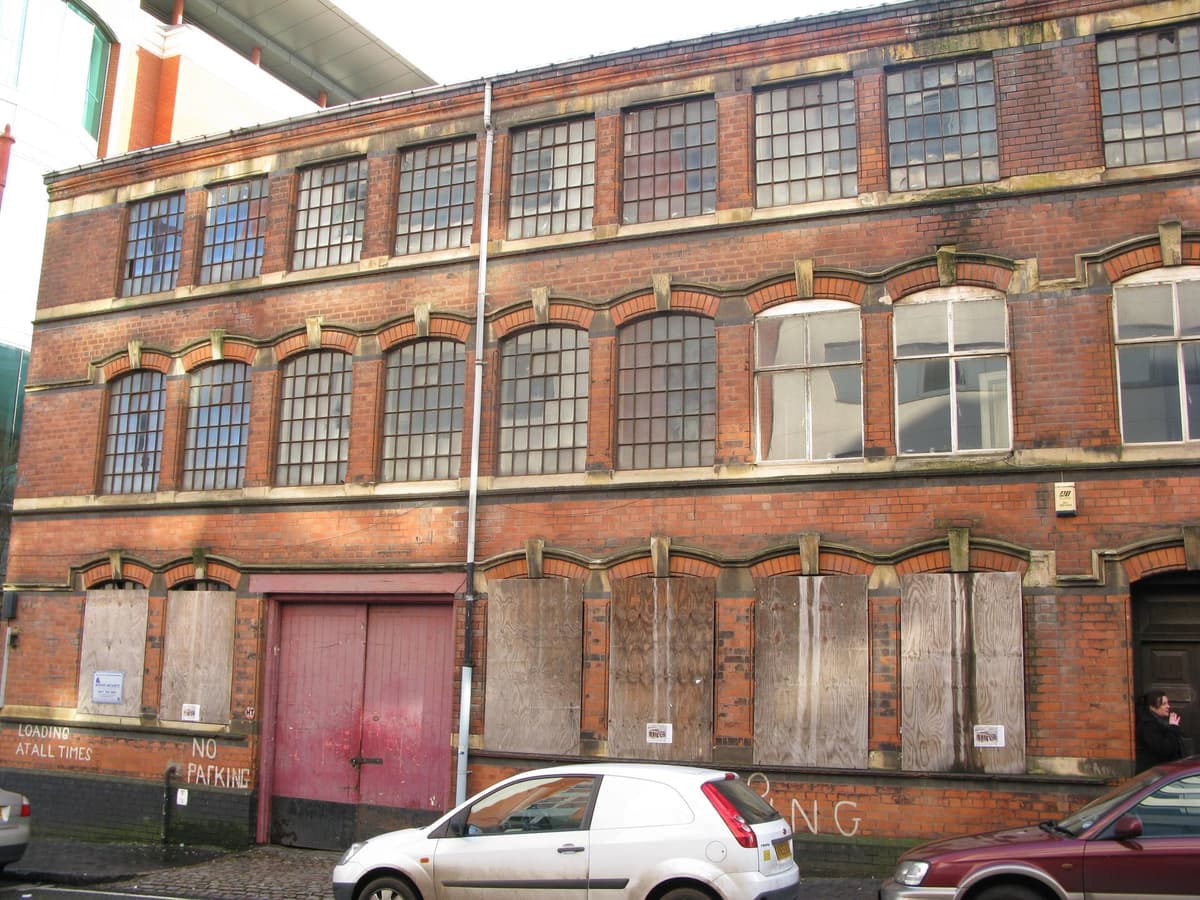
Coffin Furniture Works, 13–15 Fleet Street, 11 January 2013Brianboru100, 11 January 2013. Wikimedia Commons (own work) · CC BY-SA 3.0
Key dates
- 1894 — Newman Brothers move to Fleet StreetThe brass founders Newman Brothers move into their new works at 13–15 Fleet Street, where they make coffin furniture for over a century.
- October 2014 — The Coffin Works opens as a museumAfter a campaign by its last owner, Joyce Green, and a £2 million restoration by Birmingham Conservation Trust, Newman Brothers’ factory opens as a museum.
Sources and further reading
The date the firm stopped trading is 1998 on the Coffin Works website and in Wikipedia, and 1999 in Birmingham Conservation Trust’s project page. The architect is ‘Richard Harley’ in the Historic England list entry and ‘Roger Harley’ in Wikipedia. Wikipedia says the building was listed in 2001; the list entry gives 18 April 2000. Wikipedia names Joseph Chamberlain among the famous funerals; the museum’s own website names Churchill, Princess Diana and the Queen Mother.
- Coffin Furniture Works, 13–15 Fleet Street — National Heritage List for England entry 1380231 — Historic England
- Newman Brothers history 1894–1999 — Newman Brothers at the Coffin Works
- Newman Brothers Coffin Works — Birmingham Conservation Trust
- Jewellery Quarter Conservation Area Character Appraisal and Management Plan — Birmingham City Council (Donald Insall Associates), 2002. section 3.2
- Newman Brothers Coffin Furniture Factory — Wikipedia
Comments
Comments will load here.