
What was here?
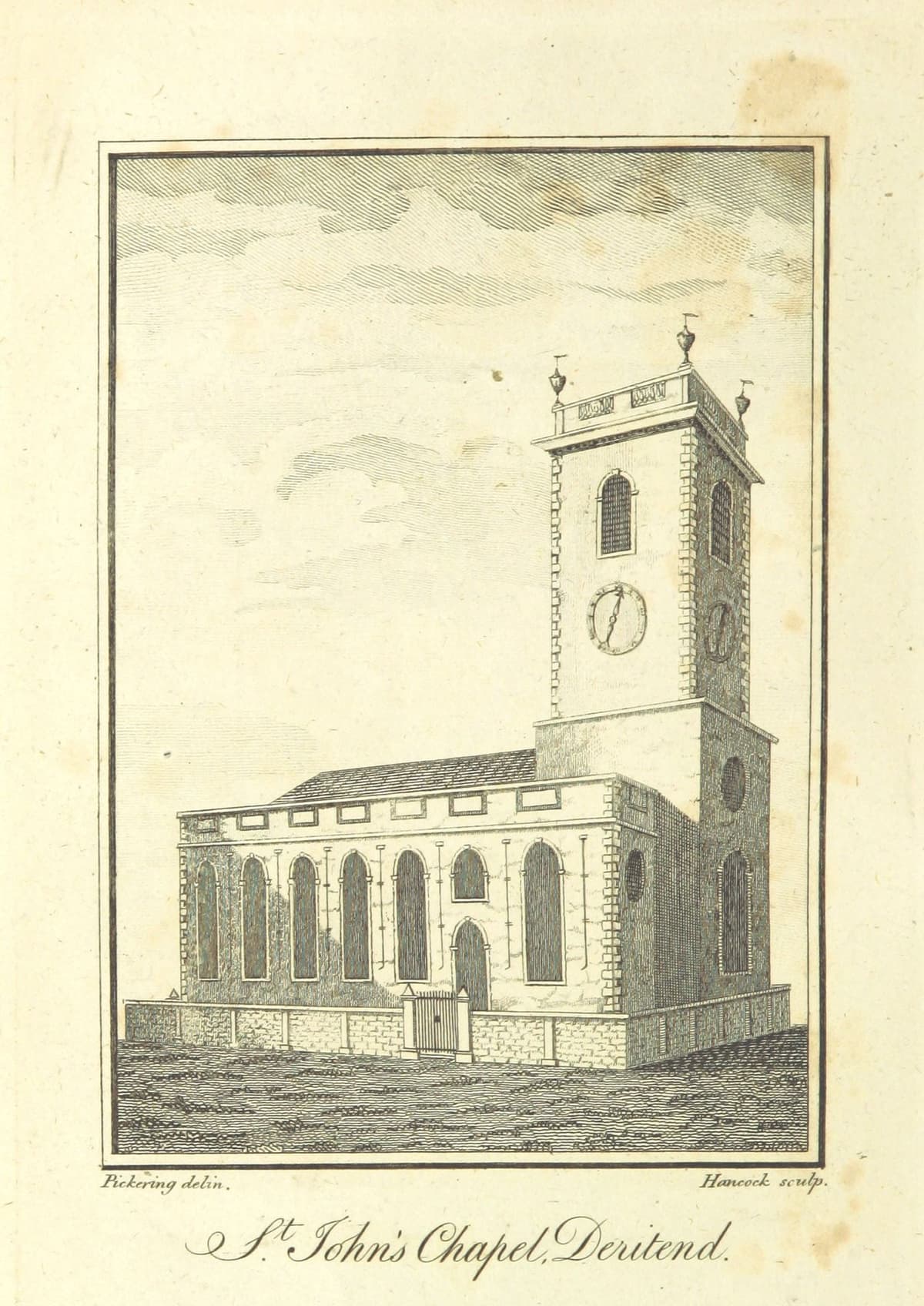
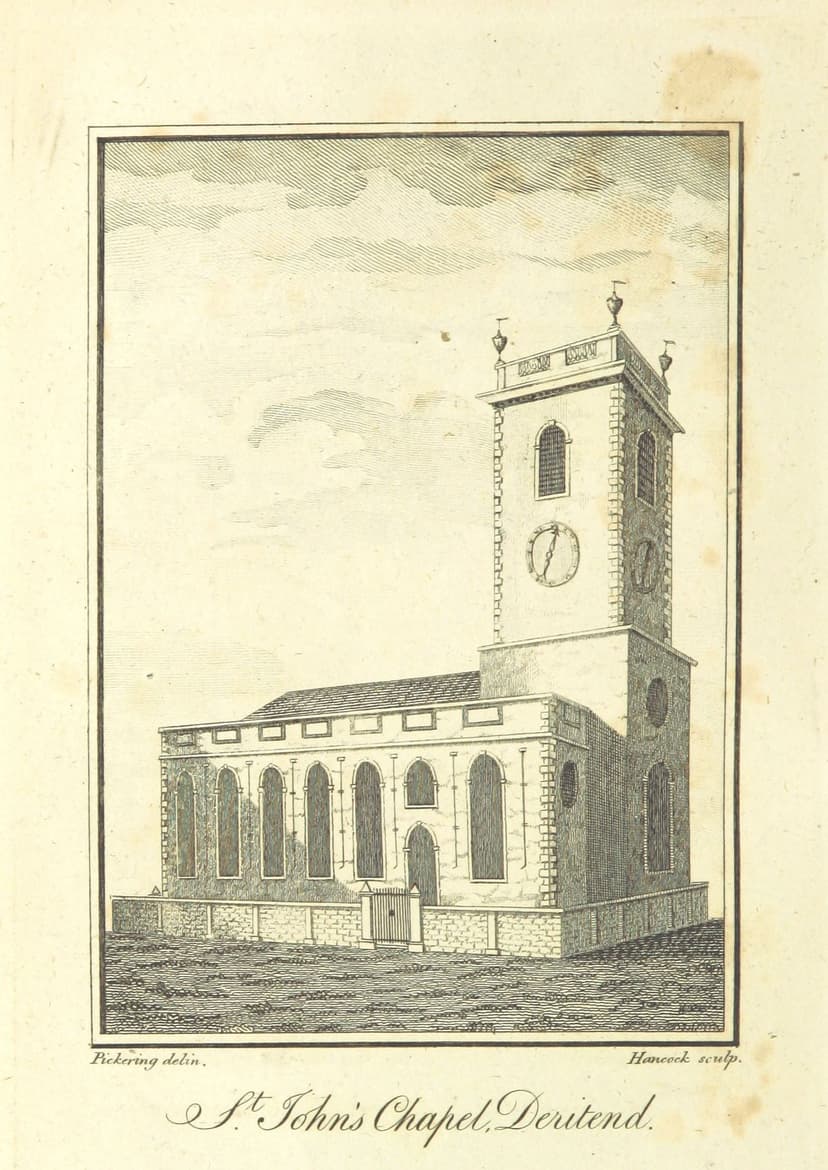
The chapel, and later parish church, of Deritend: a brick church of 1735 with tall round-headed windows and a two-stage west tower topped by a balustrade and urns. It stood on the south side of High Street Deritend at the corner of Chapel House Street, on the site of a medieval chapel that was already there in 1381.
History
A chapel across the river
In the fourteenth century Deritend was not part of Birmingham at all. It lay on the far bank of the River Rea, a hamlet in the huge parish of Aston, and Aston church was a long walk away. In winter the river flooded.
So the people of Deritend and Bordesley got a chapel of their own. In 1381 they won an agreement that let them appoint their own chaplain in the newly built chapel of St John the Baptist. The reason, as the Victoria County History puts it, was “the distance … from the parish church and the flooding of the river in winter”. The bishop ratified it, and in 1383 a licence was granted to endow a chaplain.
That right was precious, and it lasted. The chapel was tied to the guild of Deritend, which in the early sixteenth century paid two priests, one of them a schoolmaster. Centuries later the inhabitants were still electing their own minister. At the election of 15 June 1870 the winner took 3,800 votes to 2,299. The right ended only in 1890, when St John’s became a parish.
Brick, bells and a martyr
The medieval chapel was small, with a steep roof and a little bell-turret. William Hutton, the town’s first historian, did not admire it. He said it resembled “a barn, with something like an awkward dove-coat, at the west end, by way of steeple”.
The same spot, then and now
1888–1913
Today
Old map: Ordnance Survey six-inch, reproduced with the permission of the National Library of Scotland (CC BY 4.0). Today: © OpenStreetMap contributors.
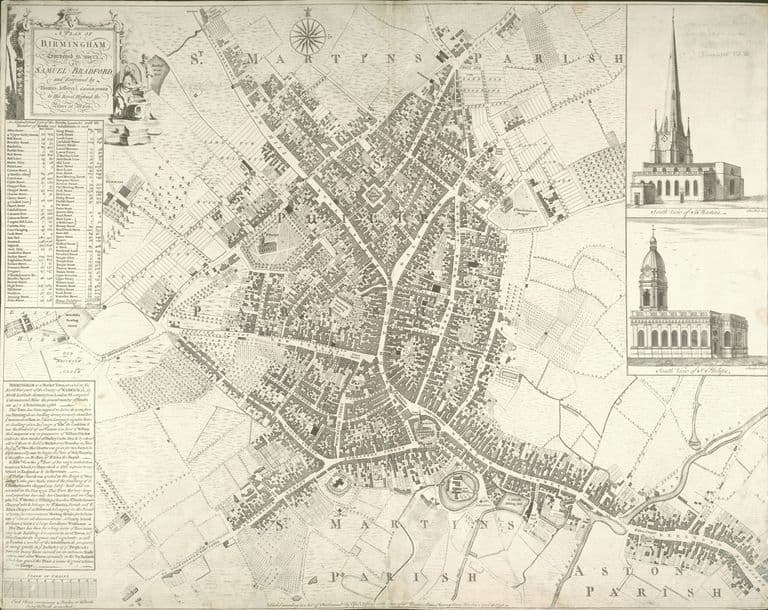
In 1735 it was rebuilt in brick, with tall round-headed windows. The tower was still unfinished in 1752 and was completed about 1762, in two stages crowned with a balustrade and urns. Hutton blamed “the inconsiderate architect of Deritend chapel” who, anxious to face due east, “lost the line of the street”. The old maps bear him out: the church sat at a skew to the road.
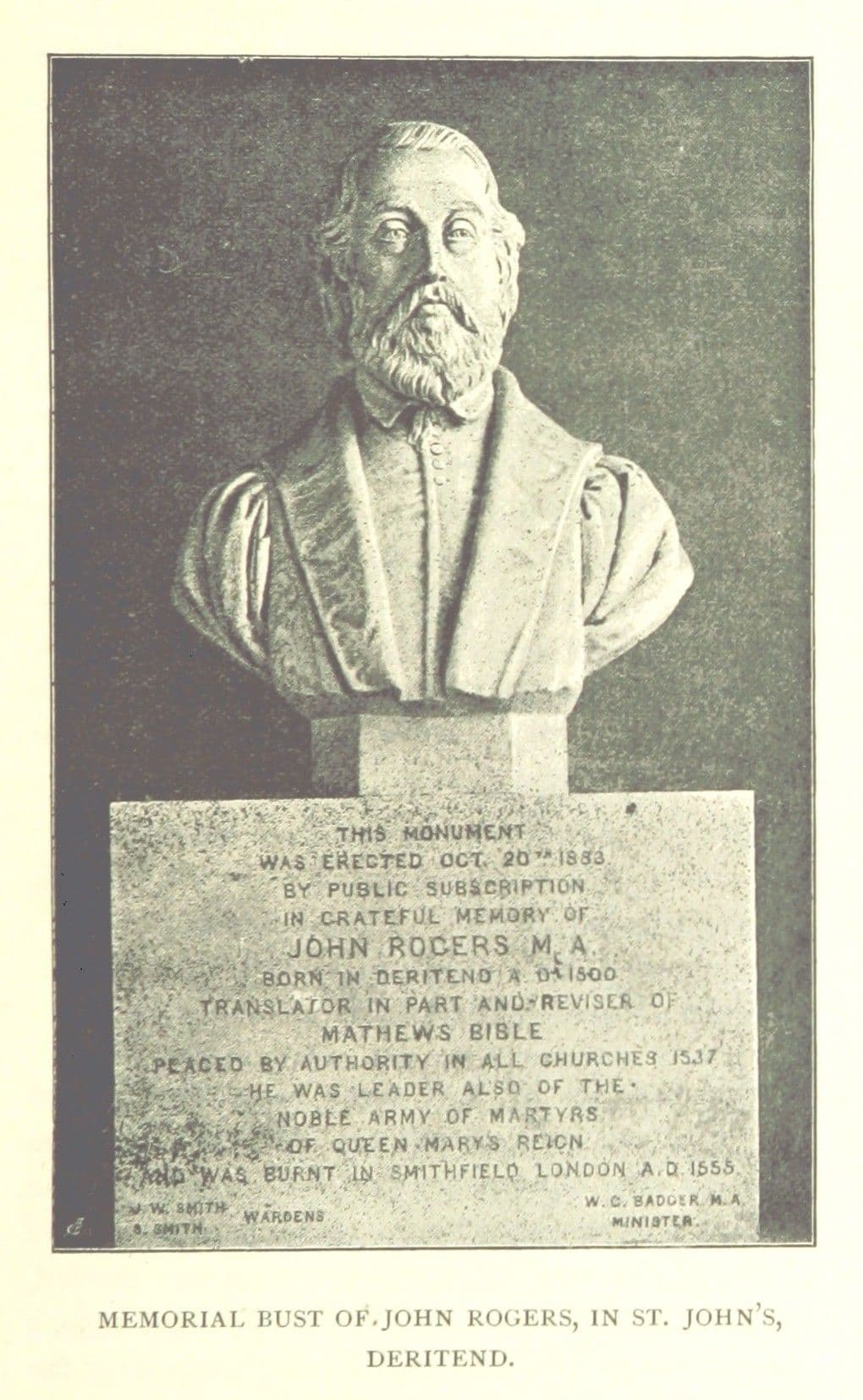
Eight bells by Robert Wells of Aldbourne were hung in 1776, with a clock. On 29 October 1883 a bust was unveiled to John Rogers, born in Deritend. Rogers edited the “Matthew” Bible and in 1555 became the first Protestant burned under Mary I, at Smithfield in London.
Bombs and the road
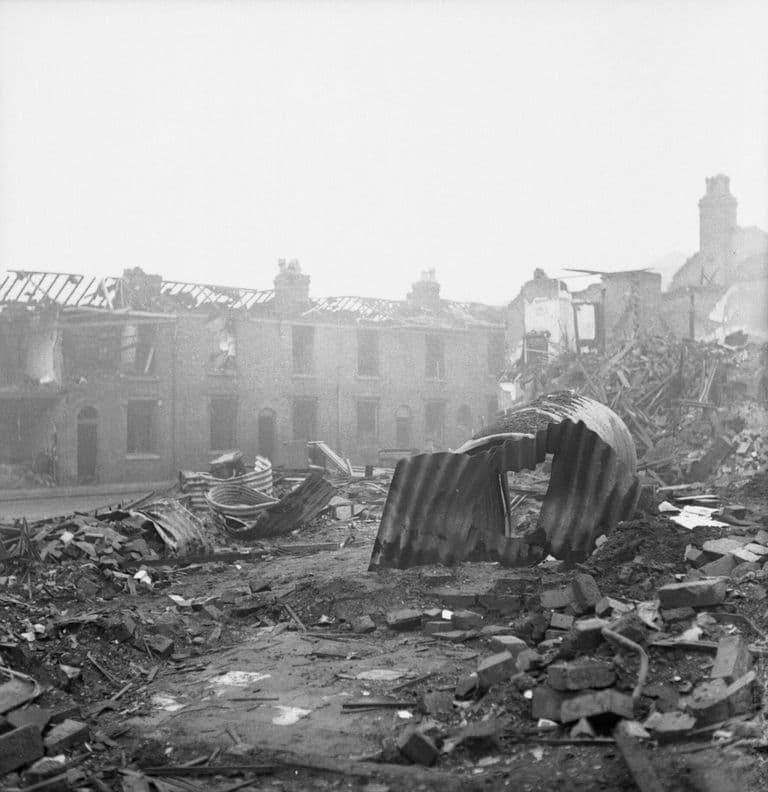
In 1939 the parish was united with St Basil’s and the site was sold to the city. The church was damaged by enemy action in 1940, used as a store from about 1943, and demolished in 1947. The widened Digbeth and High Street Deritend, reopened on 22 July 1953, now runs over most of the site.
The roadworks turned up something older still. In 1953 misfired pottery was found south of the road, the first sign that the medieval jugs and cooking pots now called Deritend ware had been made nearby.
What is left
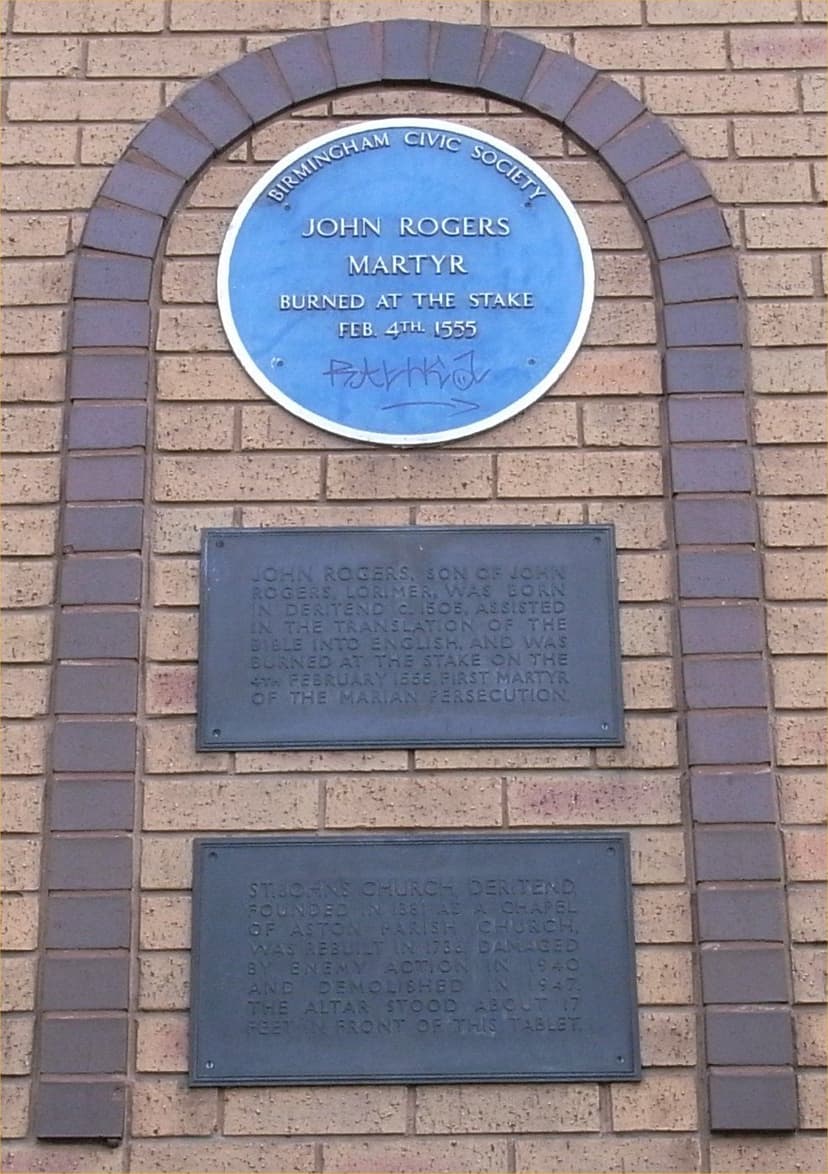
A bronze tablet on the south side of High Street Deritend records the church and tells passers-by that “the altar stood about 17 feet in front of this tablet”. Beside it is a Birmingham Civic Society blue plaque to John Rogers.
The bells had a stranger afterlife. In 1958 they were broken up at Taylor’s foundry in Loughborough and recast for Bishop Latimer Memorial Church. That ring proved too heavy for its tower, and in 1972 it was rehung at St John the Evangelist, Perry Barr. The metal that once rang over the Rea for Deritend’s own chapel still hangs in a church tower in north Birmingham.
Why it mattered
St John’s made Deritend a community in its own right. Its people won the right to choose their own chaplain in 1381 and kept it for five hundred years, until 1890. The chapel was bound up with Deritend’s guild and its school, and it remembered John Rogers, the Bible translator born in the hamlet, who became the first Protestant martyr under Mary I. With the Old Crown and the Golden Lion across and along the street, it was the heart of the old suburb over the river.
Why it disappeared
Wartime destruction · Road building
The parish was united with St Basil’s in 1939 and the site sold to the city. The church was damaged by enemy action in 1940, used as a store from about 1943 and demolished in 1947. Its ground went into the widened Digbeth and High Street Deritend, reopened in 1953.
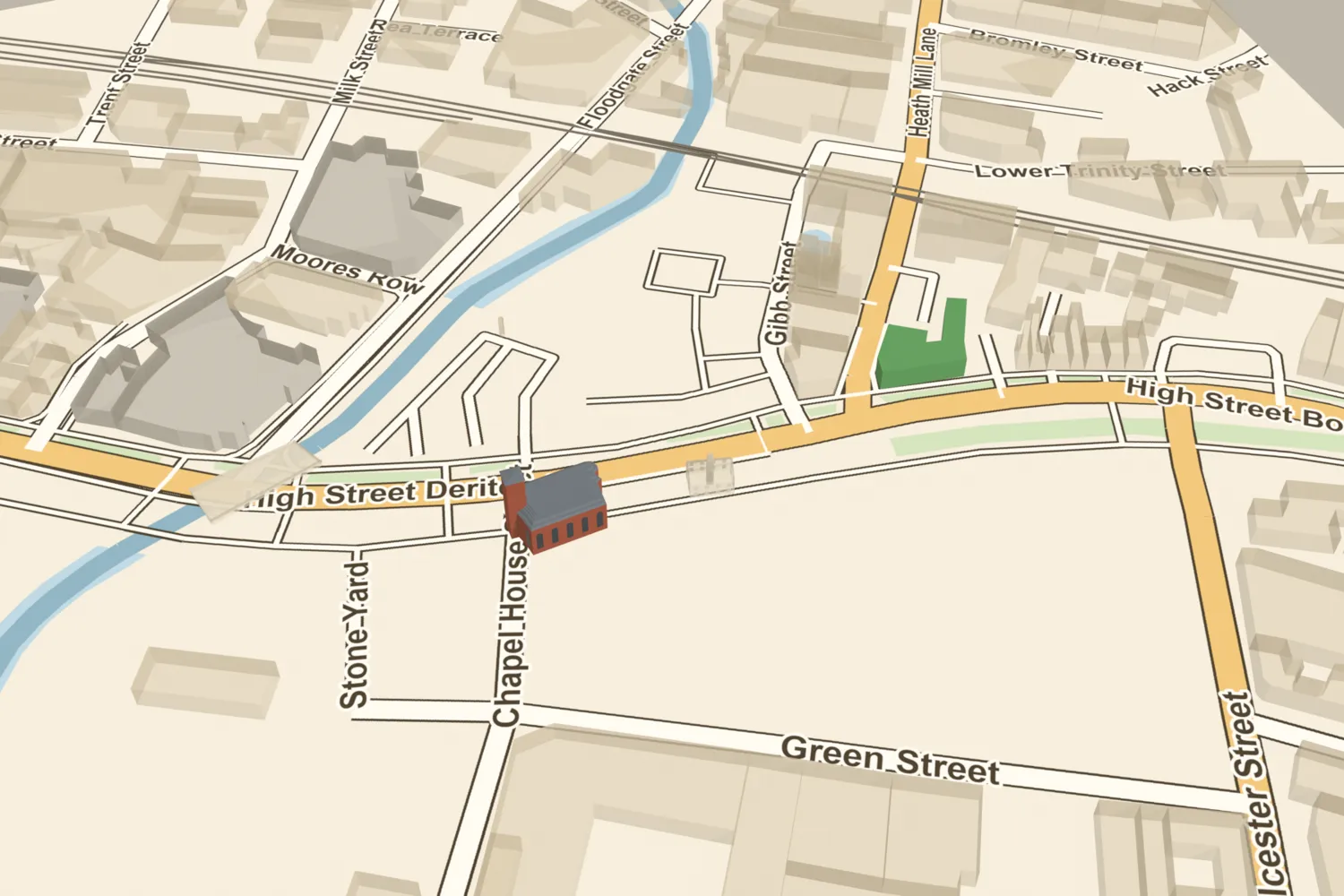
St John’s Chapel, Deritend, on today’s streets
What’s there now
What replaced it
The widened High Street Deritend, reopened on 22 July 1953. Most of the site is now the southern carriageway and pavement.
What survives
Nothing of the building. A bronze tablet and a Birmingham Civic Society plaque to John Rogers mark the site. The metal of the 1776 bells, recast in 1958, hangs at St John the Evangelist, Perry Barr. A bust of John Rogers dated 1883 in Aston parish church is very probably the one unveiled here.
Today
Stand by the tablet in a brick arch on the south side of High Street Deritend, just east of Chapel House Street. The church filled the ground from here out into the road. The Old Crown is across the street, about 120 metres to the east.
Then and now
Then · c.1809
Now · 28 February 2008
Today
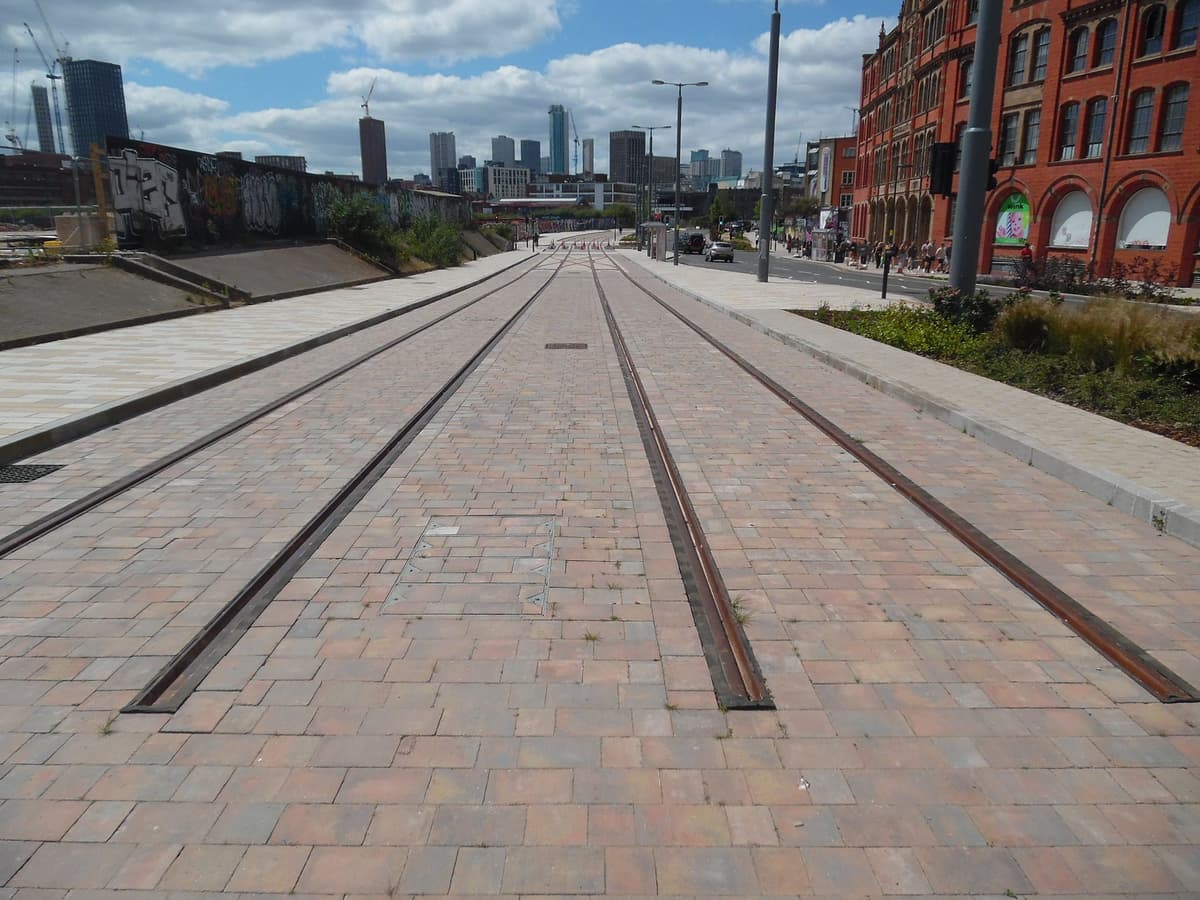
Tramlines in High Street, Deritend, 22 June 2024David Hillas, 22 June 2024. Geograph Britain and Ireland via Wikimedia Commons · CC BY-SA 2.0
Sources and further reading
Foundation: the chapel was “lately built” in 1381 (VCH). Showell’s claim that it was begun in 1375 is not supported, and Hutton gives the agreement as 1382. The medieval chapel was timber according to Hutton but stone according to Toulmin Smith.
Demolition: 1947 comes from the site tablet, a Historic England Archive caption and The Ringing World (1958). The VCH says only that the church had been demolished by 1961. A 1950 note that it was demolished in 1940 conflicts with its use as a store about 1943 and is rejected.
The bust of John Rogers dated 1883 now in Aston parish church is very probably the one unveiled at St John’s, but its move has not been documented.
The architect of 1735 is unknown. The tower’s height and the purpose of a rounded projection at the north-east corner on the plans of 1855 and 1887–88 are not recorded. The recast bells’ move to Perry Barr in 1972 rests on a newspaper report quoted by Church Bells of Warwickshire.
- A History of the County of Warwick, vol. 7: The City of Birmingham — Religious History: Churches built before 1800, pp. 361–379 — W. B. Stephens (ed.), Victoria County History, 1964. no. 4, St John the Baptist, Deritend: 1381 agreement, guild priests, rebuilding, bells, parish 1890, union 1939, store c.1943
- A History of the County of Warwick, vol. 7: The City of Birmingham — Religious History, pp. 354–361 — W. B. Stephens (ed.), Victoria County History, 1964. John Rogers; Toulmin Smith’s Wycliffite theory rejected
- An History of Birmingham (2nd edition) — William Hutton, Pearson and Rollason, Birmingham (Project Gutenberg text), 1783. ‘Saint John’s Chapel, Deritend’
- Memorials of Old Birmingham: Traditions of the Old Crown House, in Der-yat-end — Joshua Toulmin Smith, 1863. p. 7, Bradford’s 1752 view inscription
- Showell’s Dictionary of Birmingham — Thomas T. Harman and Walter Showell, Cornish Brothers, Birmingham, 1885. ‘St John’s, Deritend’, ‘Bells’, ‘Statues and Memorials’: election of 1870, bust 1883
- Old and New Birmingham: a history of the town and its people — Robert K. Dent, Houghton and Hammond, Birmingham, 1880
- Anglican Church of SS Peter and Paul, Aston — National Heritage List for England entry 1290008 — Historic England. bust of John Rogers dated 1883 in Aston church
- Church Bells of Warwickshire: Birmingham, Bishop Latimer; Perry Barr, St John the Evangelist — Church Bells of Warwickshire (warksbells.co.uk)
- Site tablet and Birmingham Civic Society plaque, St John’s Church, High Street Deritend (photograph) — Oosoom (Wikimedia Commons), 2008
- Ordnance Survey 1:500 town plan of Birmingham, 1887–88, georeferenced — National Library of Scotland, 1888. footprint traced
- Plan of the Borough of Birmingham (Pigott Smith), 1855 — J. Pigott Smith, National Library of Scotland (online), 1855
- OpenStreetMap data (Overpass and Nominatim), central Birmingham — OpenStreetMap contributors, 2026
- Deritend ware — Wikipedia contributors, Wikipedia
- St John’s Church, Deritend — Wikipedia contributors, Wikipedia
Comments
Comments will load here.