
What was here?
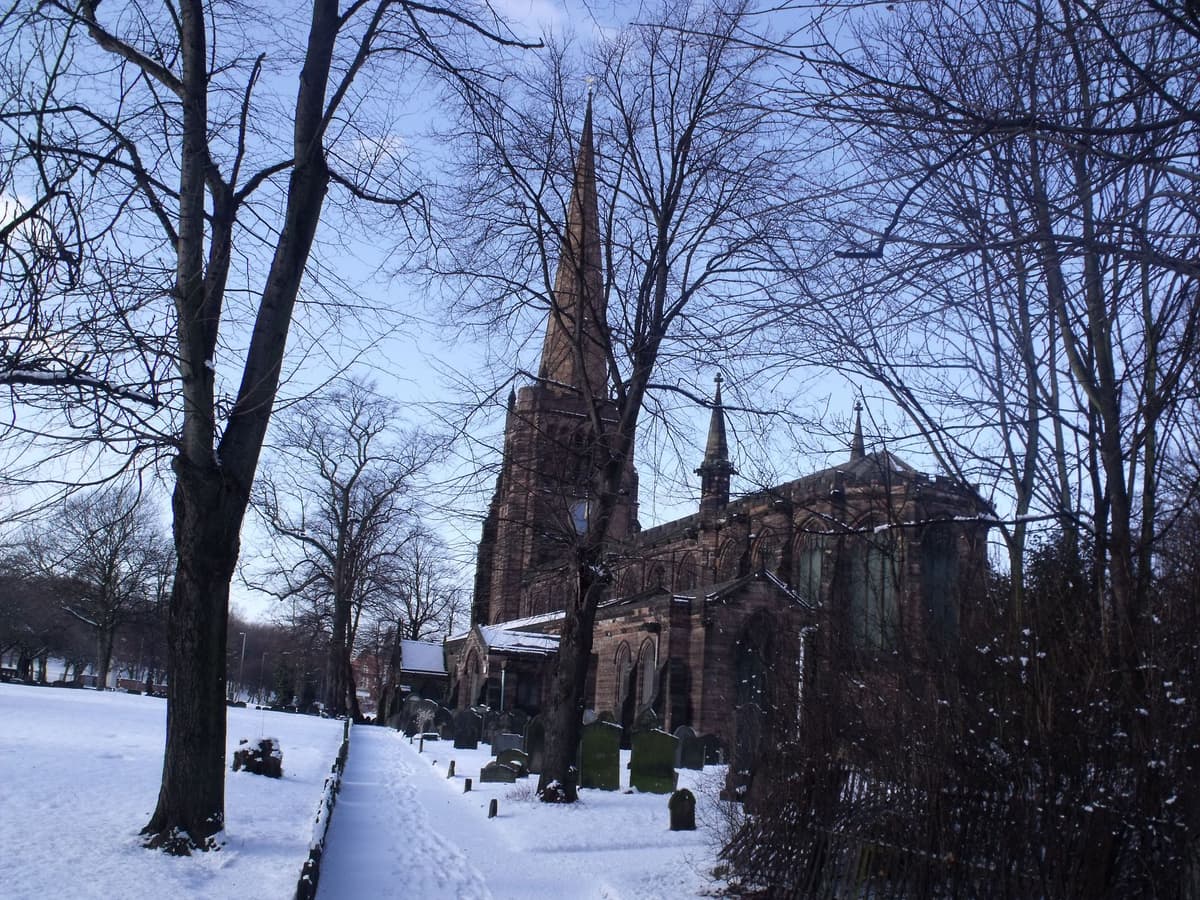
Since at least the time of Domesday Book there has been a church here, at Witton Lane and Park Road beside Aston Hall. The present building keeps a 15th-century tower and spire, with a Victorian church by J. A. Chatwin attached, full of medieval and later monuments.
History
Before Birmingham swallowed it, Aston was a huge parish, and this was its mother church.
A parish six miles wide
Domesday Book mentions a priest at Aston, so a church can be assumed here by 1086 or earlier. The Victoria County History describes a parish that covered a wide, scattered area. The church stood on its western edge, and some of its hamlets lay up to six miles away.
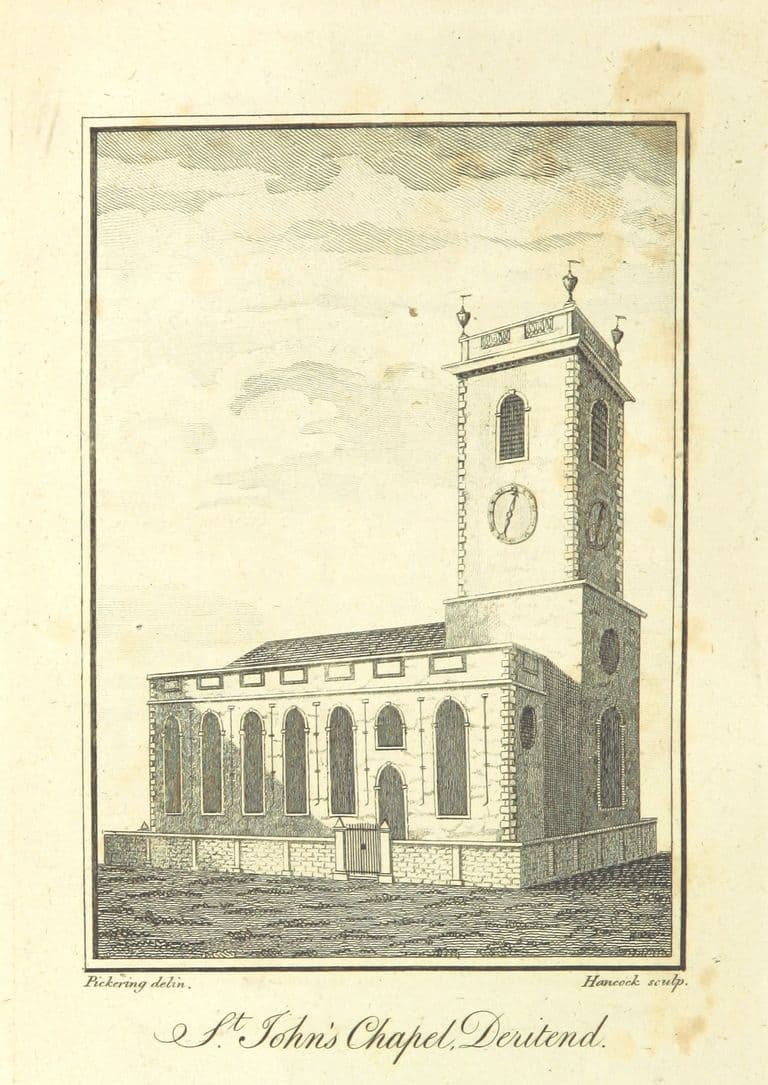
Daughter chapels grew up to serve them. In the twelfth century there were chapels dependent on Aston at Yardley, Castle Bromwich and Water Orton. Deritend’s chapel of St John the Baptist was founded in 1381, because Deritend and Bordesley were far from the parish church and the river flooded in winter. Even then, the people of Deritend still had to come to Aston on the great feasts, including the feast of St Peter and St Paul, the dedication of this church.
Lords and their tombs
The same spot, then and now
1888–1913
Today
Old map: Ordnance Survey six-inch, reproduced with the permission of the National Library of Scotland (CC BY 4.0). Today: © OpenStreetMap contributors.
The lords of the surrounding manors were buried and remembered here. In 1449 Sir Thomas Erdington, lord of Erdington, was licensed to found a chantry at the altar of St Mary in the south aisle. His family’s monuments are still in what is called the Erdington chapel. Historic England’s list entry describes the effigies of an earlier Sir Thomas Erdington, who died in the 1430s, and his wife, he in armour and she in a long skirt and mantle, on a tomb chest carved with shields and angels.
The Holtes of Aston Hall, the great house next door, are remembered mostly in the north aisle. There are effigies of William Holte (died 1514) and his wife Joan, a wall monument showing Edward Holte (died 1592) and his wife Dorothy kneeling, and an early eighteenth-century monument with weeping cherubs to Sir Thomas Holte (died 1654), who built Aston Hall. There is a knight of about 1360 and a lady of about 1490 lying together on one tomb, and effigies of Sir Edward Devereux (died 1622) and his wife Katherine.
Rebuilt by the Victorians
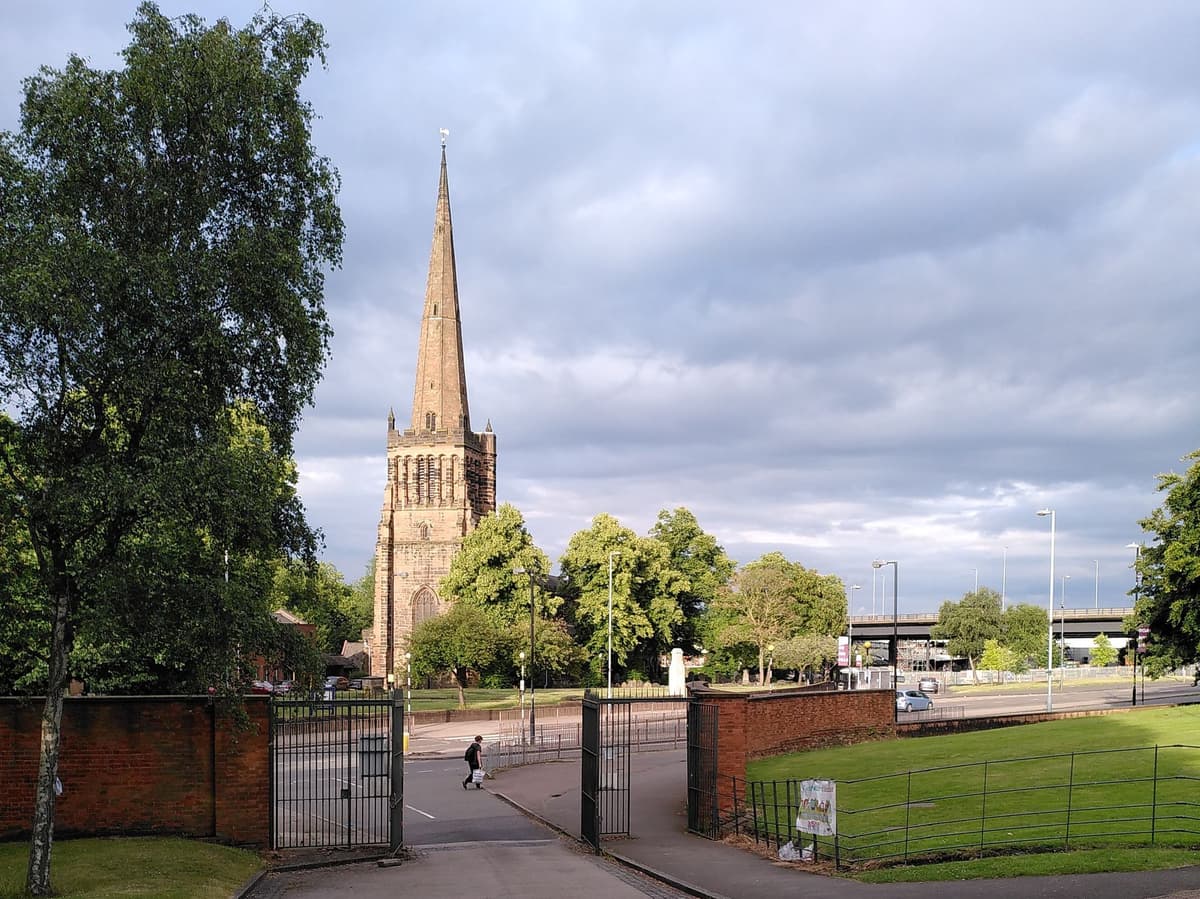
Only the tower is medieval. It dates from the fifteenth century, with four stages and unusual tall narrow openings at the bell stage. The spire above it was renewed in 1776–77 by John Cheshire.
Everything else was rebuilt between 1879 and 1890 to designs by Julius Alfred Chatwin, with a south porch added in 1908. Historic England’s list entry describes a long, high interior with no chancel arch, a hammer-beam roof full of carved angels, a five-sided apse lit by Hardman windows of 1885 showing the Adoration of the Lamb, and a marble sanctuary. Chatwin designed the font and pulpit too.
Look above the north door for a window of the eighteenth century by Francis Eginton, the engraver and artist who worked for Matthew Boulton at Soho. A bust of 1883 remembers John Rogers, born in Deritend and burned at the stake in 1555.
A parish broken up
As Birmingham grew, the old parish was carved up. The Victoria County History counts 31 more churches built and consecrated within the ancient parish of Aston, inside the modern city boundary, between 1823 and 1952. Parishes were cut out of Aston for Duddeston, Bordesley, Saltley, Lozells, Erdington, Sparkbrook, Deritend and more.
At risk
The church is listed at Grade II*. It is also on Historic England’s Heritage at Risk Register, as a place of worship at risk, in both 2024 and 2025.
This is not a lost building. It is a survivor that needs care. For more than nine hundred years Aston has had a church, and within these walls lie lords of Erdington and Aston whose own houses have long since gone.
Why it mattered
Aston church was the mother church of a parish that once stretched across much of what is now north and east Birmingham. It holds what Historic England calls an important collection of effigies and monuments, including the de Erdington and Holte families. Its place on the Heritage at Risk Register makes it a north Birmingham survivor that still needs care.
What’s there now
What replaced it
Not replaced. The medieval church, apart from its tower, was rebuilt in 1879–90.
What survives
The 15th-century west tower with its spire (renewed 1776–77); the Victorian church by J. A. Chatwin; late 15th-century choir stalls; monuments to the Arden, de Erdington, Holte and Devereux families; Hardman glass of 1885; an 18th-century window by Francis Eginton. Burial registers from 1544, marriages from 1561 and baptisms from 1563.
Today
The church stands at the junction of Witton Lane and Park Road, close to Aston Hall. It is listed at Grade II* and is on Historic England’s Heritage at Risk Register.
Then and now
Then · 8 January 2010
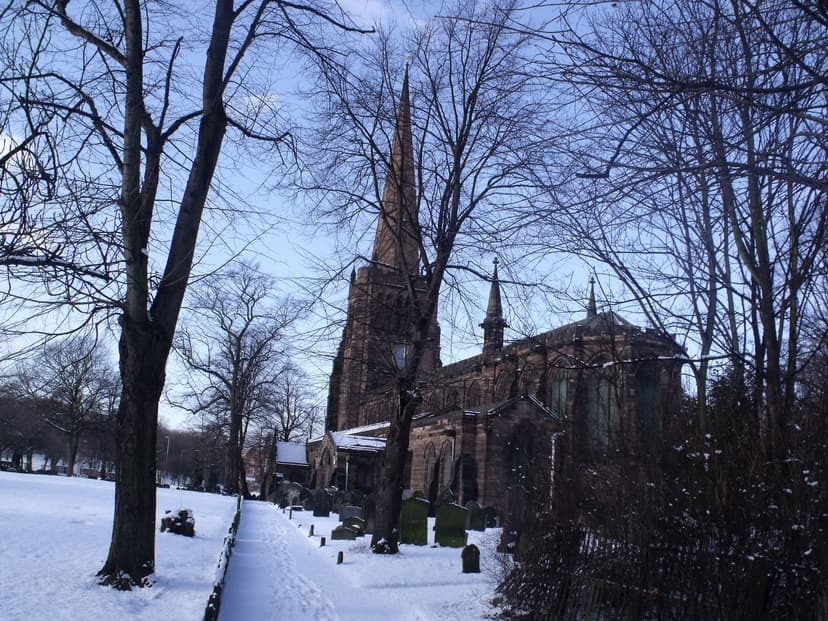
Now · 8 January 2010
Today
Parish Church of St Peter & St Paul, Aston, 13 July 2024A J Paxton, 13 July 2024. Geograph via Wikimedia Commons · CC BY-SA 2.0
Key dates
- 1879–90 — Aston parish church rebuiltAston parish church is rebuilt to designs by J. A. Chatwin, keeping its 15th-century tower and spire.
Sources and further reading
Historic England’s open data shows the church on the Heritage at Risk Register in 2024 and 2025 (entry 24367) under the places-of-worship category; the register’s assessment of its condition and the reasons for its inclusion have not been read and are not described here.
The Victoria County History dates Thomas de Erdington’s death to 1434 and names his wife Anne; Historic England’s list entry gives 1433 and Joan or Anne Harcourt. The text avoids the exact year.
The knight and lady on one tomb are possibly Ralph Arden and Elizabeth Arden, and may have been brought from Maxstoke, according to the list entry; this is not stated as fact.
- A History of the County of Warwick, vol. 7: The City of Birmingham — Religious History: Churches built before 1800, pp. 361–379 — W. B. Stephens (ed.), Victoria County History, 1964. Aston, St Peter and St Paul, pp. 361–379
- Anglican Church of SS Peter and Paul, Aston — National Heritage List for England entry 1290008 — Historic England
- Heritage at Risk Register open data, 2024 and 2025 — Historic England. HAR entry 24367

Comments
Comments will load here.