
What was here?
An underground brick tunnel holding a cast-iron shaft, about 60 metres (196 feet) long. A leather belt from the Mint’s new steam engine turned it, and it drove the coin cutting-out presses and other machines.
History
Power underground
In 1824–26 Matthew Robinson Boulton, who had run the Soho Mint since his father’s death, reorganised it from top to bottom. A third steam engine was installed, and its power had to reach a new cutting-out room, where the blanks for coins were cut out.
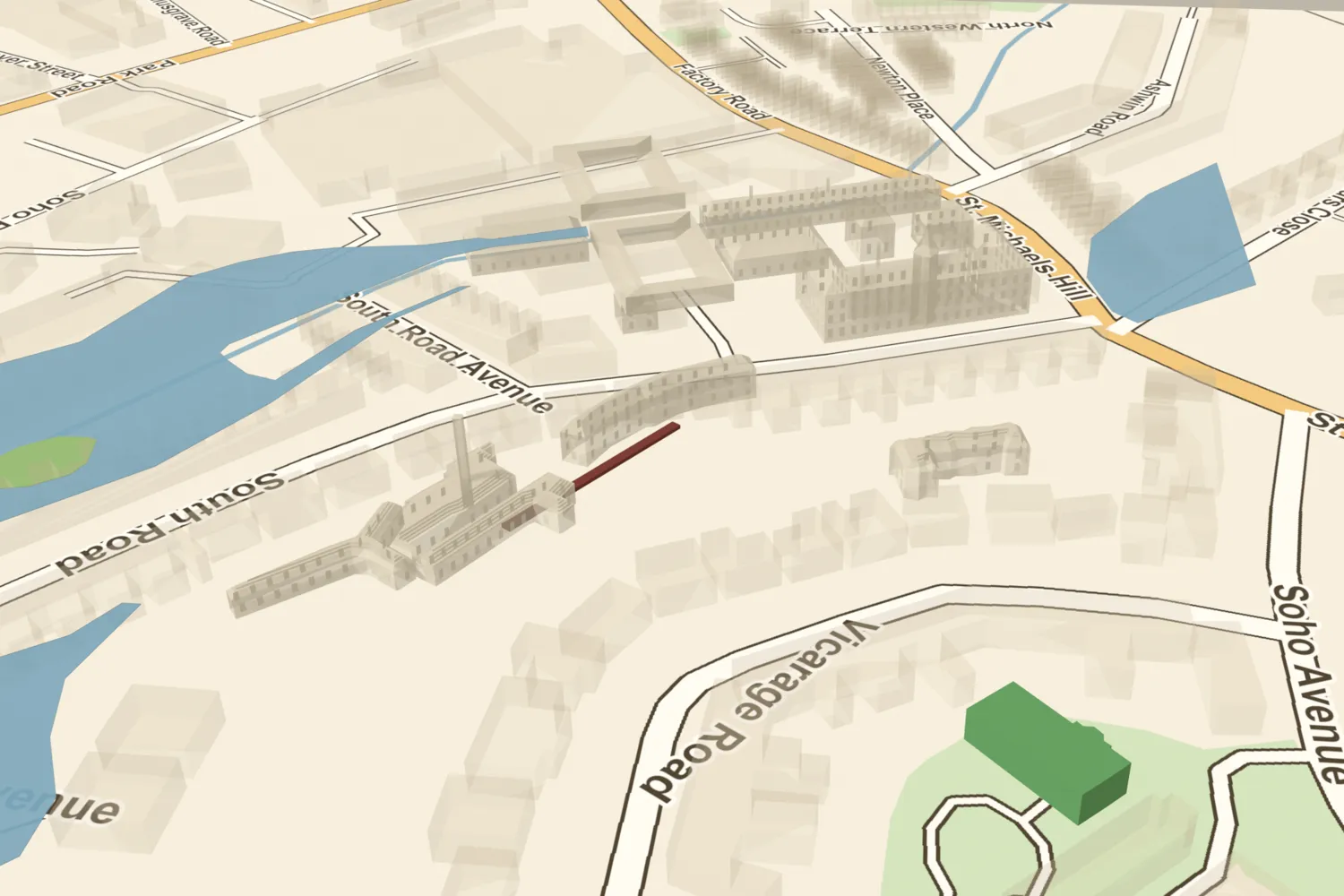
The solution was buried. Documents studied by George Demidowicz show “an underground drive shaft of about 60m (196ft) in length”. A leather belt ran from a pulley on the engine to a main pulley set below ground in a narrow yard next to the Mint. From there a cast-iron shaft ran in a brick tunnel north-west to the cutting-out room, in the central bay of the old Latchet Building. Along with four coining presses, Demidowicz says, it was driven by the new engine. A cross-section drawing in the Library of Birmingham, with the pulley added in pencil, shows how it worked.
Found in the gardens
When the Mint closed, the shaft was taken out in 1850 before the buildings were pulled down. Early in the 20th century sand digging destroyed most of the Mint itself.
The same spot, then and now
1888–1913
Today
Old map: Ordnance Survey six-inch, reproduced with the permission of the National Library of Scotland (CC BY 4.0). Today: © OpenStreetMap contributors.
The tunnel survived. At Easter 1996 Channel 4’s Time Team dug in the back gardens of South Road, guided by Demidowicz’s research. They found three separate sections of the brick tunnel, and the junction with a side tunnel leading to the engine. At the end of one trench lay a massive stone block, one of four that once carried the main pulley.
It was the proof that his reading of the plans was right. Under the lawns of a Handsworth street, part of the working machinery of the Soho Mint is still in the ground.
What happened here?
From 1824–26 to 1850 a cast-iron shaft in this tunnel carried power from the Mint’s third steam engine to its cutting-out presses and other machines. Time Team excavated sections of it in 1996.
Why it mattered
The tunnel is one of the few parts of the Soho Mint known to survive. Finding it in 1996 confirmed where the Mint stood and how it was reorganised in 1824–26.
Why it disappeared
Industrial decline · Redevelopment
The Mint closed in 1849 and the shaft was removed in 1850 before the Mint was demolished. The tunnel was buried and later built over with houses and gardens.
The Mint’s tunnel, among Boulton’s works, on today’s streets
What’s there now
What replaced it
Sand workings in the early 20th century, then 20th-century houses and gardens on South Road.
What survives
Three sections of the brick tunnel and one of the stone pulley blocks, found in 1996 in private back gardens.
Today
South Road, Handsworth (B18). The tunnel runs under the back gardens on the east side of the road, between the Mint site and the Latchet Building. It is on private land.
Sources and further reading
The length (about 60 m, 196 ft) is from the documents as reported by Demidowicz and Birmingham Images. The line of the tunnel is taken from Demidowicz’s plans, confirmed by the Time Team trenches. The ‘first steam mint’ claim is the usual one for the Soho Mint and is Demidowicz’s.
- The Soho Manufactory, Mint and Foundry, West Midlands: Where Boulton, Watt and Murdoch Made History — George Demidowicz, Historic England / Liverpool University Press, 2022
- The Time Team Excavations — George Demidowicz (Birmingham Images exhibition ‘The Three Sohos’), Birmingham Images
- Time Team excavations at the Soho manufactory and mint, Birmingham, 1996 — Archaeology Data Service
- Matthew Boulton and the Soho Mint: copper to customer (PhD thesis) — Sue Tungate, University of Birmingham, 2011
Archive references: Library of Birmingham MS 3782/13/120 (‘Particulars of Building Work’, August 1825)
Comments
Comments will load here.