
What is it?
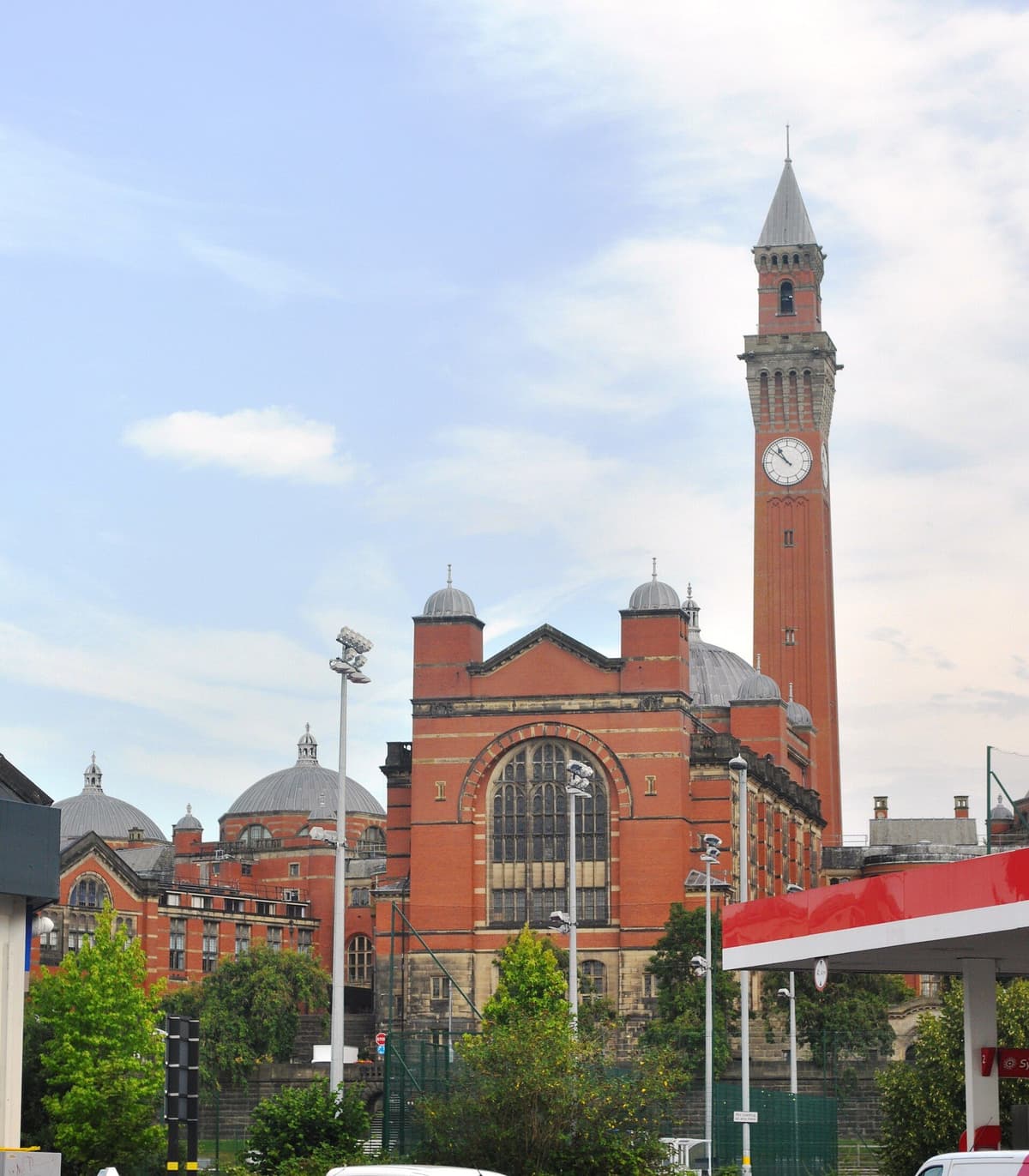
Farmland on the Calthorpe estate at Edgbaston, given in 1900 for the new University of Birmingham, which grew out of Josiah Mason’s Mason College in the city centre.
History
A university for an industrial city
Joseph Chamberlain made his fortune in screws, not in lecture halls. But he wanted his manufacturing city to have a university of its own. Its forerunner, Mason College, already taught mining, engineering and brewing. Chamberlain pushed for more, and in 1900 the University of Birmingham received its charter, with Chamberlain as its first Chancellor.
He was a ferocious fundraiser. The university itself says he used his contacts in a “vigorous fundraising campaign” for buildings and staff. Andrew Carnegie promised £50,000, and Lord Calthorpe gave 25 acres at Edgbaston.
Aston Webb’s half-moon
The architects were Aston Webb and Ingress Bell, who had already built the Victoria Law Courts on Chamberlain’s Corporation Street. They planned a great D-shaped court of red brick, terracotta and stone, with linked domed blocks around a curved front and a Great Hall at the centre. The Great Hall has stained glass by T. R. Spence, and the linking ranges carry frescoed friezes by Anning Bell. Only part of the plan was finished. In 1909 King Edward VII and Queen Alexandra came to open it.
Old Joe
In the middle of the court rises the clock tower. A gift of £50,000, announced anonymously in 1905 and later known to be from the colliery owner Sir Charles Holcroft, helped to pay for it. The Chamberlain family chose the model themselves, after admiring Italian campaniles: the Torre del Mangia in Siena. It is built of red Accrington brick with Darley Dale stone, rises about 100 metres, and has clock faces more than 5 metres across. An inscription at its base honours Chamberlain as the university’s founder.
The same spot, then and now
1888–1913
Today
Old map: Ordnance Survey six-inch, reproduced with the permission of the National Library of Scotland (CC BY 4.0). Today: © OpenStreetMap contributors.
Students call it Old Joe. For more than half a century it was the tallest structure in Birmingham, and it is often described as the tallest free-standing clock tower in the world. A screw manufacturer gave his city a university, and the city named its highest tower after him.
What happened here?
The University of Birmingham’s first purpose-built campus was laid out here from 1900 and opened in 1909, with Chamberlain Tower at its centre.
Why it mattered
The university calls itself England’s first civic university, founded to serve an industrial city, and it was Joseph Chamberlain’s last great work for Birmingham.
Today
What survives
The Great Hall and Quadrant Range (Grade II*) and Chamberlain Tower (Grade II*), with the clock mechanism by Joyce of Whitchurch and the original panelled lift.
Today
The heart of the University of Birmingham’s Edgbaston campus. University station is a short walk away.
Key dates
- 24 March 1900 — Mason’s college becomes the University of BirminghamMason University College, as Mason’s college had become in 1898, was turned into the University of Birmingham by royal charter, after a campaign led by Joseph Chamberlain.
- 1909 — The University opens at EdgbastonKing Edward VII and Queen Alexandra open the University of Birmingham’s new buildings by Aston Webb and Ingress Bell, with Chamberlain Tower, ‘Old Joe’, at their centre.
Sources and further reading
Tower dates: about 1909 (Historic England), 1907–09 (Wikipedia), and “built in 1905” (a University news story, probably the date of the gift). The university’s 2025 history dates the royal opening to 1909; local sources give 7 July 1909, which has not been checked.
Historic England dates the charter and Chamberlain’s chancellorship to 1900; this site’s Joseph Chamberlain page says he was Chancellor from 1901.
Height: about 100 metres (Historic England); other university pages give 99 m or 110 m. The claim to be the tallest free-standing clock tower in the world is the university’s own.
The idea that the tower inspired J. R. R. Tolkien is a popular story and is not used here.
- Chamberlain Tower, University of Birmingham — National Heritage List for England entry 1210306 — Historic England
- Great Hall and Quadrant Range, University of Birmingham — National Heritage List for England entry 1076133 — Historic England
- 125 years of philanthropy — University of Birmingham, 2025
- Why is there a bow on Old Joe? — University of Birmingham, 2015
- Joseph Chamberlain Memorial Clock Tower — Wikipedia
Comments
Comments will load here.