
What was here?
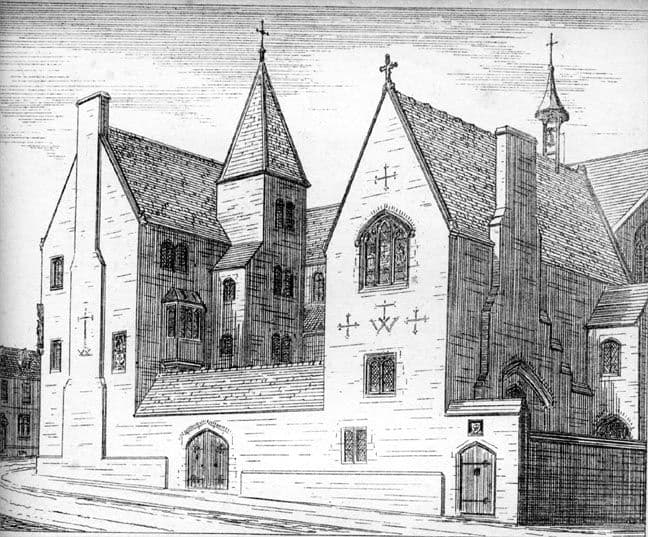
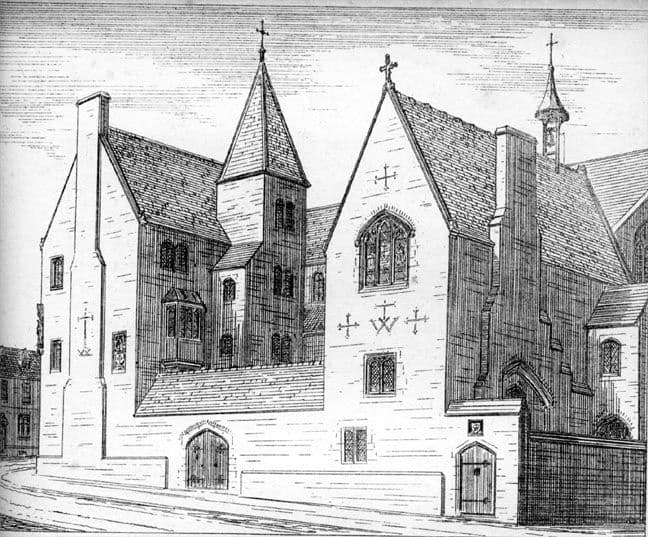
Before St Chad’s Queensway was driven through, the ground on Bath Street opposite St Chad’s Cathedral held Bishop’s House: a Gothic residence designed by A. W. N. Pugin for the Catholic bishop and his clergy, built as a pair with the church across the street.
History
In 1840 Augustus Welby Northmore Pugin was at work on St Chad’s, the Catholic church on Bath Street that became a cathedral in 1852. Across the street from it he designed a house for the bishop and his priests.
The Victoria and Albert Museum records that Bishop’s House was “built by George Myers (1804–1875) during 1840–1” and stood “opposite the Cathedral”. Myers was Pugin’s builder. Taking Stock, the Catholic Church’s heritage survey produced with Historic England, says the same: the house was built to Pugin’s designs, facing the church.
A bishop before there was a diocese
The house was built for Thomas Walsh. It is easy to call him Birmingham’s first Catholic bishop, but that is not quite right. In 1840 there was no Diocese of Birmingham. Walsh was a Vicar Apostolic, in charge of the Midland (later Central) District. The diocese itself was created only in 1850, under William Ullathorne.
The house had a second important resident. A chimneypiece now in the V&A came from “Bishop Wiseman’s study”. Nicholas Wiseman was Walsh’s coadjutor and president of Oscott College, the Catholic seminary a few miles north of the town. So this city-centre house was tied to Oscott, the college just beyond Kingstanding, from the start.
Pugin at home in the town
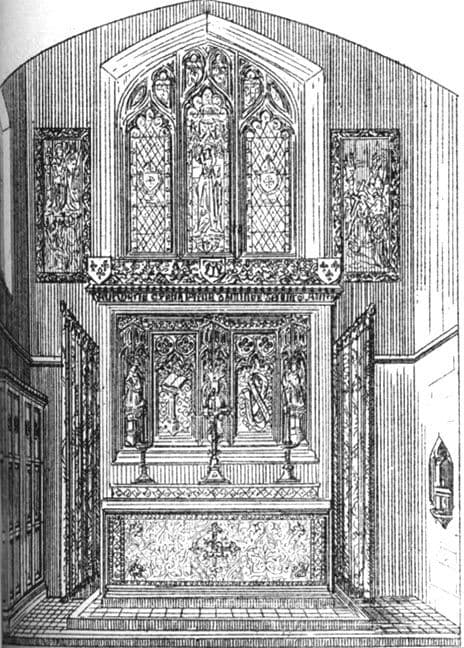
Pugin put the house in print. He published drawings of it, and of an altar inside it, in The Present State of Ecclesiastical Architecture in England (1843). This was Gothic architecture not in a cathedral close or a country park, but on a town street, opposite his church.
The same spot, then and now
1888–1913
Today
Old map: Ordnance Survey six-inch, reproduced with the permission of the National Library of Scotland (CC BY 4.0). Today: © OpenStreetMap contributors.
The chimneypiece gives a sense of the craftsmanship. It is carved stone, about 1840–41, with three heraldic shields in the overmantel. For more than a century the house did its job, a working home for the clergy of St Chad’s.
The ring road
Then came the Inner Ring Road. Taking Stock is direct: “In 1959, Pugin’s Bishop’s House was demolished to make way for the City Council’s inner ring road.” The V&A says only that it “had to be demolished because of a road-widening scheme”. Some accounts give 1960 for the demolition.
The road that replaced it, St Chad’s Queensway, now runs between the cathedral and the place where the house stood. The church survived. Its companion did not.
What was saved
Not everything went into the skip. In 1961 the Archbishop of Birmingham gave the V&A the stone chimneypiece and two chairs designed by Pugin. They are catalogued together as CIRC.351PART/1-1961. The Pugin Society’s list of his houses gives the entry a single, blunt word: demolished.
A house built in 1840–41 by one of the great architects of the Victorian age lasted less than 120 years. A fireplace and two chairs in a London museum, and Pugin’s own drawings, are almost all that is left of it.
Why it mattered
Bishop’s House was a home designed by Pugin, the leading champion of the Gothic Revival, built alongside his St Chad’s as a working house for the bishop and clergy. It linked the town-centre church to Oscott College through Nicholas Wiseman. Its demolition for the Inner Ring Road shows what the road-building years cost the historic townscape around St Chad’s.
Why it disappeared
Road building
The house was demolished to make way for the City Council’s Inner Ring Road, according to Taking Stock (1959). The V&A describes the cause as “a road-widening scheme”. The St Chad’s Queensway section of the ring road now runs between the cathedral and the former house site.
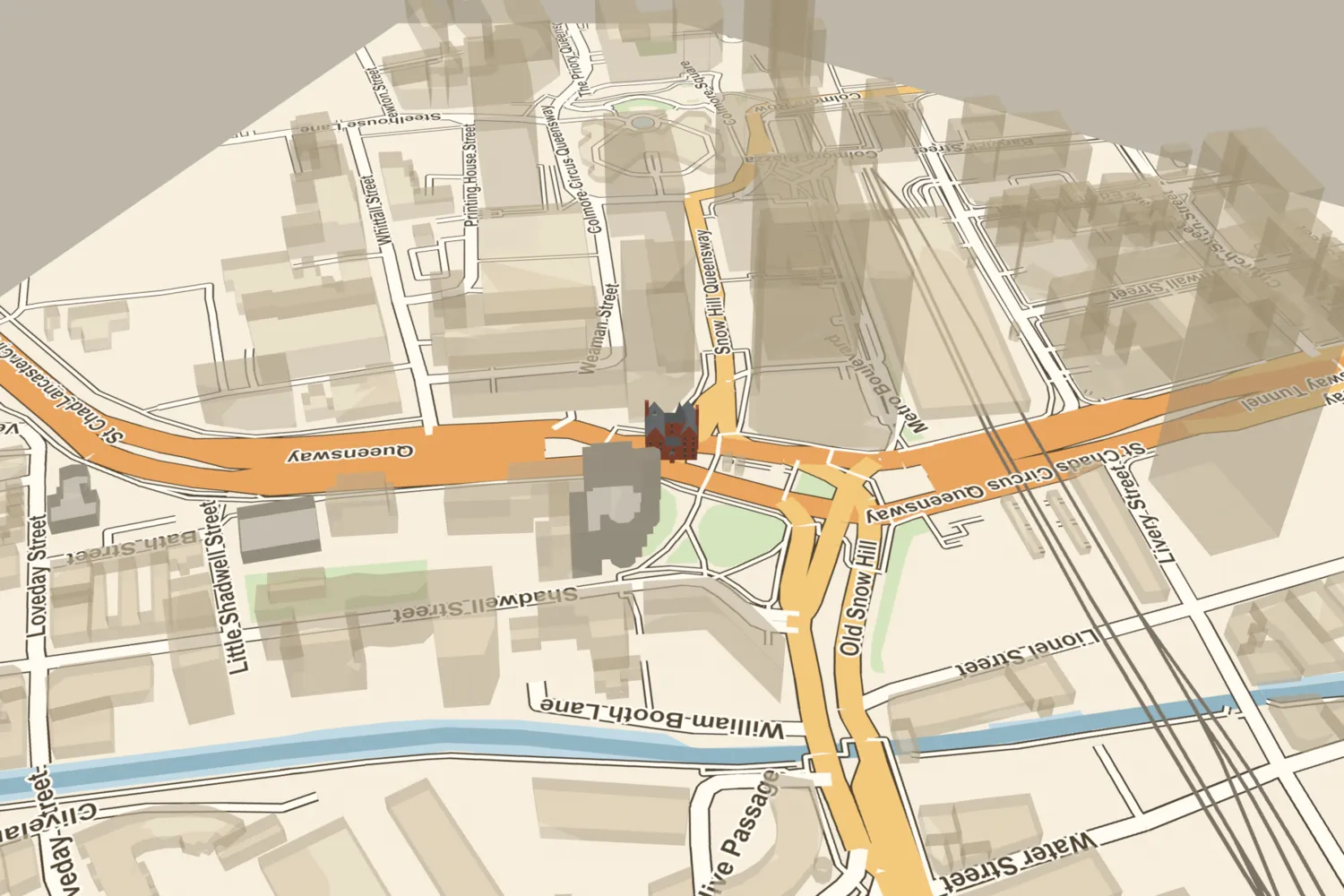
Bishop’s House, on today’s streets
What’s there now
What replaced it
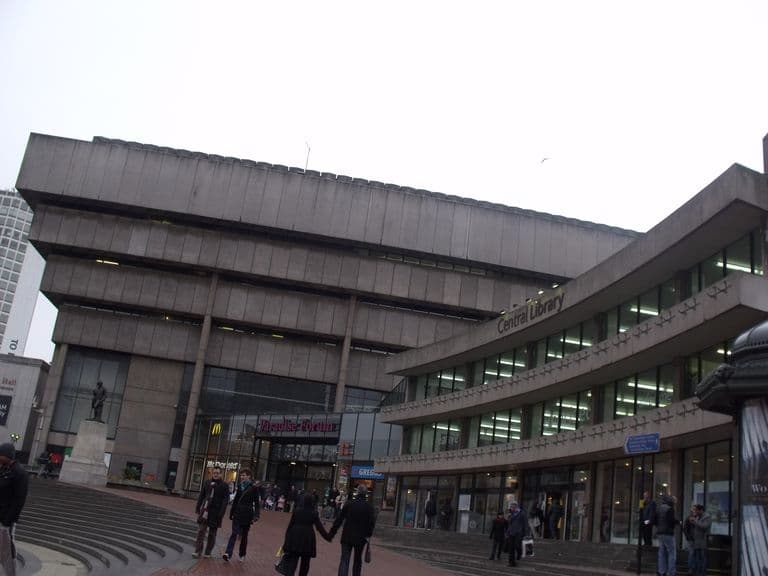
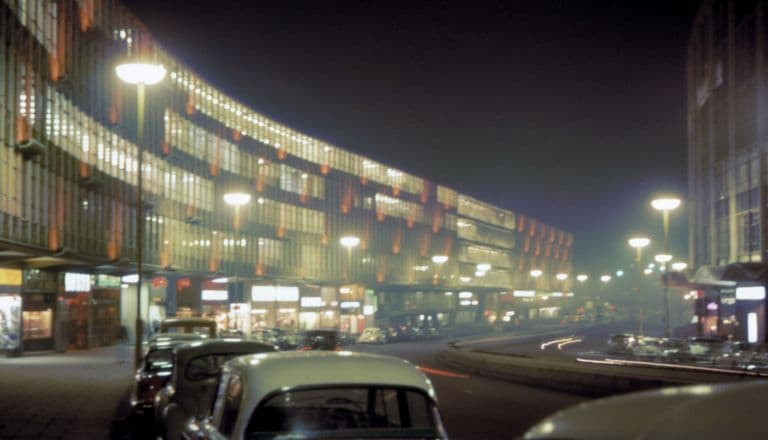
St Chad’s Queensway, part of the A4400 Inner Ring Road, which runs between St Chad’s Cathedral and the former site of the house.
What survives
No fabric survives on the site. The V&A holds a carved stone chimneypiece of about 1840–41, with three heraldic shields in the overmantel, from Bishop Wiseman’s study, and two Pugin-designed chairs, all given by the Archbishop of Birmingham in 1961 (CIRC.351PART/1-1961). Pugin’s own published drawings of the house and its altar survive. St Chad’s Cathedral (Grade II*) still stands across the road.
Today
The site lies beside St Chad’s Queensway, across the road from St Chad’s Cathedral.
Key dates
- 1840–41 — Pugin’s Bishop’s House builtGeorge Myers builds A. W. N. Pugin’s Bishop’s House on Bath Street, opposite St Chad’s, for Bishop Thomas Walsh, then Vicar Apostolic.
- 1946 — Birmingham Corporation Act passedParliament gives the council powers to build the Inner Ring Road and buy the land compulsorily. Peter Larkham calls it the largest such council scheme to have come before Parliament.
- c. 1959 (some accounts 1960) — Bishop’s House demolished for the Inner Ring RoadPugin’s Bishop’s House is demolished to make way for the City Council’s Inner Ring Road. A chimneypiece and two chairs go to the V&A in 1961.
Sources and further reading
Demolition date: Taking Stock gives 1959; Victorian Web gives 1960. Taking Stock is the stronger source, so the text says 1959 and notes the alternative.
Bishop Walsh is sometimes called the first Roman Catholic Bishop of Birmingham. That is misleading: the diocese was created in 1850, under Ullathorne. Walsh was then Vicar Apostolic of the Midland (later Central) District.
A story that the City Engineer, Herbert Manzoni, asked the Archdiocese to pay for any change to the road line appears only on Wikipedia and has not been found in a contemporary report or a published study of Pugin. It is left out.
Wikipedia calls the house among the most influential of Pugin’s works; that opinion has not been traced to a named historian and is not used.
The exact position, on Bath Street (probably at the corner of Weaman Street), should be checked on the OS 1:500 town plan of 1889.
- Chimneypiece from the Bishop’s House, Bath Street, Birmingham (CIRC.351PART/1-1961) — Victoria and Albert Museum. Ref. CIRC.351PART/1-1961
- Birmingham — Metropolitan Cathedral of St Chad — Taking Stock (Catholic Church heritage survey with Historic England)
- Residential buildings (list of Pugin’s houses) — The Pugin Society
- Catholic Cathedral Church of St Chad — National Heritage List for England entry 1220729 — Historic England
Archive references: Victoria and Albert Museum CIRC.351PART/1-1961
Comments
Comments will load here.