
On 27 September 1859 a percussion-cap works in Whittall Street, in the middle of Birmingham, blew up. Nineteen of its seventy workers were killed, children among them. The factory was wrecked, and the streets around it damaged.
One of the men who worked there was a young Scot called George Kynoch. Out of that disaster came a move to the edge of town, and one of the biggest businesses north Birmingham has ever had.
From Peterhead to New Street
George Kynoch was born at Peterhead, in Aberdeenshire, on 22 August 1834, the youngest son of John Kynoch, a journeyman tailor, and his wife Margaret. The family was poor. He went to the parish school and then worked as a clerk, first in an insurance office in Glasgow and then at a bank in Worcester.
From Worcester he came to Birmingham as a ledger clerk at the Birmingham and Midland Bank in New Street. His obituary in the Birmingham Daily Post called him “a man of much intelligence of a business kind, and of a naturally pushing disposition”. Banking was “too slow for his taste”. About 1856 he left it for a far riskier trade, making percussion caps for Pursall & Phillips in Whittall Street.
The cap works at Witton
Percussion caps were the small copper caps that fired a gun. Making them meant handling explosives in quantity, and in 1859 Whittall Street showed what that could mean in a crowded town.
Two years later, in 1861, Pursall was given permission to build a powder magazine and cap works on a four-acre site at Witton. Witton was then a country hamlet north of Aston, and safer. In 1862 Kynoch was formally recognised as the proprietor. An old shed was rolled out from the town factory and joined to a new building, and work began with one man and twelve girls. In 1863 he took over the business, and it became G. Kynoch & Co.
The same year he married Helen Birley, the daughter of an Edgbaston jeweller. Her father’s money may have helped him, and the business grew quickly.
The Lion Works
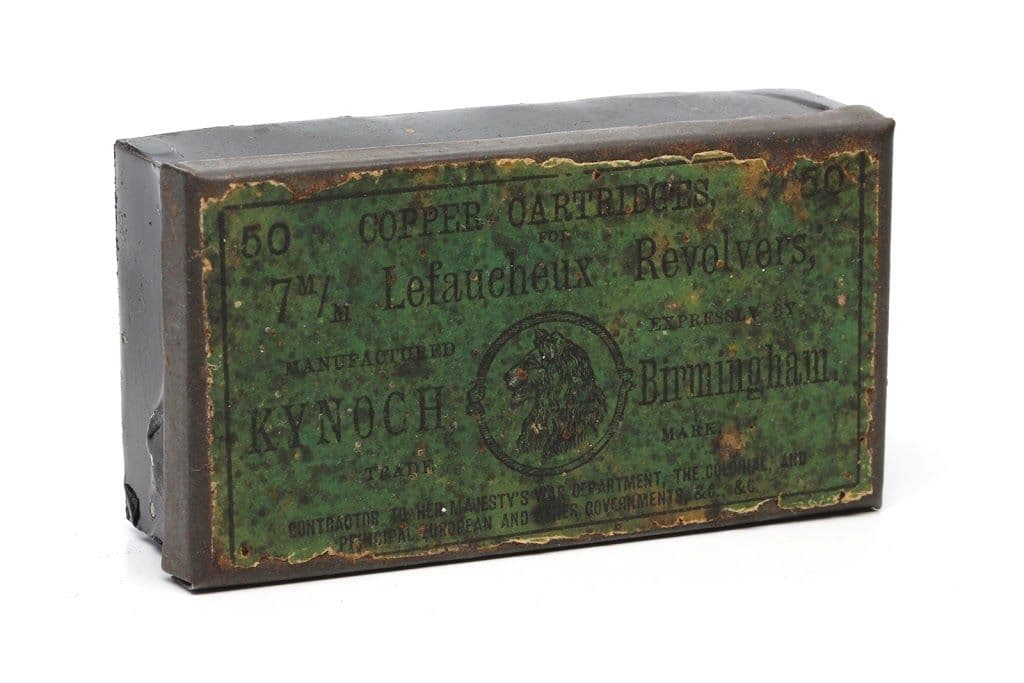
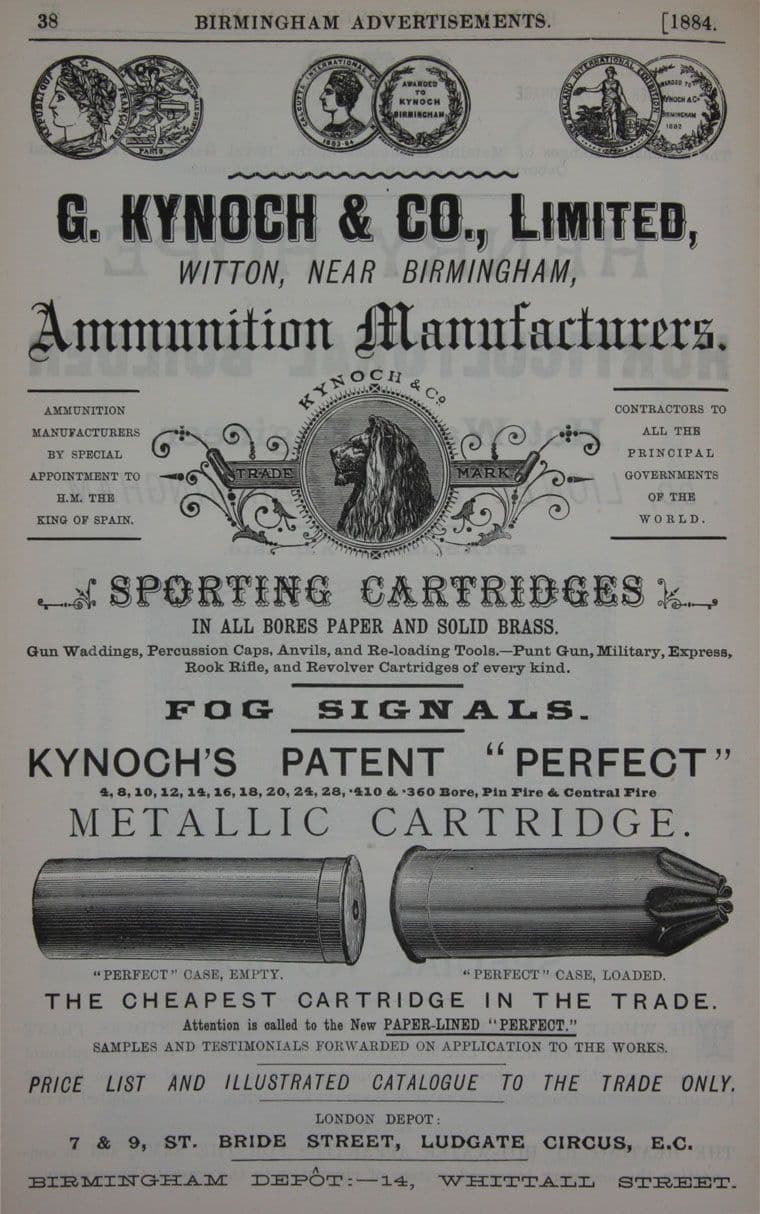
By 1867 the works had a name, the Lion Works, and its trade mark was a lion’s head. It was a good moment to be making ammunition. Guns were changing from muzzle-loaders fired by a separate cap to breech-loaders that took a complete metal cartridge, and Kynoch moved into the new cartridges, patenting several improvements in the 1870s. He also made fog signals for the railways.
His customers included governments. Grace’s Guide says he was well known at the Russian, Turkish and Romanian royal courts, where he travelled to make sales. Around 1872 a large Russian contract went wrong and he could not pay his creditors. A Birmingham businessman, John Abraham, rescued him by going into partnership and putting money in. The partnership was later dissolved, and Kynoch was left as sole owner.
He bought 19 more acres at Witton in 1872, and in 1877 leased a rolling mill in Water Street, Birmingham, taking the firm into the metal trade. By 1882 the works covered 24 acres, employed 800 people and could make 400,000 cartridges a day. According to the Staffordshire Home Guard history of the firm, it was then the second-largest ammunition factory in Britain.
The cost
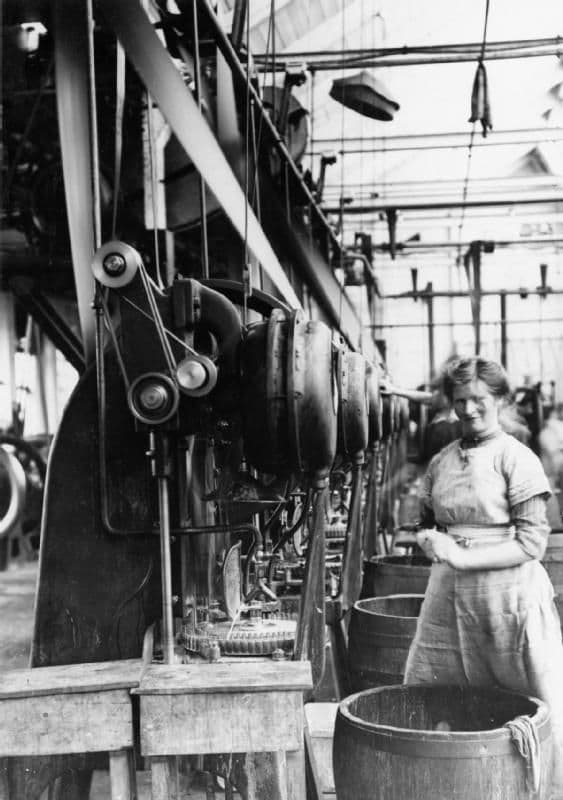
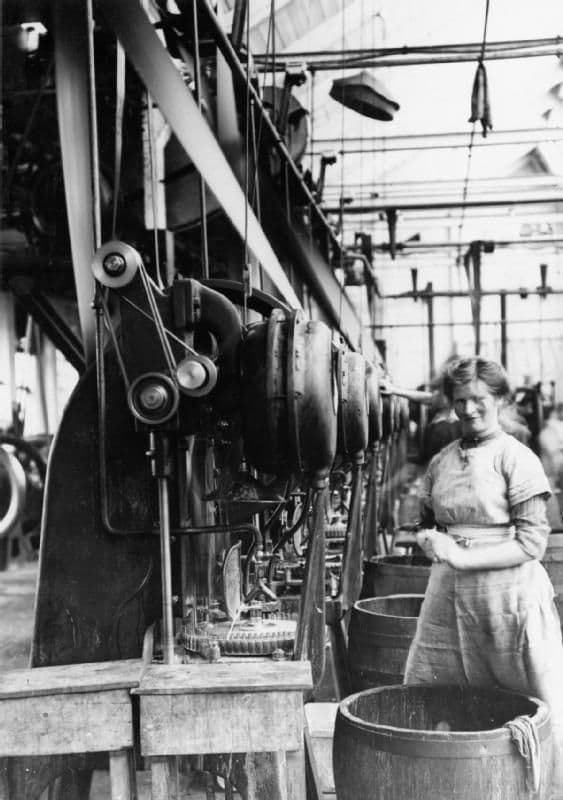
The work was dangerous, and much of it was done by women and girls. Percussion caps, run by a Mrs McNab, had a good safety record. Cartridge-making did not. On 17 November 1870 an explosion at Witton killed eight people and injured more than twenty. It was the fourth explosion at the works in two years.
Three weeks later, on 9 December, the neighbouring cartridge works of Ludlow & Co. blew up. Seventeen people were killed outright and 34 more died later of their injuries. There was a national outcry. The Post later wrote that the two disasters brought “Government interference” that changed how ammunition was filled, giving workers some safety in place of “the very perilous arrangements under which they had previously laboured”.
Hamstead Hall and the House of Commons
Kynoch lived the part of a self-made man. In 1871 he was at Bell Lane, Handsworth, and in 1881 at Bloomfield House, Handsworth. By 1883 he had moved to Hamstead Hall, with a 300-acre estate for shooting.
On 6 July 1884 the ammunition business became a limited company. Kynoch sold it to the new company for £260,000 in cash plus shares, and stayed on as managing director.
He moved into public life. He laid out a cricket ground near Perry Barr for a club made up largely of men from the works. He was president of Aston Villa in 1887, the year the club won the FA Cup. In 1885 the Aston Conservative Association made him its president. At the general election of 1886, fought over Irish Home Rule, he won Aston Manor from the sitting Home Rule Liberal, H. G. Reid, by 3,495 votes to 2,713.
The Post described his election speeches as “of a very violent character”. It reported that he had promised to give the Ulstermen 10,000 rifles and 2,000,000 cartridges if they rebelled against Home Rule. In the Commons he argued that the government should buy its munitions from British makers.
The fall
Then everything went wrong at once. He leased a gun factory in Lichfield Road, at Aston Cross, and it lost money. He spent heavily on Hamstead Hall. He was away from Witton more and more, on politics and on business of his own. Quality at the works slipped, losses mounted, and in 1887 and 1888 the company paid no dividend. In 1888 the board forced him to resign. Arthur Chamberlain, brother of Joseph Chamberlain, became chairman.
In November 1888 Kynoch, already a sick man, left for South Africa. In the Transvaal he won concessions to import and make arms and ammunition, and he tried gold mining. For a while it looked as if he might recover his fortune. He did not. Early in 1890 the contents of Hamstead Hall were sold. At the end he was keeping a gun shop in Johannesburg.
He was still MP for Aston Manor. His constituents wrote again and again asking him to come back or resign, and the Post said he “appeared to treat all these communications with contempt”. The question was raised in the Commons of whether his seat could be declared vacant. Nothing could be done.
He died of cancer at Johannesburg on 28 February 1891, aged 56, “in comparative poverty”, and was buried in Braamfontein Cemetery.
After Kynoch
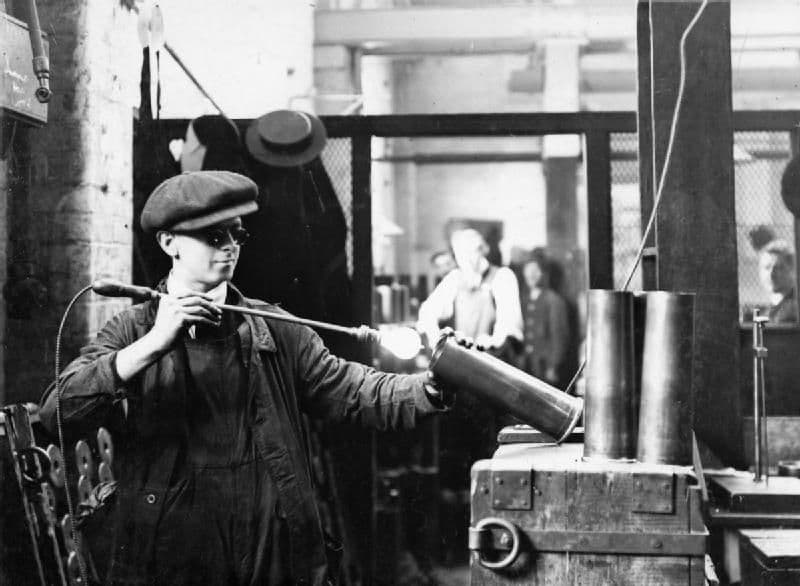
The firm he had founded did better without him. Under Arthur Chamberlain the board improved quality, bought its own rolling mills and expanded. In 1897 it was refloated as Kynoch Ltd. By 1903 it had ten factories, six of them in Birmingham, including the Holford Works next to the Lion Works, and 6,000 workers. During the First World War about 18,000 people worked at Witton alone.
In 1918 Kynoch became part of Nobel Industries, and in 1926 part of Imperial Chemical Industries. From 1929 the firm was called ICI Metals, and from 1962 it was IMI. The works carried on at Witton for well over a century, on the ground where a bank clerk from Peterhead had started with one man and twelve girls.
Why it mattered
George Kynoch is easy to tell as a cautionary tale: the bank clerk who got rich, bought a hall, won a seat in Parliament and died broke in Johannesburg. But his real legacy is a place.
Without the Whittall Street explosion and Kynoch’s drive, Witton might have stayed a hamlet between Aston and Perry Barr. Instead it became the home of one of north Birmingham’s great factories, a couple of miles south of Kingstanding. Under Kynoch, then ICI and IMI, it made ammunition and rolled brass and copper for most of a century. In the First World War 18,000 people worked there.
That growth had a cost. Explosives were handled by hand, often by girls, and the disasters of 1870 at Witton and at Ludlow’s works next door helped bring government regulation of the trade.
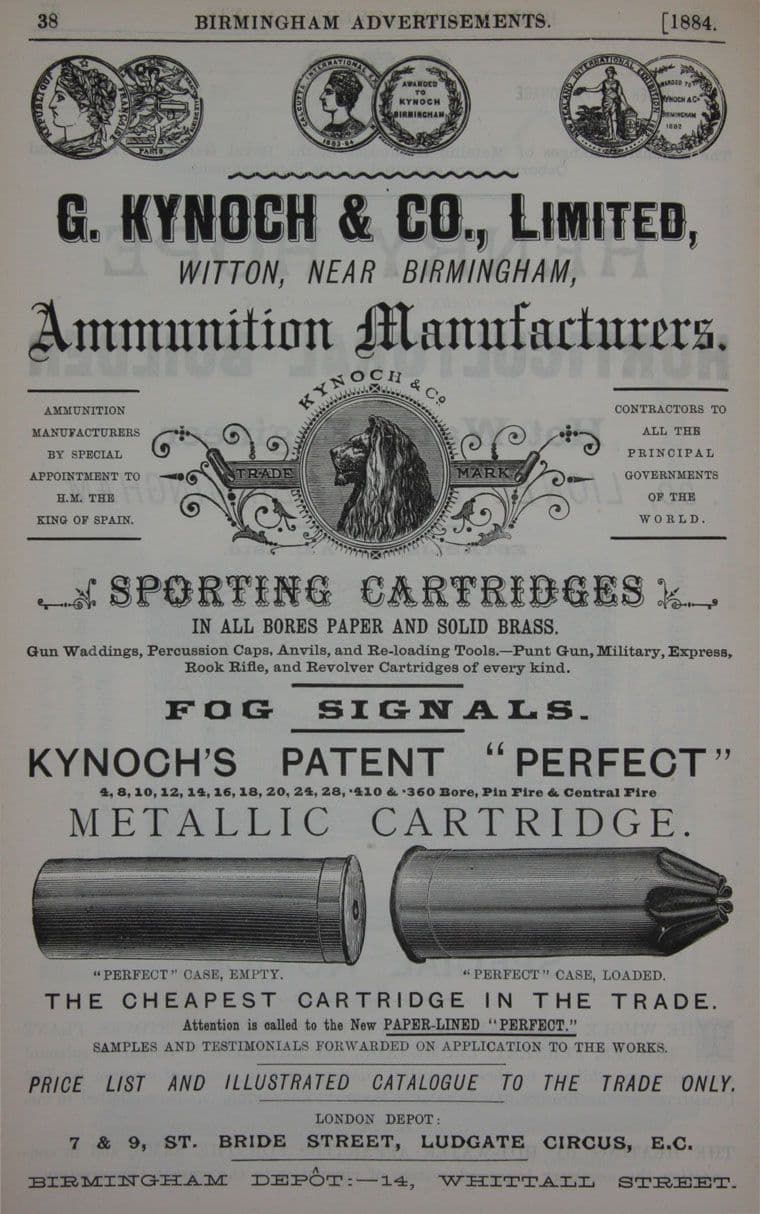
The arms trade made Kynoch, and the arms trade broke him. His firm advertised itself as contractor to “all the principal governments of the world”. Under the Chamberlains its cordite contracts were attacked in the Commons in 1900 as a case of favouritism.
Little of the Lion Works survives. But the war memorial by the old main gate on Brookvale Road, and the industrial estate on the site, still mark the place where a percussion-cap shed grew into a giant.
On the map
2 places connected with George Kynoch. Tap a number for directions — some sites are private homes or gardens, so each place’s page says what you can see from the street.

- The Gun Quarter — Partly surviving, Site redeveloped
- Kynoch’s Lion Works, Witton — Lost, Site redeveloped
Key dates
- November–December 1870 — Explosions at Witton and Ludlow’s cartridge worksAn explosion at Kynoch’s Witton works kills eight; three weeks later one at Ludlow & Co.’s neighbouring cartridge works kills 51. The outcry brings government regulation of cartridge-filling.
- 6 July 1884 — Kynoch’s becomes a limited companyGeorge Kynoch sells his Witton ammunition business to a new limited company for £260,000 in cash plus shares. Four years later he is forced off the board and Arthur Chamberlain becomes chairman.
Sources and further reading
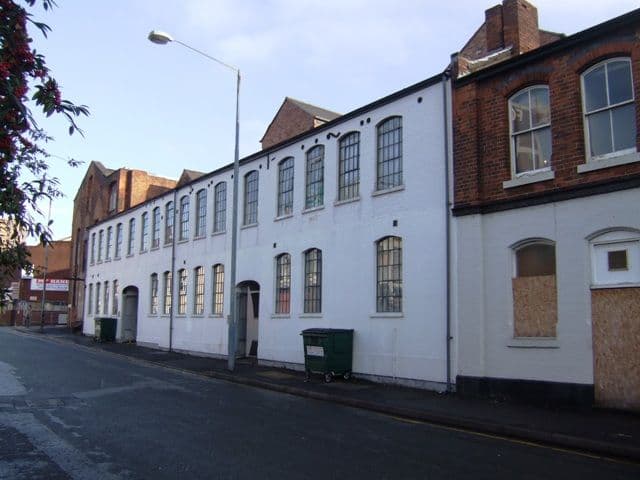
Where it started: the Staffordshire Home Guard history and the 1891 obituary place Pursall & Phillips in Whittall Street; the Victoria County History (Warwickshire vol. 7) says Kynoch’s began making percussion caps in Great Hampton Street. The 1884 advertisement gives the firm’s Birmingham depot as 14 Whittall Street.
The 1870 explosion: the Birmingham Daily Post obituary (1891) says eight killed and twenty-eight injured; the Staffordshire Home Guard history says eight killed and twenty injured. We say “more than twenty”.
Shares in 1884: the obituary says Kynoch received £260,000 in cash, £10,000 in preference shares and all £40,000 of the ordinary shares. The VCH says he took “most of the shares himself”.
The Ulster promise is reported in the obituary in its own words, not quoted from a speech. We report it as the Post did.
Kynoch Ltd: the firm became a limited company (G. Kynoch & Co. Ltd) in 1884 and was refloated as Kynoch Ltd in 1897. Some accounts give 1897 for “Kynoch Ltd” and some 1884.
Aston Villa: he is often called the club’s chairman; the obituary and Grace’s Guide say president.
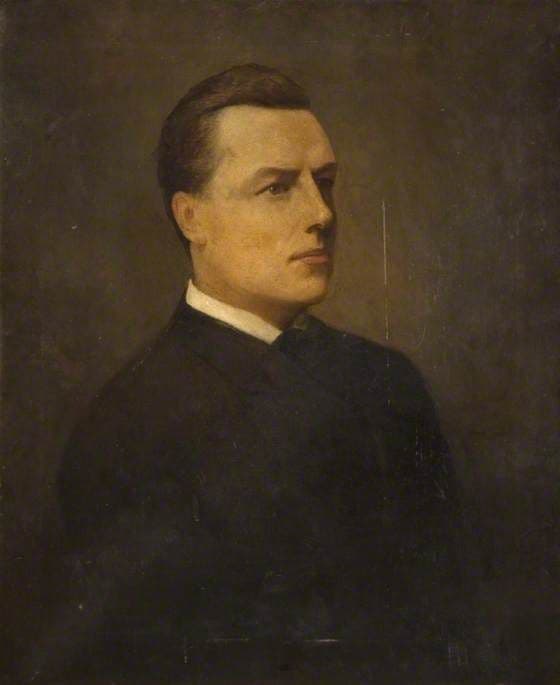
The Oxford DNB entry on Kynoch was not seen; Wikipedia’s summary of it was used only as a lead. No portrait of Kynoch with a clear open licence has been found.
- Obituary of George Kynoch, MP — Birmingham Daily Post, Birmingham Daily Post, 1891. Ref. Birmingham Daily Post, Monday 2 March 1891. career, 1870 explosion, 1884 company, 1886 election, South Africa, death
- George Kynoch — Grace’s Guide to British Industrial History. birth, family, marriage, censuses, burial
- History of Kynoch, part 1 — Staffordshire Home Guard website. 1859 explosion; Witton 1861–62; 1870 explosions; 1882 figures; 1888 resignation
- Economic and Social History: Industry and Trade, 1500–1880, in A History of the County of Warwick, vol. 7, pp. 81–139 — W. B. Stephens (ed.), Victoria County History, 1964. Kynoch’s and the gun trade; Witton
- A History of the County of Warwick, vol. 7: The City of Birmingham — Industry and Trade, 1880–1960, pp. 140–208 — W. B. Stephens (ed.), Victoria County History, 1964. Abraham, Hamstead Hall, Aston Cross; Kynoch Ltd, ICI Metals
- Kynoch — Grace’s Guide to British Industrial History. 1897, 1918, 1926, 1962
- George Kynoch (businessman) — Wikipedia. British and Turkish contracts (lead only)
Comments
Comments will load here.