
What was here?
A short-lived spinning mill in a former warehouse on the Upper Priory, a street off Old Square. Around 1741 Lewis Paul and John Wyatt set fifty spindles turning, powered by two donkeys walking round an axle and worked by ten women. By 1743 it had all but failed. The street itself vanished under the Priory Queensway in the 1960s.
History
Spinning without fingers
For thousands of years every thread of cotton or wool had been spun by hand. In the 1730s two men in Birmingham set out to change that.
Lewis Paul was an inventor with a house in Old Square. His partner was John Wyatt, born in 1700. In 1738 Paul patented a machine that drew out cotton between pairs of rollers, so that the fibre was stretched and twisted by machinery rather than by a spinner’s fingers. Roller spinning was the idea that, decades later, would sit at the heart of the great cotton mills.
Two donkeys and ten women
The partners needed somewhere to prove it worked. They found a former warehouse in the Upper Priory, a street running north-west from Old Square towards Steelhouse Lane and Snow Hill, close to Paul’s house.
By July 1740 the machinery was already being shown to visitors: a letter of that month records a visit to “Mr. Paul’s machine”. The mill is usually dated to 1741, and Wikipedia’s account says it opened in the summer of that year. It had fifty spindles, turned by two donkeys walking round and round an upright axle, and at first it was worked by ten women.
This was not water or steam power, but it was power: the machine did the spinning, and animals drove the machine. That is why the Upper Priory mill is often described as the world’s first powered cotton-spinning mill. The Victoria County History of Warwickshire, more cautious, confirms only that “Wyatt himself worked at it in the Upper Priory for some time”.
Backers and debts
The venture had well-connected supporters. They included Edward Cave, the London publisher of the Gentleman’s Magazine, and Thomas Warren, a Birmingham bookseller. Through Warren and Wyatt there may be a link to the young Samuel Johnson, though that connection is a lead rather than a fact.
Money was the problem. The mill did not pay. In 1742–43 John Wyatt was imprisoned for debt. By 1743 the mill was almost derelict, and after late 1743 it disappears from the record. Like many first attempts, it showed the idea worked but not how to make it pay.
A street that vanished
No picture of the mill is known, and nobody knows exactly which building it was. The Upper Priory itself survived into the 20th century: the Ordnance Survey’s 25-inch maps of the 1880s–1900s show it clearly beside Old Square. In the 1960s it was swept away for the Priory Queensway and Colmore Circus, part of the city’s new ring road.
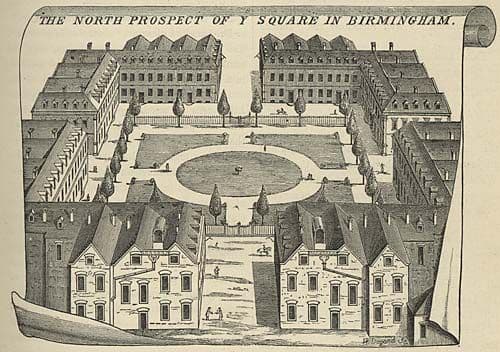
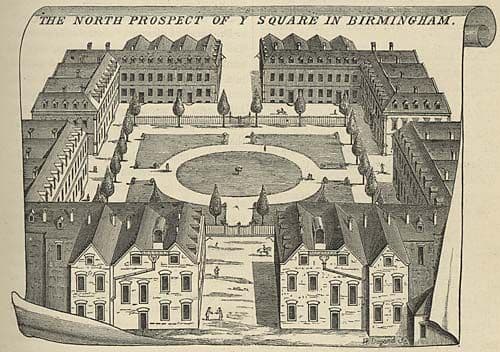
The name lives on in the Priory Queensway, and Old Square, though rebuilt, is still a public space. William Westley’s 1732 print shows the square as Lewis Paul would have known it, with neat brick houses around a garden.
A beginning
The Upper Priory mill has no plaque, no ruin and no archaeology. Its evidence is a handful of letters, printed by historians in the 20th century. But it marks a real beginning. Within a lifetime, machines built on the same principle of drawing out fibre between rollers would fill mills across Britain. One of the first places anyone tried it was a converted warehouse in Birmingham, with two donkeys going round in circles.
What happened here?
Lewis Paul and John Wyatt set up roller-spinning machinery here, shown to visitors by July 1740 and usually dated to 1741. Fifty spindles were driven by two donkeys and worked at first by ten women. The business struggled; Wyatt was imprisoned for debt in 1742–43, and the mill was almost derelict by 1743.
Why it mattered
It was one of the first attempts anywhere to spin cotton by powered machinery, using Lewis Paul’s 1738 roller-spinning patent. Its failure did not stop the idea, which became central to the factory cotton industry.
Why it disappeared
Other or unknown · Road building
The business failed: Wyatt was imprisoned for debt in 1742–43, the mill was almost derelict by 1743, and there is no record of it after late 1743 (sources summarised by Wikipedia, citing Wadsworth & Mann 1931). The Upper Priory street was later swept away in the 1960s for the Priory Queensway and Colmore Circus.
What’s there now
What replaced it
Later 18th- and 19th-century buildings on the Upper Priory, then, from the 1960s, the Priory Queensway and Colmore Circus ring road and the buildings around them.
What survives
Nothing physical. The name survives in the Priory Queensway. Old Square still exists as a pedestrianised space. The story survives in letters printed by Wadsworth & Mann (1931) and J. J. Brown (1946).
Today
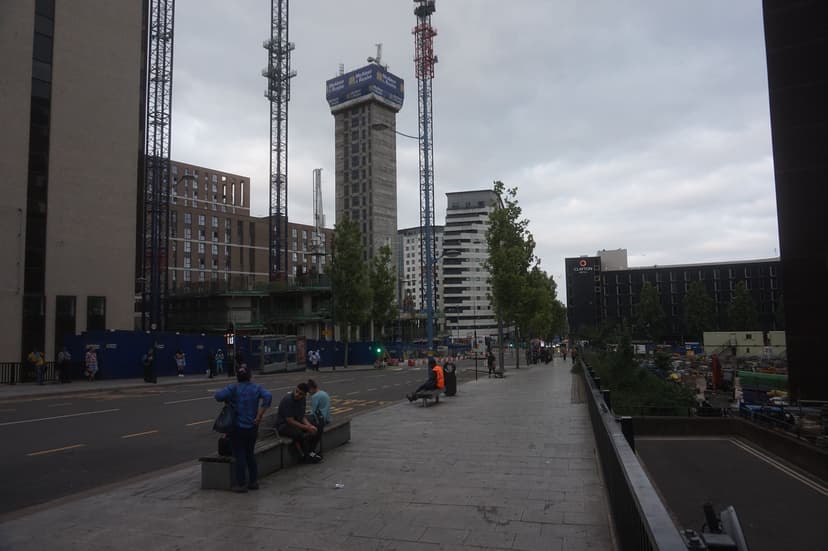
Stand in Old Square, at the corner of Corporation Street and the Priory Queensway. The Upper Priory ran north-west from here, roughly along the line of today’s Priory Queensway towards Steelhouse Lane. The exact site of the mill is unknown.
Then and now
Then · 1732
Now · 23 July 2021
Today
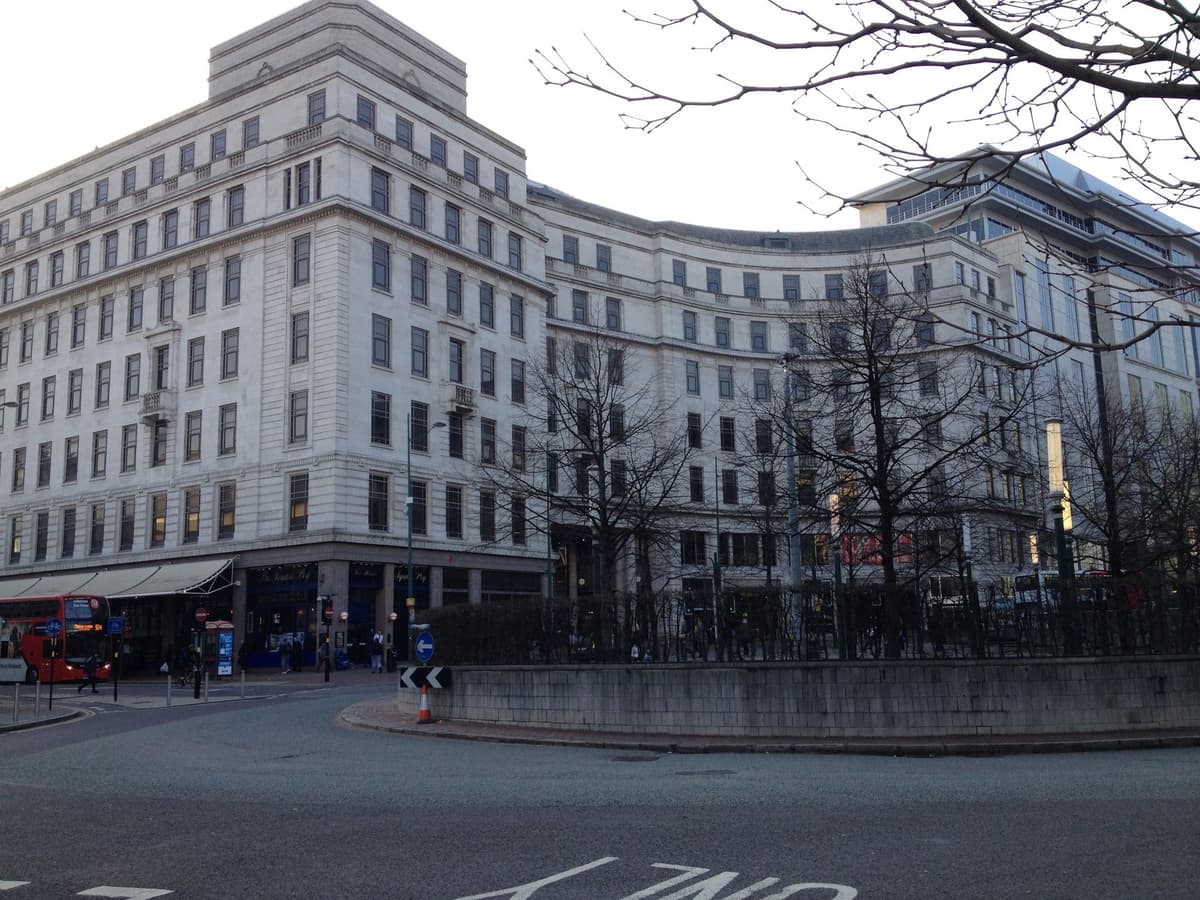
Old Square, Birmingham, 12 March 2014Richard Cooke, 12 March 2014. Geograph Britain and Ireland via Wikimedia Commons · CC BY-SA 2.0
Key dates
- c. 1741 — Paul and Wyatt’s mill in the Upper PrioryLewis Paul and John Wyatt set up one of the earliest powered cotton-spinning mills in a warehouse in the Upper Priory, its spindles turned by two donkeys.
- c. by 1743 — Upper Priory mill failsWith John Wyatt imprisoned for debt, the Upper Priory cotton mill was almost derelict by 1743, and disappeared from the record after that year.
Sources and further reading
The exact building is unknown; the map point is the midpoint of the Upper Priory as shown on the OS 25-inch map, so it marks the street, not the mill. The opening date (summer 1741), the donkeys and spindles, and the role of backers come from Wikipedia, which is well referenced to Wadsworth & Mann (1931) and others but has not been checked against those books. The Samuel Johnson connection is a lead only. The ‘world’s first powered cotton-spinning mill’ description is widely repeated but is a superlative. A 1967 mural by Kenneth Budd in Old Square is reported but unverified.
- Economic and Social History: Industry and Trade, 1500–1880, in A History of the County of Warwick, vol. 7, pp. 81–139 — W. B. Stephens (ed.), Victoria County History, 1964
- Upper Priory Cotton Mill — Wikipedia
- Ordnance Survey 25-inch map, Warwickshire (Birmingham sheet), georeferenced — National Library of Scotland

Comments
Comments will load here.