

Sometime in 1733, in a small building near Sutton Coldfield, a carpenter from Lichfield fed a strand of cotton into a wooden machine about two feet square and watched it come out as thread.
That, at least, is how his son told it. Writing in 1818, Charles Wyatt said that his father had spun “the first thread of cotton ever spun without the intervention of human fingers”, alone and “without a single witness”, while he stood “all the time in a pleasing but trembling suspense”. It is a family story, and it was told to win an argument. But the letters that survive back up the bones of it. Something important happened in the 1730s, just outside Birmingham, and John Wyatt was at the heart of it.
A carpenter from Weeford
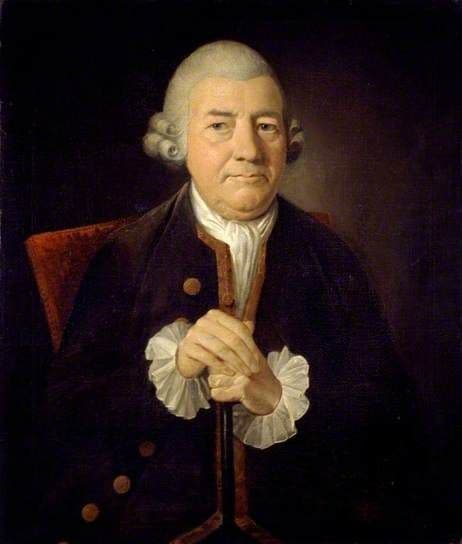
John Wyatt was born in April 1700 at Thickbroom, in the parish of Weeford near Lichfield, the eldest son of John and Jane Wyatt. He went to Lichfield school. His family was connected with that of Sarah Ford, the mother of Samuel Johnson, according to the Dictionary of National Biography (1900). He worked as a carpenter in his home village.
He could not stop inventing. His notes, which the French historian Paul Mantoux studied in Birmingham’s library early in the twentieth century, were full of schemes: harpoons fired from a gun, machines to mend roads, improved weighing machines. One early idea, a machine for cutting files, found a backer in a Birmingham gunmaker, Richard Heeley. When Heeley ran into money troubles, his rights passed to a gentleman called Lewis Paul. On 19 September 1732, “John Wyatt of the parish of Weeford … carpenter” signed an agreement with Paul. It was the start of a long and painful partnership.
The “gymcrack”
Paul reminded him, in a line that still stings: “I know your grand secret and can use you as I please.”
In 1733 Wyatt wrote to one of his brothers that he meant to live in or near Birmingham, because he had “a gymcrack there of some consequence”. The gimcrack was a spinning machine.
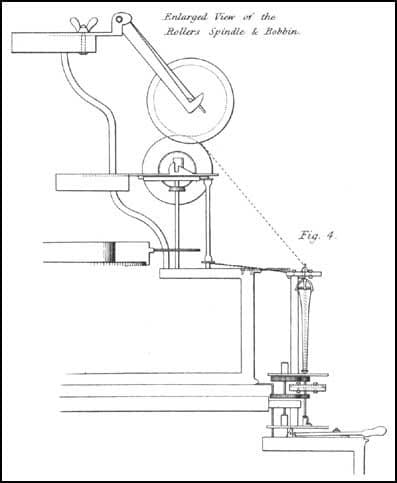
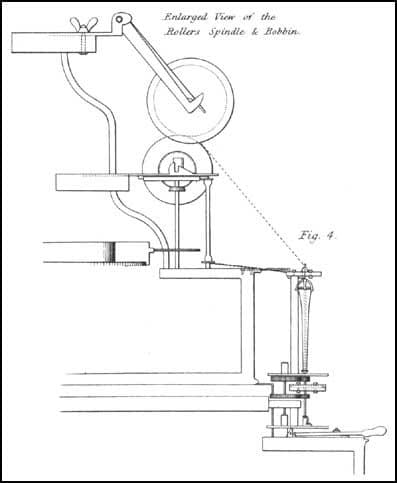
Its secret was rollers. A loose rope of cotton fibre passed between one pair of rollers, then a second pair turning faster. The faster pair pulled the fibre out thinner and thinner, the way a spinner’s fingers do. In June 1738 the principle was patented: in Paul’s name. Wyatt’s name does not appear.
The partners did not get rich. In 1736 they nearly fell out for good. Wyatt complained he was “much poorer than a pauper”. Paul reminded him, in a line that still stings: “I know your grand secret and can use you as I please.” The letters are quoted by Mantoux from Wyatt’s own papers.
Two donkeys in the Upper Priory
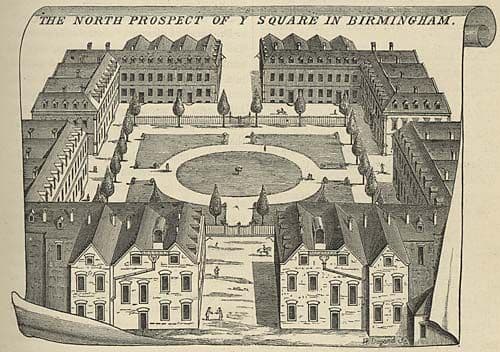
In about 1741 the machine finally went to work, in a warehouse in the Upper Priory, a street off Old Square in the middle of Birmingham. It was driven not by water but by donkeys. A hank of its yarn, later given to the town’s library by Wyatt’s descendants, carried a label in his own hand: spun by “two or more asses walking round an axis”, with “John Wyatt” as superintendent.
The visitors were impressed. Dr Robert James, a friend of Johnson, wrote in July 1740 that “Mr. Paul’s machine” had given “entire satisfaction both in regard to the carding and the spinning”. The business was another matter. Wyatt offered to run the mill from December 1741, but by June 1742 he was in the Fleet Prison for debt, according to Wadsworth and Mann’s history of the cotton trade. A letter sent to him there reported that hardly an ass was left alive. By 1743 the mill was almost derelict.
The weighing machine
Meanwhile Wyatt had another idea, and this one worked. He built weighing machines using a set of compound levers, so that a small weight could balance a loaded cart. The Science Museum holds a working model of the cart-weighing machine he made for Birmingham’s Overseers of the Poor in 1741. The Dictionary of National Biography says five-ton machines of his design were set up at Birmingham, Liverpool, Chester, Hereford, Gloucester and Lichfield.
The timing was good. The Victoria County History points out that the Turnpike Act of 1741 made it necessary to weigh waggons on the roads. Grace’s Guide calls Wyatt’s machine probably the first true compound-lever platform scale.
With Boulton
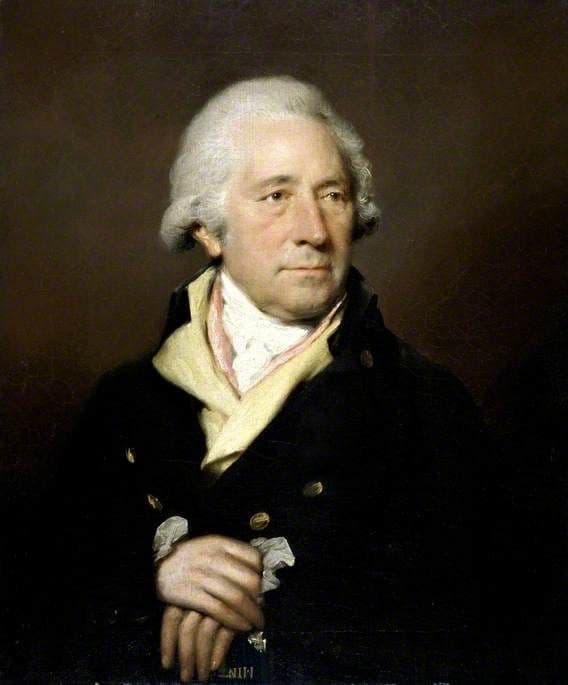
In his last years Wyatt worked with Matthew Boulton, who was building his great Soho Manufactory from 1762. The Victoria County History lists Boulton among his later backers, and the Dictionary of National Biography says Wyatt was employed at Soho. The details of what he did there are thin.
He died on 29 November 1766 and was buried in the churchyard of St Philip’s, Birmingham. Boulton and John Baskerville followed him to the grave. Boulton, it was said, scolded Wyatt’s sons for not standing up for their father’s inventions.
Who invented roller spinning?
That question became a long fight. Charles Wyatt claimed the credit for his father in 1818. In 1858 the collector Robert Cole, who had bought Lewis Paul’s papers, argued for Paul. The Dictionary of National Biography printed both sides. Mantoux, weighing the letters, thought it “probable that Paul did much less, and Wyatt much more than might be supposed”.
The honest answer is that it was a partnership. Paul had the patent, the connections and the debts. Wyatt had the hands, the skill and, very probably, much of the idea.
Why it mattered
John Wyatt died poor and nearly forgotten, and the mill he ran failed within two years. Yet the principle he helped to build, drawing out fibre between rollers turning at different speeds, became the heart of the factory cotton industry. Thirty years later Richard Arkwright’s water frame used rollers in the same way. Mantoux, setting the 1738 patent beside Arkwright’s machine, called the rollers “the essential contrivance which will also be found in the machine said to be Arkwright’s”.
Wyatt also saw what such machines would mean. In 1736 he wrote that a mill with “wheels turned either by horses, water or wind” could drive many machines at once, and he argued that cheaper thread would create more work, not less. That is the factory age, imagined by a Lichfield carpenter in a shed near Sutton Coldfield. Matthew Boulton, who knew good work when he saw it, walked behind his coffin.
On the map
One place connected with John Wyatt. Tap a number for directions — some sites are private homes or gardens, so each place’s page says what you can see from the street.

- Upper Priory Cotton Mill — Lost, Site redeveloped
Key dates
- 24 June 1738 — Lewis Paul patents roller spinningLewis Paul, ‘of Birmingham, gentleman’, patents ‘a machine or engine for spinning of wool and cotton in a manner entirely new’, drawing fibre between rollers turning at different speeds. The machine was built with the carpenter John Wyatt, whose name does not appear.
- 1741 — John Wyatt’s weighing machine for BirminghamJohn Wyatt makes a compound-lever cart-weighing machine for Birmingham’s Overseers of the Poor. A working model is in the Science Museum. The Turnpike Act of the same year made weighing waggons necessary.
- 29 November 1766 — Death of John WyattJohn Wyatt, co-inventor of roller spinning, dies and is buried at St Philip’s, Birmingham. Matthew Boulton and John Baskerville follow his coffin.
Sources and further reading
Who invented roller spinning has been argued since 1818: Charles Wyatt (1818) and Baines claimed it for Wyatt; Robert Cole (1858) for Paul; Mantoux (1928) leans to Wyatt. The 1733 Sutton Coldfield scene comes from Charles Wyatt’s 1818 account and cannot be checked; Wikipedia names the place as New Forge (Powell’s) Pool, which is not confirmed here. The ‘gymcrack’ letter is quoted slightly differently by the DNB (‘a gymcrack there of some consequence’) and Mantoux (‘a gymerak of some importance’); the DNB wording is used. The file-cutting machine: the DNB says Wyatt sought Paul’s money for it in 1730; Mantoux describes a first machine for turning and boring metal bought by Richard Heeley; the VCH says Heeley backed the file-cutting machine c.1732. Wyatt’s imprisonment in the Fleet (June 1742 to October 1743) comes from Wikipedia citing Wadsworth & Mann (1931), not checked against the book; Mantoux says only that the partners went bankrupt in 1742. The DNB says Wyatt worked at ‘the Soho foundry, which was established in 1762’ (the Soho Foundry was not built until 1795–96; the Soho Manufactory was begun in 1762), so the nature of his work for Boulton is uncertain. Grace’s Guide says he fitted roller bearings to Boulton’s mill in 1761; not checked. The hank of yarn and Wyatt’s papers were in the Birmingham Reference Library; whether they survived later losses is not known.
- Wyatt, John (1700–1766), Dictionary of National Biography, vol. 63 — Thomas Seccombe, Smith, Elder & Co., 1900
- The Industrial Revolution in the Eighteenth Century (English translation) — Paul Mantoux, Jonathan Cape, London, 1928. Part II, ch. 3, section IV, pp. 213–220
- Paul, Lewis (d. 1759), Dictionary of National Biography, vol. 44 — R. B. Prosser, Smith, Elder & Co., 1895
- Economic and Social History: Industry and Trade, 1500–1880, in A History of the County of Warwick, vol. 7, pp. 81–139 — W. B. Stephens (ed.), Victoria County History, 1964. 1640–1760: ‘Entrepreneurs and Capital’ and ‘Technological advance’
- Working model of John Wyatt’s original cart-weighing machine (object 1930-715) — Science Museum Group
- John Wyatt — Grace’s Guide to British Industrial History
- Johnson, John Wyatt and Lewis Paul: Improvements to Cotton Spinning — Revolutionary Players
- Upper Priory Cotton Mill — Wikipedia

Comments
Comments will load here.