Birmingham is not a cotton town. Yet one of the key inventions of the cotton industry was patented, built and first set to work here.
Spinning by rollers
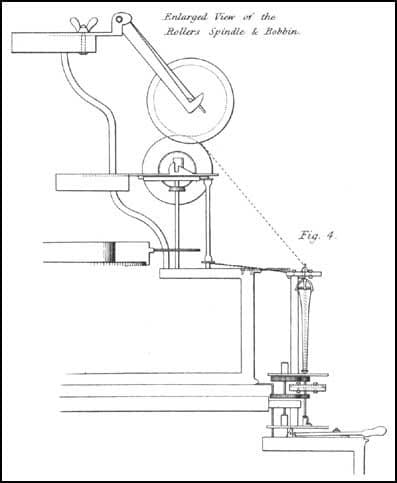
For thousands of years thread had been spun by hand. In the 1730s Lewis Paul, “of Birmingham, gentleman”, and the carpenter John Wyatt developed a machine that did it differently. Fibre was passed between two pairs of rollers, the second turning faster than the first, so that the cotton was drawn out thin and even before it was twisted. Paul patented the principle on 24 June 1738.
Two donkeys and a warehouse
In about 1741 the partners opened a mill in a warehouse in the Upper Priory, Birmingham. Fifty spindles were driven by two donkeys walking round an axle. As early as July 1740 a visitor had found that the machine gave “entire satisfaction”. But the business failed by 1743. Edward Cave, publisher of the Gentleman’s Magazine, set up a larger, water-powered mill at Northampton, and another ran at Leominster. Neither made money. The Victoria County History concludes that spinning “in Birmingham had little future”.
Paul went on to patent a carding machine in 1748 and an improved spinning machine in 1758. He died in 1759, Wyatt in 1766.
Arkwright
In 1769 Richard Arkwright patented his water frame, which also drew cotton between rollers. With capital, water power and tight management, he made the idea pay at Cromford and founded the factory cotton industry. How much he owed to Paul and Wyatt is still argued. The historian Paul Mantoux, comparing the 1738 patent with Arkwright’s machine, called the rollers “the essential contrivance which will also be found in the machine said to be Arkwright’s”.
Key dates
- 24 June 1738 — Lewis Paul patents roller spinningLewis Paul, ‘of Birmingham, gentleman’, patents ‘a machine or engine for spinning of wool and cotton in a manner entirely new’, drawing fibre between rollers turning at different speeds. The machine was built with the carpenter John Wyatt, whose name does not appear.
- 1748 — Lewis Paul patents a carding machinePaul patents a machine for carding cotton and wool, the first suggestion of a continuous carding engine. It was tried in Birmingham and Northampton.
- April 1759 — Death of Lewis PaulLewis Paul dies at Brook Green, Kensington, and is buried at Paddington on 30 April. His mills had failed, but his roller-spinning principle would be at the heart of the cotton industry.
- 29 November 1766 — Death of John WyattJohn Wyatt, co-inventor of roller spinning, dies and is buried at St Philip’s, Birmingham. Matthew Boulton and John Baskerville follow his coffin.
Sources and further reading
- The Industrial Revolution in the Eighteenth Century (English translation) — Paul Mantoux, Jonathan Cape, London, 1928. pp. 213–220
- Paul, Lewis (d. 1759), Dictionary of National Biography, vol. 44 — R. B. Prosser, Smith, Elder & Co., 1895
- Wyatt, John (1700–1766), Dictionary of National Biography, vol. 63 — Thomas Seccombe, Smith, Elder & Co., 1900
- Economic and Social History: Industry and Trade, 1500–1880, in A History of the County of Warwick, vol. 7, pp. 81–139 — W. B. Stephens (ed.), Victoria County History, 1964
- Upper Priory Cotton Mill — Wikipedia