

In January 1879 fire tore through Birmingham’s Free Library. Among the treasures lost were several hundred letters, bought at auction only a few years before. They had been written to a man called Lewis Paul: thirteen of them by Samuel Johnson, about twenty by Edward Cave of the Gentleman’s Magazine, thirty or forty by the physician Robert James. Before anyone had properly catalogued them, they were ash.
The Dictionary of National Biography (1895), noting the loss, said that a memoir by the collector who had owned them formed “the sole source of information respecting Paul’s career”. So we know Lewis Paul mostly at second hand. What we do know is remarkable. He took out the patent for the idea that would spin the world’s cotton, and he lost nearly everything trying to make it pay.
A gentleman with an idea
Paul was the son of a physician, Dr Paul, who died when the boy was very young. The family was of French Protestant, Huguenot, descent. Lewis was brought up under the guardianship of Lord Shaftesbury and his brother. In February 1728 he married Sarah Meade, a widow; she died in September 1729.
His first money came from a machine for “pinking” shrouds, cutting the decorative edges on burial cloths. One of his pupils in the art of pinking was Mrs Desmoulins, later a friend of Samuel Johnson. Paul moved in literary London. That world would fund his great gamble.
The patent of 1738
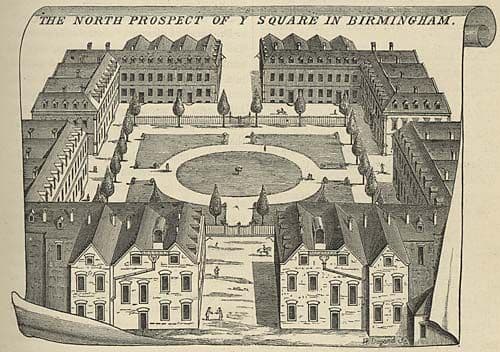
In 1732 Paul struck a bargain with a Lichfield carpenter, John Wyatt, over an earlier invention. By 1733 the two men were working on a machine to spin. On 24 June 1738 Paul was granted a patent for “a machine or engine for spinning of wool and cotton in a manner entirely new”. In it he is described as “of Birmingham, gentleman”, and he had a house in Old Square.
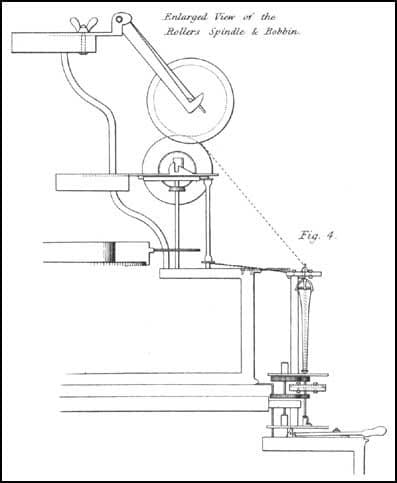
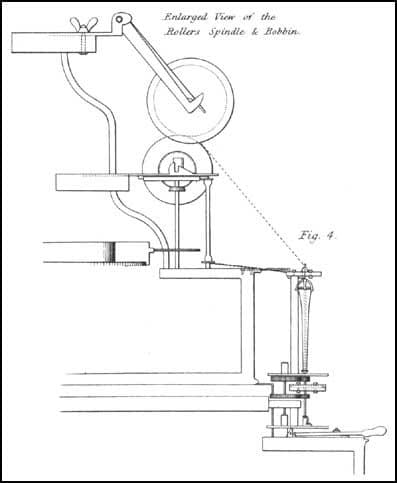
The idea was simple and enormous. Cotton was drawn between pairs of rollers, the second pair turning faster than the first, so that the fibre was stretched out evenly before it was twisted into thread. The Dictionary of National Biography called it “of the greatest importance”, in use “in every cotton-mill in the world”.
Paul’s friends were dazzled. In July 1740 Dr Robert James wrote to the Birmingham bookseller Thomas Warren that “Mr. Paul’s machine” had given “entire satisfaction”. “I am certain,” he went on, “that if Paul could begin with £10,000 he must, or at least might, get more money in twenty years than the City of London is worth.”
Mills that would not pay
The money never came. Paul had already been imprisoned for debt, and his machine seized with his furniture, before it ever ran, according to Mantoux. In about 1741 a small mill opened in a warehouse in the Upper Priory, Birmingham, near his house, with two donkeys walking round to drive fifty spindles. It was almost derelict by 1743.
Paul sold rights to Edward Cave, who set up a bigger mill at Northampton in the early 1740s. It had five machines with fifty spindles each, driven by a water wheel on the River Nene, and about fifty workers. Mantoux says it limped on until 1764. Another mill using the machinery ran at Leominster. None made a fortune.
Johnson stayed loyal. He wrote to Paul over many years, advised him in his quarrels, and drafted a letter for him to the Duke of Bedford, president of the Foundling Hospital, offering the machine to set the children to work.
Carding, and a poem
Paul kept inventing. In 1748 he patented a carding machine, which combed the raw cotton into a soft, even lap ready for spinning. It contained the first suggestion of a continuous carding engine with a comb to strip off the carded fibre. Nobody disputed that this one was his.
In June 1758 he took out a third patent, for an improved spinning machine. He was then living at “Kensington Gravel Pits”. The poet John Dyer had already put it into verse. In The Fleece (1757) Dyer described “a circular machine, of new design”, which “draws and spins a thread / Without the tedious toil of needless hands”. A footnote names the inventor: “Mr. Paul”.
He died in April 1759 at Brook Green, Kensington, and was buried at Paddington on 30 April.
Why it mattered
Lewis Paul’s mills failed, his papers burned, and his name is often left out of the story of cotton. Yet the 1738 patent describes, for the first time, spinning by pairs of rollers moving at different speeds: the principle at the heart of Richard Arkwright’s water frame thirty years later. Historians still argue how much Arkwright owed directly to Paul and Wyatt, and the honest answer is that nobody can prove it either way. What is beyond doubt is that the idea was written down, patented and set to work first in Birmingham.
Arkwright succeeded where Paul failed because he had capital, discipline and the right moment. Paul had a brilliant idea a generation too early, and a circle of friends, Johnson among them, who believed in it. In a warehouse in the Upper Priory, two donkeys turning a wheel were a first glimpse of the factory age.
On the map
One place connected with Lewis Paul. Tap a number for directions — some sites are private homes or gardens, so each place’s page says what you can see from the street.

- Upper Priory Cotton Mill — Lost, Site redeveloped
Key dates
- 24 June 1738 — Lewis Paul patents roller spinningLewis Paul, ‘of Birmingham, gentleman’, patents ‘a machine or engine for spinning of wool and cotton in a manner entirely new’, drawing fibre between rollers turning at different speeds. The machine was built with the carpenter John Wyatt, whose name does not appear.
- 1748 — Lewis Paul patents a carding machinePaul patents a machine for carding cotton and wool, the first suggestion of a continuous carding engine. It was tried in Birmingham and Northampton.
- April 1759 — Death of Lewis PaulLewis Paul dies at Brook Green, Kensington, and is buried at Paddington on 30 April. His mills had failed, but his roller-spinning principle would be at the heart of the cotton industry.
Sources and further reading
Paul’s birth date and place are unknown. Whether roller spinning was Paul’s idea or Wyatt’s is disputed: Grace’s Guide says ‘Roller Spinning was certainly Paul’s idea, and Wyatt built a machine (or model) for him’; Charles Wyatt (1818) and Mantoux (1928) give Wyatt more credit. The date of the Northampton mill is given as 1742 by Wikipedia; Mantoux says it ran until 1764 and that its plant was later bought by Arkwright, which has not been checked. Mantoux says Paul was imprisoned for debt before 1740; the date is not given. The dating of the Johnson letters (1741–1756) comes from Revolutionary Players. Revolutionary Players dates the library fire to ‘January 1897’, an error for 1879.
- Paul, Lewis (d. 1759), Dictionary of National Biography, vol. 44 — R. B. Prosser, Smith, Elder & Co., 1895
- The Industrial Revolution in the Eighteenth Century (English translation) — Paul Mantoux, Jonathan Cape, London, 1928. Part II, ch. 3, section IV, pp. 213–220
- Wyatt, John (1700–1766), Dictionary of National Biography, vol. 63 — Thomas Seccombe, Smith, Elder & Co., 1900
- Lewis Paul — Grace’s Guide to British Industrial History
- Johnson, John Wyatt and Lewis Paul: Improvements to Cotton Spinning — Revolutionary Players
- Economic and Social History: Industry and Trade, 1500–1880, in A History of the County of Warwick, vol. 7, pp. 81–139 — W. B. Stephens (ed.), Victoria County History, 1964
- Upper Priory Cotton Mill — Wikipedia

Comments
Comments will load here.