
What was here?
This is where Birmingham built some of the most original cars of the Edwardian age. From 1900 the Lanchester Engine Company, later the Lanchester Motor Company, made cars, armoured cars and aero engines at Armourer Mills on Montgomery Street, until production moved to Coventry after the BSA–Daimler takeover of 1930–31.
History
In 1900 three brothers moved a car company into an old mill in Sparkbrook. Frederick, George and Frank Lanchester had formed the Lanchester Engine Company on 30 November 1899. Frederick’s first car had taken to the road in 1896, built in borrowed workshops, and their second had been made at Ladywood Road. Now they needed a factory.
A mill becomes a motor works
They found it in Armourer Mills, on Montgomery Street. According to Looking at Buildings, the Pevsner guide’s companion website, the buildings were a rolling mill and tube works of 1887 by Ewen Harper, the architect best known for Birmingham’s Methodist Central Hall. Lanchester fitted them out for car production and shared the site with a firm of iron founders, Giles & Ward.
In August 1901 the first production model, a 10-horsepower two-cylinder car, was on the road; six were finished that summer. In 1902 a big new block went up on the street front, which Lanchester appears to have shared for offices. It is faced in bands of red and dark blue brick, with four huge gables and heavy classical detail in terracotta. Its architect was Arthur Edwards of Bennetts Hill, who normally designed pubs. In 1903 the company took over the neighbouring Radix Works, and moved its carriage building to the Alpha Works in Deritend.
Receivership and recovery
The same spot, then and now
1888–1913
Today
Old map: Ordnance Survey six-inch, reproduced with the permission of the National Library of Scotland (CC BY 4.0). Today: © OpenStreetMap contributors.
The cars were brilliant and the finances were not. In March 1904 the directors refused to put in the capital the business needed, and the company went into receivership. It was reformed in November as the Lanchester Motor Company, and carried on at Armourer Mills. Between 1900 and 1905, Grace’s Guide says, three to four hundred of the 10- and 12-horsepower cars were made here.
J. L. Ball’s buildings
In 1911 the company turned to J. L. Ball, a pioneering architect and a friend of W. R. Lethaby. Ball first designed an extension at the back of the mills, beside the canal. Then, because Lanchester wanted to build its own car bodies, he designed a long production block next to the 1902 building, with side galleries where bodies were built, varnishing and paint shops at the rear, and a showroom on the street.
War brought more. In 1915 Ball designed a second factory on the far side of the Giles & Ward block, with a long single-storey street front of round-headed arches and a large machine shop. Lanchester built armoured cars and aero engines, and Ball added a special engine-testing shop at the rear.
Leaving Birmingham
After the war Lanchester made big, expensive cars such as the Forty. The slump of the late 1920s hit the luxury trade hard, and in 1930–31 the company was bought by BSA, which already owned Daimler. Production moved to Daimler’s works in Coventry, and Lanchester cars slowly became re-badged Daimlers. The last Lanchester was made in the mid-1950s.
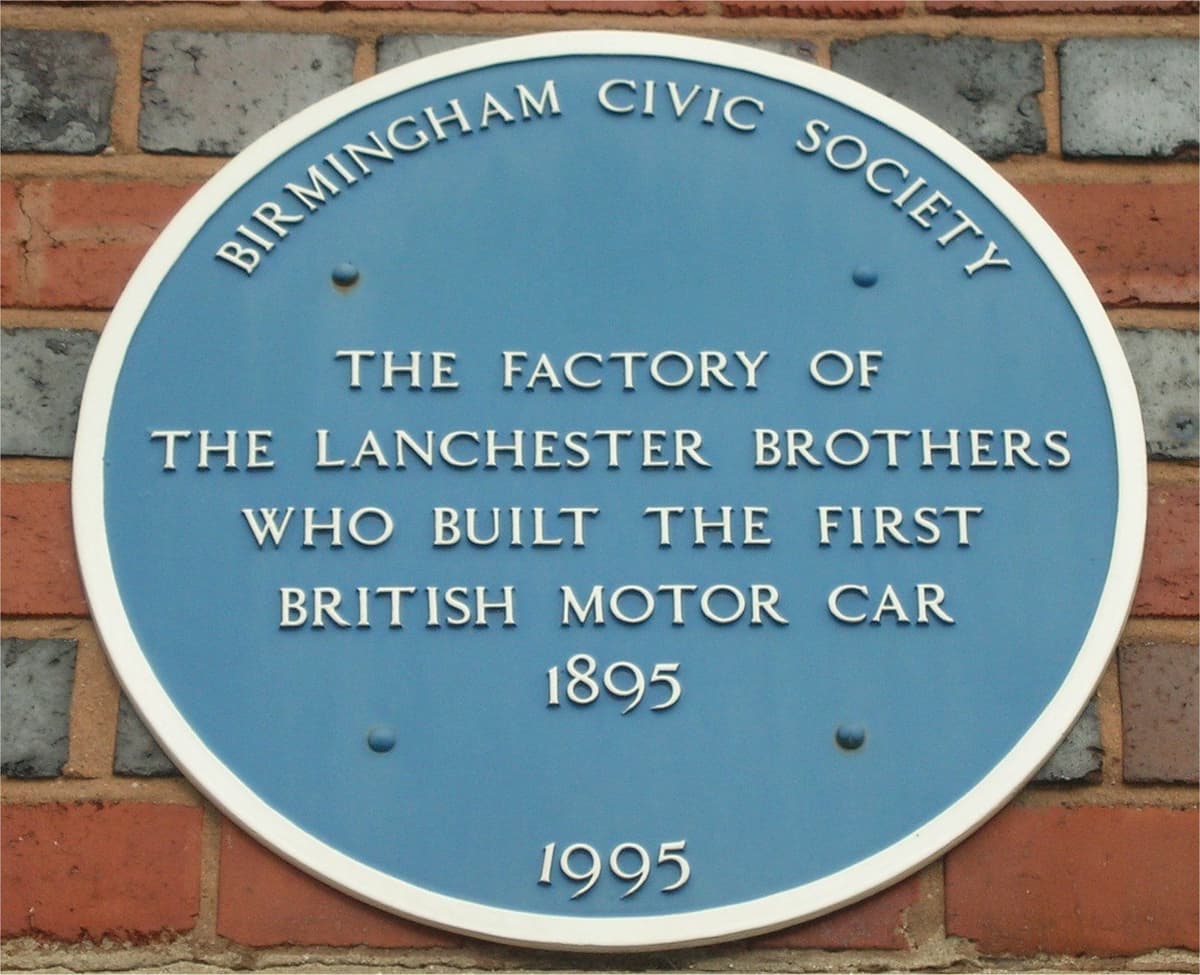
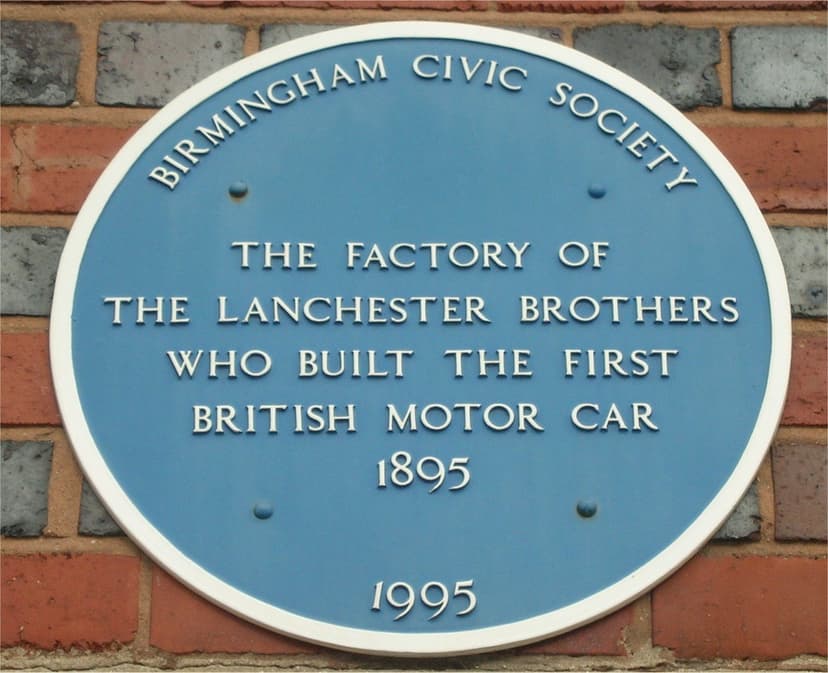
The buildings stayed. In 1995 the Birmingham Civic Society put up a blue plaque: “The factory of the Lanchester brothers who built the first British motor car 1895”. Looking at Buildings, writing in the 2000s, judged that the 1915 block had lost half its frontage and been much rebuilt behind, but that “the rest of the Lanchester works is a wonderful survival”. Birmingham City Council has put the former Lanchester works building on its local list at Grade A, its highest grade, kept for buildings of national listing quality. In a city that has kept few early motor-industry buildings, it is a rare chance to stand in front of an Edwardian car factory and see it much as its makers did.
What happened here?
The Lanchester Engine Company (from 1904 the Lanchester Motor Company) built cars here from 1900, its first production model appearing in August 1901. During the First World War the works made armoured cars and aero engines. Car production continued until the company was taken over by BSA in 1930–31 and moved to Coventry.
Why it mattered
Armourer Mills was the works of Frederick Lanchester, whose cars were designed from first principles rather than adapted from carriages, and it is one of the earliest motor factories in Britain to survive. Looking at Buildings calls it “a wonderful survival”, and its buildings by Edwards and J. L. Ball show how a mill was turned into a car factory and then extended for coachbuilding and war work.
What’s there now
What survives
According to Looking at Buildings: the 1887 mill buildings (much altered), the 1902 street block by Arthur Edwards with its red and blue banded brick, four gables and terracotta, and J. L. Ball’s production block of the early 1910s. Ball’s 1915 factory has lost half its street frontage and been much rebuilt behind. The 1995 Civic Society blue plaque is on the works.
Today
Montgomery Street runs through an industrial and residential part of Sparkbrook, near Small Heath railway station. The Lanchester buildings are in industrial use; the Civic Society blue plaque is on the street front. Look for the long banded-brick front with its four big gables.
Then and now
Then · Photographed 16 October 2006
Now · Photographed 16 October 2006
Key dates
- 30 November 1899 — Lanchester Engine Company formedFrederick, Frank and George Lanchester form the Lanchester Engine Company, backed by James and Allan Whitfield. In 1900 it moves to Armourer Mills, Montgomery Street, Sparkbrook.
- March 1904 — Lanchester Engine Company goes into receivershipWith its directors unwilling to provide more capital, the Lanchester Engine Company goes into receivership. It is reconstructed as the Lanchester Motor Company, registered on 21 November 1904.
- c. 1930–31 — BSA takes over LanchesterThe Lanchester Motor Company is bought by BSA, owner of Daimler, and production moves from Armourer Mills, Sparkbrook, to Coventry.
Sources and further reading
Origins of the mills: Looking at Buildings describes a rolling mill and tube works of 1887 by Ewen Harper; Grace’s Guide says the Lanchester Engine Co bought “part of the site of the Royal Small Arms Factory (Birmingham), the Armourer Mills”. The two accounts have not been reconciled.
Present condition: the descriptions of what survives come from Looking at Buildings (last updated 2009) and the council’s local list. The Birmingham Civic Society gives the plaque’s address as MBC Metal Powders, Montgomery Street, B11 1DT. The buildings have not been inspected for this entry, and their state since 2009 is unconfirmed.
Takeover date: Grace’s Guide says 1931; the Civic Society says 1930.
The plaque’s claim that the brothers built “the first British motor car” in 1895 is a claim, not a settled fact (see Frederick Lanchester). The 1895 car was built before the company came to Montgomery Street.
- The Lanchester Works — Looking at Buildings (Pevsner Books Trust)
- Lanchester Engine Co — Grace’s Guide to British Industrial History
- Lanchester Motor Co — Grace’s Guide to British Industrial History
- Blue Plaque: Lanchester Brothers Factory — Birmingham Civic Society
- Locally listed buildings (spreadsheet) — Birmingham City Council, Birmingham City Council
Archive references: Coventry University Lanchester Interactive Archive
Comments
Comments will load here.