
Early in 1793 the Gentleman’s Magazine printed a single sentence among its notices of deaths:
“Towards the end of 1792 died Mr. John Handy, the artist who cut the punches for Baskerville’s types, and for twelve years was employed in a similar way at the Birmingham Typefoundry of Mr. Swinney.”
That is almost everything we know about him. We do not know when or where he was born, what he looked like, where he lived or where he is buried. We have found no letter in his hand. Yet the letters his hands shaped are still read every day, in books and on screens all over the world, under another man’s name.
This is the story of the craftsman behind Baskerville’s letters, and of why men like him vanish.
What a punch-cutter did
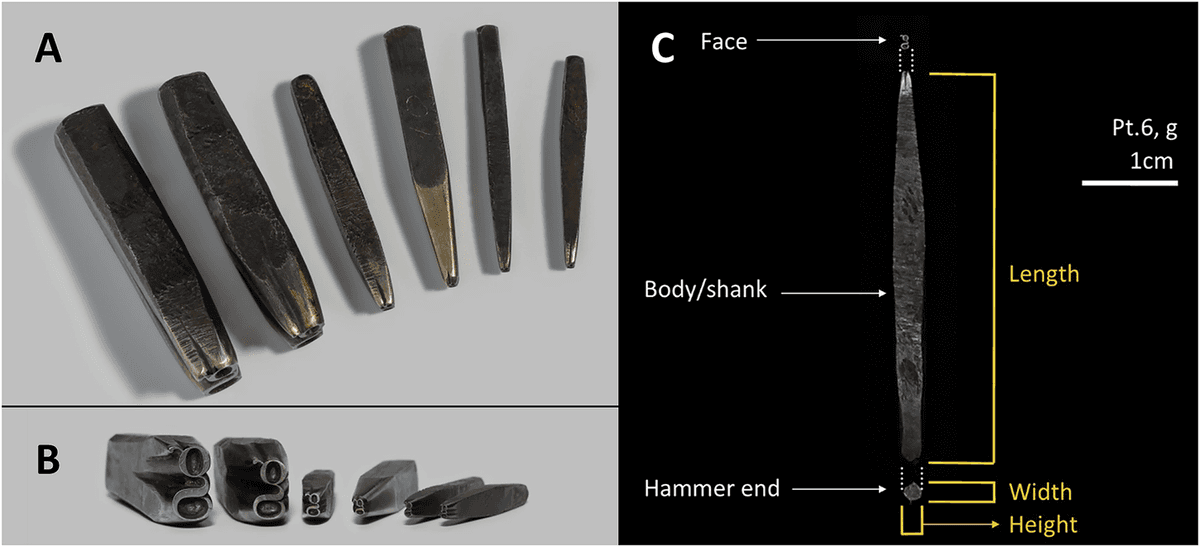
Every piece of metal type in an eighteenth-century printing office began as a punch: a short bar of iron or steel, a few centimetres long, with a single letter carved in relief, back to front, on one end.
Baskerville was proud and exacting: “The R wants a few slight touches, and the Y half an hour’s correction. This day we have resolutely set about thirteen of the same siz’d Italic Capitals.”
The punch-cutter shaped that letter with files and fine engraving tools, checking his progress by holding the punch in a candle flame to blacken it and pressing it on paper to see a “smoke proof”. When it was right, the punch was hardened. Then it was struck into a small block of copper, leaving a sunken, right-reading impression: the matrix. The matrix was trimmed and adjusted, “justified”, so that every letter would sit at the same height and line. Fitted into a hand mould, it received a squirt of molten metal, an alloy of lead, tin and antimony, and out came a piece of type. One punch could make one matrix, and one matrix could cast thousands of letters.
Every capital and small letter, every italic, figure and stop needed its own punch, and every size needed its own set. The punch-cutter decided, to a fraction of a millimetre, what the reader would see.
Easy Hill, 1752
John Baskerville was a writing master, a carver of gravestones and a rich japanner when, around 1750, he decided to make the most beautiful books in the world. He needed his own type. For that he needed punches.
His letters to the London publisher Robert Dodsley let us watch the workshop at Easy Hill at work. On 2 October 1752 he sent “an impression of fourteen punches of the Two-lines Great Primer, which have been begun and finished in nine days only”. Baskerville was proud and exacting: “The R wants a few slight touches, and the Y half an hour’s correction. This day we have resolutely set about thirteen of the same siz’d Italic Capitals.” On 19 October he sent “impressions from a candle”, smoke proofs, of twenty italic capitals “begun and finished in ten days only”. His next care, he wrote, was “to strike the punches into copper and justify them with all the care and skill I am master of”.
Notice the “we”. His early biographers wrote that Baskerville was “fortunate in obtaining an artist, John Handy, who worked well with him; and with Handy to help him, days, months, years passed before a single fount was completed.”
Whose hand?
So who actually cut Baskerville’s letters? The 1793 notice is clear: Handy did. Baskerville’s own letters speak of “I” and “we”. The latest scientific study of the punches, published in 2026, says Baskerville made his punches “with the assistance of the engraver John Handy”, his foreman William Martin and the printer Myles Swinney.
The likeliest answer is a partnership. Baskerville, the writing master, designed the letters, judged every proof and demanded corrections. Handy, the specialist, did much of the cutting. Where one man’s work ends and the other’s begins cannot now be separated.
What the punches remember
After Baskerville died in 1775, his widow Sarah sold the punches and matrices in 1779 to the French playwright Beaumarchais, who wanted them to print the complete works of Voltaire. Beaumarchais’s printing house sent a young armourer, Claude Jacobe, to England for two years to learn the Birmingham methods, and he worked, the 2026 study records, “under the supervision of John Handy”. Even with Baskerville gone, Handy was the man who knew how it was done.
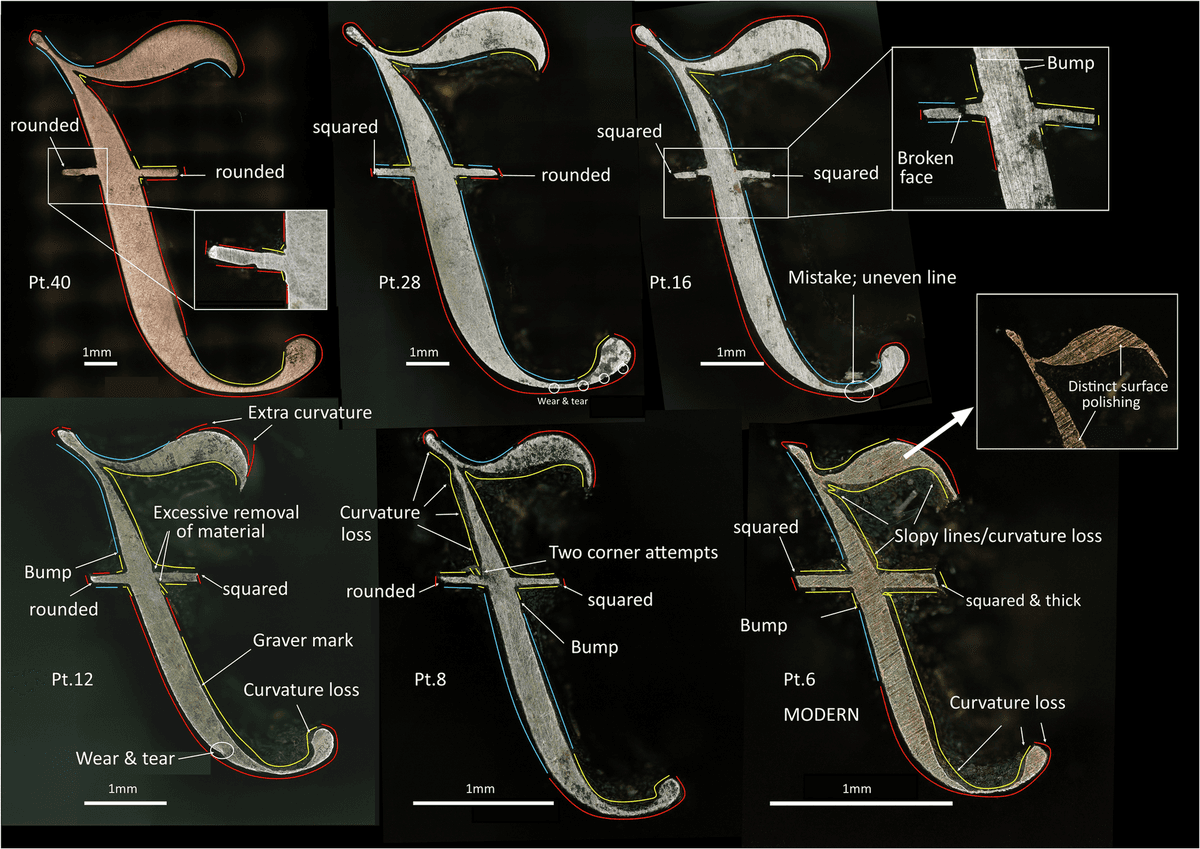
The punches went to France, changed hands seven times, and in 1953 were presented to the University of Cambridge. Today 3,240 of them are kept at Cambridge University Library. A team from Cambridge and Birmingham City University has examined them under microscopes and X-rays. They found punches forged from bars cut to set lengths for each size, big strokes shaped with files, tight corners finished with gravers, and, behind the even beauty of the printed letters, “remarkable variability” in how each was made. On one small italic J they marked a “mistake; uneven line”; on another, “two corner attempts”.
We cannot prove that those are Handy’s own slips and second tries. But they are the marks of the Birmingham workshop in which he was the specialist: a human being, bent over a bench, getting a curve right.
Swinney’s foundry
Baskerville’s death did not end type-founding in Birmingham. Myles Swinney, printer of the Birmingham Chronicle, set up a type foundry in the High Street; James Bisset’s directory of 1800 said the art had been “immediately on the demise of the late celebrated Baskerville … resumed” by him, and a Victorian writer called him for many years the only typefounder in the provinces. Handy joined him, and, according to his death notice, cut punches there for twelve years.
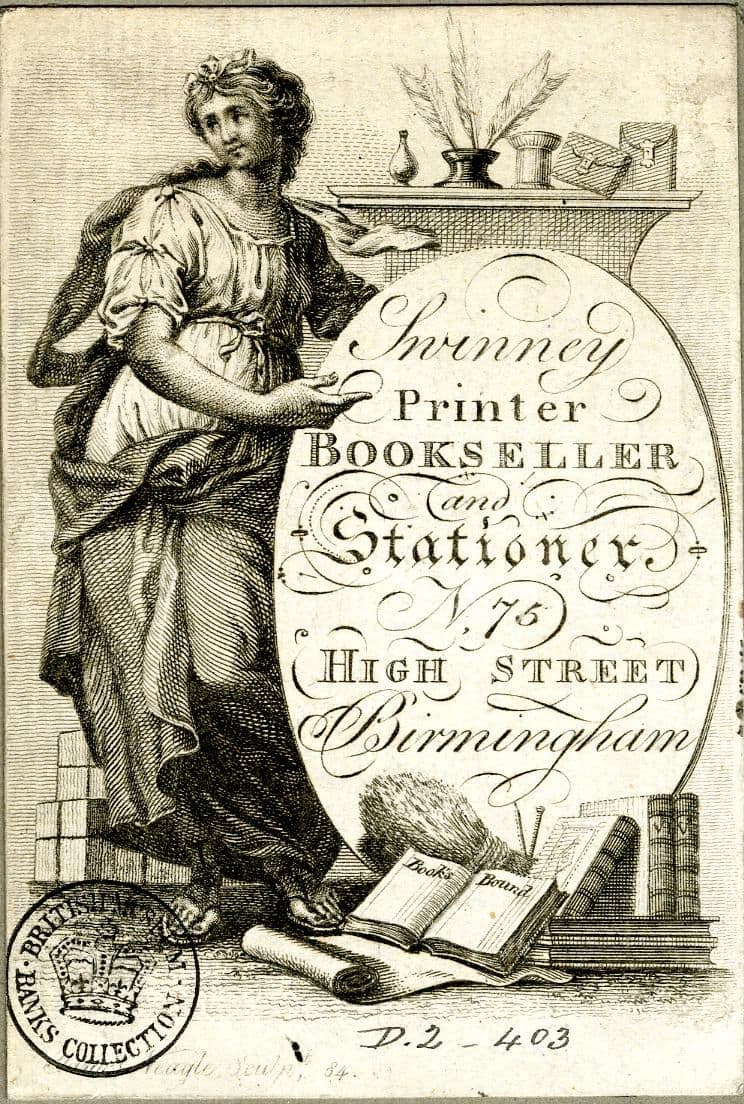
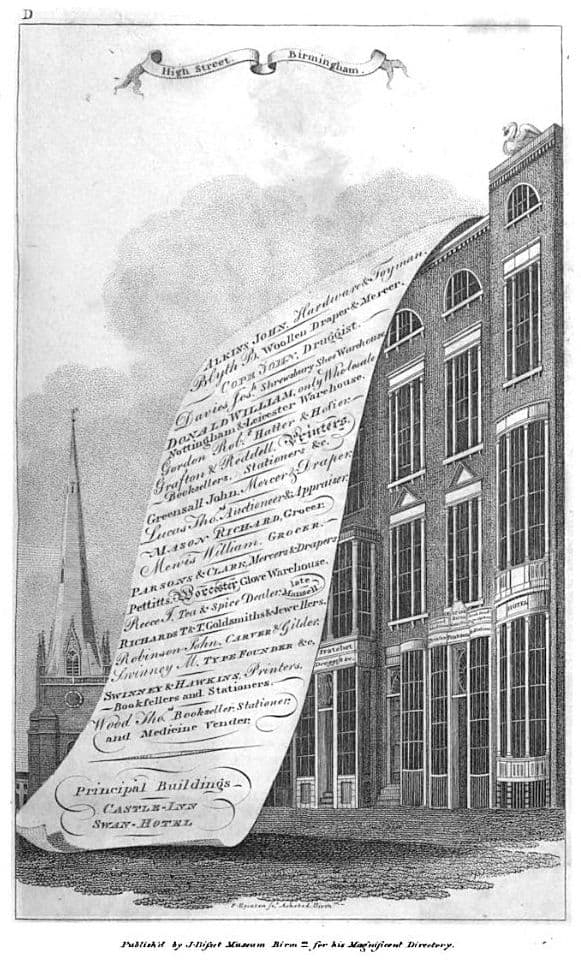
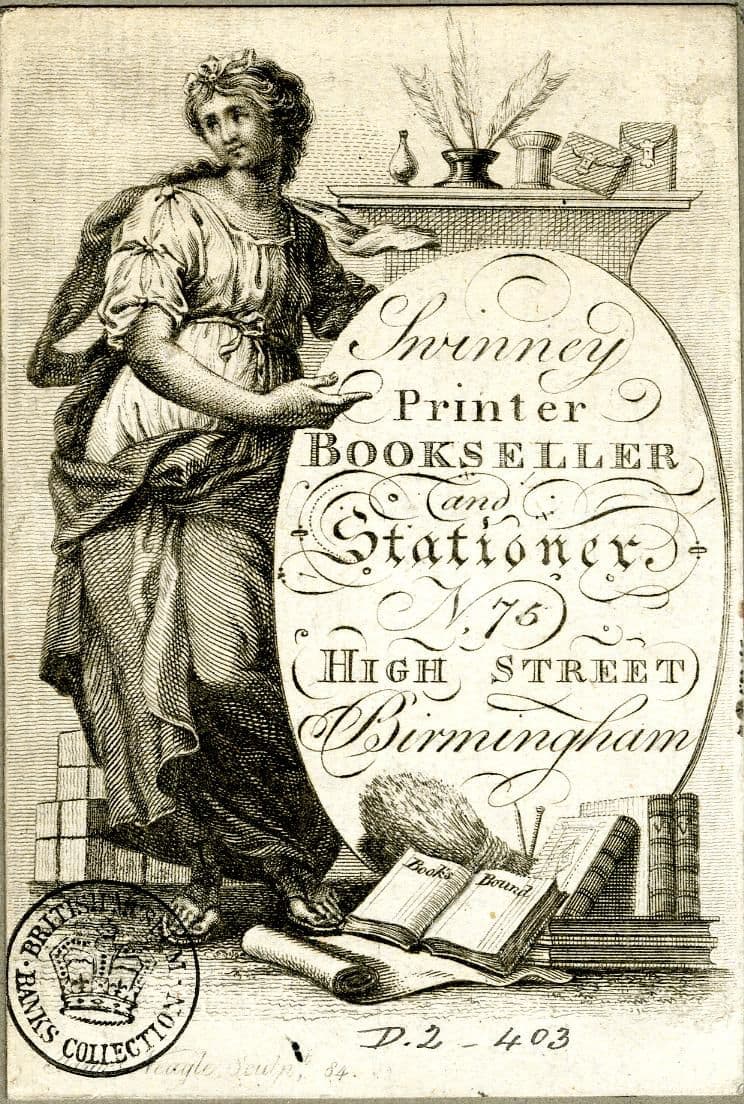
Swinney’s trade card of 1784 shows his shop at 75 High Street. Bisset’s engraving of 1800 lists “Swinney M., Type Founder &c.” among the High Street’s businesses. Somewhere behind that shopfront, until the end of 1792, John Handy was still at his bench.
Why the Handys disappear
Baskerville’s name is on the title pages, on a square in Birmingham, on a typeface. Handy’s is on nothing. That is not unusual. Masters signed the books, wrote the letters, sat for the portraits and kept the accounts that survive. Journeymen and specialists were paid wages, and their working lives went unrecorded unless something unusual happened. Handy left a trace only because his trade was so rare that a magazine thought his death worth one sentence.
The researchers who studied the punches in 2026 ended with a call for “a history of craft practice that deservedly places materials and craftspeople at the centre”. John Handy is a good place to start.
Why it mattered
Baskerville’s books were admired across Europe and by Benjamin Franklin in America, and the typeface named after him is still used every day. None of that could exist without punches, and the man who cut them for Baskerville, and taught others the Birmingham method, was John Handy.
His story is a reminder that famous names in Birmingham’s industrial history usually stand for workshops, not lone geniuses. Behind Baskerville stood Handy; behind Boulton and Watt stood engine erectors and pattern makers; behind every famous Birmingham brand stood people whose names were never written down.
We know almost nothing about John Handy’s life. We know a great deal about his work, because it survives: more than three thousand punches in Cambridge, most of them made in Birmingham and many still bearing the file marks of the bench. Every time a page is set in Baskerville, letters first given their edges in steel at Easy Hill come back to life. That is a better memorial than most portraits.
On the map
2 places connected with John Handy. Tap a number for directions — some sites are private homes or gardens, so each place’s page says what you can see from the street.

Key dates
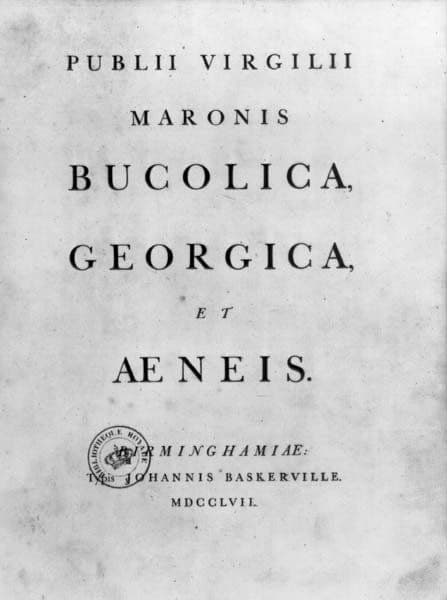
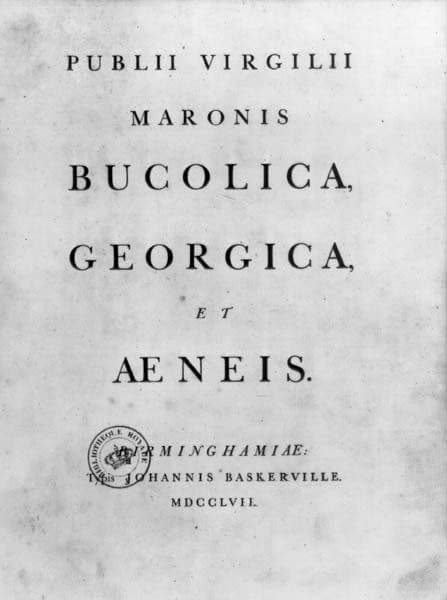
- October 1752 — Baskerville’s workshop finishes its first punchesAt Easy Hill, John Baskerville tells the publisher Robert Dodsley that fourteen punches for his large titling letters have been “begun and finished in nine days only”. His punch-cutter John Handy did much of the cutting; the type was used for the Virgil of 1757.
Sources and further reading
Life: no record of Handy’s birth, baptism, marriage, burial or address has been found, and no Birmingham directory entry. The death notice is known from quotations in Reed (1887) and Straus and Dent (1907), both citing the Gentleman’s Magazine, 1793, p. 91; the original page has not been checked.
Dates of work: he was working with Baskerville by the early 1750s (Straus and Dent; the 2026 study says Baskerville spent about five years making his punches). If his twelve years at Swinney’s ended with his death, he joined Swinney in about 1780; the notice does not say so.
Who cut the punches: the 1793 notice says Handy did; our profile of John Baskerville says Baskerville cut some himself; the 2026 study says Baskerville made them with Handy’s assistance. The surviving letters do not settle it.
Jacobe’s training: the 2026 study, citing earlier work by John Dreyfus and others, says Jacobe spent two years in England under Handy’s supervision; the exact years are not given.
Swinney: Reed (1887) says he began type-founding shortly after Baskerville’s establishment broke up and is styled “Letter Founder” in directories of 1785. The phrase “only typefounder in the provinces for many years” comes from a footnote in Timmins (1866).
- A History of the Old English Letter Foundries — Talbot Baines Reed, Elliot Stock, London, 1887. Baskerville chapter (Dodsley letters; Handy death notice); Myles Swinney
- John Baskerville: a Memoir — Ralph Straus and Robert K. Dent, Chatto & Windus, London, 1907. p. 16 and note
- John Baskerville, Type-founder and Printer, 1706–1775 — Josiah H. Benton, Boston, 1914. Handy ‘worked well with him’
- The manufacture of the Baskerville typographic punches: the versatile chaîne opératoire of an 18th-century printing workshop — Julia Montes-Landa, Mark Box, Caroline Archer-Parré, Ann-Marie Carey, Maciej Pawlikowski and Marcos Martinón-Torres, npj Heritage Science 14, 246, 2026. workshop, Jacobe, collection, tool marks, closing quotation
- The Resources, Products, and Industrial History of Birmingham and the Midland Hardware District — Samuel Timmins (ed.), Robert Hardwicke, London, 1866. footnote on Swinney
- A Poetic Survey round Birmingham, with a Magnificent Directory — James Bisset, Swinney & Hawkins for the author, Birmingham, 1800. plate D, High Street
- Trade card of Swinney, printer, bookseller and stationer, No. 75 High Street, Birmingham — British Museum (Banks collection, D,2.403), 1784. 75 High Street
- Baskerville, John (1706–1775), printer and typefounder — James Mosley, Oxford Dictionary of National Biography, 2004. abstract only
- The Baskerville Punches (film) — Baskerville Punches project (Cambridge University Library and Birmingham City University). Baskerville’s use of Handy
Comments
Comments will load here.