
What was here?
The shop, printing office and type foundry of Myles Swinney: printer, bookseller, stationer, publisher of the Birmingham Chronicle and directories, and for many years the only typefounder outside London.
History
After Baskerville
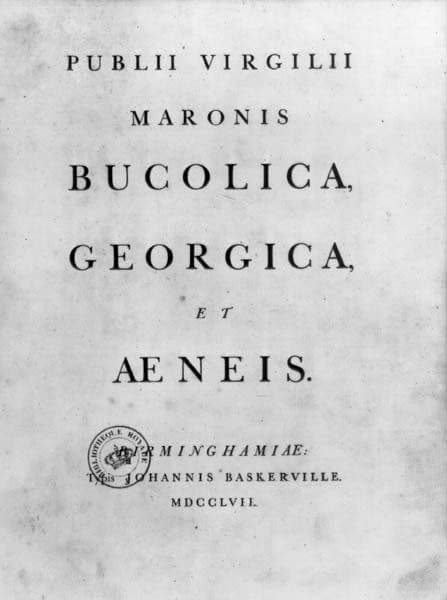
When John Baskerville died in 1775, his printing office at Easy Hill wound down and his widow sold the punches to France in 1779. Type-founding in Birmingham did not stop. James Bisset’s directory of 1800 said that this “useful Branch of the Typographic Art, immediately on the demise of the late celebrated Baskerville, was resumed and is now continued, with persevering industry and success, by Mr. Swinney”.
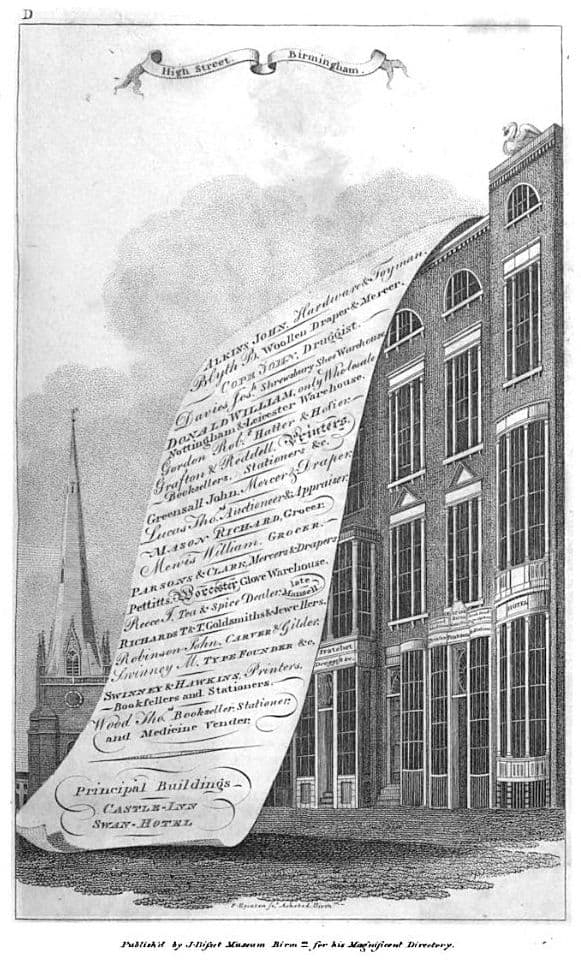
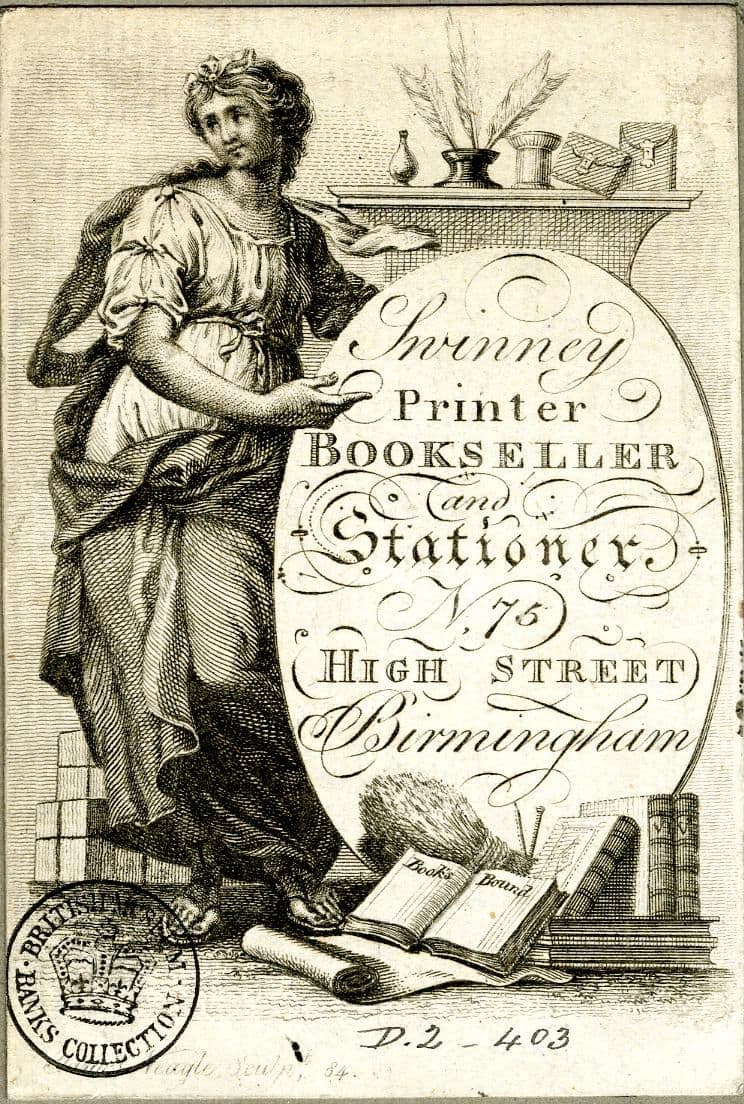
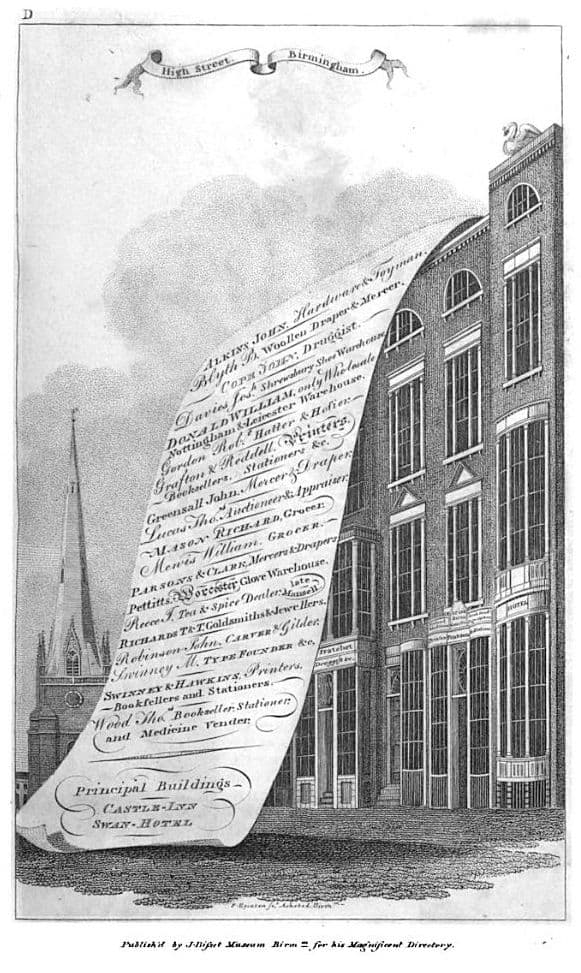
Myles Swinney printed and owned the Birmingham Chronicle. His trade card of 1784 gives his shop as No. 75 High Street, and Bisset’s engraved view of High Street in 1800 lists “Swinney M., Type Founder &c.” and the printers Swinney & Hawkins. Talbot Baines Reed, the historian of English typefounding, says that among his workmen was John Handy, Baskerville’s former punch-cutter. A notice of Handy’s death in 1792 says he had worked at Swinney’s foundry for twelve years.
Swinney issued a type specimen book in about 1803 and died in 1812, aged 74.
What happened here?
Printing, bookselling and the casting of printing type, including punch-cutting by John Handy in the 1780s and early 1790s.
Why it mattered
It kept Baskerville’s craft alive in Birmingham, and gave work to the craftsman who had cut his punches.
Why it disappeared
Redevelopment
High Street has been rebuilt many times. The foundry’s end has not been traced.
The same spot, then and now
1888–1913
Today
Old map: Ordnance Survey six-inch, reproduced with the permission of the National Library of Scotland (CC BY 4.0). Today: © OpenStreetMap contributors.
What’s there now
What replaced it
Later High Street shops and offices.
What survives
Nothing of the building is known to survive. Swinney’s trade card is in the British Museum; his directories and printed works survive in libraries.
Today
High Street, between the Bull Ring and New Street. Nothing marks the site.
Sources and further reading
The 1784 trade card gives No. 75 High Street; whether the foundry itself was at the same address throughout is not certain. Old street numbers do not match today’s, so the map point is general. The date Swinney began type-founding is uncertain: Reed says shortly after Baskerville’s establishment broke up, and directories of 1785 call him a letter founder.
- A History of the Old English Letter Foundries — Talbot Baines Reed, Elliot Stock, London, 1887. ‘Myles Swinney, 1785’
- Trade card of Swinney, printer, bookseller and stationer, No. 75 High Street, Birmingham — British Museum (Banks collection, D,2.403), 1784
- A Poetic Survey round Birmingham, with a Magnificent Directory — James Bisset, Swinney & Hawkins for the author, Birmingham, 1800. plate D
- John Baskerville: a Memoir — Ralph Straus and Robert K. Dent, Chatto & Windus, London, 1907. Handy death notice
- The Resources, Products, and Industrial History of Birmingham and the Midland Hardware District — Samuel Timmins (ed.), Robert Hardwicke, London, 1866. footnote on Swinney
Comments
Comments will load here.