
What was here?
A Decorated Gothic church of red sandstone, with a chancel, a nave, a north aisle and a three-stage north-west tower that until the 1890s carried an octagonal stone broach spire. It stood on raised ground at the corner of St Andrew’s Street and St Andrew’s Road, Bordesley.
History
The last of the ten
The Birmingham Church Building Society set out to raise ten new churches for the fast-growing town. It managed five. As R. K. Dent put it, “it was found impracticable to complete the ten churches as proposed”. The fifth and last was St Andrew’s, built “on the waste land at Bordesley, near the Coventry Road”.
Henry Pepys, Bishop of Worcester, laid the foundation stone on 23 July 1844, and the church was consecrated on 30 September 1846. A new parish was carved out of Aston for it. Its architect was Richard Cromwell Carpenter, one of the architects favoured by the Cambridge Camden Society and its journal, The Ecclesiologist.
A church the critics liked
The Ecclesiologist liked what it saw. In 1844 it praised the high-pitched roofs, the correct Decorated windows, the lack of galleries and the uniform low seats. It added that the church had “the great advantage of standing on an eminence above the level of the street”.
In March 1846, with the building nearly finished, it called St Andrew’s “a very successful church”. It admired the arcade of “five very graceful arches springing from unaffectedly moulded compound pillars, all in red sandstone”, and wrote: “We are especially pleased with the west elevation.” Its one complaint was the position of the sacristy.
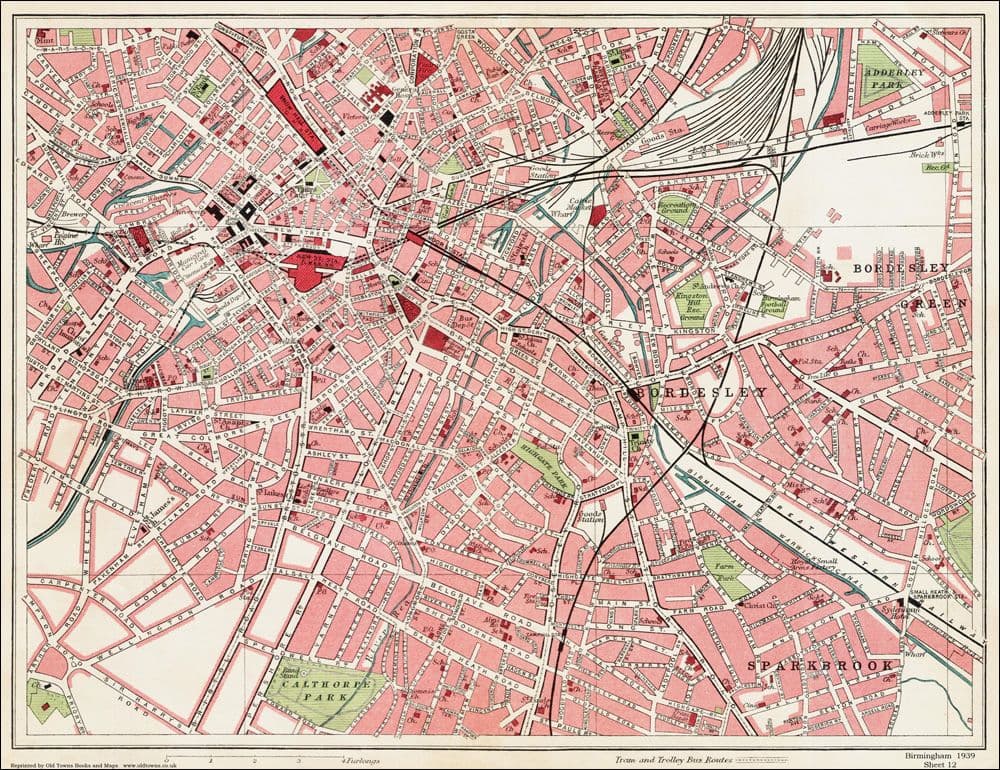
The same spot, then and now
1888–1913
Today
Old map: Ordnance Survey six-inch, reproduced with the permission of the National Library of Scotland (CC BY 4.0). Today: © OpenStreetMap contributors.
The church had a chancel, a nave and a north aisle only. At the north-west corner a three-stage tower rose above the nave gable, topped by an octagonal stone spire with broaches. Carpenter himself gave a three-light window at the east end of the aisle. Showell counted 800 seats, a quarter of them free.
A spire lost
St Andrew’s gave its name to the streets around it, St Andrew’s Road and St Andrew’s Street. When a football ground opened beside them in 1906, it took the name too. St Oswald’s, Small Heath, began as St Andrew’s iron mission church.
The church itself had harder times. By the 1890s, the Victoria County History says, “this church’s property and morale seem to have been in poor condition”. A storm damaged the spire in 1894. When the church was restored in 1901, the spire was taken down rather than rebuilt, and the tower was left flat-topped.
Gone without a record
St Andrew’s carried on through the twentieth century. Local people remember weddings there in 1949, 1959, 1969 and 1979. It was demolished in about 1985, though no official record of the date has been found. Small industrial units now stand on the plot.
The church that gave the streets their name has gone almost without trace. But every match day thousands of people walk past its site to a ground that still carries its name.
Why it mattered
St Andrew’s was the fifth and last church of the Birmingham Church Building Society, designed by R. C. Carpenter and praised by The Ecclesiologist as “a very successful church”. It gave its name to the streets around it and so to Birmingham City’s ground.
Why it disappeared
Other or unknown
Why and exactly when it closed is not recorded in the sources found. Weddings were held there until at least 1979, and it was demolished in about 1985; the plot was then built over with small industrial units.
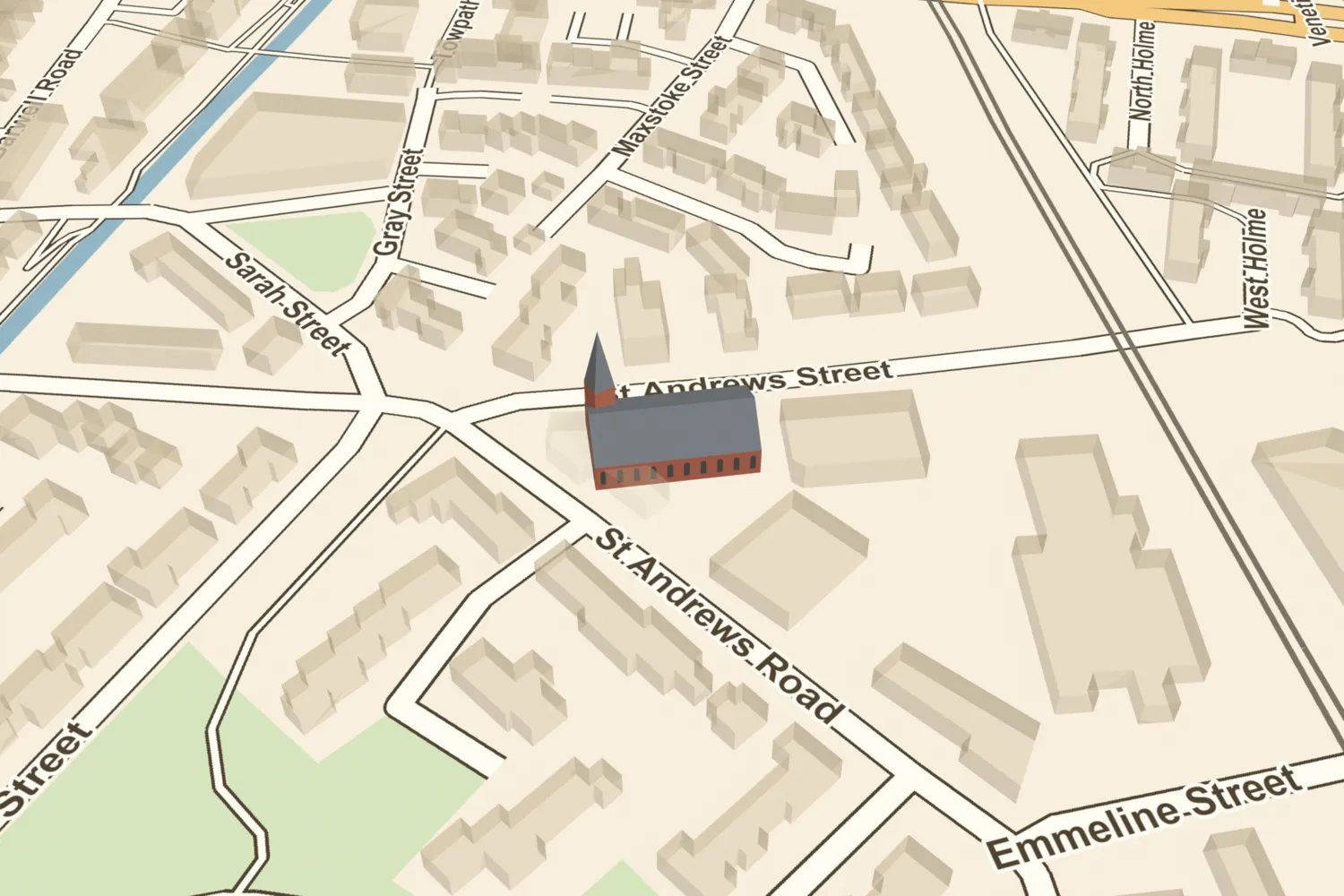
St Andrew’s, Bordesley, on today’s streets
What’s there now
What replaced it
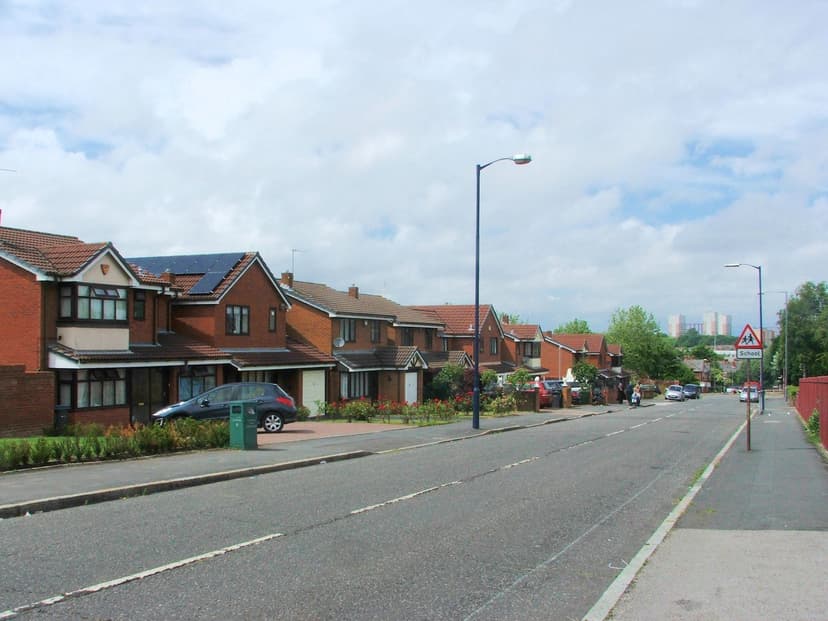
Small industrial units on St Andrew’s Street.
What survives
Nothing confirmed. A forum post says the original iron railings round the plot were kept when the units were built (unverified). The name survives in St Andrew’s Road, St Andrew’s Street and the football ground.
Today
The site is the block of industrial units at the south-west corner of St Andrew’s Street and St Andrew’s Road, across the road from Birmingham City’s ground.
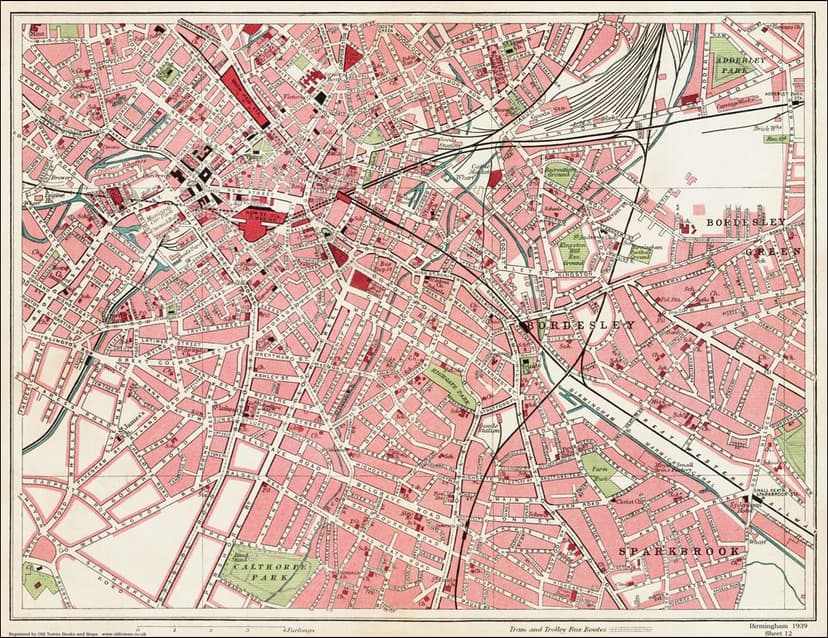
Then and now
Then · 1939
Now · 28 June 2015
Sources and further reading
Demolition: no authoritative source gives the date. Wikipedia and several members of the Birmingham History Forum, one a descendant of a vicar, say 1985. Weddings in 1969 and 1979 rule out the date of about 1953 sometimes given, and the VCH (1964) still describes the living in the present tense. A forum post says the site was bought in 1983 for factory units, which may mean the plot was sold before the church came down; another recalls it used as a warehouse in the 1980s.
Spire: the VCH says it was removed and the church restored in 1901; Wikipedia says the spire was restored. Photographs and memories of a flat-topped tower support the VCH.
Cost is given as £3,500, “nearly £4,000” or about £5,000, and seating as 800 or about 1,000. No height for the tower or spire is recorded, and no openly licensed view of the church has been found.
- A History of the County of Warwick, vol. 7: The City of Birmingham — Religious History: Churches built since 1800, pp. 379–396 — W. B. Stephens (ed.), Victoria County History, 1964. no. 46, St Andrew, Bordesley
- “S. Andrew’s, Birmingham”, The Ecclesiologist, vol. 3 — Cambridge Camden Society, 1844
- St Andrew’s, Bordesley, The Ecclesiologist, new series vol. 2, no. IX (March 1846), pp. 124–5 — Cambridge Camden Society, 1846
- Old and New Birmingham: a history of the town and its people — Robert K. Dent, Houghton and Hammond, Birmingham, 1880. the Church Building Society churches
- Showell’s Dictionary of Birmingham — Thomas T. Harman and Walter Showell, Cornish Brothers, Birmingham, 1885. ‘St Andrew’s, Bordesley’
- Modern Birmingham and its Institutions, vols 1–2 — John Alfred Langford, 1873–77. vol. 1, entries for 1844 and 1846
- Ordnance Survey 1:500 town plan of Birmingham, 1887–88, georeferenced — National Library of Scotland, 1888. footprint traced
- Ordnance Survey 25-inch map, Warwickshire (Birmingham sheet), georeferenced — National Library of Scotland
- OpenStreetMap data (Overpass and Nominatim), central Birmingham — OpenStreetMap contributors, 2026
- St Andrews Church Bordesley Green (forum thread, pages 1–4) — Birmingham History Forum members
- St Andrew’s Church, Bordesley — Wikipedia contributors, Wikipedia
Comments
Comments will load here.