
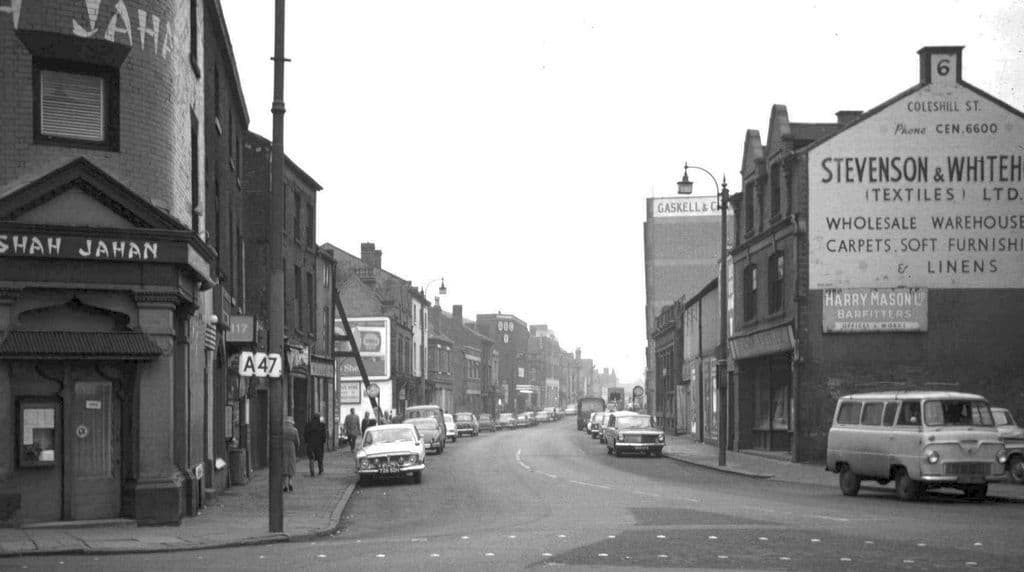
What was here?
A music hall built behind a pub on the north side of Coleshill Street, at its corner with Gem Street. It grew from the inn’s singing evenings into a hall seating 2,200 by 1885, and after a partial rebuilding in 1897 it was the Gaiety Theatre of Varieties, then a picture house.
History
Singing at the Rodney
Long before it had a stage, the Rodney Inn on Coleshill Street was known for its “harmonic meetings”, evenings of song in the pub. Its landlord, Henry Holder, saw where that could lead. On 24 June 1846 he opened a concert hall behind the inn. The Victoria County History records the opening of Holder’s Concert Hall, “later the Gaiety Music Hall”, in its account of Birmingham’s theatres and halls.
Holder’s became one of the town’s best-known music halls. By 1885 Showell counted seats for 2,200.
Fire and fortune
It had its disasters. On 3 July 1865 fire broke out on the stage, and “two ballet dancers died from fright and injuries”. In 1879 a 12-year-old performer, Alfred Bishop, broke his leg doing a trick billed as the “Shooting Star”.
The same spot, then and now
1888–1913
Today
Old map: Ordnance Survey six-inch, reproduced with the permission of the National Library of Scotland (CC BY 4.0). Today: © OpenStreetMap contributors.
It was a political hall too. On 14 November 1868, during the general election, John Bright, George Dixon and P. H. Muntz spoke at “Holder’s Concert Hall”.
The hall passed through several hands. Soward & Gardner took it in 1863, John Soward junior in 1867 and John Judd & Co. in 1871, who renamed it the Birmingham Concert Hall. Phillips & Chowles followed in 1876. In 1886 Charles Barnard renamed it the Gaiety Concert Hall.
The Gaiety Theatre of Varieties
In 1897 the Gaiety was partly demolished and rebuilt for about £30,000, to designs by the Birmingham architects Crouch & Butler with William Hope. It reopened on Monday 8 November 1897 as the Gaiety Theatre of Varieties, under George Barnard. The Era thought the old hall had held about 2,500.
Over the years its bills included Arthur Lloyd, Vesta Tilley, Little Tich, George Lashwood, Eugene Stratton and, according to later accounts, the young Charlie Chaplin. In 1939 the Evening Dispatch called it “perhaps the last of the Birmingham Music Halls to have a chairman”.
Pictures, an explosion and the end
In 1920 the Gaiety closed as a theatre and reopened as the Gaiety Picture House. On 2 September 1936 an explosion in the projection box closed it for good. In mid-1938 the old building was demolished.
A new ABC Gaiety cinema, designed by William Riddell Glen with 1,500 seats, opened on the site in December 1939. It closed on 29 November 1969 and was demolished, and Aston University grassed the site over.
Today the ground is open campus on the north side of Coleshill Street, and the eastern end of Chancellor’s Lake lies over part of it. Students now walk past water and lawns where Birmingham once came to sing along.
Why it mattered
Holder’s was one of Birmingham’s earliest purpose-built music halls, growing straight out of a pub’s singing evenings in 1846. For half a century it was among the town’s main halls, and as the Gaiety it played host to leading variety stars before becoming a cinema. It was also a big public meeting place, where John Bright spoke in the 1868 election.
Why it disappeared
Commercial redevelopment · Redevelopment
It became a cinema in 1920 and closed after an explosion in the projection box in 1936. The old building was demolished in 1938 and replaced by the ABC Gaiety cinema, which closed in 1969 and was itself demolished as the site became part of the Aston University campus.
The Gaiety Theatre, on today’s streets
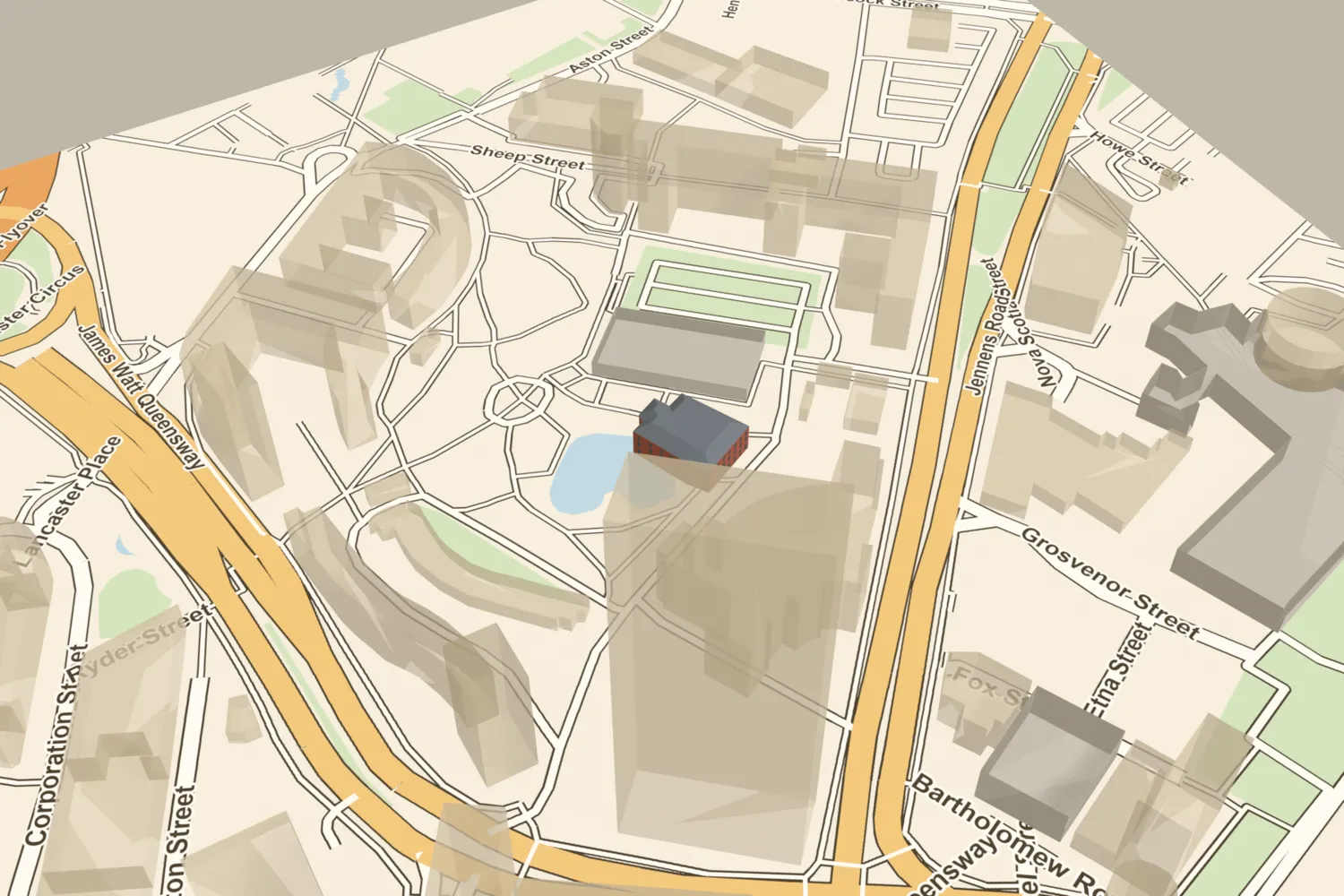
What’s there now
What replaced it
The ABC Gaiety cinema (1939, W. R. Glen), which closed on 29 November 1969 and was demolished. The site was then grassed over by Aston University and is now open campus beside Coleshill Street, partly under Chancellor’s Lake.
What survives
Nothing, and there is no plaque. Music-hall tokens from Holder’s survive as collectors’ items.
Today
Walk along Coleshill Street through the Aston University campus to the eastern end of Chancellor’s Lake. Holder’s and the Gaiety stood on the north side of the street here, at the old corner of Gem Street, partly where the lake now is.
Then and now
Then · 1964
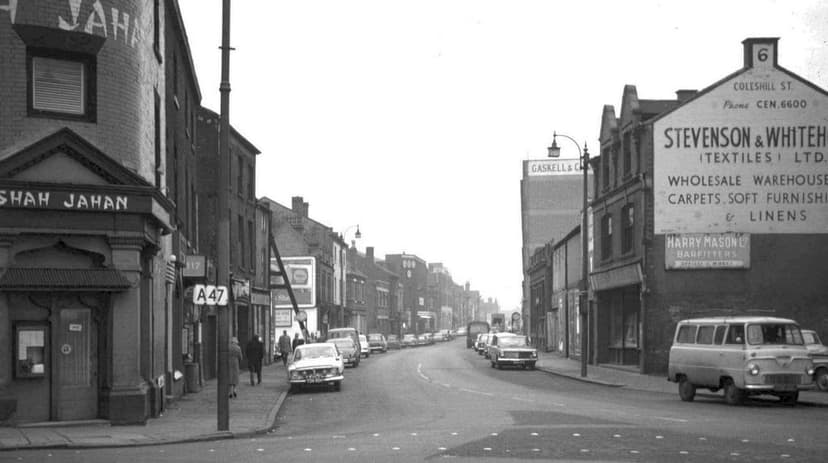
Now · 7 February 2007
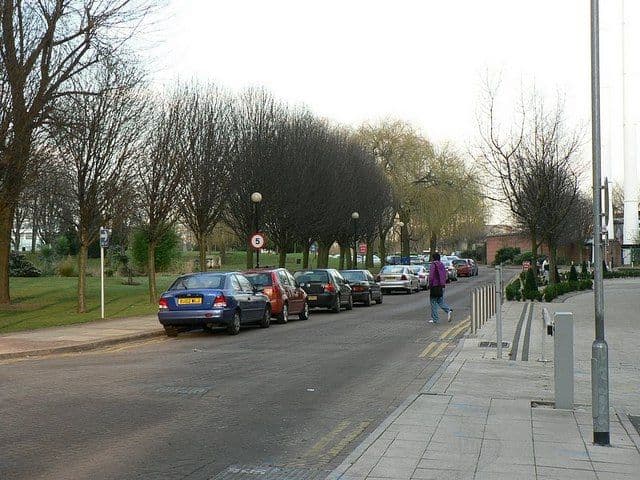
Today
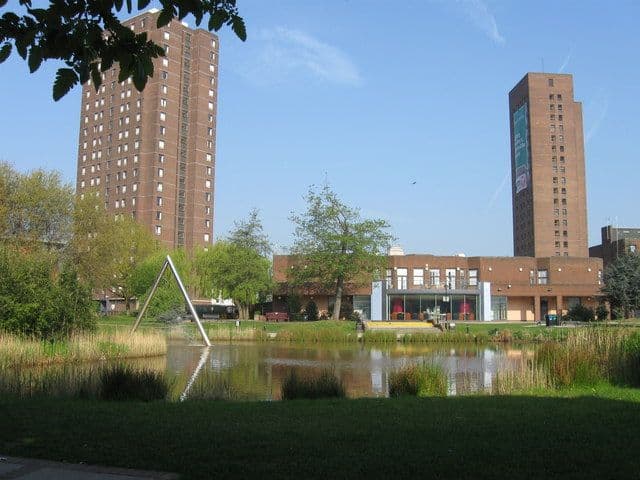
Aston University lake, 19 April 2011Alex McGregor, 19 April 2011. Geograph Britain and Ireland via Wikimedia Commons · CC BY-SA 2.0
Sources and further reading
The Victoria County History says the Gaiety “became the Coliseum Theatre in 1920”, while Arthur Lloyd and Cinema Treasures say it closed in 1920 and reopened as the Gaiety Picture House; this is not resolved. The ABC Gaiety opened on 18 December 1939 (Evening Dispatch) or 17 December (Cinema Treasures), and its demolition date after closure in 1969 was not found. Capacity is 2,200 seats in Showell (1885), about 2,500 for the old hall and 3,000–4,000 estimated for the new in The Era (1897), and 3,500 in Cinema Treasures. Who built the 1846 hall is not recorded, and William Hope’s role beside Crouch & Butler in 1897 is as given in the opening speech. The 1897 rebuilding was partial, so its outline may differ from the 1887–88 plan used for the map, and which plot was the Rodney Inn is not certain. Chaplin’s appearance is reported only by later accounts.
- A History of the County of Warwick, vol. 7: The City of Birmingham — Social History since 1815, pp. 223–245 — W. B. Stephens (ed.), Victoria County History, 1964. Holder’s opened 1846; ‘became the Coliseum Theatre in 1920’ (fn. 231)
- Showell’s Dictionary of Birmingham — Thomas T. Harman and Walter Showell, Cornish Brothers, Birmingham, 1885. ‘Concert Halls’, ‘Fires’, ‘Accidents’: harmonic meetings, 2,200 seats, 1865 fire, 1879 accident
- Modern Birmingham and its Institutions, vols 1–2 — John Alfred Langford, 1873–77. vol. 2: election meeting, 14 November 1868
- The Era (25 September and 13 November 1897) and Birmingham Evening Dispatch (15 December 1939) on the Gaiety — The Era; Birmingham Evening Dispatch, 1897; 1939
- Holder’s Grand Concert Rooms, 88, 89, 90, Coleshill Street, Birmingham — arthurlloyd.co.uk
- Gaiety Picture House — Ken Roe (Cinema Treasures)
- Ordnance Survey 1:500 town plan of Birmingham, 1887–88, georeferenced — National Library of Scotland, 1888. ‘Gaiety Palace (P.H.)’ traced
- Ordnance Survey 25-inch map, Warwickshire (Birmingham sheet), georeferenced — National Library of Scotland
- OpenStreetMap data (Overpass and Nominatim), central Birmingham — OpenStreetMap contributors, 2026
Comments
Comments will load here.