
What was here?
A large non-ferrous metal works on the Birmingham Canal at Smethwick. From 1842 Muntz rolled his copper-zinc yellow metal here into sheathing, bolts and nails for ships; it was later run by Muntz’s Metal Company.
History
The French Walls was a small farm in north-east Smethwick. After the Birmingham Canal was cut through it in 1768–9 the land was built over with industry. By about 1800 there was a steam-powered gun-barrel works on the south side of the canal, opposite Soho Foundry. By 1815 it had become a flour mill with a Boulton & Watt engine, and in 1816 James Watt the younger bought it for an ironworks.
In 1842 G. F. Muntz bought the works because demand for his patent metal had outgrown his Water Street mill in Birmingham. He converted it to non-ferrous metals. Around 1850 he added six and a half acres to the west, across the Stour Valley Railway, and a private bridge linked the Old Side and New Side works.
After his death his son sold the business in 1864 to Muntz’s Metal Co. Ltd. From about 1900 the works also made aluminium castings for motor vehicles. A Birmingham firm took it over in 1921, and that firm joined ICI in 1928. Non-ferrous manufacture ended in 1932. ICI’s paints division later used the New Side, and in 1937 George Burn Ltd opened tube mills in Rabone Lane on the Old Side.
What happened here?
Rolling and finishing yellow-metal sheathing, bolts and nails for ships’ hulls.
Why it mattered
This was the main works of the alloy that replaced pure copper as the standard sheathing for British merchant ships from the 1840s.
Why it disappeared
Industrial decline · Redevelopment
The metal trade here ended in 1932 and the site was split between other firms.
The same spot, then and now
1888–1913
Today
Old map: Ordnance Survey six-inch, reproduced with the permission of the National Library of Scotland (CC BY 4.0). Today: © OpenStreetMap contributors.
What’s there now
What replaced it
Later tube works and other industrial premises.
What survives
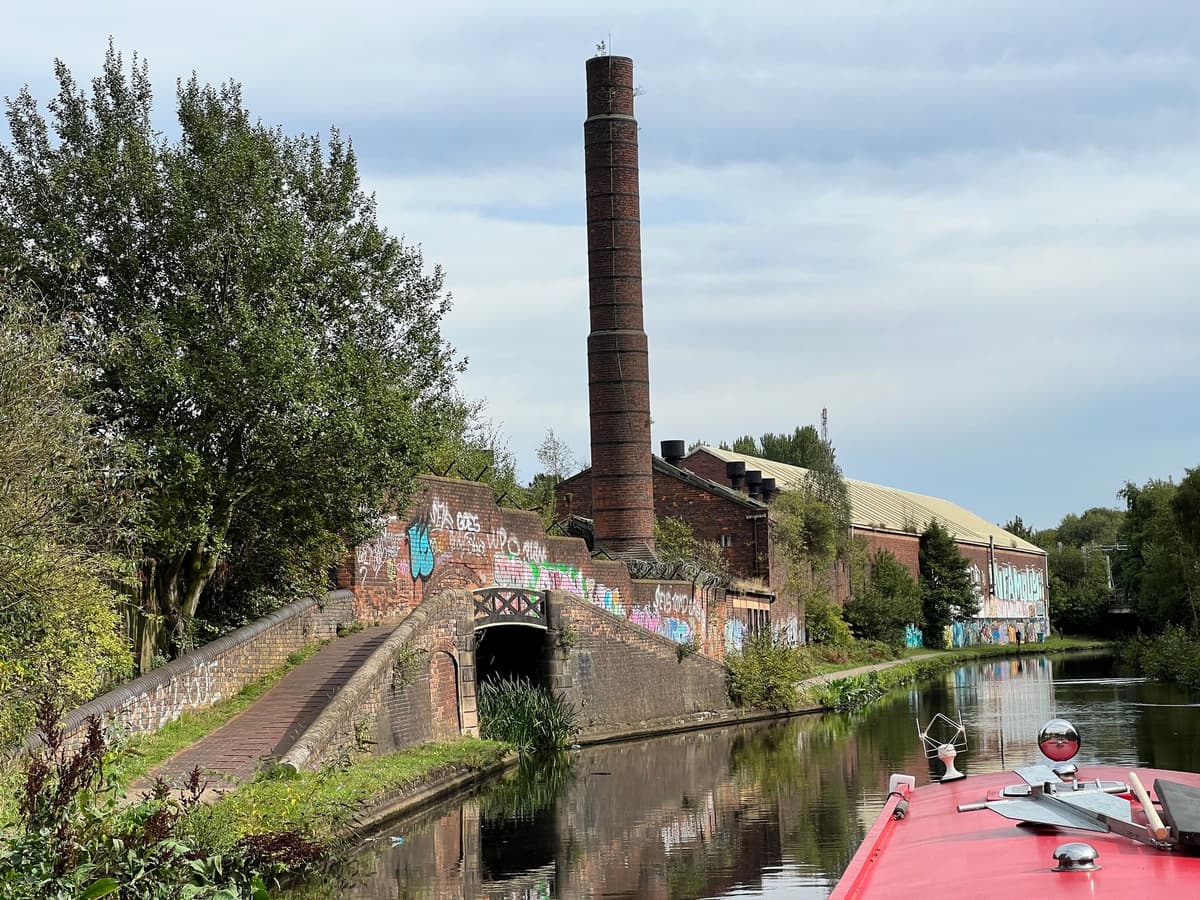
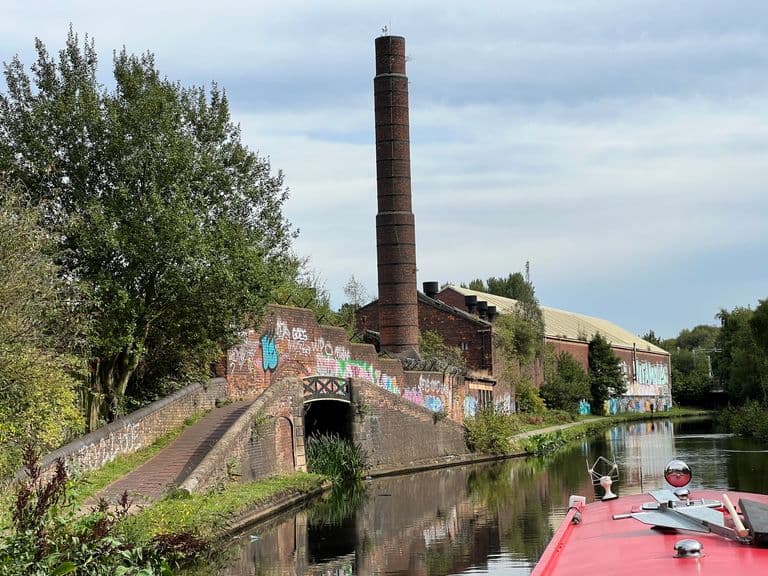
Industrial buildings on the canal bank; their date is not established.
Today
Industrial land between the Birmingham Canal and the railway near Rabone Lane, Smethwick, opposite the Soho Foundry site.
Then and now
Then · 13 September 2022
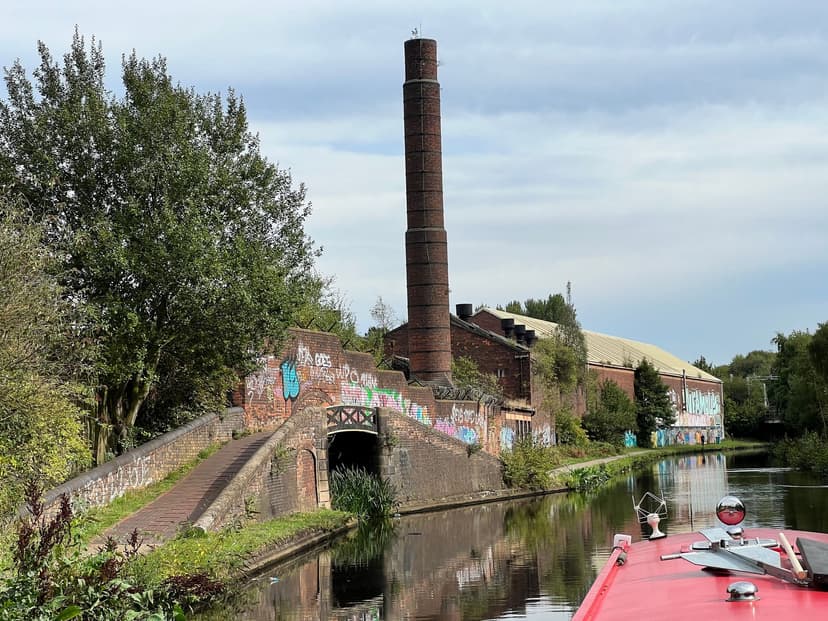
Now · 13 September 2022
Key dates
- 1842 — Muntz moves to French Walls, SmethwickWith demand outgrowing his Water Street mill, Muntz buys the French Walls works on the Birmingham Canal opposite Soho Foundry and converts it to non-ferrous metals. It makes yellow metal there until 1932.
Sources and further reading
Industrial buildings and a tall chimney still stand on the canal bank here, photographed in 2022 as ‘Muntz’s Metal Works’; which, if any, date from Muntz’s time has not been established. Position is approximate.
- Smethwick: Economic history, in A History of the County of Stafford, vol. 17, pp. 107–118 — M. W. Greenslade (ed.), Victoria County History, 1976
- Smethwick: Other estates, in A History of the County of Stafford, vol. 17, pp. 99–107 — M. W. Greenslade (ed.), Victoria County History, 1976
- Smethwick: The growth of the town, in A History of the County of Stafford, vol. 17, pp. 88–96 — M. W. Greenslade (ed.), Victoria County History, 1976
- Muntz, George Frederick — Dictionary of National Biography, vol. 39 — Samuel Timmins, Smith, Elder & Co., 1894
Comments
Comments will load here.