
What was here?
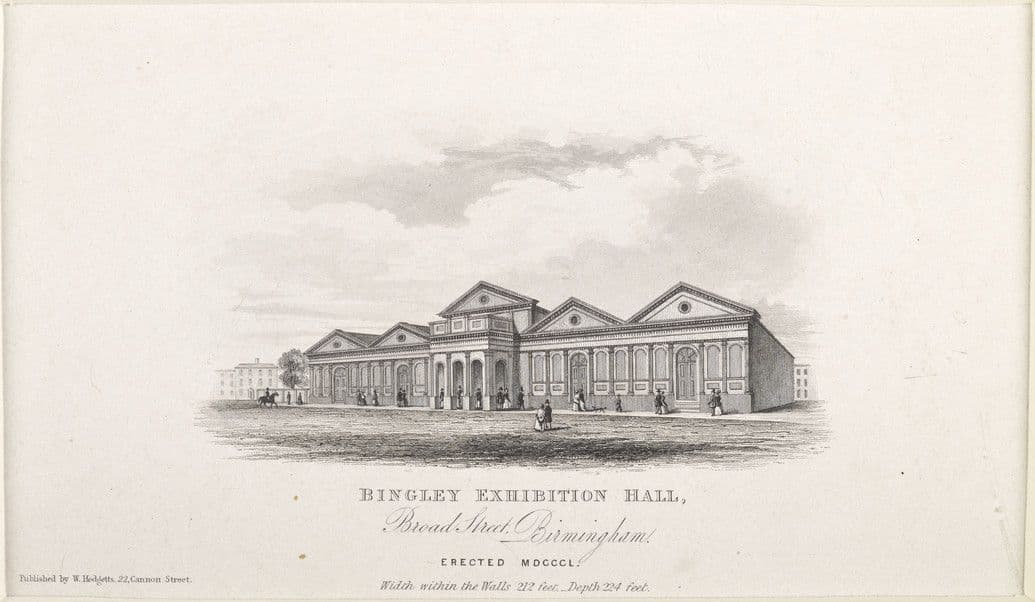
A vast low brick hall covering nearly an acre and a half, between King Edward’s Place and King Alfred’s Place off Broad Street. Its front had five pedimented gables over an arched entrance. It held cattle shows, exhibitions, circuses and mass political meetings from 1850 until a fire in 1984.
History
A prince at Bingley House
The story starts with a house. In 1849 Birmingham held an Exposition of Art and Manufactures in and around Bingley House, off Broad Street. Prince Albert came to see it on 12 November 1849. Showell’s Dictionary records that “Birmingham men proudly believe” his visit gave him the idea for the Great Exhibition of 1851. That is a local belief rather than a proven fact, but the town was certainly thinking big.
Built in a hurry
In 1850 a joint stock company put up a permanent hall on the site. The builders were Branson and Gwyther, the cost was about £6,000 and the shares were £100 each. Its designer was a young man in the builders’ office, Julius Alfred Chatwin, then about 20. One modern account says the hall went up in six weeks.
It was built for the Birmingham and Midland Counties Agricultural Association. Its first cattle show had been held in Kent Street in 1849. The second, in December 1850, filled the new hall, and the Illustrated London News sent an artist. His engraving shows iron columns carrying round arches, a light roof with long strips of glass, and the pens below.
The same spot, then and now
1888–1913
Today
Old map: Ordnance Survey six-inch, reproduced with the permission of the National Library of Scotland (CC BY 4.0). Today: © OpenStreetMap contributors.
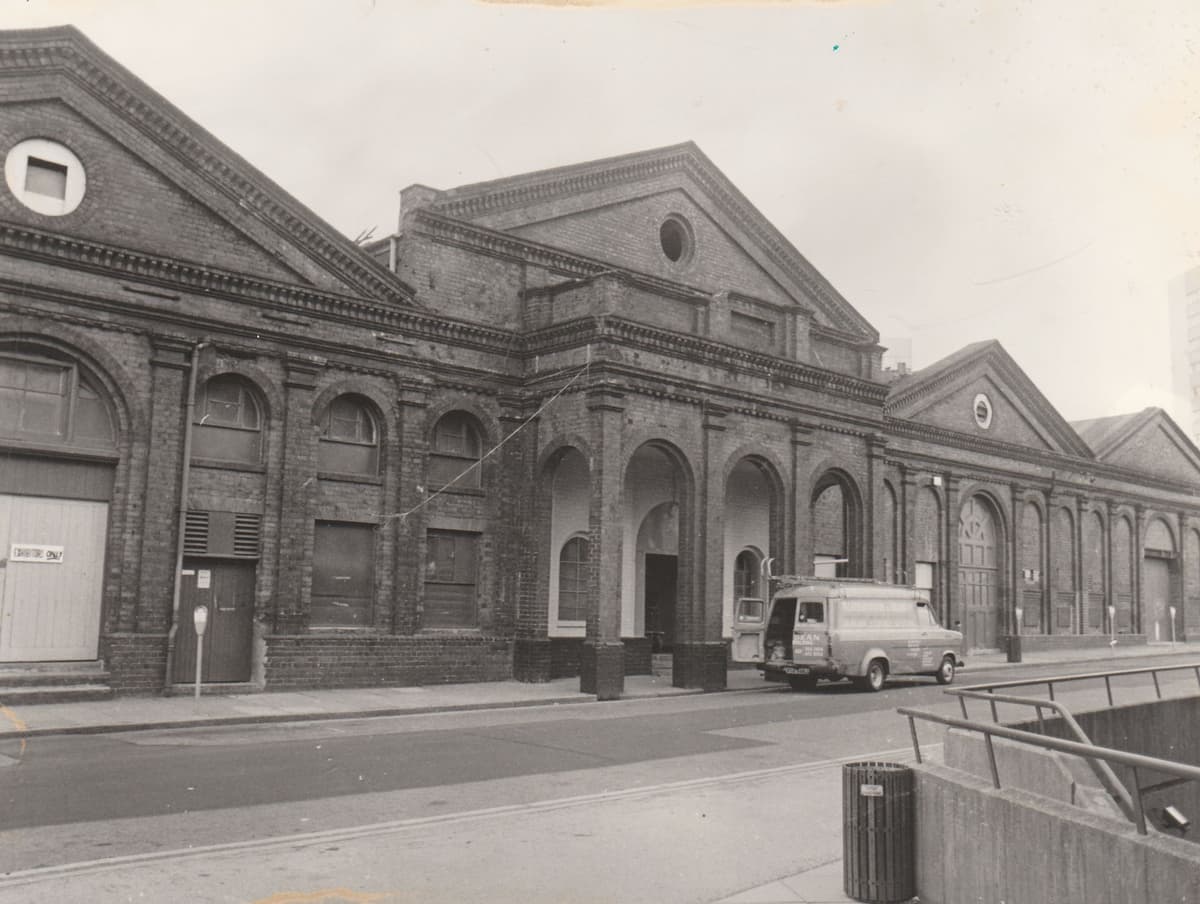
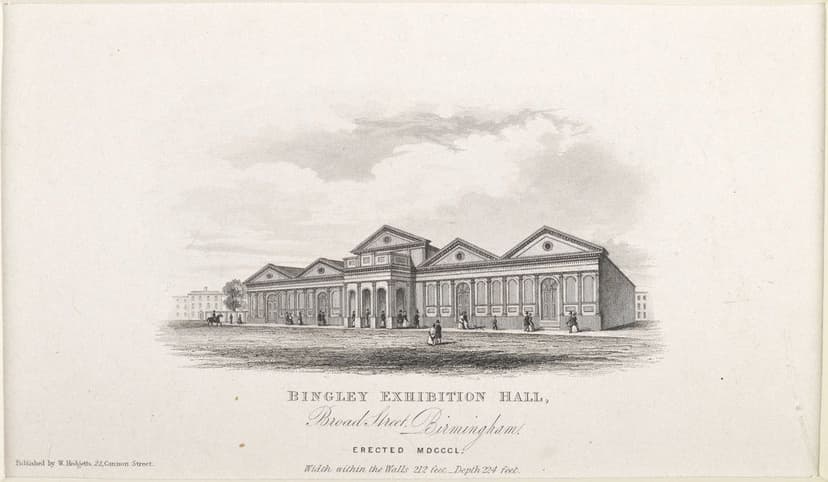
From outside, the hall was a long, low brick building. An engraving of 1850 shows five gables across the front, each with a classical pediment and a round window, the middle one raised over an entrance of round arches. There were ten doors, five on King Edward’s Place and five on King Alfred’s Place. The great space inside could be split into five compartments, and Showell says it held “from 20,000 to 25,000 people”.
A hall for everything
Birmingham soon found other uses for all that room. In December 1853 John Tonks fitted it up as an amphitheatre for 4,500, known as Tonks’s Colosseum, and plays were licensed there in 1854. On 25 January 1858 it fed 1,200 poor people at a single dinner. On 12 October 1859 the newly raised Birmingham Rifle Volunteers held their first general muster here, and the hall became their headquarters. An industrial exhibition that opened on 28 August 1865 drew 160,645 visitors.
Above all it was the place for a mass meeting. On 31 May 1877 William Gladstone spoke to what Dent called “a densely packed meeting in Bingley Hall, at which it was estimated there were, at least, 20,000 persons present”.
Fire
The hall lasted more than 130 years, and its brick front of 1850 was still standing in the 1970s. In January 1984, during the Midlands Caravan, Camping and Leisure Exhibition, fire swept through it. The building was gutted and then demolished.
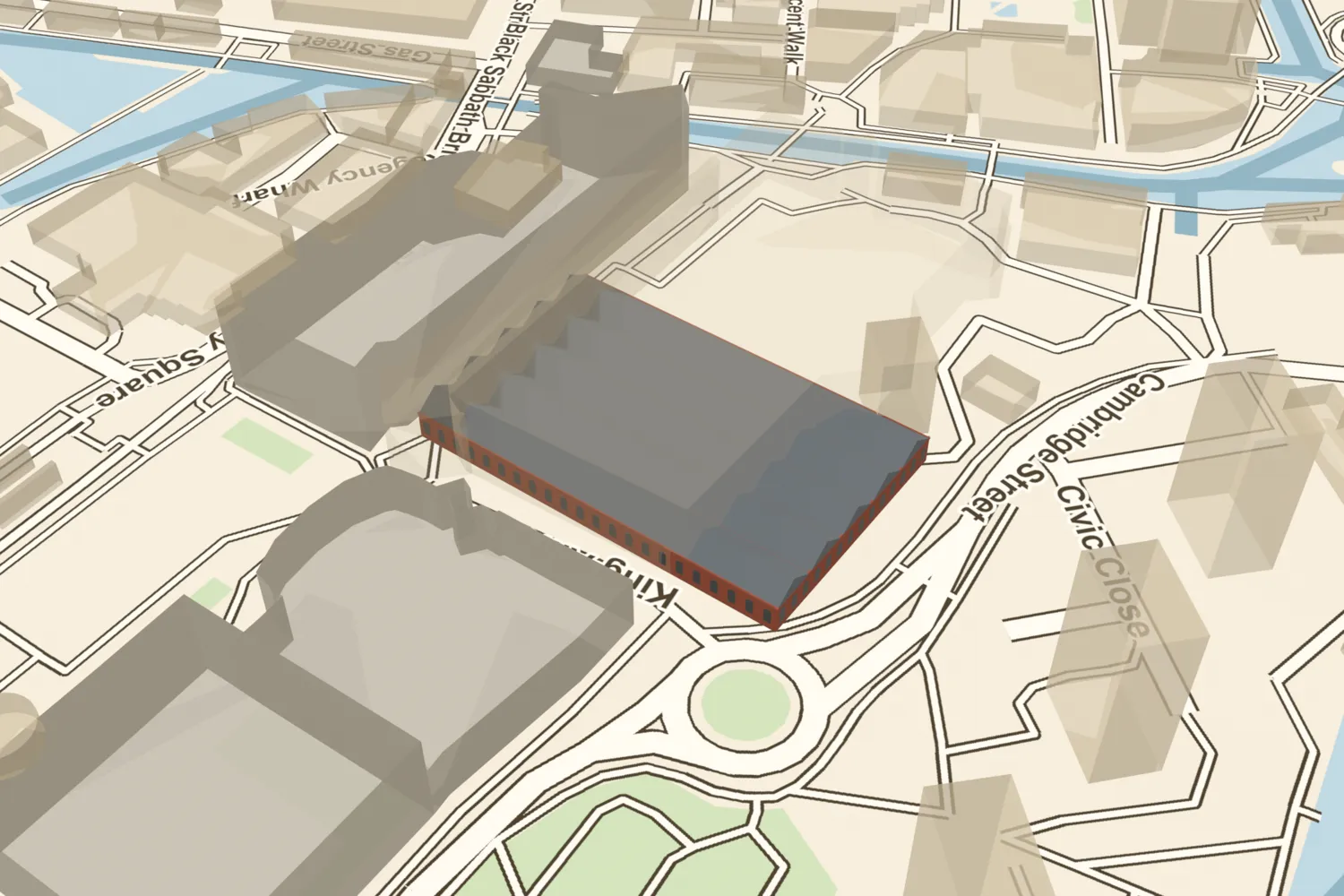
The site did not stay empty. The International Convention Centre, opened in 1991, now covers about three-quarters of the old hall’s footprint, and its mall covers most of the rest. More than 130 years after the first cattle show, the same ground off Broad Street is still where Birmingham comes to gather in its thousands.
Why it mattered
Bingley Hall was one of the earliest permanent exhibition halls in Britain, built a year before the Crystal Palace. For more than a century it was the biggest covered meeting place in Birmingham: home of the cattle and poultry shows, of exhibitions, and of mass meetings such as Gladstone’s in 1877. It was also an early work of J. A. Chatwin.
Why it disappeared
Fire
Fire gutted the hall in January 1984, during the Midlands Caravan, Camping and Leisure Exhibition. What was left was demolished, and the site was used for the International Convention Centre, which opened in 1991.
Bingley Hall, on today’s streets
What’s there now
What replaced it
The International Convention Centre, opened in 1991. About three-quarters of the old footprint is under the ICC’s main block and most of the rest under the ICC mall. Symphony Hall stands just to the south, on the old Prince of Wales Theatre site, not on the hall.
What survives
No fragments or plaque are known. King Alfred’s Place and King Edward’s Place survive as pedestrian ways near their old lines. The hall survives in an 1850 engraving, the Illustrated London News view of the first cattle show, and photographs.
Today
Stand at the west end of Centenary Square, off Broad Street. The International Convention Centre in front of you covers almost all of the site. Symphony Hall, to the south, stands where the Prince of Wales Theatre was.
Then and now
Then · 1850
Now · 22 August 2015
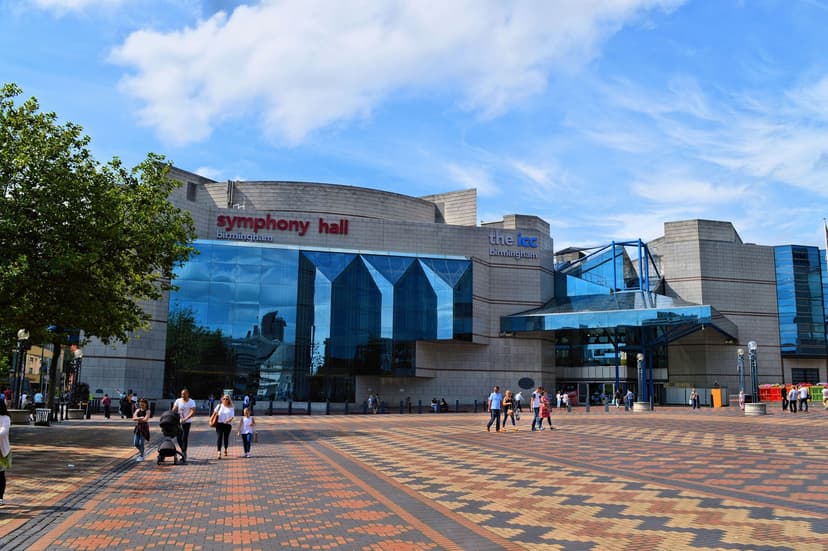
Today
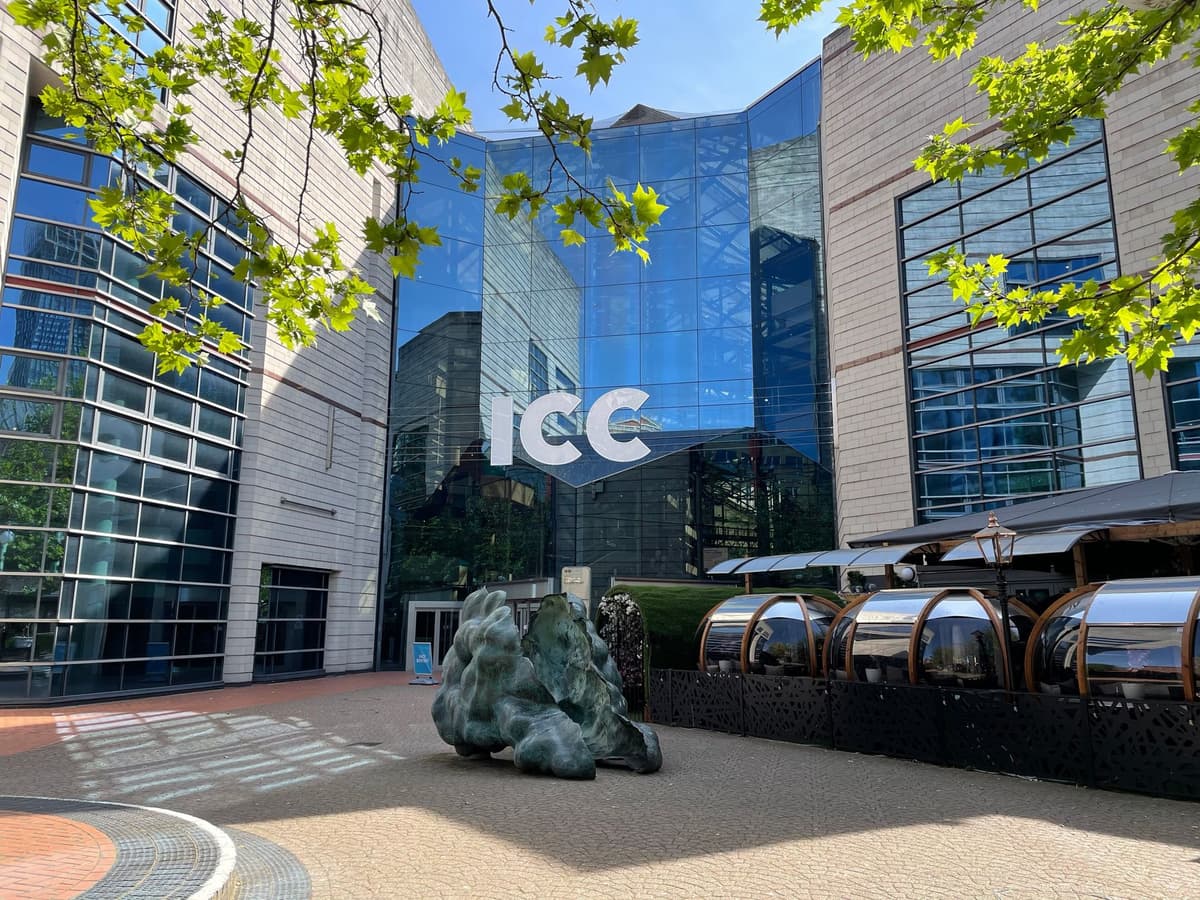
ICC Birmingham, 7 July 2021delegateconnectimages, 7 July 2021. Flickr via Wikimedia Commons · CC BY 2.0
Sources and further reading
The fire is securely dated only to January 1984; a precise day (14 January) appears only in unreliable online sources, and the date of demolition has not been confirmed. Claims that this was the first purpose-built exhibition hall in Britain come from secondary sources only, so we say “one of the earliest”. Wikipedia says it was built with columns left over from Euston station; no primary or authoritative source supports this. The 1850 engraving gives the hall as 212 ft wide and 224 ft deep, smaller than the block shown on the 1855 and 1888 plans (about 1.48 acres, which matches Showell’s “nearly one acre and a half”); later additions or side ranges may explain the difference. A 1984 account mentions a “Queen’s Hall”, implying later extensions we could not date. Which street the main pedimented front faced is not proven; it was probably King Alfred’s Place.
- Showell’s Dictionary of Birmingham — Thomas T. Harman and Walter Showell, Cornish Brothers, Birmingham, 1885. ‘Bingley Hall’, ‘Exhibitions’, ‘Royal Visits’
- Modern Birmingham and its Institutions, vols 1–2 — John Alfred Langford, 1873–77. vol. 1, pp. 69, 497; vol. 2 (Volunteers)
- Old and New Birmingham: a history of the town and its people — Robert K. Dent, Houghton and Hammond, Birmingham, 1880. Gladstone, 1877; Rifle Volunteers, 1859
- Birmingham and Midland Counties Agricultural Association (Illustrated London News, 14 December 1850, pp. 458–60) — Illustrated London News, 1850. pp. 458–60
- Bingley Exhibition Hall, Broad Street, Birmingham, erected 1850 (1933V12) — Birmingham Museums Trust, 1850. Ref. Birmingham Museums Trust 1933V12
- Chatwin, Julius Alfred (1830–1907) — AHRnet Biographical Dictionary of British and Irish Architects 1800–1950
- Bingley Hall, Birmingham, by Julius Alfred Chatwin — Jacqueline Banerjee (Victorian Web), 2024
- Remembering Bingley Hall on Broad Street which got burned down in the 1980s — BirminghamWorld, 2024. fire, January 1984
- Ordnance Survey 1:500 town plan of Birmingham, 1887–88, georeferenced — National Library of Scotland, 1888. footprint traced
- Plan of the Borough of Birmingham (Pigott Smith), 1855 — J. Pigott Smith, National Library of Scotland (online), 1855
- OpenStreetMap data (Overpass and Nominatim), central Birmingham — OpenStreetMap contributors, 2026. ICC ways 22820907 and 22820909
- Bingley Hall — Wikipedia. lead only
Comments
Comments will load here.