
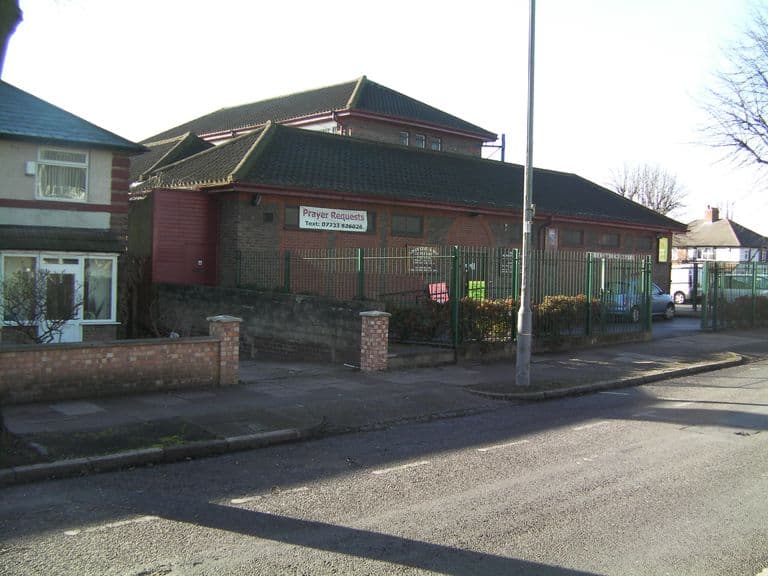
Peter Noden grew up next door, at 369 Kings Road. As a small boy in the war he would sit with Mr Blaney, the caretaker, in the church boiler room, its wall covered in cigarette cards of footballers. When the coke for the boiler was delivered, it was tipped against the wooden fence of his garden. There was a gap at the bottom, and a few pieces always fell through. He found that a gentle tug on the fence brought down a few more. “In mitigation,” he wrote seventy years later, “I was only about 6 or 7 at the time, and coke was in short supply, and I liked to please my mother.”
A House of Friendship
The Methodists came to Kingstanding early. Their mission work began in 1934 with a temporary building called the House of Friendship, seating 200, designed by the Birmingham architects Crouch, Butler and Savage. The permanent church on Kings Road, at the corner of Carshalton Road, was finished shortly before 1937 at a cost of £11,667. In 1940 it was described as a brick building with a main hall seating 400 and ten other rooms, three of them built as school halls.
The name lived on. When Mr Blaney died, Aber and Blodwen Thomas became caretakers, “as Welsh as their names suggest”, and Peter became a regular visitor to their flat “in the House of Friendship”.
Everybody’s building
Those extra rooms made the church useful to the whole estate. Peckham Road School, round the corner, used the Kingstanding Methodist Hall as extra classroom space. In the mid-1950s the church was also, in effect, Kingstanding’s library. Gwen Hutt walked there every Saturday afternoon to a large room with big window sills, “on which you could sit and read for hours and hours”. Kingstanding did not get a library building of its own until 1964.
The 29th
Most of all, Kings Road meant the Boys’ Brigade. Around 1943 or 1944 Brian Scott joined the 29th Birmingham Company, attached to the church. The minister then was the Reverend Conibear, who left to become a missionary in China. “We had a very good band,” Brian remembered: Bobby Betts was the star bugler and Stan “Beefy” Beale played the bass drum. They were at camp at Little Stretton when the news came of the atom bomb on Hiroshima. Richard Wall, then about seven, watched them parade along Hurlingham Road, led by John Swinburn. Steve Morton remembered them marching up Hornsey Road on Sunday mornings.
Brian Parkes said that his brother Joey and Dicky Monk were the first two King’s Badge holders in the company, in the 1950s. When Russ Martin joined in 1973, the captain was Stan Beale, very likely the same Stan who had beaten the bass drum in the 1940s. There were camps every year, at Talybont and Croyde Bay. Martin Goode, whose father, the Reverend John Goode, was minister here around 1963, remembered summer camps at Saundersfoot.
Girls had their own companies. Susan Spencer and her brothers and sisters went through the Sunday school, the Girls’ Brigade and the Sunday evening Youth Fellowship in the 1950s, 60s and 70s. She married Philip Holmes at the church in August 1970. Going back years later, she found “still the same warm welcome”.
The church is still on Kings Road, and old members still go back to meet friends there. When they write about the 29th, they tend to say what Russ Martin did: “Brings tears to my eyes just thinking about them.”
From the Heritage Archive
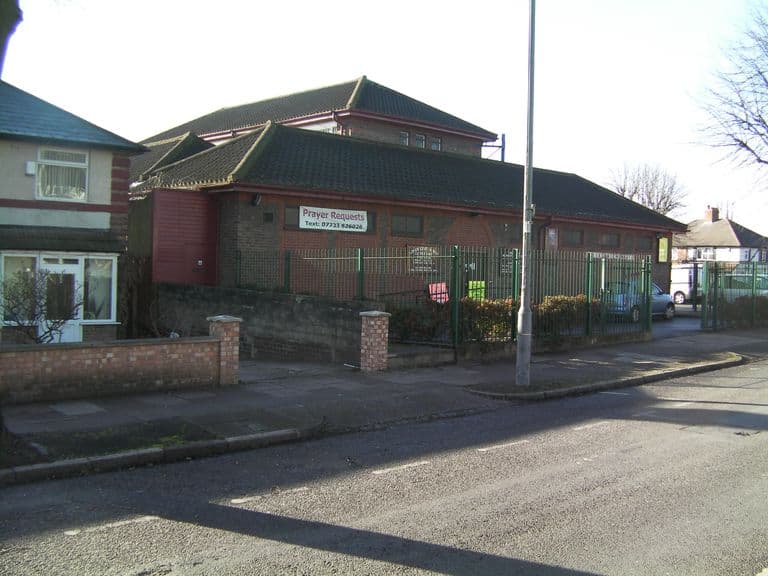
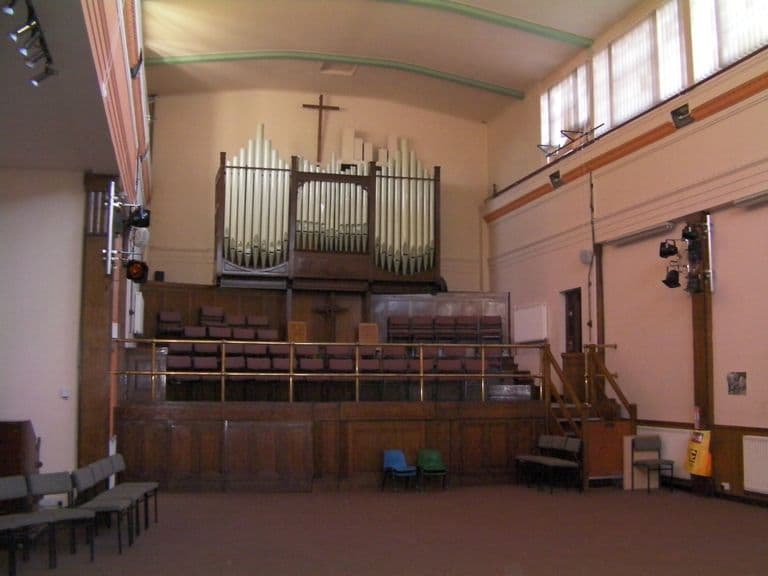
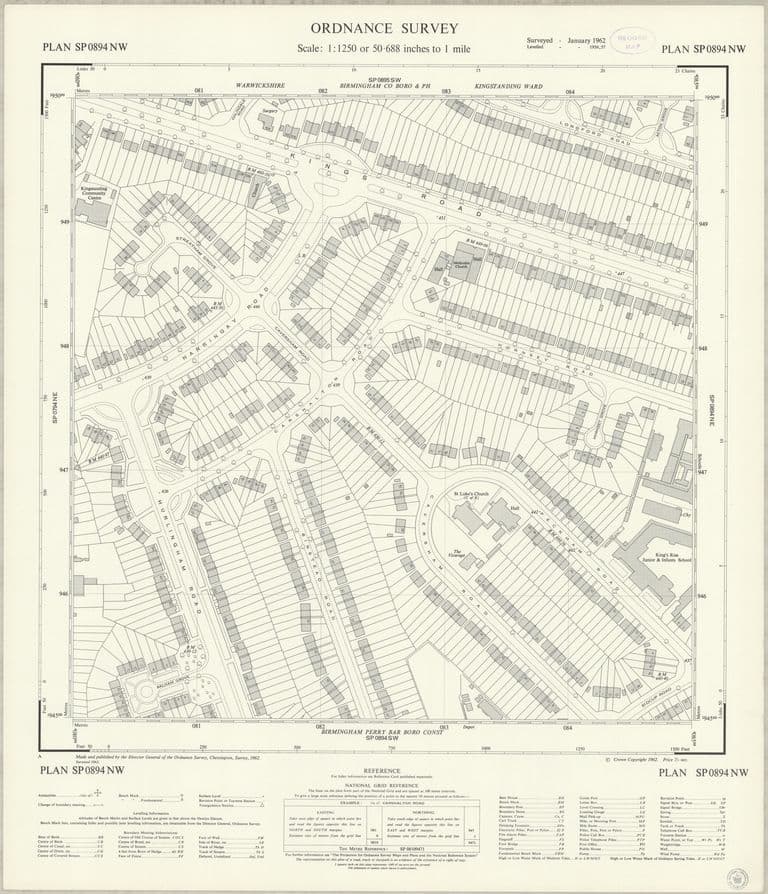
- A History of the County of Warwick, vol. 7: Religious history, places of worship (Methodists: King’s Road, Kingstanding) — Victoria County History / British History Online, 1964. Chapel completed shortly before 1937, cost £11,667; in 1940 brick-built, main hall seating 400 and ten ancillary rooms, three built as school halls; mission from 1934 in a temporary “House of Friendship” seating 200 by Crouch, Butler and Savage.
- A History of the County of Warwick, vol. 7: list of Birmingham schools (King’s Rise) — Victoria County History / British History Online, 1964. Peckham Road Council School used the Kingstanding Methodist Hall (as cited in peckham-road-school entry).
- Kingstanding Methodist Church — Find a Church (UK Church Directory), accessed 29 Sep 2026. 371 Kings Road (Carshalton Road), B44 0TF.
- Kings Road Methodist Church, Kingstanding (records) — The National Archives, Discovery, n.d.. Catalogue entry exists; not read.
- Kingstanding Methodist church, King’s Rd (page and comments) — Chris Hillcox and contributors, Voices of Kingstanding. Brian Scott (29th BB c.1943/4; Rev Conibear; band; Little Stretton camp); Richard Wall 28 Apr 2012; Brian Parkes 12 Dec 2014; Steve Morton 19 Feb 2015; Susan Holmes (née Spencer) 11 Apr 2015; Richard Conibear 12 Jun 2020 (Rev Albert Allan Conibear); Russ Martin 22 Jun 2020; Martin Goode 6 Jun 2022; Peter Noden 15 Jul 2023; Linda Sheehan 7 Aug 2024 (31st Girls and 29th Boys).
- Kingstanding Library (comments) — Chris Hillcox and contributors, Voices of Kingstanding, 15 Nov 2012. Gwen Clifford (née Hutt): library in the Methodist church building, mid-1950s; also used as an annexe for Kings Rise classrooms.
- Kings Road Methodist Church, Kings Road — OpenStreetMap / Nominatim, accessed 29 Sep 2026. 52.5516, -1.8788.
Comments
Comments will load here.