
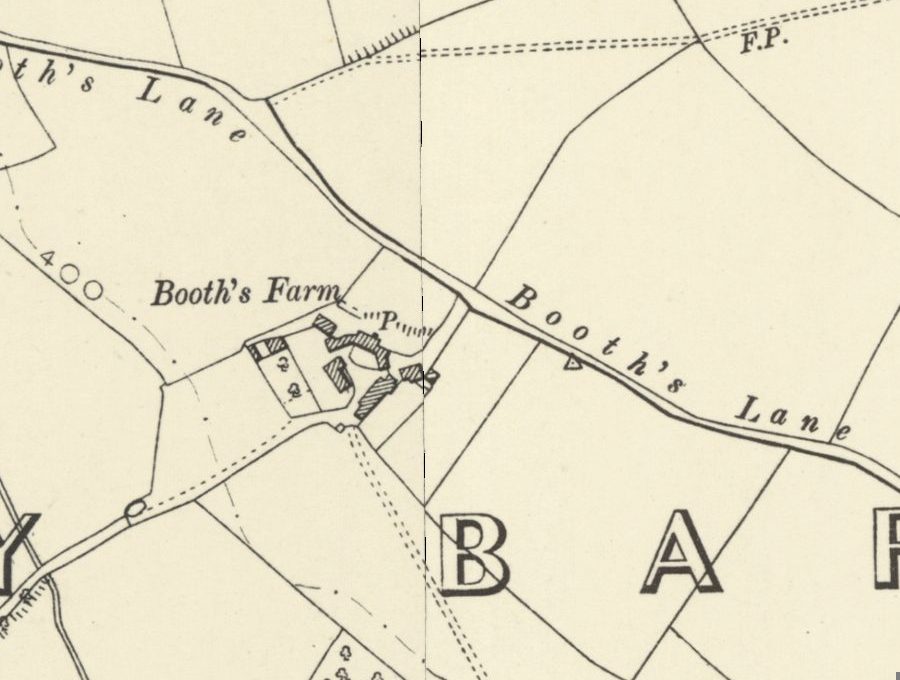
On 16 March 1812 ten special constables and seven dragoons went out to Booth’s Farm at Perry Barr. On the way they had stopped at the Boar’s Head. They had come for William Booth.
A tenant of the Goughs
Booth was born in 1776 at Hall End Farm near Beaudesert, in Warwickshire. In 1799 he and his brother John took a 21-year lease of the farm from John Gough of Perry Hall; the account of his trial puts it at 200 acres. It was not his first time in court. In 1808 he had been tried at the Lent Assizes for the murder of his brother, and acquitted.
Forger
Forging Bank of England notes was a hanging offence in 1812, and it stayed one until 1832. Booth was tried at the Stafford Summer Assizes at the end of July 1812 and sentenced to death. Evidence of his trade turned up long afterwards: the Stone Collection at the Library of Birmingham holds a photograph, dated 1900, of a metal plate, a forged note and coins found at Booth’s Farm.
Two hours on the scaffold
He was hanged on Saturday 15 August 1812, and even that went wrong. A broadside printed that year tells it. The rope slipped, and he fell eight or ten feet onto the platform. At the second attempt the drop failed to fall. At the third, he died. From first to last it had taken nearly two hours.
A recent book quotes the burial register of St Mary’s, Handsworth, for 17 August, and he was very probably buried there. Local lore sums him up as “twice tried, twice hung, twice buried”. The record bears out the first two: the murder trial of 1808 and the forgery trial of 1812; the drop that failed and the one that did not. The third is explained by accounts printed in 1914 and 1923: his body was moved when a neighbouring vault was enlarged. The rhyme itself is probably much later than 1812.
The farm after Booth
The Gough estate had the farm valued for crops and dilapidations after the Booths, and bought bricks for repairs, between 1817 and 1820. New tenants followed: John Clarke in 1850 and 1858, Josiah Cooke in 1875. At Lord Calthorpe’s Perry Hall estate sale of 1921 Booth’s Farm was offered at 246 acres, let at £465, and withdrawn at £7,750.
Under its fields lay sand and gravel. The farm was sold in 1926, and in 1932 the Court of Appeal decided Waring v Foden, heard with Waring v Booth Crushed Gravel Co., holding that sand and gravel were not “minerals”. It became a leading case in English law. The Booth Crushed Gravel Company is recorded here through the 1930s, and the pits that followed are now the Queslett Nature Reserve.
Footings in the grass
The farmhouse outlived Booth by more than 160 years. The council’s information board describes it as mostly late 17th century, built around an earlier timber-framed house. Other records call it 18th-century, “circa 1780”, or 16th-century, and only the excavation report will settle it. Archaeologists here also found pottery going back to the 13th century: people were on this spot in the Middle Ages, long before any Booth.
The house was demolished in 1974. Its footings were consolidated in 2012 and still lie in the grass near Booths Lane, where the site is recorded in the Birmingham Historic Environment Record as number 3933. The M6 now runs along the valley about half a kilometre to the south.
Booths Lane and Booths Farm Road keep the farm’s name. Stand by the footings and you are where William Booth’s forging came to an end, on a March day in 1812.
Pictures
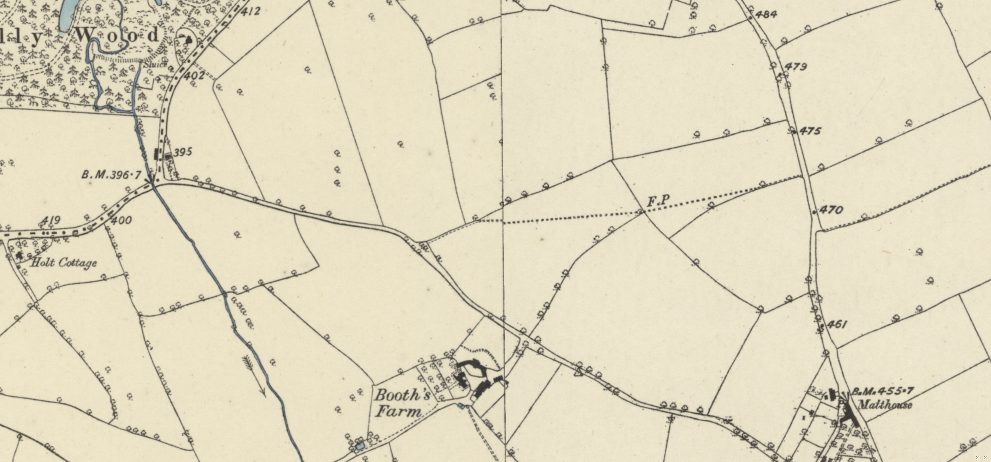
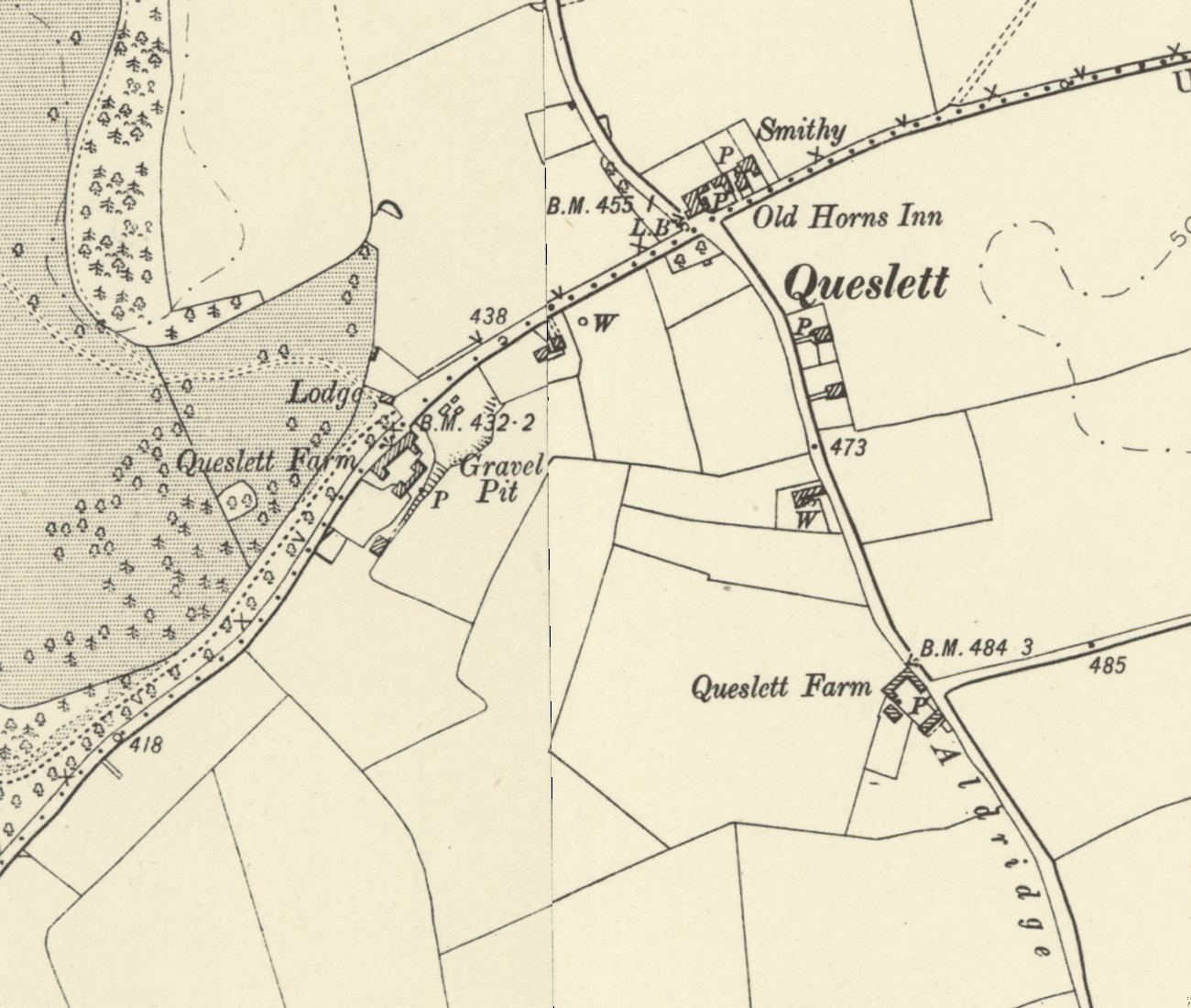
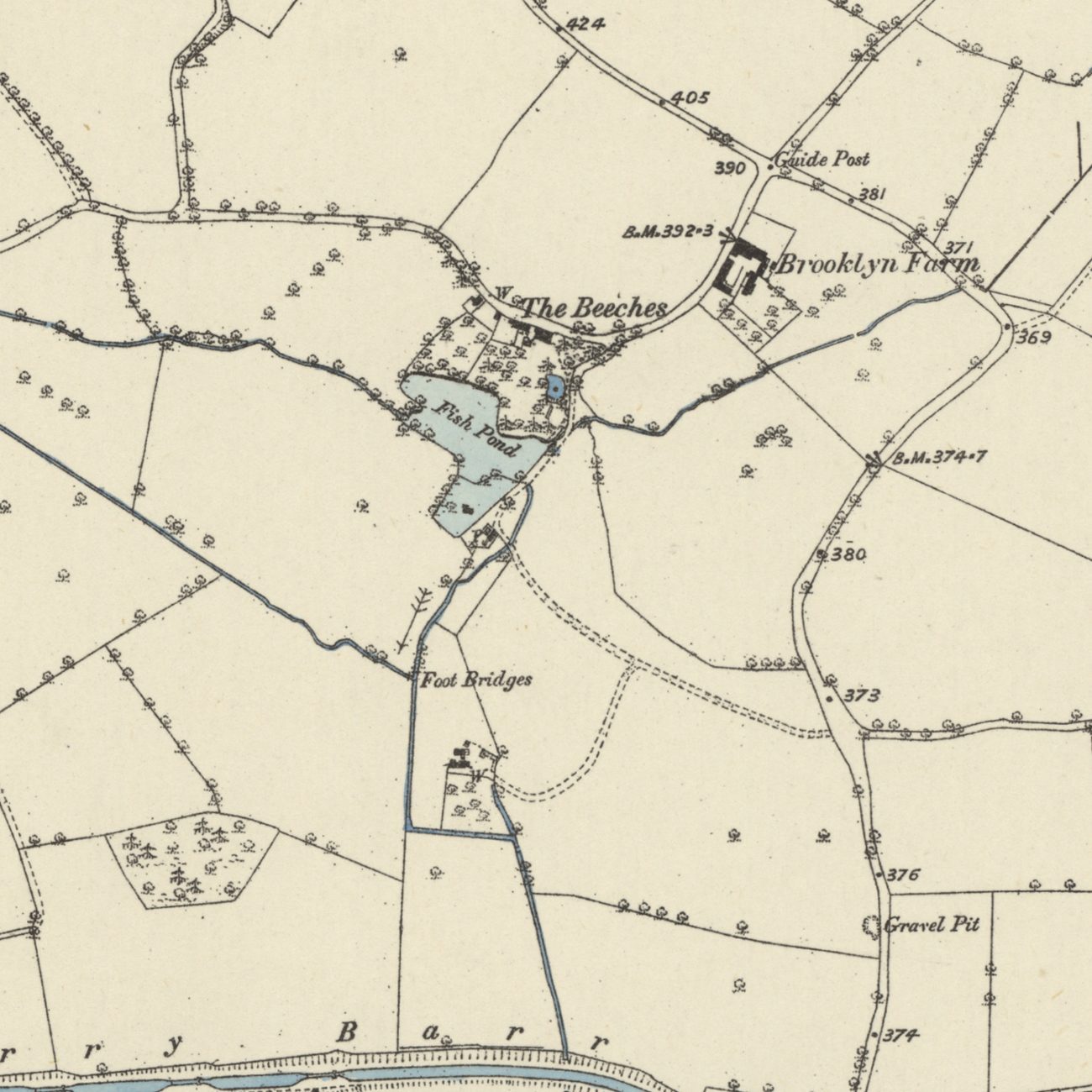
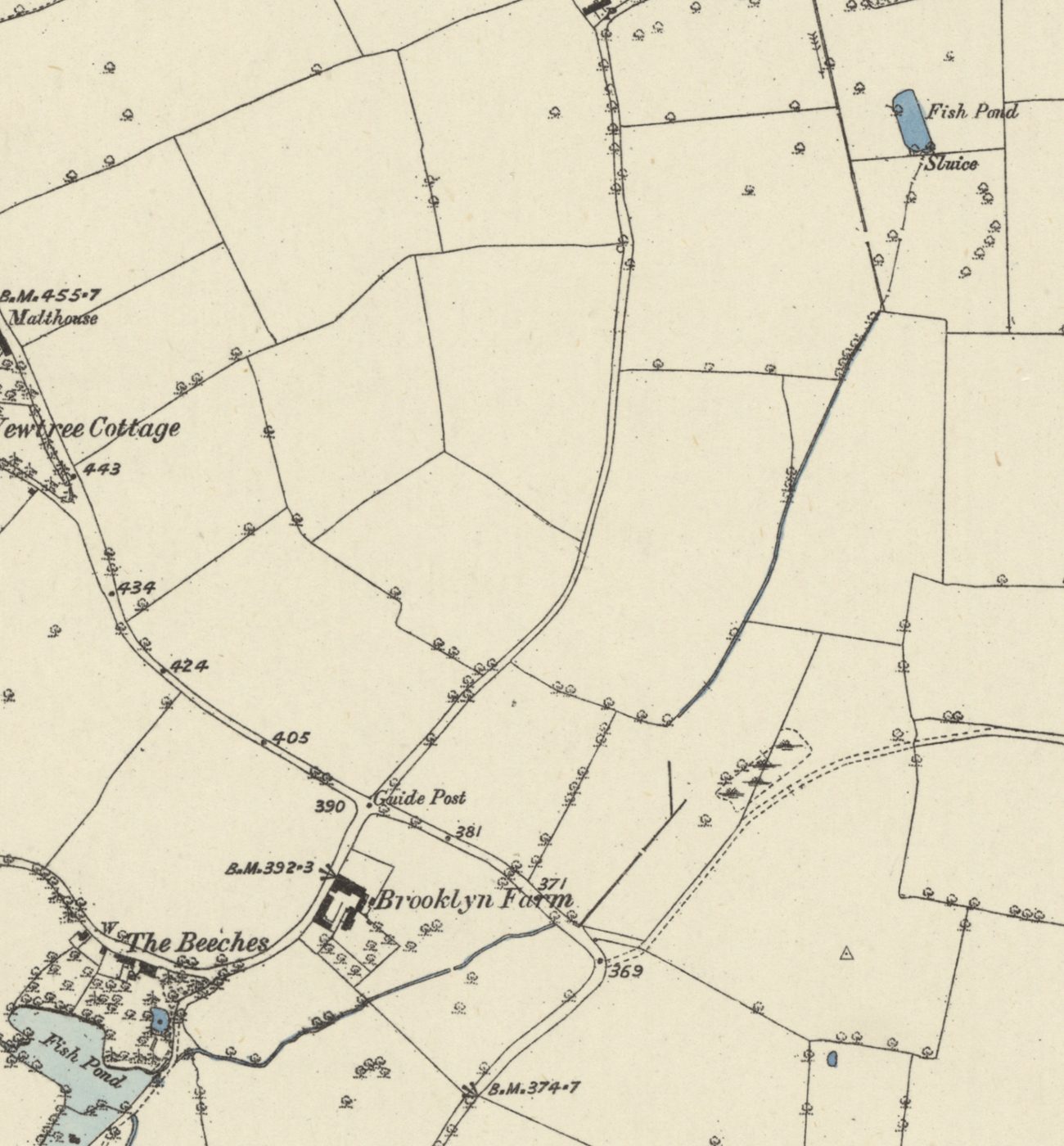
Booth’s Farm in the 1880s, with the brook from Great Barr Park to the westOrdnance Survey six-inch map, first edition, 1880s · Out of copyright
- Counterpart lease for 21 years, John Gough to John Booth and William Booth; bond for performance — Library of Birmingham, Gough of Perry Hall papers, 1799. Ref. MS 3145/45a; MS 3145/45b. Catalogue entry only; no day of the month given.
- The life, trial, and execution, of Wm. Booth (broadside) — Turner, printer, 1812. Ref. Harvard Law School Library, English Crime & Execution Broadsides. Primary. Execution Saturday 15 August 1812; the rope slipped, the second drop failed, death at the third; nearly two hours.
- The trial and execution of William Booth (handbill) — Turner, printer, 1812. Ref. cf. Warwickshire CRO CR2565/8. Primary. The raid; the 1808 acquittal.
- The Trial of William Booth, of Perry Barr … Stafford Summer Assizes, 1812 — J. Drewry, Stafford, 1812. Ref. Harvard Law School Library. Primary. 200 acres; raid of 16 March; sentence.
- The Trial, at Large, of William Booth and his Associates — Gower & Smart, Wolverhampton, 1812. Ref. Harvard Law School Library. Primary. Trial 31 July 1812.
- Rex v. William Booth, murder brief, Lent Assizes — Shakespeare Birthplace Trust, 1808. Ref. ER10/1/26. Catalogue entry only.
- The execution of William Booth of Beaudesert (Document of the Month) — Warwickshire County Record Office / Our Warwickshire, May 2014. Ref. CR2565/8. Booth born at Hall End Farm near Beaudesert, 1776.
- Handsworth, Old & New — 1908. Booth buried at Handsworth.
- The History of Forgery — Rachael Rowe, 2026. Quotes the Handsworth St Mary burial register, 17 Aug 1812 (register not seen). Repeats a wrong 25-year lease term.
- Transactions of the Halifax Antiquarian Society; “William Booth, the Perry Barr Forger”, The Numismatist — 1914; Mar 1923. Reburial because a neighbouring vault was enlarged (probable).
- Metal plate, forged note and coins found at Booth’s Farm (Stone Collection) — Library of Birmingham (Birmingham Images 3716), 1900. Ref. Stone Collection Box 79 Print 32. Caption only; image not reproduced.
- Valuation of crops and dilapidations after the Booths; bricks for repairs at Booth’s Farm — Library of Birmingham, 1817–1820. Ref. MS 3145/343/2, /343/3; MS 3145/312/28e. Catalogue entries only.
- Trade directories: Post Office 1850 (p. 300); Dix 1858 (p. 674); White 1875 (p. 762) — University of Leicester Special Collections, Historical Directories, 1850–1875. John Clarke, Booth’s Farm (1850, 1858); Josiah Cooke, Booth Farm (1875).
- Perry Hall estate sale report — Birmingham Daily Gazette, 23 Sep 1921. Ref. BNA BL/0000669/19210923/067. Booth’s Farm, 246 acres, let at £465, withdrawn at £7,750. Free search snippet only.
- Waring v Foden; Waring v Booth Crushed Gravel Co. [1932] 1 Ch 276 (CA) — Law Reports; also 146 LT 107, 1932. Sand and gravel held not to be “minerals”.
- Booths Farm farmhouse information board (FOI response) — Birmingham City Council / WhatDoTheyKnow, 30 Jul–8 Oct 2020. Ref. BCC ref. 16683822. Board text: late 17th-century house around an earlier timber frame; 13th-century pottery; reburial. Also carries a false claim about a “non-capital crime”, not used here.
- Historic England research records: Booths Farm; Booths Farmhouse; geophysical survey — Historic England via Archaeology Data Service, harvested 2020. Ref. NRHE 1173372, 1127159; event 1839649; WM SMR 3933. Dates for the house differ (“C18 … poss incorporating med house”; “circa 1780”).
- Booth’s farm was part of the Perry Hall estate … (caption) — Library of Birmingham (Birmingham Images 2392). Ref. 7/2392. Calls the house sixteenth century.
- Booths Farm unearthed for the future — Cllr Keith Linnecor (blog), 13 Sep 2012. The 2012 consolidation of the footings (probable).
- Directory of Quarries; Highways and Bridges — 1935; 1939. Booth Crushed Gravel Co. Snippets.
- Ordnance Survey six-inch maps, first and second editions — Ordnance Survey, 1880s; revised 1901. Ref. Staffs LXVIII.NE, LXIX.NW. “Booth’s Farm” and “Booth’s Lane”.
Comments
Comments will load here.