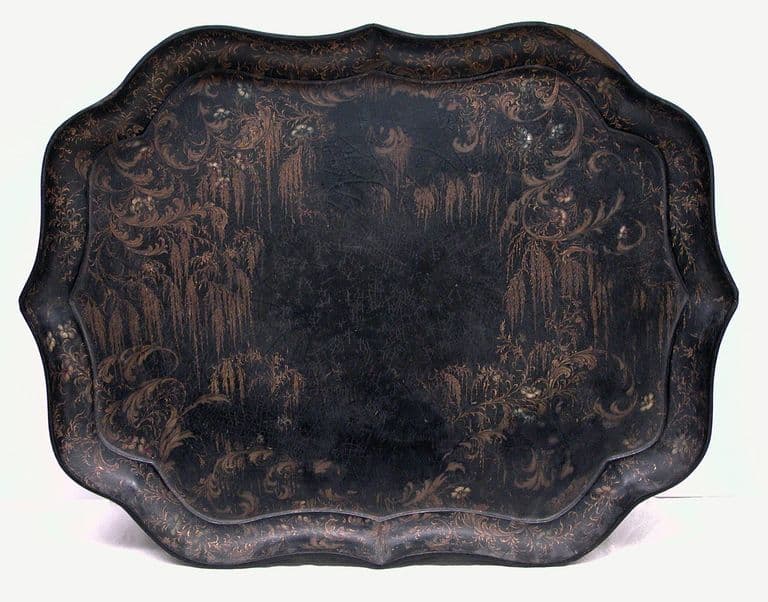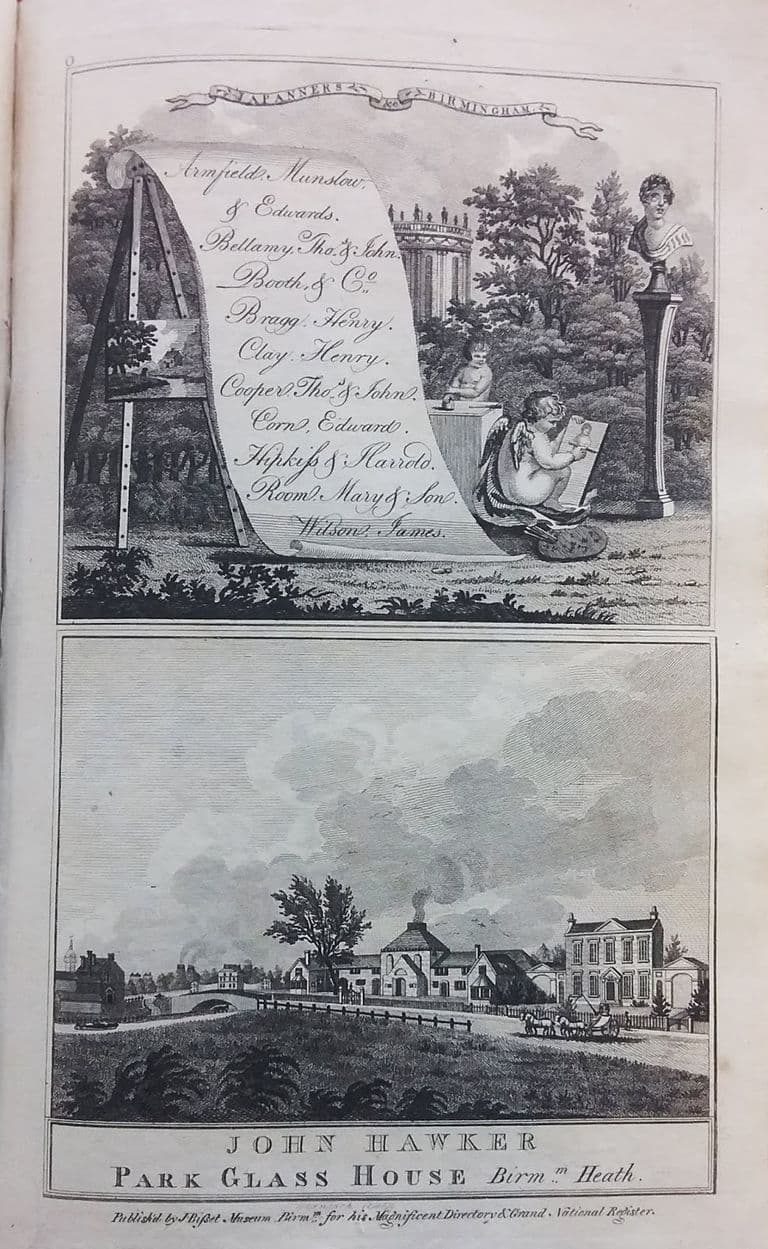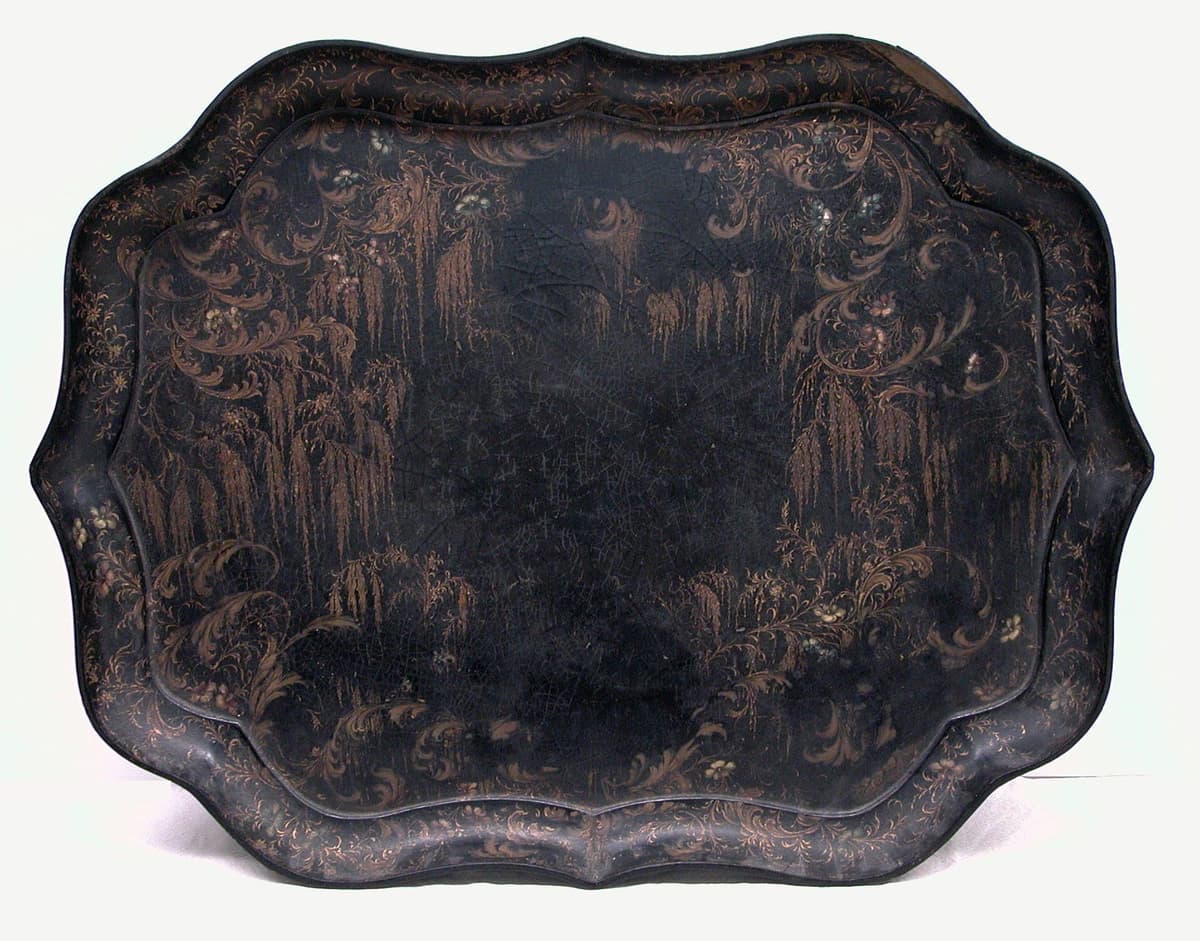
Japanning was Europe’s imitation of Asian lacquer. Coat after coat of hard varnish was laid on metal, wood or paper, baked in a stove, painted and gilded, and polished to a deep, glassy black. In eighteenth-century Birmingham it decorated the snuff boxes, trays and other “toys” that were the town’s speciality.
Baskerville and Taylor
John Taylor, the button maker, japanned snuff boxes on a large scale, and William Hutton credited his works with the painted paper snuff box. John Baskerville patented a japanning process in 1742 and grew rich on it before he turned to printing. When Lady Shelburne visited Birmingham in May 1766 she bought japanned goods at Baskerville’s, where his wife Sarah managed the business, and watched papier-mâché boxes being made elsewhere in the town.
Henry Clay’s paper ware
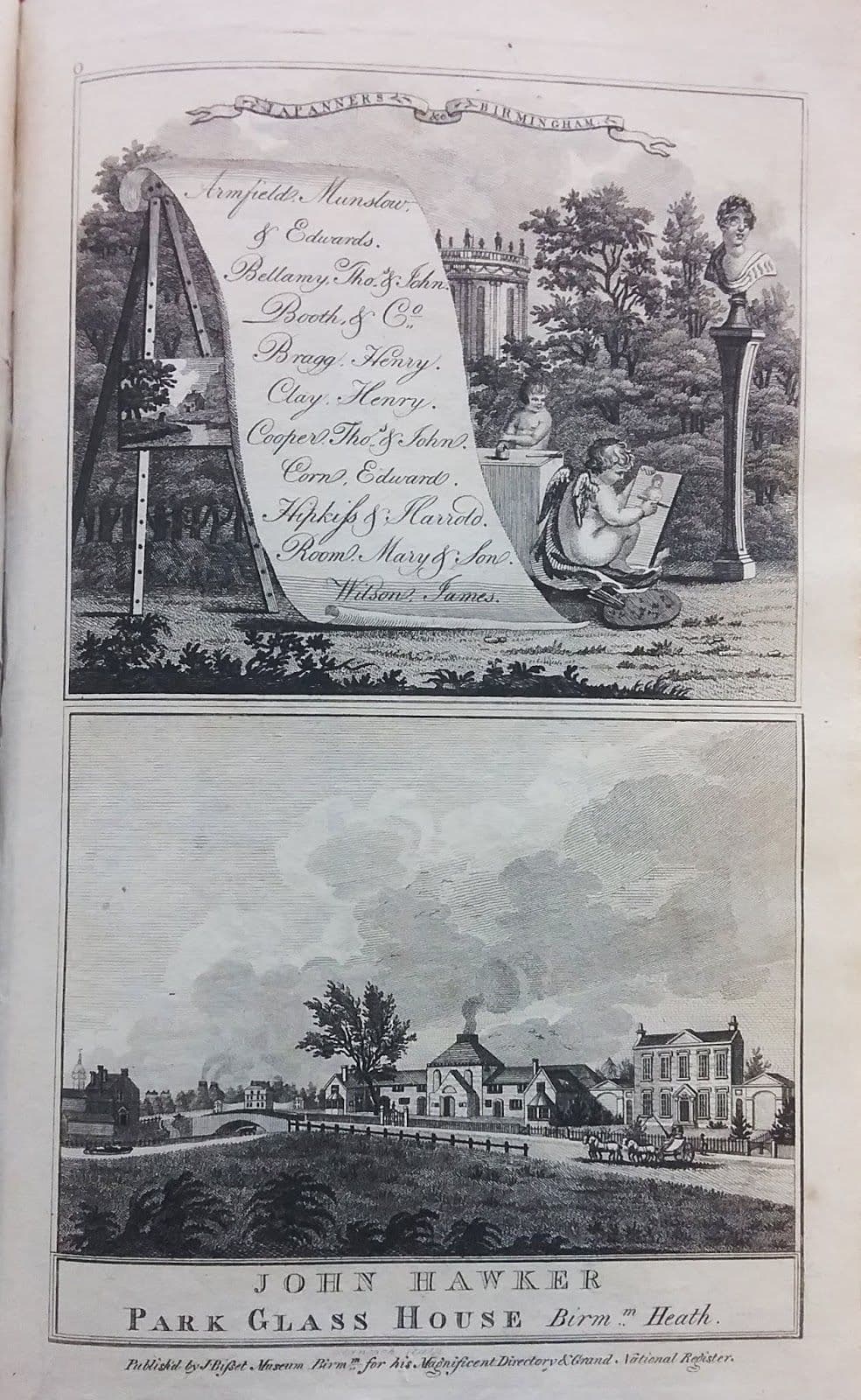
That early papier mâché was made from pulp pressed into moulds. Henry Clay, who had worked for Baskerville, changed the material. His patent of 20 November 1772 covered panels, furniture and trays made by pasting whole sheets of paper together over a metal core, then stoving, oiling, planing and varnishing them. The result could be sawn and planed like wood and polished like lacquer. From his works in Newhall Street, with up to 300 workers, Clay supplied fashionable houses and the royal family through his showroom in Covent Garden.
Jennens and Bettridge
After Clay’s patent expired, other makers moved in, and in 1816 Jennens and Bettridge began business. For decades they set the standard. Their decorators added pearl-shell inlay, patented by George Souter in 1825, and imitations of Chinese and Japanese work. Later makers pressed pulp into heated metal moulds and steamed their blanks for strength. W. C. Aitken, writing in 1866, called papier mâché “a speciality of industry for which Birmingham has been long and deservedly famous”.
The Victoria County History calls it “really a forerunner of present-day plastic substances”. Fashion moved on in the late nineteenth century, but black-and-gold Birmingham trays still fill museum cases and antique shops around the world.
On the map
One place connected with Japanning and papier-mâché. Tap a number for directions — some sites are private homes or gardens, so each place’s page says what you can see from the street.

Key dates
- 20 November 1772 — Henry Clay patents papier-mâché ‘paper ware’Patent No. 1027 gives the Birmingham japanner Henry Clay a monopoly on making japanned panels, coach roofs, furniture and tea trays “in paper”, by pasting sheets together rather than moulding pulp. It founds Birmingham’s papier-mâché industry.
- 1816 — Jennens and Bettridge begin making papier mâchéAfter Henry Clay’s patent has run out, Jennens and Bettridge begin business in Birmingham. Moving from tea trays to furniture and decorative wares, they become the most celebrated papier-mâché makers in Britain.
Sources and further reading
- The Resources, Products, and Industrial History of Birmingham and the Midland Hardware District — Samuel Timmins (ed.), Robert Hardwicke, London, 1866. W. C. Aitken, ‘Papier Mâché Manufacture’
- Economic and Social History: Industry and Trade, 1500–1880, in A History of the County of Warwick, vol. 7, pp. 81–139 — W. B. Stephens (ed.), Victoria County History, 1964
- Titles of Patents of Invention, Chronologically Arranged (2 vols) — Bennet Woodcroft, Great Seal Patent Office, London, 1854. no. 1027
- Life of William, Earl of Shelburne, vol. 1 — Lord Edmond Fitzmaurice, Macmillan, London, 1875. vol. 1, pp. 275–6
- An History of Birmingham (2nd edition) — William Hutton, Pearson and Rollason, Birmingham (Project Gutenberg text), 1783