
What was here?
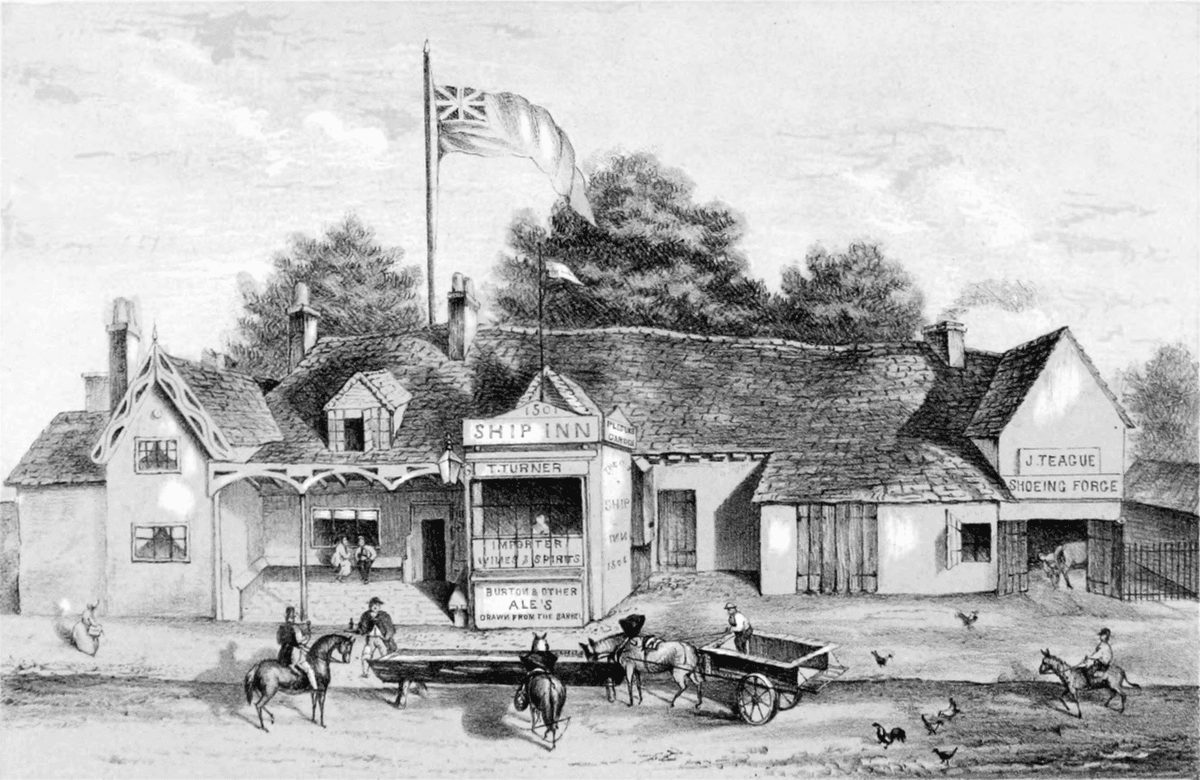
A long, low inn on the east side of Camp Hill, in the fork where Sandy Lane left the old road to Stratford and Warwick. It had a two-storey gabled wing, a verandah, a garden behind and a smith’s forge at one end. In 1868 the Ship Hotel replaced it on the same corner.
History
Easter Monday, 1643
On Easter Monday, 3 April 1643, Prince Rupert’s Royalist force came up the road from Stratford and Warwick to attack Birmingham. Two London pamphlets printed within days describe the fight at the town’s defences, the burning of about eighty houses and the death of the Earl of Denbigh. William Hutton, writing in 1783, says the townsmen blocked “the deep and narrow road, then between Deritend and Camp-hill”, which “obliged the Prince to alter his route to the left”.
At the top of Camp Hill, in the fork where Sandy Lane left the main road, stood a long, low roadside inn. R. K. Dent says it was once called the Anchor and was “probably a roadside inn three centuries ago”. By the nineteenth century it was the Ship.
The landlord’s story
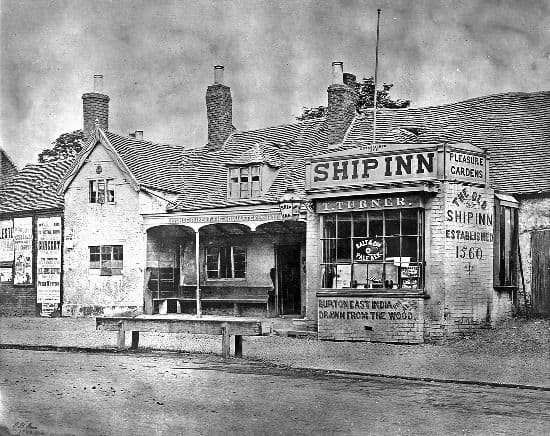
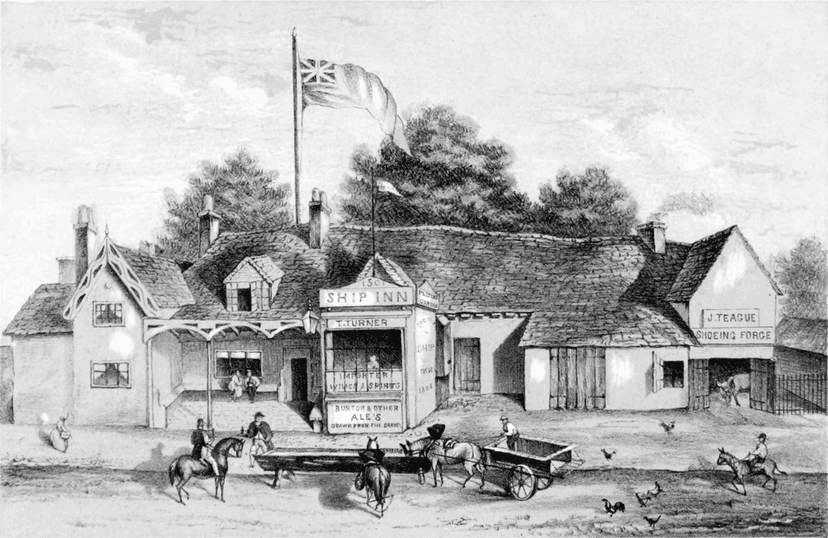
In the 1860s its landlord, Thomas Turner, painted “Established 1560” on the building and published a pamphlet, The History of the Old Ship Inn, Camp Hill: Prince Rupert’s Head Quarters, 1643. A photograph of the time shows a low range with a verandah, Turner’s name over the bar and “The Old Ship Inn Established 1560” on the side. An engraving in J. A. Langford’s A Century of Birmingham Life adds a flagpole, a horse trough and a shoeing forge at one end.
Was Rupert ever here? None of the accounts of 1643 names any inn or headquarters. Hutton says it was the Parliament men, not the Prince, who “formed their camp in that well chosen angle, which divides the Stratford and Warwick roads, upon Camp-hill”, and he does not mention the inn at all.
The same spot, then and now
1888–1913
Today
Old map: Ordnance Survey six-inch, reproduced with the permission of the National Library of Scotland (CC BY 4.0). Today: © OpenStreetMap contributors.
The headquarters story first appears in print in the 1860s, from the inn itself. Langford repeated it. Dent was more careful: the inn “is said to have been the head quarters of Prince Rupert”. Showell stated it flatly in 1885, yet in the same book linked a different inn, the Old Swan in the town, with Rupert and his officers.
The fair verdict is that the inn stood on Rupert’s line of attack. The rest is tradition.
From inn to roundabout
The old inn was pulled down in 1867. On 6 February 1868 the Ship Hotel opened on the same corner, and in July 1882 it was sold for £12,050. A century later Camp Hill was rebuilt for traffic, and the Ship Hotel went too. A plaque gives the date as 1972.
That bronze plaque stands on Bordesley Middleway at Camp Hill Circus. It reads “Site of the Ship Inn 1560 to 1972” and says that the inn “was reputedly Prince Rupert’s headquarters”. Reputedly is exactly the right word. The battle was real, and the road Rupert came along is still there under the traffic. The headquarters lives on in a landlord’s pamphlet and a plaque.
Why it mattered
The Old Ship stood on the road Prince Rupert took to attack Birmingham in 1643, the town’s one real battle. Its claim to have been his headquarters, promoted by its own landlord in the 1860s, shows how a good story could become local history, and why the plaque on the site rightly says “reputedly”.
Why it disappeared
Redevelopment · Road building
The old inn was pulled down in 1867 and replaced by the larger Ship Hotel, which opened in 1868. That building was demolished in the early 1970s, in 1972 according to the plaque, when the Camp Hill junction was rebuilt for road works.
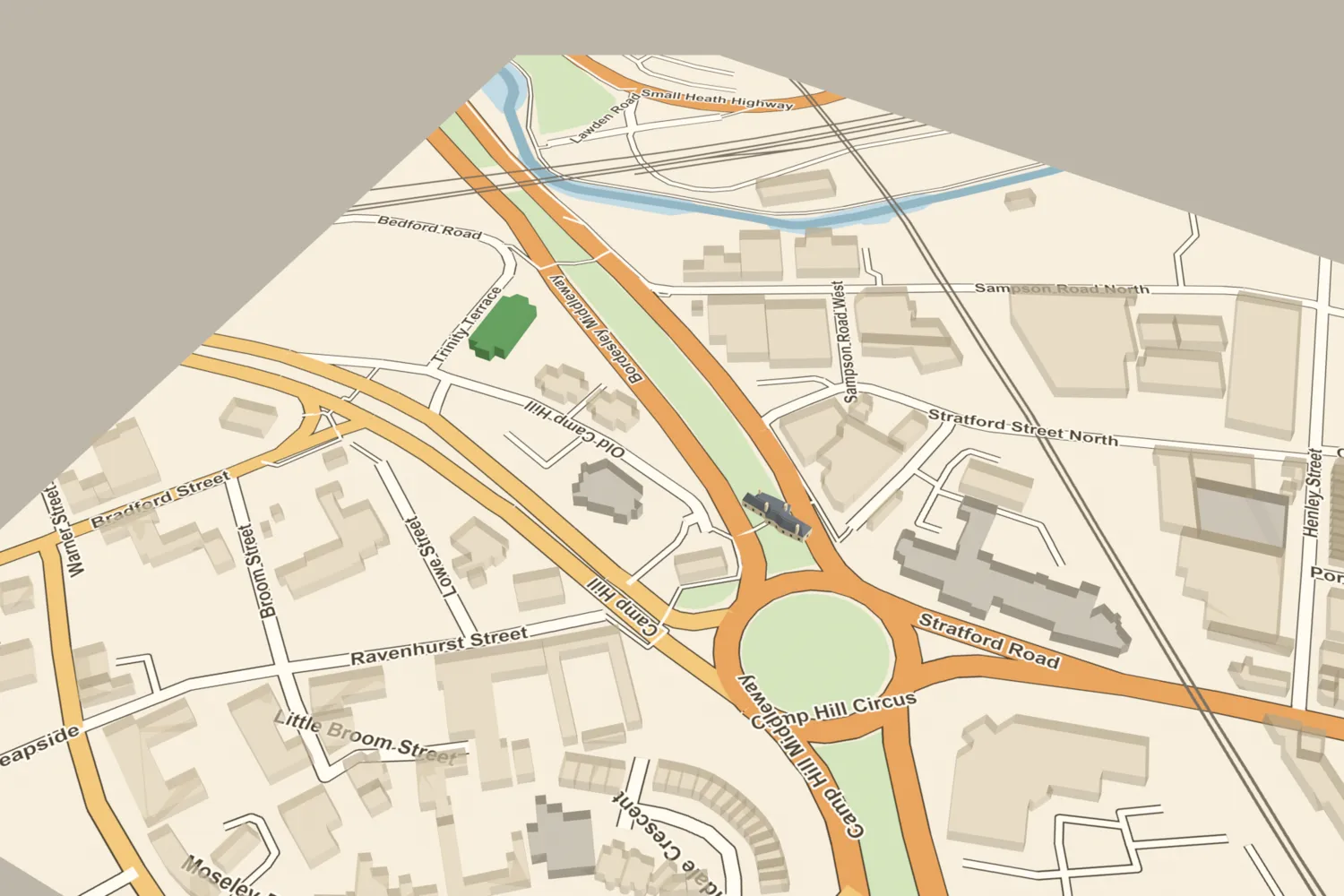
The Old Ship Inn, Camp Hill, on today’s streets
What’s there now
What replaced it
The Ship Hotel (1868 to the 1970s), then the rebuilt road junction. The site is now Bordesley Middleway at Camp Hill Circus.
What survives
Nothing. A bronze plaque on Bordesley Middleway, about 20 m south-west of the site, records the inn.
Today
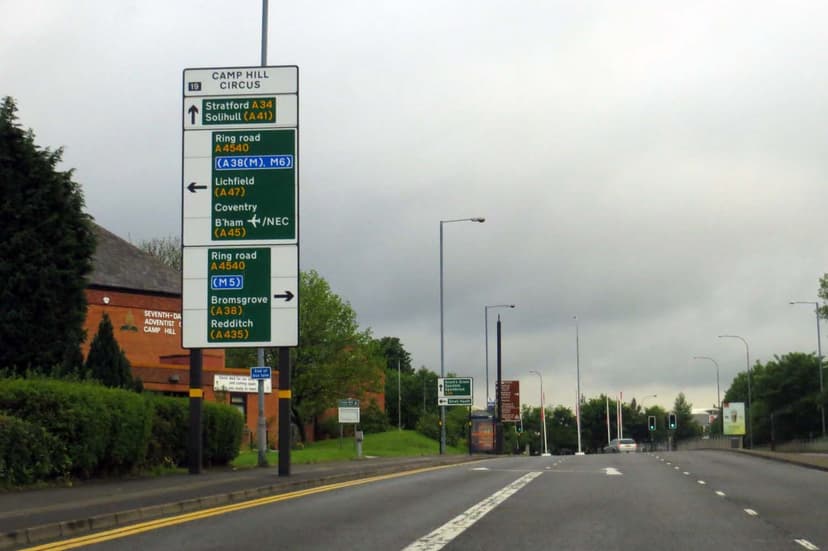
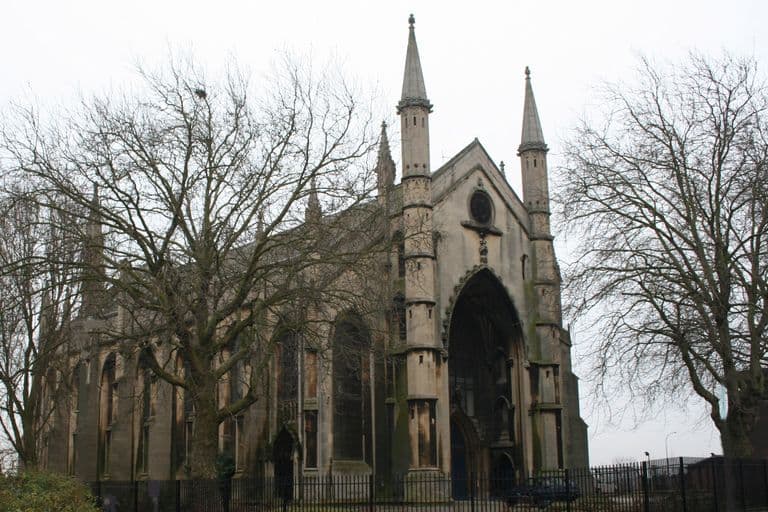
The site is under the Bordesley Middleway carriageway at Camp Hill Circus. The plaque is on the Middleway nearby, and Holy Trinity Church stands about 180 m to the north.
Then and now
Then · 1868–70
Now · 22 May 2014
Sources and further reading
Prince Rupert’s headquarters is a tradition. It first appears in the 1860s, from the inn’s own landlord, and conflicts with Hutton’s statement of 1783 that the Parliamentarians camped on Camp Hill. No account of 1643 names an inn. Turner’s pamphlet has not been read; only its cover has been seen.
“Established 1560” comes only from the inn’s sign and the plaque. The old inn was pulled down in 1867 according to Showell, which fits the Ship Hotel opening in February 1868; a caption to Langford’s engraving says 1869. The Ship Hotel’s demolition in 1972 rests on the plaque. Which part of the long range on the 1855 plan was the inn itself, and which the forge and stables, is inferred from the pictures.
- Showell’s Dictionary of Birmingham — Thomas T. Harman and Walter Showell, Cornish Brothers, Birmingham, 1885. ‘Ship Inn’, ‘Foxalls’
- Old and New Birmingham: a history of the town and its people — Robert K. Dent, Houghton and Hammond, Birmingham, 1880. Civil War chapter; ‘the traditional head-quarters’
- An History of Birmingham (2nd edition) — William Hutton, Pearson and Rollason, Birmingham (Project Gutenberg text), 1783. ‘Battle of Camp-hill’
- A Century of Birmingham Life — John Alfred Langford, 1870. vol. 1 (1868), introduction and plate at p. 33
- A True Relation of Prince Rupert’s Barbarous Cruelty against the Towne of Brumingham; Prince Rupert’s Burning Love to England, discovered in Birmingham’s Flames — Anonymous (letters signed R. P. and R. G.), 1643
- The History of the Old Ship Inn, Camp Hill: Prince Rupert’s Head Quarters, 1643 — Thomas Turner, 1860s
- Site of the Ship Inn (Open Plaques plaque 9811) — Open Plaques
- Battle of Birmingham (Camp Hill), 1643 — The Battlefields Trust
- Plan of the Borough of Birmingham (Pigott Smith), 1855 — J. Pigott Smith, National Library of Scotland (online), 1855. footprint traced
- Ordnance Survey 1:500 town plan of Birmingham, 1887–88, georeferenced — National Library of Scotland, 1888. ‘Ship Hotel’
- OpenStreetMap data (Overpass and Nominatim), central Birmingham — OpenStreetMap contributors, 2026
Comments
Comments will load here.