
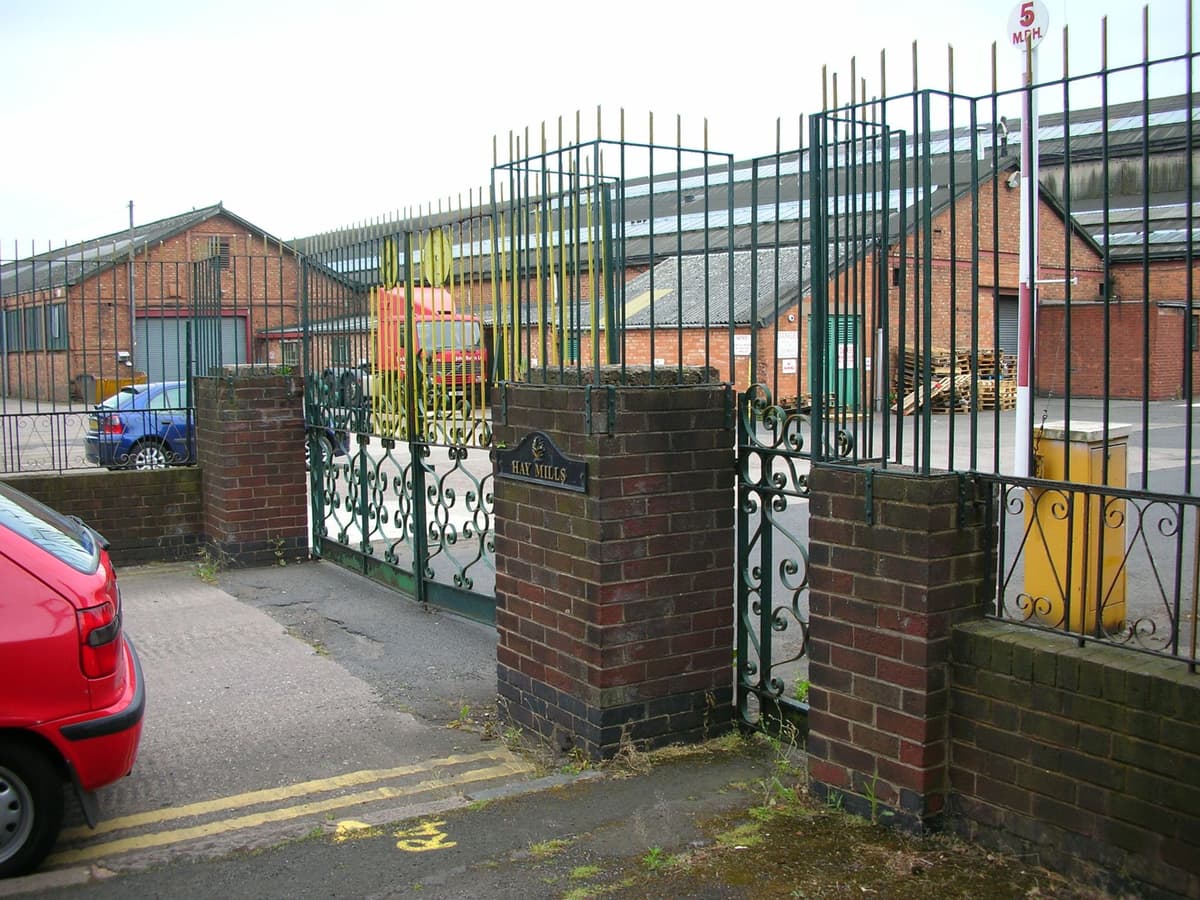
What was here?
An old water mill on the River Cole, used for corn and later for grinding blades, became the wire works of James Horsfall and then Webster & Horsfall. In 1864–65 about 250 workers here drew roughly 30,000 miles of wire for the Atlantic telegraph cable. The firm is still here, in modern buildings off the Fordrough.
History
A mill on the Cole
Hay Mill stood on the River Cole, east of Birmingham, in the old parish of Yardley. It belonged to Hay Hall and was at first a corn mill. By the seventeenth century it ground blades, and in 1820 it was described as a blade mill that could be turned to corn or paper. Between 1836 and 1840 it was held by William Deakin, who may have made gun barrels or bayonets.
Wire comes to Hay Mills
Soon after that the tenants were ‘Smith and Horsfall’ and James Horsfall, a music-wire maker. Horsfall, a wire-drawer from Digbeth, had demolished the old mill and built new works about 100 metres to the north, including a new wire-drawing mill. In 1853 he patented a heat treatment that made steel wire much stronger. In 1855 he went into partnership with the Websters of Penns Mill, Sutton Coldfield, the most famous wire-makers in the country, and in 1859 their production moved from Penns to Hay Mills. When Baron Dickinson Webster died in 1860, Webster & Horsfall was Horsfall’s.
Wire for the ocean
The same spot, then and now
1888–1913
Today
Old map: Ordnance Survey six-inch, reproduced with the permission of the National Library of Scotland (CC BY 4.0). Today: © OpenStreetMap contributors.
In May 1864 the firm won the contract for the armouring wire of the new Atlantic telegraph cable: 1,600 tons, due within about a year. A great shop, seventy to eighty yards square, was built or enlarged for the job. A report of 1866 describes men each tending a drum as the wire was drawn down through dies from one size to the next, then tested at 1,000 pounds. Ten of these wires were wound spirally round the cable’s core. Hay Mills drew about 30,000 miles in all.
The 1865 cable was lost in mid-Atlantic, partly because broken flakes of armouring wire pierced its insulation. The firm still got the repeat order for 1866, using a softer, galvanised wire. That year the Great Eastern laid the new cable and recovered the old one. At Christmas 1866 Horsfall’s workers gave him a case of samples of the 1858, 1865 and 1866 cables, which the company still owns.
A works village
Horsfall built a community round his works. In 1860 he gave a schoolroom for his workers’ children beside the river and built a row of cottages on the Fordrough. The schoolroom became a chapel in 1863, and a new schoolroom was built next to it. In 1873–74 he built St Cyprian’s Church, designed by Frank Barlow Osborn, partly over the old mill race, using the chapel as its chancel. A mortuary chapel for his daughter, Mary Elizabeth Simms, followed in 1877. The district took its name from the mill and grew into the suburb of Hay Mills.
Ropes, springs and war
In the 1880s Latch & Batchelor, a wire-rope firm in which Horsfall’s son Henry was involved, was set up on part of the site to make Telford Batchelor’s locked-coil rope. The two firms merged in 1895 and separated again in 1955. In the twentieth century the works turned to spring wire. In the First World War it made fuse-spring wire for shells and cable for mines, aircraft and balloons, and in the Second it was hit several times by bombs. Webster & Horsfall still draws wire at Hay Mills today.
What happened here?
James Horsfall drew wire here from the mid-nineteenth century; Webster & Horsfall made the armouring wire for the 1865 and 1866 Atlantic telegraph cables; Horsfall built a school, cottages and St Cyprian’s Church for his workers; Latch & Batchelor made wire rope on part of the site from 1884.
Why it mattered
Hay Mills put Birmingham wire into the cables that first gave Britain and North America lasting telegraph links. Horsfall’s strong steel wire also led to new kinds of wire rope and spring. The works has drawn wire on the same site for more than 160 years.
What’s there now
What survives
The works is still in use by Webster & Horsfall, in largely modern buildings. Next to it are St Cyprian’s Church (Grade II, list entry 1343408) with its Horsfall Chapel, and the 1863 schoolroom, which the Hay Mills Foundation has used to display the firm’s history. The company keeps the presentation case of cable samples given to James Horsfall in 1866.
Today
An industrial works at the end of the Fordrough, off the Coventry Road (A45) near Heybarnes Circus, beside the River Cole and the Grand Union Canal. St Cyprian’s Church stands at the works entrance.
Today
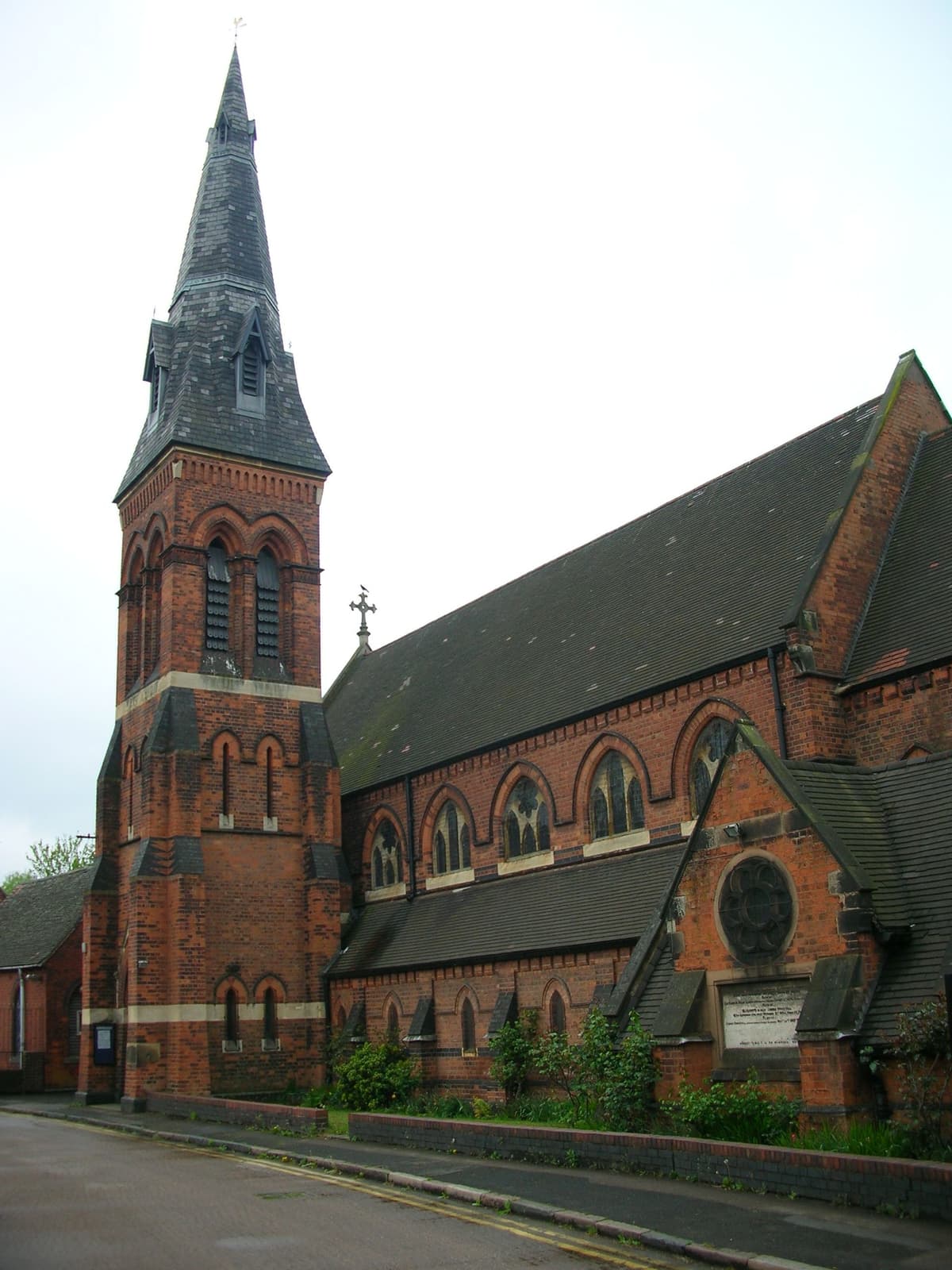
St Cyprian’s Church, Hay Mills, 2007 (uploaded 10 January 2007)Oosoom, 2007 (uploaded 10 January 2007). Wikimedia Commons (transferred from English Wikipedia) · CC BY-SA 3.0 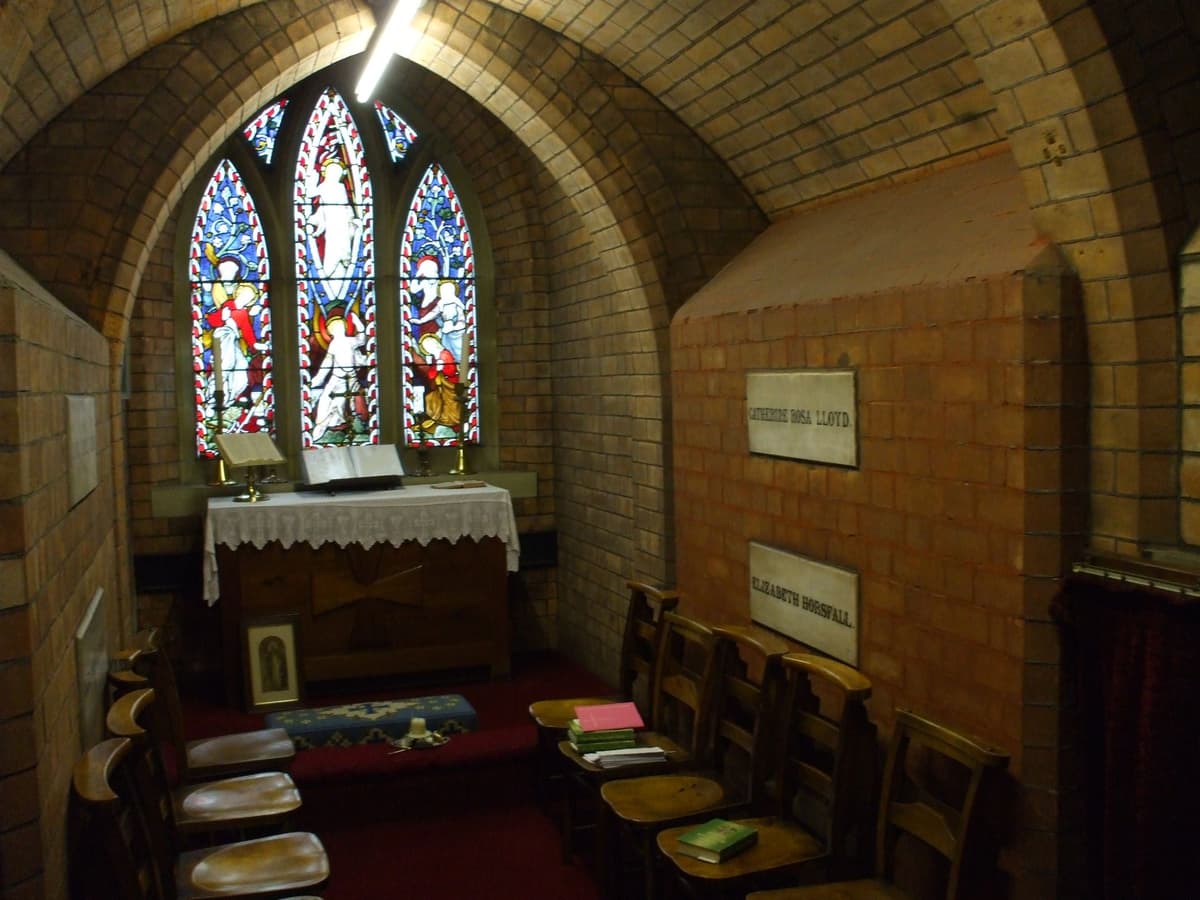
The Horsfall Chapel, St Cyprian’s, Hay MillsArgrogan. Wikimedia Commons · Public domain
Key dates
- 1859 — Webster and Horsfall move to Hay MillsFour years after James Horsfall’s partnership with Baron Dickinson Webster, wire production moves from the Websters’ Penns Mill near Sutton Coldfield to Horsfall’s works at Hay Mills.
- 9 May 1864 — Hay Mills wins the Atlantic cable wire contractJames Horsfall signs a contract to supply 1,600 tons of armouring wire for the Atlantic telegraph cable, the biggest order in Webster & Horsfall’s history. About 250 workers at Hay Mills draw some 30,000 miles of wire.
- 1866 — The Atlantic cables are completedThe Great Eastern lays a new Atlantic telegraph cable armoured with wire from Hay Mills, then recovers and completes the cable lost in 1865. On Christmas Eve, Horsfall’s workers present him with a case of cable samples.
- 1873–74 — St Cyprian’s Church built at Hay MillsJames Horsfall pays for St Cyprian’s Church beside his wire works, designed by Frank Barlow Osborn and built partly over the old mill race, with his workers’ chapel of 1863 as its chancel.
Sources and further reading
Historic England says the nineteenth-century buildings have been replaced with modern units; atlantic-cable.com (2022) says the shop built for the 1865 cable is still in use. Which is right has not been checked on site. The date Horsfall came to Hay Mills is uncertain: about 1830 (Historic England), soon after 1840 (VCH Warwickshire), 1856 (BBC; Grace’s Guide), with the Penns production moved in 1859 (Historical Manuscripts Commission). VCH loosely says the ‘first Atlantic cable’ was made there; the wire was for the 1865 and 1866 cables. The 1895 merger and 1955 separation come from the 1991 HMC report. Latch & Batchelor is said to have been formed in 1884 (Grace’s Guide) or 1891 (the company). The use of the 1863 schoolroom by the Hay Mills Foundation is reported in Birmingham Heritage Week listings and has not been checked directly.
- Economic and Social History: Mills, in A History of the County of Warwick, vol. 7, pp. 253–269 — W. B. Stephens (ed.), Victoria County History, 1964. Hay Mill
- Church of St Cyprian and St Chad, Hay Mills — National Heritage List for England entry 1343408 — Historic England
- Summary report on the records of Webster & Horsfall Ltd, spring steel wire manufacturers, Birmingham (GB-800819-Webster) — Historical Manuscripts Commission (N. James), Historical Manuscripts Commission, 1991
- 1865 & 1866 Atlantic Cables — Bill Burns (ed.)
- About — The Webster and Horsfall History — Webster & Horsfall
- The Atlantic Telegraph Cable story: the Birmingham factory that made history — BBC Birmingham, BBC, 2003
- Webster and Horsfall — Grace's Guide
- Ordnance Survey six-inch map, second edition (1888–1913), georeferenced — National Library of Scotland
Archive references: Library of Birmingham MS 2689 (Acc. 2017/079), Trans-Atlantic Cable Chart, Webster & Horsfall records

Comments
Comments will load here.