
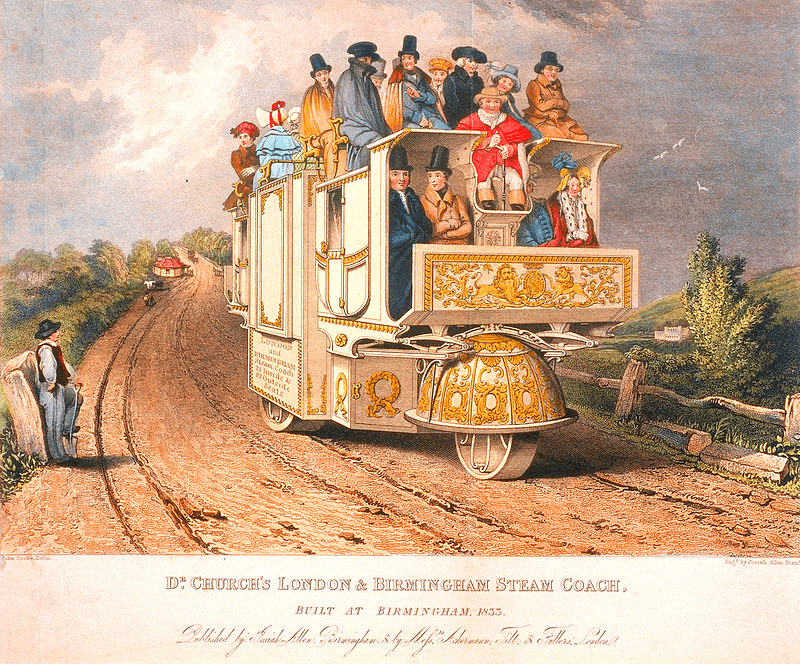
There is a coloured print of 1833 that shows a wonder of the age. A tall, gilded carriage, decorated with lions, rolls along a country road with no horses in front. Passengers in top hats and bonnets crowd its roof. Underneath is the caption: “Dr. Church’s London & Birmingham Steam Coach, built at Birmingham, 1833.”
It is a picture of a journey that never happened. The coach never ran a service to London. Its inventor, William Church, was one of the most prolific minds in nineteenth-century Birmingham, and one of the least rewarded.
A doctor from America
Church was American. His Birmingham obituary says he was born in Vermont; the printing historians Legros and Grant, writing in 1916, called him a native of Boston. He was born in about 1778 and, his obituary says, educated for a medical career. That is why Birmingham always called him “Dr Church”, and in 1835 a directory listed him under both physicians and engineers.
He was in England by 1818, when he patented machinery for making nails, spikes, wire and screws, giving his address as Turner Street, off the Commercial Road in London. In 1821 and 1822 he patented printing apparatus from addresses in the City and in Nelson Square, south of the Thames.
The machine that set type
To see why the 1822 patent mattered, picture a printing office. A compositor stood at a case of type and picked out every letter, space and comma by hand, one at a time, building lines in a composing stick. When the job was printed, every piece had to be put back in its compartment. It had worked like this since Gutenberg.
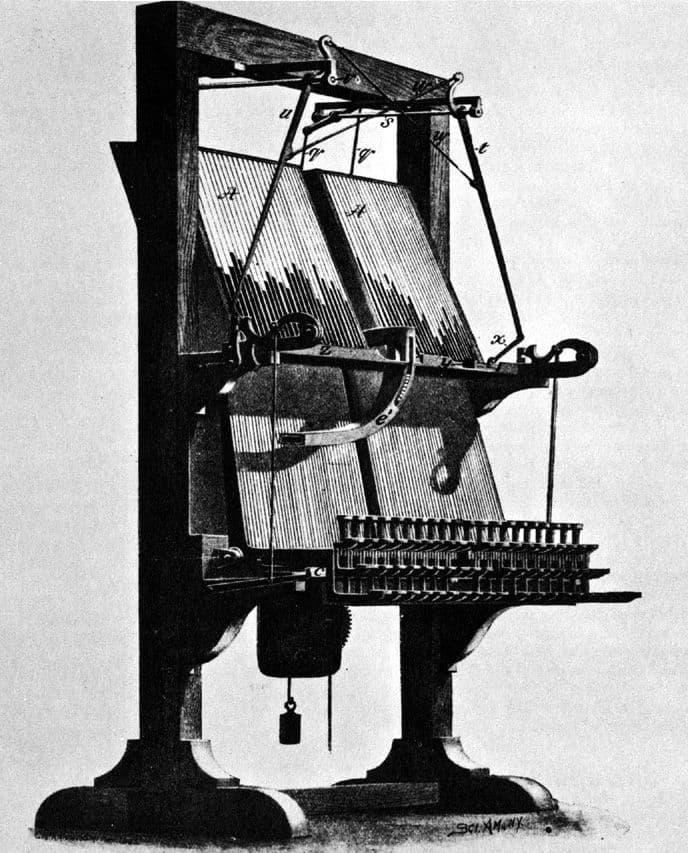
Church’s patent, number 4664, granted on 21 March 1822, attacked the whole process. It described three machines: a type-caster, a composing machine and a press. In the composing machine the letters were stored in channels in a tall, sloping frame; pressing a key released a piece of type, which dropped into line. The type-caster was meant to cast a whole fount at a time. Legros and Grant reported that it was said to produce 75,000 pieces of type an hour.
The boldest idea was what happened next. Church did not plan to sort used type back into cases at all. He would melt it down and cast fresh type for the next job. Legros and Grant, looking back from 1916, saw that this “distribution through the melting-pot” was exactly how the great composing machines of their own day, the Monotype and Linotype, worked. “The earliest and simplest form of composing machine, so far as the authors are aware,” they wrote, “was that of Church.”
What nobody has shown is that Church’s system went into regular commercial use. Hand composition remained normal for decades. The idea was ahead of the machinery to make it pay.
Birmingham
By May 1824 Church described himself as “of Birmingham, esquire”, and he stayed for nearly forty years. The town had what an inventor needed: skilled metalworkers, foundries, engine builders and men with money to risk. The patents poured out. Woodcroft’s index lists him for casting iron and casting tubes and cylinders (1824–25), augers and boring bits (1824), more printing improvements (1826), spinning (1827), buttons (1829), knife sharpeners (1829), and nail-making machinery (1831 and 1832). His obituary says he built machines for spikes, nails, button shanks and hooks and eyes, the small staples of Birmingham’s trade.
From 1829 he lived at Haywood House, Bordesley Green, then still on the edge of the countryside east of the town.
Steam on the road
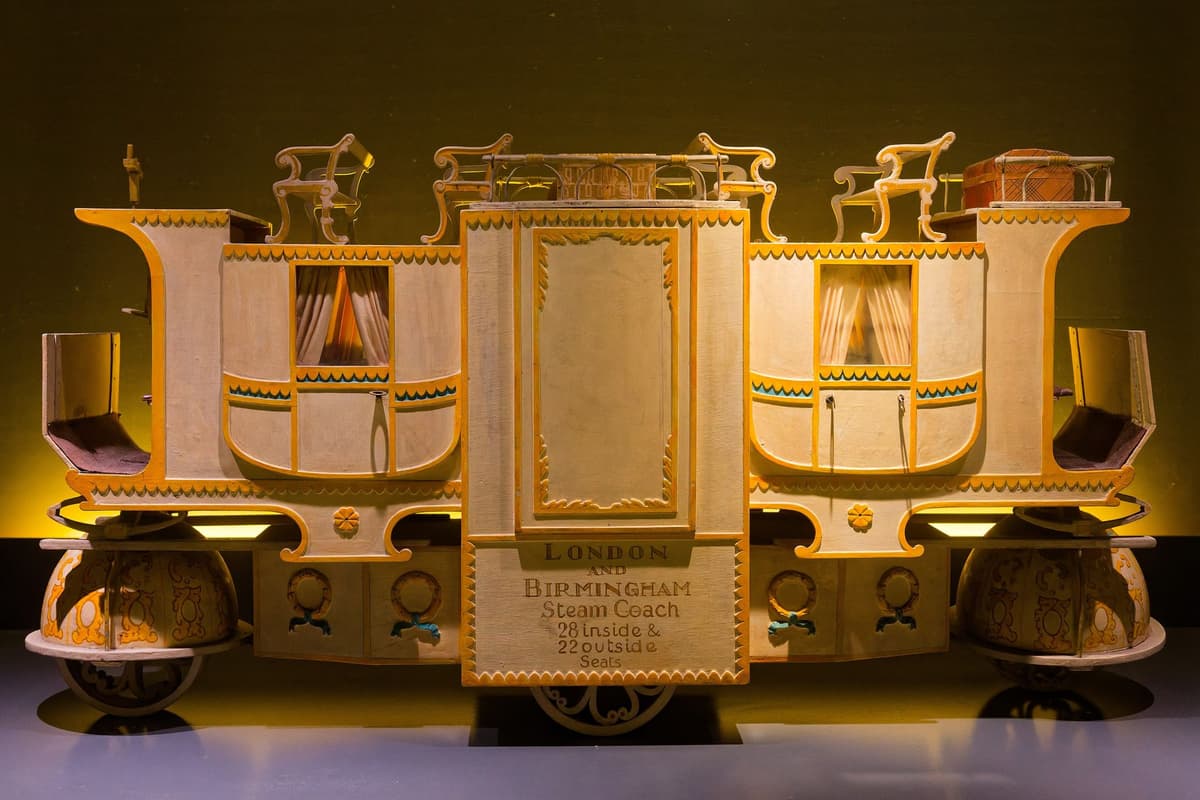
In 1829 Church patented improvements in steam propulsion for boats, and from 1832 he turned to steam carriages for the road. His patent of 9 February 1832 was the first of three. His coach had an iron frame, a boiler made of upright tubes, and wheels with springy rims meant to soften the jolts of a rough road.
Backers in Birmingham formed the London and Birmingham Steam Carriage Company, which, according to the engineer-historian William Fletcher, raised “a large capital” and advanced Church large sums. Trials began on the roads in November 1834. In 1835 the coach set out from the works with forty passengers aboard, but turning a corner its rear struck the footpath, damaging part of the boiler, and it had to be hauled back. A few days later the Birmingham Gazette reported it running six miles out along the Coventry Road and six miles back, three of them at 15 miles an hour.
That was as good as it got. “The carriages were constantly brought out,” Fletcher wrote in 1891, “and as constantly failed.” The company advertised that all difficulties were overcome, but no coach ever ran a regular service to London. In April 1835 a fiat in bankruptcy was issued against Church. Three years later the London and Birmingham Railway opened, and it was the railway, not the steam coach, that carried Birmingham’s passengers to London.
A railway engine, and a disaster
Church turned to rails. In 1838 an engine of his design was at work as a ballast engine on the new London and Birmingham Railway. Then came tragedy. On 10 November 1840, at Bromsgrove station, the boiler of a locomotive called Surprise, on trial for the Birmingham and Gloucester Railway’s steep Lickey Incline, exploded. The driver, Thomas Scaife, and Joseph Rutherford were killed. The Birmingham Gazette reported that the engine had been designed by Dr Church and built three years earlier by Joshua Horton of Brierley Hill. The two men’s gravestones still stand in the churchyard of St John the Baptist, Bromsgrove.
Still inventing
Church kept going. In the 1840s he patented ways of making metal tubes with Jonathan Harlow (1841), machinery for stamping candlestick parts (1846), and machines for cutting and printing playing cards (1848, with the woollen draper Thomas Lewis, and 1850). In 1850 a Birmingham paper reported he was perfecting a machine for dating railway tickets, to stop fraud. In the 1850s, with the merchant and gun manufacturer Samuel Aspinwall Goddard, he worked on heavy guns, and in 1860 a gun built on a principle “varying between that of Sir William Armstrong and Dr. Church” was tested at Woolwich.
His Birmingham obituary put its finger on the problem: “As soon as the mechanical difficulty was solved he tended to lose interest in a project.” Twice married, he outlived his second wife by twelve years. He was about eighty when his son-in-law invited him home to Vermont, and Birmingham friends helped to pay for the journey. He died there on 7 October 1863, aged 85. The death notice called him “for more than forty years a resident of Birmingham, and one of the first mechanical geniuses of the age”. The obituary added: “The Doctor never accumulated any money.”
Why it mattered
Measured by money, William Church failed. His steam coach never ran to London, his company sank, he was declared bankrupt, and he left Birmingham poor. One of his engines killed two railwaymen.
Measured by ideas, he was remarkable. His 1822 printing patent combined casting, composing and printing, and proposed melting used type down instead of sorting it back by hand. That principle sat at the heart of the composing machines that finally transformed printing at the end of the century. Legros and Grant, the leading printing engineers of 1916, gave him “the place of honour” among the inventors of composing machines.
His forty years in Birmingham also show what the town offered an inventor: foundries and engine shops to build anything, metalworkers to make it, and backers willing to gamble. Church took more than twenty patents there on everything from nails and buttons to boats and playing cards. Most came to little. A few pointed the way. Birmingham’s industrial story is usually told through its winners. Dr Church is a reminder of how many brilliant attempts it took to produce one.
Key dates
- 21 March 1822 — William Church patents a type-casting and composing systemPatent No. 4664 describes a type-caster, a keyboard composing machine and a press, with used type to be melted and recast rather than sorted by hand. Church moved to Birmingham by 1824. Printing historians later counted it among the earliest composing machines known.
- 1835 — Dr Church’s steam coach runs on the Coventry RoadWilliam Church’s steam coach, built for the London and Birmingham Steam Carriage Company, makes public trials with up to forty passengers, running six miles out along the Coventry Road and back. It breaks down repeatedly and never runs a service to London.
Sources and further reading
Origins: the Birmingham death notice (1863) and obituary (1864), as summarised by Grace’s Guide, say he was born in Vermont; Legros and Grant (1916) say Boston, Massachusetts. Wikipedia (lead only) says he patented the machine “while living in Boston”, but his British patents of 1818–23 give London addresses. His date of birth is known only from his age at death.
“First”: Wikipedia and Britannica call his 1822 machine “generally considered the first” typesetting machine. Legros and Grant say “so far as the authors are aware”. We use their qualified wording. Legros and Grant also say Church’s machines were “in actual operation” by about 1840; we found no other evidence of commercial use.
The 75,000 type an hour is a figure Legros and Grant say was “stated”, not one they tested.
Steam coach: Fletcher (1891) dates the forty-passenger trial to 1835; Grace’s Guide cites road trials in November 1834 from the Birmingham Gazette. The print is dated 1833, probably before the coach was finished.
Railway engine: the 1838 ballast engine and the Surprise are taken to be the same machine by Wikipedia (lead only; it says the engine was first named Victoria and later rebuilt as Eclipse). Fletcher calls Church’s railway engine the Eclipse and claims it was the first four-wheel tank engine; that claim is not used. Some accounts place the 1840 explosion on the Lickey Incline itself; local railway historians say it was at Bromsgrove station. The second man killed is named Joseph Rutherford by the Worcestershire Community Rail Partnership and John Rutherford by Wikipedia; we use Joseph.
His obituary also credits him with smelting iron by hot blast with anthracite in 1825 and proposing an electric telegraph to London in 1832; these come from one source and are not used. Fletcher says he sailed for America in 1861; the obituary implies about 1859.
No site for his works has been securely identified, so none is mapped.
- Titles of Patents of Invention, Chronologically Arranged (2 vols) — Bennet Woodcroft, Great Seal Patent Office, London, 1854. nos. 4258 (1818), 4565 (1821), 4664 (1822), 4760 (1823), 4953–14,087 (1824–52)
- William Church, British Patent No. 4664 (1822): improved apparatus for printing — William Church, Eyre and Spottiswoode (official printing, 1857), 1822. grant 21 March 1822; specification and drawings
- Typographical Printing-Surfaces: the Technology and Mechanism of their Production — Lucien Alphonse Legros and John Cameron Grant, Longmans, Green, London, 1916. chapters on typecasting and composing machines
- William Church — Grace’s Guide to British Industrial History, Grace’s Guide. directories, Gazette reports, bankruptcy, 1840 explosion, death notice and obituary
- History and Development of Steam Locomotion on Common Roads — William Fletcher, E. & F. N. Spon, London, 1891. pp. 104–7
- The Early Bromsgrove and Lickey Incline History — Worcestershire Community Rail Partnership. the 1840 explosion
- Surprise (locomotive) — Wikipedia. lead only
- William Church (inventor) — Wikipedia. lead only
Comments
Comments will load here.