Kingstanding: The Ancient Mound, the King, and the Making of a Birmingham Suburb
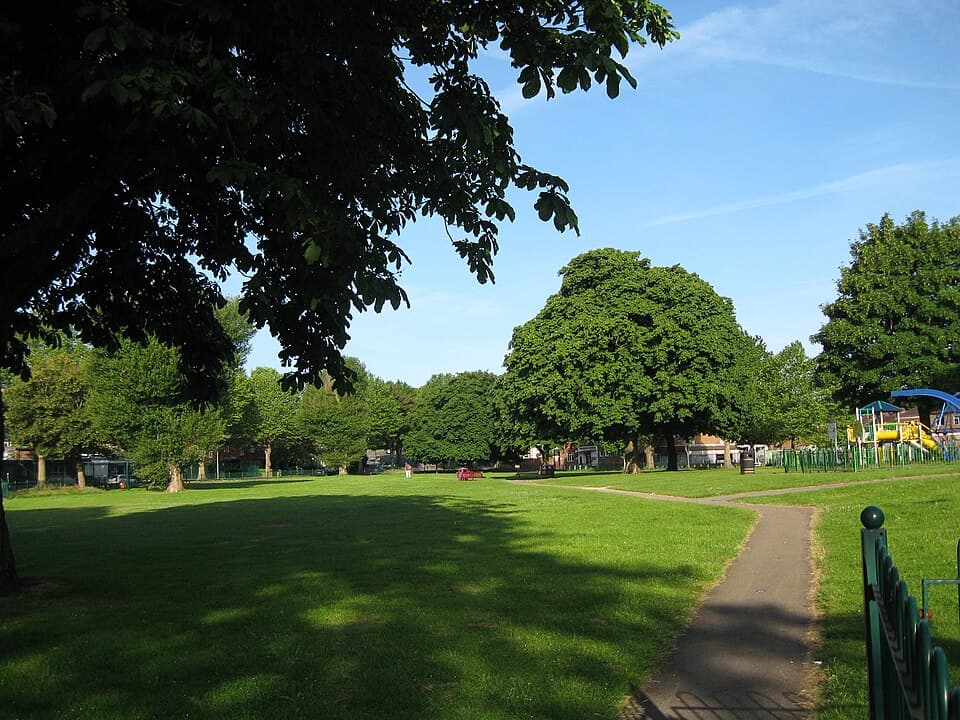
There are places in Britain where history shouts. Kingstanding is not one of them. It does not greet you with castle walls, abbey ruins or a medieval market square. It presents itself as a Birmingham suburb: red-brick houses, shopping parades, bus routes, grass verges, schools, churches, traffic islands and the ordinary noise of modern life. But that is exactly why Kingstanding is interesting. Its history has not been polished for visitors. It has been built over, driven past, lived beside and half-forgotten.
At the heart of the story is a small grassy mound.
The ancient mound
Today, King’s Standing looks modest. Two trees. A low rise in the ground. Houses close by. Cars passing within sight. But this is not just a patch of open space. It is one of Birmingham’s oldest surviving monuments: a prehistoric bowl barrow, probably dating from the late Neolithic or Bronze Age. Long before Birmingham became a workshop of the world, long before the smoke of industry, long before municipal housing, long before even the Roman road beside it, people marked this ground for the dead.
That is where the story of Kingstanding must begin.
The mound is not dramatic in the way Stonehenge is dramatic. Its power lies in the opposite quality. It is quiet. It survives not in some remote ceremonial landscape, but in the middle of a suburb. It asks us to imagine a time when this part of north Birmingham was open country, when the high ground above what became Sutton Park looked out across a very different Midlands, and when communities used earth, ritual and burial to make meaning in the landscape.
Close to the mound ran Ryknield Street, one of the great Roman roads. Here again the layers of time begin to fold over one another. A prehistoric burial mound stood near a Roman route; the Roman route remained as a line through the landscape; later generations noticed the mound, named it, explained it, and made stories around it. Kingstanding is not a place with one origin. It is a palimpsest — a landscape written on again and again.
The king — and the name
Then comes the name: King’s Standing.
There are two serious possibilities, and a good documentary should hold both in view. One tradition says the name comes from King Charles I. In October 1642, at the very beginning of the English Civil War, Charles was moving south from Shrewsbury, where he had been gathering Royalist forces. He stayed at Aston Hall, the great Jacobean house of Sir Thomas Holte, before continuing towards the confrontation that would soon come at Edgehill. Local tradition says that Charles stood on or near this ancient mound and reviewed, addressed or harangued troops gathered from Staffordshire and the surrounding gentry. The dates vary slightly in the old accounts, but the story places the king in this landscape at one of the most dangerous moments in English history.
It is a marvellous image: the doomed Stuart king, not yet defeated, not yet tried, not yet executed, standing above the Birmingham countryside, speaking to men who were about to be drawn into a civil war that would tear the kingdom apart. In a few years, monarchy itself would be put on trial. In October 1642, that future was not yet clear. The king was still raising an army. The old order was still trying to defend itself.
But professional history must be careful. The Charles I story is plausible, not certain. Antiquarian sources record it, but not always with firm evidence. The safest line is this: Charles I was certainly in the area, Aston Hall was certainly part of his Civil War route, and local tradition has long connected his troop review with King’s Standing. But the mound itself is far older than Charles. It was not thrown up for him. If he used it, he used a monument already ancient beyond comprehension.
The second possibility is equally fascinating. The name may come from a medieval “standing” — a place where a king or noble waited while deer were driven past during a hunt. This would connect Kingstanding not simply to one dramatic day in 1642, but to the longer world of royal forests, chases and hunting landscapes. Sutton Chase and the wider countryside around Perry Barr and Sutton Coldfield carried exactly the kind of landscape memory in which such a name could survive.
In that version, Kingstanding is not named after Charles I personally. It is named after an older royal function: the king’s place of waiting, watching and killing. The mound, already ancient, became useful again as a vantage point. First a burial place, then a landmark, then perhaps a hunting stand, then a Civil War memory. That is the deep story. The place did not begin when houses arrived. It did not even begin when the king arrived. It began in prehistory, and every later age found a way to reuse it.
From farmland to a new suburb
For centuries after those early layers, the area remained rural. The modern street names preserve hints of what was there before: Warren Farm, Kingsvale Farm, Kettlehouse, Witton Lodge, Perry Common. This was not yet the Kingstanding of municipal estates and shopping parades. It was farms, common land, lanes, open fields and scattered buildings on the edge of Birmingham’s expanding influence.
That changed decisively in the twentieth century.
By the early 1900s, Birmingham had a severe housing problem. The inner city contained overcrowded courts, back-to-backs and poor-quality housing. Families lived in conditions that reformers increasingly saw as unacceptable. The answer, pursued with great ambition between the wars, was municipal expansion. Birmingham would build outward. It would take rural land and turn it into planned estates. It would move working families from cramped inner districts into houses with gardens, air and light.
In 1928, Birmingham took control of the Perry Barr area. Almost immediately, the city moved to acquire land at Warren Farm and Kingsvale Farm for municipal housing. What followed was one of the great interwar council housing projects. Kingstanding, Kettlehouse, Witton Lodge Farm and neighbouring estates became part of a vast belt of new homes in north Birmingham. Thousands of houses were built. Streets were laid out. Families arrived. A new suburb was made.
This is the second great transformation in Kingstanding’s story. The first was ritual: a prehistoric community raising a mound. The second was civic: a modern city raising an estate.
It is easy now to be cynical about council housing, but that would be bad history. The original ambition was serious and humane. For many families, the move to Kingstanding meant a front door, a garden, space for children, cleaner air and a new sense of dignity. These were not palaces, but they represented a huge change in daily life. The suburb was built as an answer to urban hardship.
And it needed a centre.
Kingstanding Circle and the Odeon
That centre became Kingstanding Circle. Every successful suburb needs somewhere people recognise as its heart: the shops, the meeting place, the point where routes cross, the place you mention when giving directions. Kingstanding Circle performed that role. In 1935, it gained a landmark of genuine national interest: the Odeon.
The Kingstanding Odeon was not just a cinema. It was a declaration that this new working-class suburb deserved glamour. Designed in the modern Odeon language associated with Harry Weedon’s practice, with bold lines, faience, fins and a powerful street presence, it turned entertainment into architecture. It gave the estate a beacon. In the 1930s, a cinema like this was a democratic palace. Ordinary people could step inside and enter another world.
The building’s later life as a bingo hall matters too. When the cinema age faded, the building continued as a social space. Bingo halls are often dismissed, but for many communities they were places of routine, company and belonging. The old Odeon carried on serving Kingstanding long after the projectors stopped. That continuity is part of its value. It was not merely an architectural object. It was a vessel of shared life.
Crisis and community regeneration
Kingstanding’s story, however, is not a simple march of progress. The post-war decades brought pressure, wear and disappointment. Some of the wider Perry Common housing, particularly the concrete and steel-framed “Boot” houses, developed serious structural problems. By the late twentieth century, hundreds of homes faced demolition. For residents, this was not a technical housing issue. It was the threatened loss of streets, neighbours and memory.
Out of that crisis came one of the most important modern chapters in the area’s history: resident-led regeneration. Witton Lodge Community Association grew from local people refusing to be passive spectators while decisions were made over their homes. That is a vital part of the Kingstanding story. The suburb was built by municipal power, but it was defended and reshaped by community power.
Why Kingstanding matters
This is why Kingstanding deserves serious treatment. It is not just “an estate”. It is a compressed history of Britain. In one landscape we find prehistoric burial, Roman movement, medieval or royal hunting memory, Civil War tradition, rural farms, municipal socialism, working-class aspiration, cinema modernism, post-war housing failure, community resistance and twenty-first century questions about heritage and belonging.
The opening shot almost writes itself.
We begin on the mound. Not with trumpets, not with grandeur, but with traffic in the background and houses beyond the grass. The presenter stands there and says: this is one of Birmingham’s oldest monuments, and almost nobody driving past realises what it is. Beneath our feet is a burial mound older than the city, older than England, older than the Roman road nearby. Later, people said a king stood here. Perhaps he did. But the deeper truth is even better: kings, soldiers, planners and residents have all come and gone, and the mound remains.
That is the story Kingstanding tells. The British suburb is not empty of history. It is full of it. You just have to know where to look.
Gallery
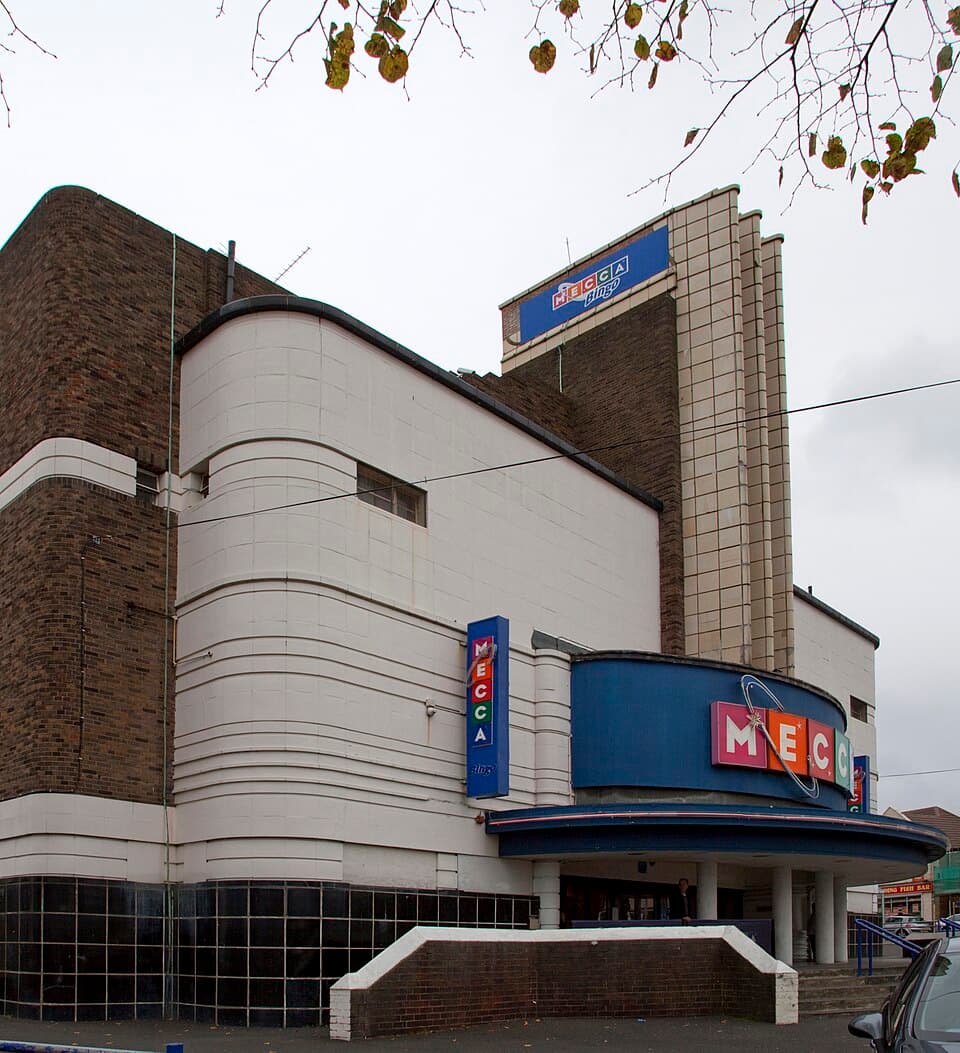
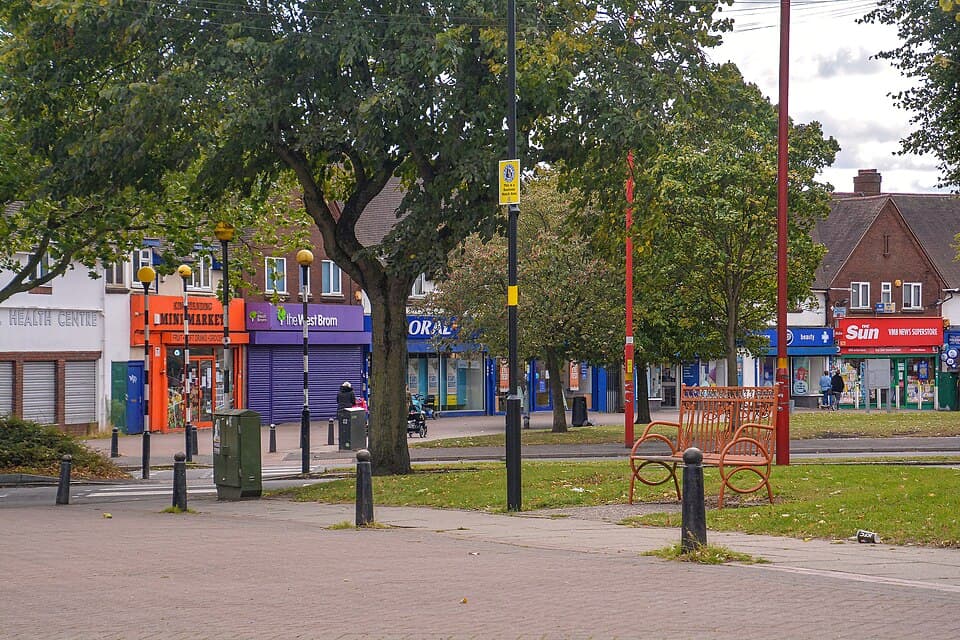
Source & credit: An original feature for This is Kingstanding. The Charles I troop-review at King’s Standing is long-standing local tradition rather than firmly documented fact — the bowl barrow itself is far older. Photographs: the King’s Standing mound, the former Odeon (now Mecca Bingo) and Kingstanding Circle.